
Newcomer Classrooms Are a Workforce Pipeline: Five Ways Louisville Employers Can Help
Talent development is strongest when it expands capability without treating people as inventory.
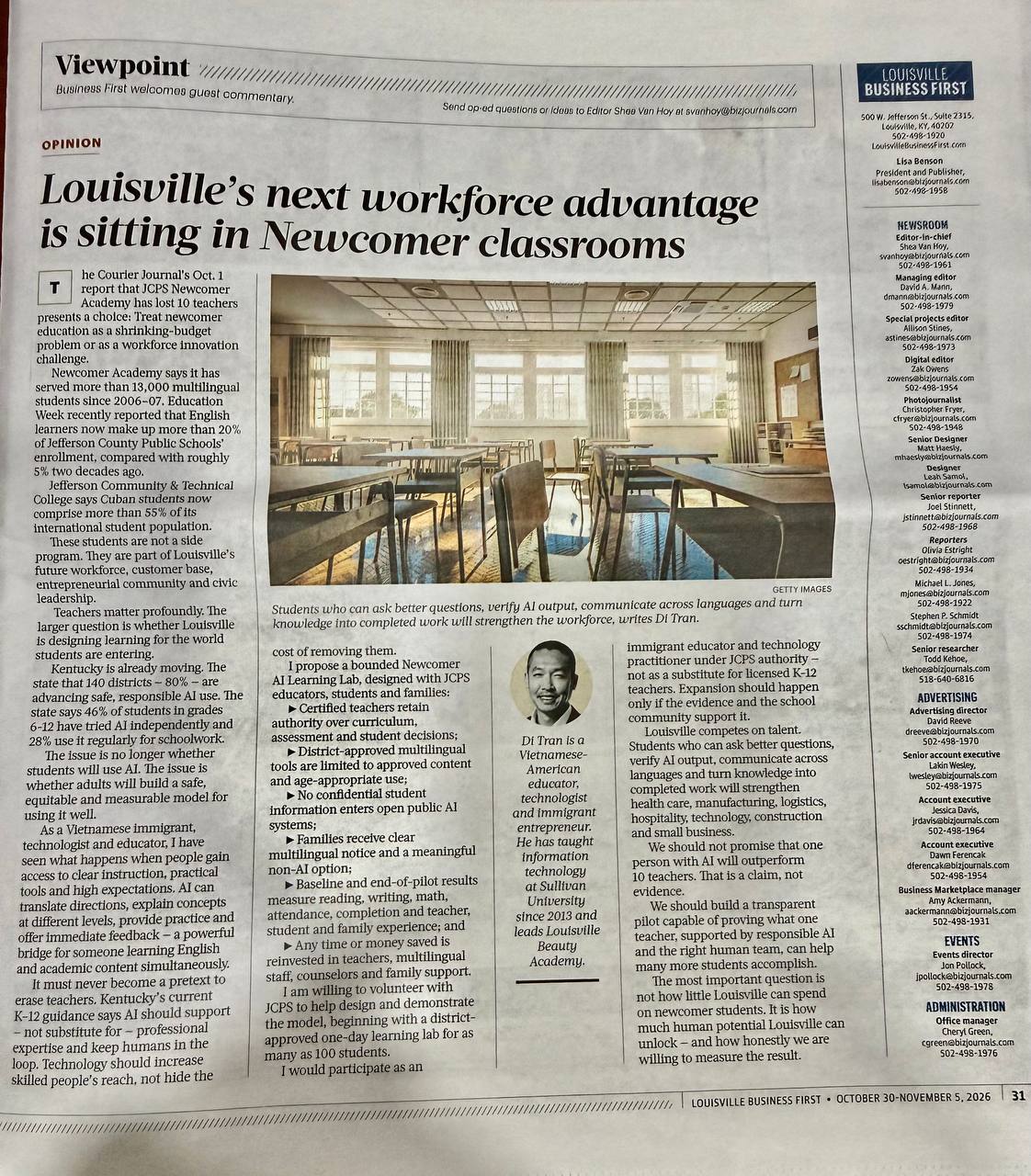
Louisville Business First published Di Tran’s viewpoint, “Louisville’s next workforce advantage is sitting in Newcomer classrooms,” in its Oct. 30–Nov. 5, 2026 print issue. For employers and small businesses, the useful question is: what can we contribute now without bypassing educators, families, or student protections?
Five practical contributions
- Translate real work: donate plain-language, multilingual examples of workplace instructions, customer communication, safety steps, and completed-work standards—subject to school review and without proprietary or personal data.
- Show the verification habit: teach how workers check AI output against a supervisor, source, measurement, policy, or customer requirement before acting.
- Offer bounded exposure: support district-approved career talks, job-shadow structures, project examples, and mentors with clear safeguarding, scheduling, and no-recruitment boundaries.
- Value multilingual capability: identify where language, cultural navigation, customer trust, and cross-border understanding create real business value; do not reduce students to translation labor.
- Measure contribution: preserve the artifact donated, time and cost, school-approved use, learner feedback, and observed result. Do not inflate access, attendance, or activity into hiring or economic impact.
What responsible employers should not do
Do not collect student records or immigration information, market directly to minors without school and family controls, imply guaranteed jobs, claim partnership without written authority, use AI to rank students, or treat a classroom as an immediate recruiting pool. A school, employer, nonprofit, and student each retain different authority and interests.
A better workforce compact
The strongest compact is simple: educators control education; families and students retain meaningful notice and choice; employers contribute current work examples and honest skill standards; community organizations reduce access barriers; and every participant measures results without manufacturing certainty.
NABA thanks Louisville Business First for continuing to elevate practical Louisville voices and community questions. NABA’s role is educational and convening-oriented; this article does not create a school partnership, employer commitment, internship, job, funding route, or representation agreement.
Publication and source note: Louisville Business First published Di Tran’s guest viewpoint in its Oct. 30–Nov. 5, 2026 print issue, page 31. The supplied print page and the editor’s acceptance thread verify publication. As of Nov. 2, a public article permalink was not discoverable in the publication’s web index; the link below therefore goes to Louisville Business First’s Louisville edition rather than an invented URL. This page displays Di Tran’s exact, unaltered photograph of the published print page for documentary and community-reference purposes. The photograph is credited to Di Tran; the article, page design, and all underlying publication rights remain © Louisville Business First / American City Business Journals. All rights reserved. Publication does not imply that Louisville Business First, JCPS, KDE, JCTC, or any cited organization endorses Di Tran, this proposal, or any affiliated organization.
Sources and publication record
- Louisville Business First — Louisville edition (print issue Oct. 30–Nov. 5, 2026, p. 31)
- JCPS Newcomer Academy — About
- Kentucky Department of Education — AI in Kentucky K–12
- Jefferson Community and Technical College — International Student Support
- Courier Journal — Oct. 1 Newcomer Academy staffing report
Sources reviewed Nov. 2, 2026. Web pages, policies, and access can change; verify the current controlling source before action.
Discover more from New American Business Association (NABA) - Louisville, KY
Subscribe to get the latest posts sent to your email.