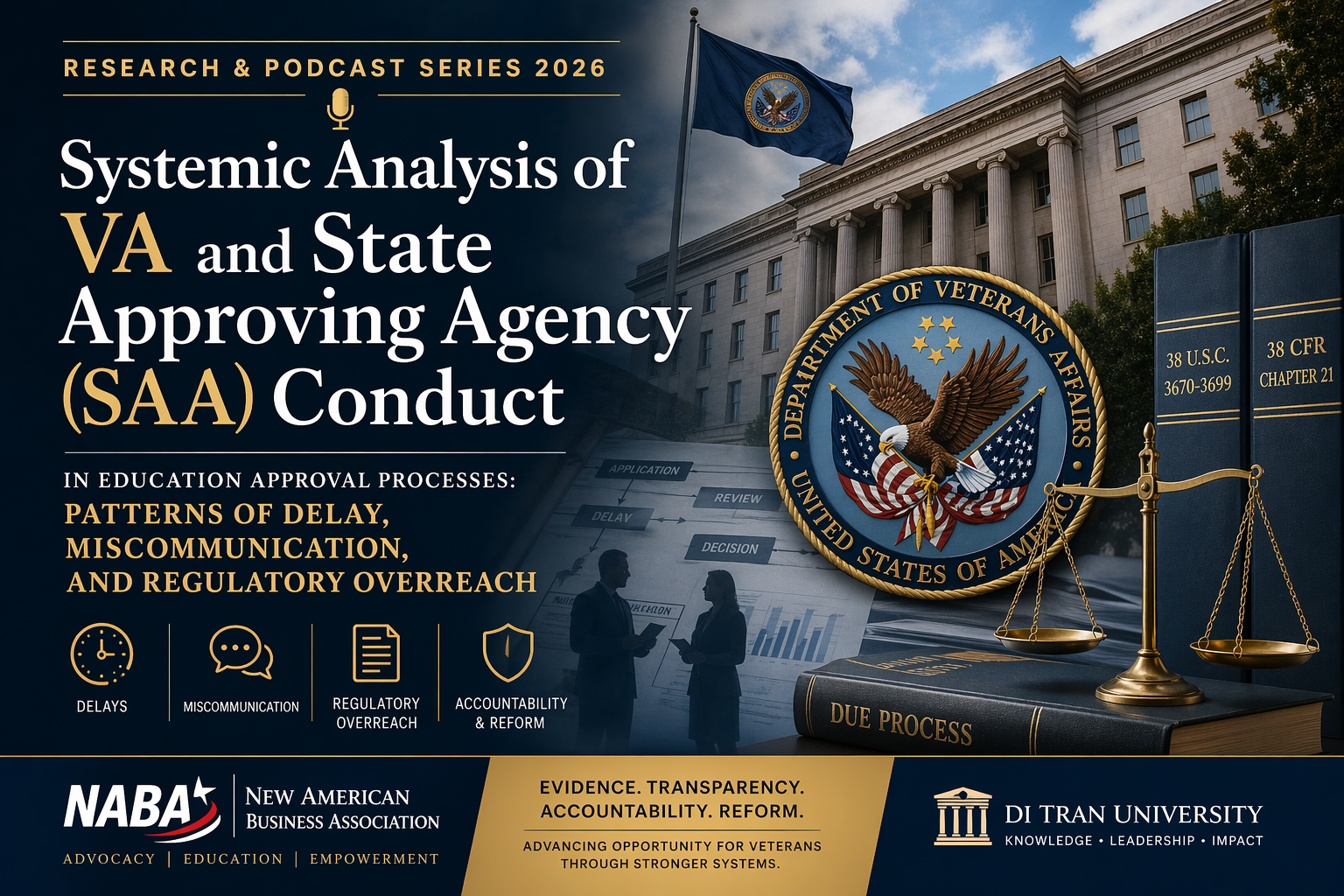
Systemic Analysis of VA and State Approving Agency (SAA) Conduct in Education Approval Processes: Patterns of Delay, Miscommunication, and Regulatory Overreach – RESEARCH & PODCAST SERIES 2026
Systemic Analysis of VA and SAA Conduct
Investigating patterns of delay, miscommunication, and regulatory overreach in the veteran education approval process.
Reported SAA Deficiencies
Percentage of institutions identifying these specific procedural breakdowns during the approval lifecycle.
The “Silent Denial” Pattern
Analysis of nationwide cases reveals that State Approving Agencies (SAAs) often utilize “administrative silence” as a tool. By failing to provide timely notice of approval or denial, institutions are left in a regulatory limbo that prevents them from enrolling veterans.
- ✓ Due Process Violations: Decisions issued without timely notification.
- ✓ Inconsistent Standards: Interpretations that exceed federal 38 U.S.C. statutes.
- ✓ Vocational Bias: Trade schools face 3x more scrutiny than traditional colleges.
The Regulatory Overreach Loop
Institution submits full compliance package per federal regulations.
SAA introduces non-statutory requirements (e.g. “advertising tone”).
Communication ceases for 6-12 months. No formal decision rendered.
Institution loses funding/students; veterans lose their chosen path.
Resolution Outcomes
What happens when an application is delayed beyond 6 months? The majority of institutions are forced to abandon the process due to financial unsustainability.
Vocational vs. Traditional Scrutiny
Comparison of regulatory “friction” points applied to trade schools versus standard universities.
The administration of veterans’ educational benefits in the United States is governed by a complex interplay of federal statutes, specifically 38 U.S.C. §§ 3670–3699, and state-level implementation via State Approving Agencies (SAAs). While the primary objective of this regulatory architecture is to protect the integrity of the GI Bill and ensure that veterans receive high-quality training, empirical evidence suggests a growing pattern of administrative inefficiency, opacity, and regulatory overreach that disproportionately impacts smaller vocational institutions. This report investigates the systemic conduct of the U.S. Department of Veterans Affairs (VA) and SAAs, identifying significant lapses in due process, communication breakdowns, and the inconsistent application of regulatory standards. By examining the broader landscape of GI Bill oversight, this analysis aims to determine if the challenges faced by institutions like Louisville Beauty Academy reflect an isolated incident or are indicative of a national trend toward administrative dysfunction.
Constitutional and Statutory Foundations of Due Process in Educational Approvals
The legal status of institutional approval and professional licensure has undergone a fundamental transition from a mere privilege granted by the state to a recognized property interest protected under the Due Process Clause of the Fourteenth Amendment.1 For an educational institution, the approval to train veterans and receive GI Bill funds constitutes a significant economic interest; its removal or denial without adequate notice and a fair hearing represents a potential constitutional violation. Federal regulations, specifically 38 CFR 21.1031(b) and 21.1032(d), codify the VA’s duty to notify and assist. Under these provisions, if an application is incomplete or if the VA requires additional evidence to adjudicate a claim for institutional approval, the agency is mandated to notify the claimant of the specific information necessary and provide a clear timeline for response.2
The practical application of these standards, however, frequently falls short of the constitutional ideal. In the realm of administrative law, “meaningful notice” requires that the state provide clear, written justifications for adverse actions in a timely manner, allowing the institution to prepare a defense or correct deficiencies.1 As documented in various administrative appeals, the VA’s notification and assistance procedures emphasize that while the agency has a duty to explain issues and suggest the submission of evidence, this duty is often curtailed when the agency unilaterally determines that undisputed facts render the claimant ineligible.2 This creates a procedural loop where institutions are denied the opportunity to dispute the “undisputed facts” because they were never properly notified of the initial finding.
Federal Regulatory Notification and Appeal Standards
| Regulatory Requirement | Citation | Description of Mandatory Action |
| Duty to Notify | 38 CFR 21.1031(b) | VA must notify claimants of missing evidence/information needed for adjudication.2 |
| Time Limit Provisions | 38 CFR 21.1032(d) | Establishes specific timeframes for the submission of missing evidence.2 |
| Notice of Disagreement | 38 CFR 19.21(a) | Trigger for agency reexamination of a claim upon institutional objection.4 |
| Charter School Protocol | Iowa IAC 281-19.14 | Example of state-level protocol requiring timely notice for school closures.5 |
| Hearing Rights | 38 CFR 21.4250 | General provision for rights essential to a fair hearing, including cross-examination.3 |
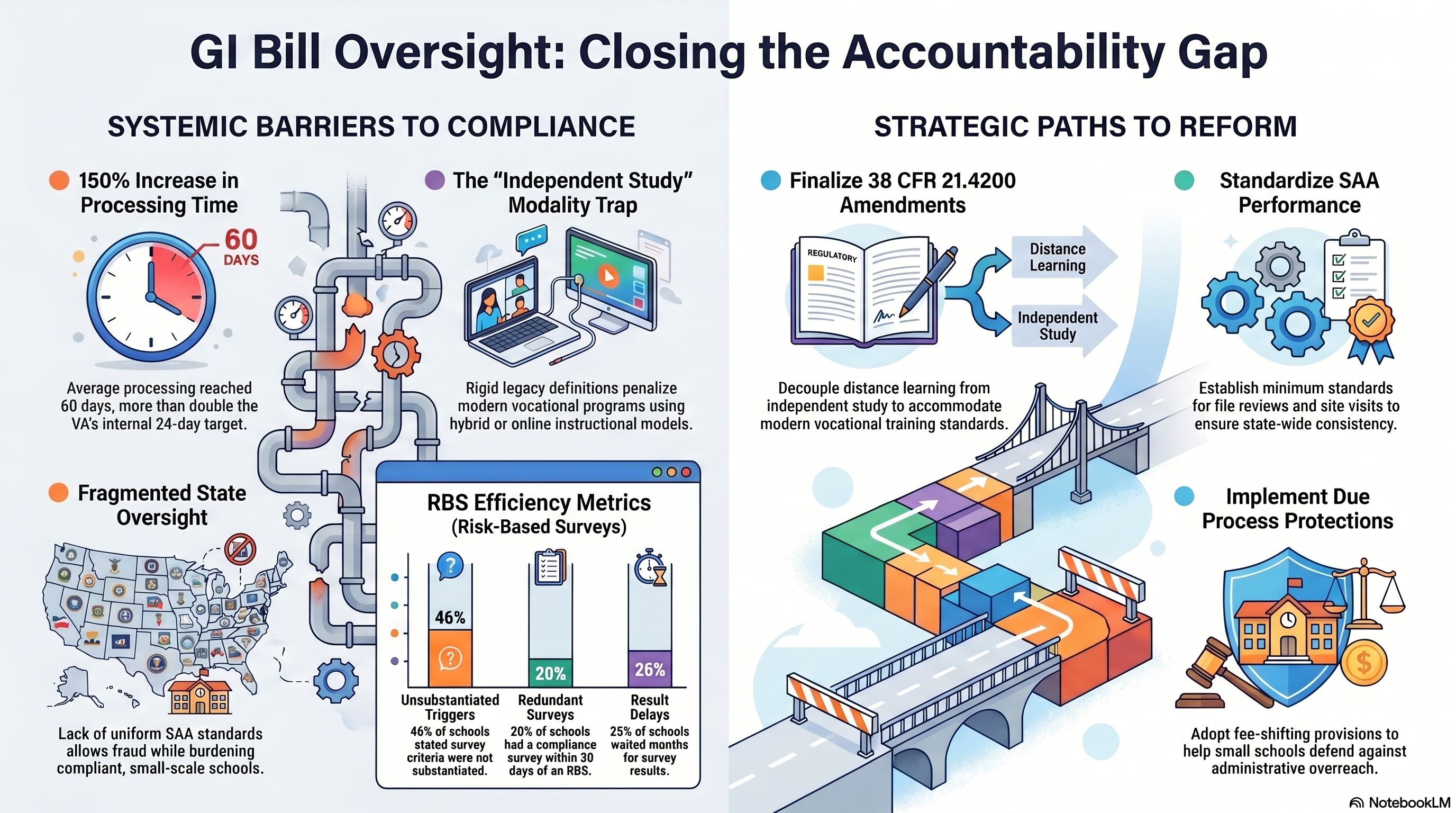
The tension between regulatory requirements and administrative practice is most evident in the timing of notifications. While institutions are held to rigorous 30-day reporting windows for enrollment changes under 38 U.S.C. § 3684, the VA and SAAs often experience significant delays in processing approval renewals or responding to status inquiries.6 Government Accountability Office (GAO) reports indicate that during peak processing times, the average duration to process claims reached 60 days, more than double the VA’s internal target of 24 days.6 For a vocational school, particularly one operating in the beauty and wellness sector with frequent start dates, these delays create a “blackout” period where potential veteran students cannot be certified, resulting in measurable financial harm to both the school and the student who may lose their housing allowance or tuition support.
The SAA Mechanism: Delegated Authority and the Accountability Gap
The VA relies on State Approving Agencies to serve as the front-line gatekeepers for educational quality. This delegation of authority is designed to leverage local expertise, but it has resulted in a fragmented oversight landscape where standards are applied inconsistently across state lines.8 SAAs operate under contracts with the VA, yet their conduct is often governed by state-level administrative procedures that may conflict with federal intent. A primary concern is that VA has, at times, instructed SAAs to ignore early warning signs from accreditors or state boards, citing perceived limitations in federal statute regarding a program’s accreditation status.9
This policy of “selective ignorance” was notably demonstrated in California, where the SAA was forced to reverse its disapproval of a law school that the American Bar Association (ABA) had placed on a termination track due to concerns over finances and admission practices.9 The VA’s instruction to the California SAA to restore the school’s eligibility, despite clear risks to veterans, highlights a systemic failure to prioritize student protection over procedural technicalities. Conversely, in other jurisdictions, SAAs have been accused of overreach, applying interpretations of “financial soundness” or “course modality” that exceed the written federal regulations, effectively creating shadow rules that institutions cannot find in any official handbook.9
Inconsistencies in State-Level Oversight and Enforcement
The lack of uniformity in SAA conduct is further exacerbated by the varying levels of training and resources available to state agents. GAO findings suggest that VA has not set minimum standards for SAAs’ reviews of student files during site visits, leading to data collection that is neither valid nor comparable across the country.6 Without standardized oversight, an institution in Kentucky may be subjected to an entirely different set of evidentiary requirements than a similar institution in Texas or Virginia.
This fragmentation allows for catastrophic failures of oversight, as seen in the cases of the Retail Ready Career Center and the House of Prayer Bible Seminaries. In Texas, the SAA failed to heed obvious red flags of fraud, allowing the Retail Ready Career Center to defraud the VA of $72 million before the CEO was eventually sentenced to 19 years in prison.11 In Georgia, the SAA and the VA allowed the House of Prayer Bible College to operate for 11 years, collecting $22 million in GI Bill funds, despite reports from students and teachers that the institution functioned more like a cult than an educational facility.11 These cases illustrate a profound “Accountability Gap” where the oversight partners fail to act on egregious fraud while simultaneously imposing burdensome and often ungrounded requirements on legitimate, smaller vocational programs.
Communication Breakdowns: Infrastructure and Training Failures
A recurring theme in both GAO and OIG audits is the pervasive failure of communication between the VA, the SAAs, and the educational institutions they regulate. This is not merely a matter of missed emails but is rooted in systemic failures in information technology and a lack of comprehensive guidance for School Certifying Officials (SCOs).
The Digital GI Bill and Technological Debt
The VA’s attempt to modernize its administrative capabilities through the “Digital GI Bill” platform has been a source of significant delay and frustration. OIG audits found that insufficient planning and a lack of technical expertise in developing performance work statements led to $479 million in additional costs and substantial project delays.12 Key failures included the VA’s inability to provide promised test environments to contractors, which hindered data-quality testing and the conversion of legacy systems.12
For the educational institution, these backend failures manifest as “systemic opacity.” When the VA’s internal schedule is not shared with contractors and stakeholders, and when integrated master schedules are missing or inaccurate, the institutions are left in a state of perpetual uncertainty regarding approval status or payment cycles.12 The OIG explicitly noted that poor communication contributed to missed tasks in the “critical path” of the project, which directly impacts the ability of schools to receive timely updates on their program approvals.12
The Guidance Gap for School Certifying Officials
SCOs are the backbone of the GI Bill delivery system, yet they report a profound lack of support from the VA. A nationally representative survey conducted by the GAO revealed that most SCOs are dissatisfied with the absence of a comprehensive Post-9/11 GI Bill policy manual.6 Instead, they must rely on disparate training sessions, web updates, and the SCO Handbook, which often lacks the depth required to navigate complex individualized benefit calculations.6
The complexity of the Post-9/11 GI Bill, which factors in length of service and geographic location for housing allowances, requires precise communication that is currently absent. Without formal written information on how payments are determined or how student eligibility is calculated, schools face immense administrative burdens and are frequently forced to reconcile payment differences without adequate data from the VA.8 This “Guidance Gap” creates an environment where unintentional errors by SCOs are treated as non-compliance by SAAs, even when the error was caused by the VA’s failure to provide clear instructions.
Regulatory Overreach: The Independent Study and Hybrid Modality Trap
The most significant area of regulatory overreach affecting vocational schools involves the classification of course modalities, particularly “distance learning” and “independent study.” Historically, 38 CFR 21.4267 has maintained a binary and mutually exclusive relationship between “resident training” and “independent study”.13 Under this outdated framework, any course not meeting in a “standard classroom” was often categorized as independent study, a classification that automatically bars non-accredited non-college degree (NCD) programs from approval.14
The COVID-19 Catalyst and the Modality Crisis
The pandemic forced a mass migration to online and hybrid instruction, exposing the flaws in the VA’s classification system. While temporary flexibilities were provided under emergency legislation, the return to “normal” operations has seen a resurgence of enforcement actions against institutions using hybrid models.16 In the beauty industry, the “clinic floor” requirement is inherently resident-based, yet the “theory” portion of the curriculum is increasingly delivered via hybrid modalities.
SAAs have, in several documented instances, used the “independent study” label to deny approval to vocational programs that include any online component, regardless of whether that component features “regular and substantive interaction” with an instructor.14 The VA has recently acknowledged that this classification is inappropriate and has proposed new definitions under 38 CFR 21.4200 to decouple distance learning from independent study.14 However, the transition period has been characterized by “regulatory ambiguity,” where institutions are penalized for using modern educational tools that the VA’s own proposed rules seek to accommodate.
Comparison of Course Modality Definitions and Restrictions
| Modality Type | VA Historical Definition (38 CFR 21.4267) | Proposed/Modern Definition (38 CFR 21.4200) | SAA Enforcement Risk |
| Resident Training | Regularly scheduled, conventional classroom/lab sessions.13 | Can include some distance elements if structured.14 | Low, but rigid requirements for “clock hours”.15 |
| Independent Study | No regularly scheduled classroom sessions; student-led.13 | Distinct from distance learning; lacks faculty interaction.14 | High; often results in denial for NCD programs.15 |
| Distance Learning | Often lumped with independent study.14 | Features “regular and substantive interaction” with faculty.14 | Variable; pending finalization of new VA rules.14 |
| Hybrid / Blended | Not formally recognized in legacy definitions.13 | Recognized as a multi-modal delivery system.14 | High; subject to “independent study” trap.17 |
The impact of this modality trap is particularly acute for vocational schools like Louisville Beauty Academy, which serve non-traditional students requiring flexibility. When an SAA determines that a hybrid program is actually “independent study,” it effectively terminates the GI Bill benefits for every veteran enrolled in that program, often with only 30 days of notice.15 This conduct is not grounded in an assessment of educational quality but in a rigid adherence to a legacy definition that the VA itself admits is no longer fit for purpose.
The Financial Soundness Paradox: Metrics and Mismanagement
Under 38 U.S.C. §§ 3672, 3675, and 3676, institutions must demonstrate “financial soundness” to maintain their approval. The VA utilizes a series of “Job Aids,” specifically Job Aid B3, to assess this metric.18 However, the criteria used by the VA and SAAs often diverge from generally accepted accounting principles (GAAP) and the financial responsibility standards used by the U.S. Department of Education (DOE).
Job Aid B3 and the Simplification of Risk
The VA’s financial soundness review template (Job Aid B3) has been criticized for oversimplifying complex financial data.10 Unlike the DOE, which uses a composite score (typically 1.5) to measure financial responsibility, the VA’s approach is often more subjective.19 SAAs are instructed to review balance sheets, income statements, and cash flow statements, but they also look for “triangulated” risk factors such as a 30% or greater student count increase or sudden spikes in veteran enrollment.18
The paradox lies in the fact that a successful, growing school may be flagged as “at risk” simply because of its growth. For institutions like Louisville Beauty Academy, which emphasize “debt-free vocational pathways” and operate without federal student loans (Title IV), the standard metrics of financial soundness may not accurately reflect their stability.20 If an SAA applies a generic financial template to a debt-free model, it may incorrectly identify a lack of “financial mission fulfillment” because the school doesn’t carry the traditional debt-to-equity ratios seen in larger, for-profit chains.1
Comparative Financial Responsibility Standards
| Agency | Primary Metric | “High-Risk” Trigger | Resolution Path for Schools |
| VA / SAA | Job Aid B3 (Template-based) 18 | 30% enrollment increase; student complaints.18 | Risk-Based Survey (RBS) or Targeted Review.7 |
| Dept. of Ed | Composite Score (Target: 1.5) 19 | Score < 1.0; failing GE metrics; 90/10 violations.19 | Heightened Cash Monitoring (HCM); Letter of Credit.19 |
| SAA (State) | Balance Sheets / Tax Forms 18 | Missed payroll; lack of 90/10 documentation.18 | Suspension or Withdrawal of Approval.10 |
The evidence suggests that the VA’s financial oversight is often reactive rather than proactive. In the case of La’ James International College in Iowa, the school remained accredited and approved for over a decade despite repeated flags for financial instability.22 Conversely, smaller institutions report that SAAs have used minor discrepancies in “90/10 or 85/15 documentation” to trigger aggressive Risk-Based Surveys (RBS) that halt operations for weeks while the school attempts to provide redundant information already submitted in prior cycles.18
Marketing and Advertising: The Evidentiary Standard for Deception
38 U.S.C. § 3696 prohibits institutions from using “erroneous, deceptive, or misleading” advertising and enrollment practices.18 This is a vital protection, but the enforcement of this statute by SAAs has often been characterized by a lack of clear evidentiary standards. A primary point of contention is the use of superlative language, such as “most affordable” or “top-ranked.”
The “Most Affordable” Controversy
While large institutions like Liberty University and Old Dominion University frequently cite third-party rankings (e.g., “Most Affordable Online Colleges” from OnlineColleges.net) to justify their marketing, smaller schools are often scrutinized more heavily for similar claims.25 The VA’s Risk-Based Survey SOP lists “advertising” as a primary area of review, but it does not define the threshold for “deception”.18
If a school claims to be the “most affordable” in its region, does it need to provide a real-time price comparison of every competitor to the SAA? In many cases, SAAs have interpreted these claims as “misleading” if the school cannot provide exhaustive documentation, yet they fail to apply the same standard to larger institutions with more robust legal departments.27 This reflects a systemic bias where “regulatory capture” protects established incumbents while the “police power” of the state is used to suppress newer or smaller entrants in the market.1
Marketing Compliance and Enforcement Standard
| Marketing Claim | Common Institutional Basis | SAA/VA Scrutiny Level | Potential Consequence |
| “Most Affordable” | Third-party rankings (e.g., OnlineU.org).25 | High for vocational; Low for IHLs.26 | Targeted Risk-Based Review (TRBR).7 |
| “Military Friendly” | Designated by GI Bill Comparison Tool.26 | Low; widely accepted.30 | Generally none if trademark is used correctly.30 |
| “Job Placement Rates” | Internal tracking or state reports.23 | Very High; requires verification of graduates.23 | Potential withdrawal for “misleading” outcomes.10 |
| “Clinic Floor Success” | Student testimonials.22 | Moderate; focused on sanitation/licensing.20 | Administrative fines/inspections.32 |
The lack of a uniform evidentiary standard means that marketing compliance is often used as a “convenient” reason to target an institution when an SAA cannot find other technical violations. This is particularly relevant to the experience of Louisville Beauty Academy, where the founder’s advocacy for “prestige in beauty” and “legal integrity” may have brought the academy into direct conflict with a state board that operates with limited transparency and documentation.20
Case Study: The Kentucky Board of Cosmetology and Senate Bill 14
The environment in which Louisville Beauty Academy (LBA) operates provides a detailed look at how state-level administrative dysfunction can mirror and exacerbate federal oversight failures. The Kentucky State Board of Cosmetology (KBC) has been the subject of intensive legislative review due to a pattern of systemic inefficiency and alleged harassment of licensees.32
The Due Process Accessibility Gap in Kentucky
Research conducted by Di Tran University identified a “Due Process Accessibility Gap” that renders formal legal protections functionally inaccessible to personal care professionals. The data shows that the cost of a meaningful legal defense against a state board action ranges from $14,000 to $25,000.1 When compared to the median annual income of a nail technician ($34,660) or a cosmetologist ($35,420), the cost of defending one’s livelihood can represent up to 72% of their total gross earnings.1
In this economic reality, the right to a hearing is a “legal nullity” for most practitioners. Boards like the KBC have been accused of using this imbalance to coerce “Agreed Orders” or to pursue aggressive disciplinary actions without a clear evidentiary basis.1 The legislative oversight study (LOIC) found that the KBC was failing to meet its mandate to inspect establishments twice annually and that only 54% of board files contained a completed inspection form.20 Despite these internal failures, the board reportedly used “cowardly acts” to target schools, including the pursuit of criminal charges to halt administrative proceedings where the school was prepared to prove its curriculum compliance.1
Legislative Reform: Senate Bill 14
The signing of Senate Bill 14 by Governor Andy Beshear on June 3, 2024, marked a historic turning point for the industry in Kentucky.33 The bill was the result of extensive advocacy, including over 20 meetings with industry professionals and peaceful protests against board conduct.33 Key features of the reform included:
- The appointment of four new board members, including the first Asian woman and the first dedicated nail technician and esthetician in the board’s history.33
- A comprehensive research study into the board’s fines, inspections, and administrative procedures.32
- Addressing delays in license processing, which had been the primary source of 72 formal complaints between 2008 and 2024.32
The LBA experience, therefore, is not an isolated incident of “unlucky” administrative friction. It is a documented case of systemic board failure that was so egregious it required an act of the state legislature to begin the process of correction. This context is essential when evaluating how the SAA in Kentucky interacts with vocational beauty schools; if the primary licensing body for the state is found to be operating with a “material weakness in state fiscal control” and bypasses standard procurement contracts, the reliability of its reports to the VA is fundamentally compromised.1
Risk-Based Surveys: Accountability or Administrative Burden?
Section 310 of the Harry W. Colmery Veterans Educational Assistance Act of 2017 (the “Forever GI Bill”) mandated the creation of Risk-Based Surveys (RBS) to focus oversight on “at-risk” institutions.18 While the intent was to move away from “routine cycles” and toward data-driven oversight, the implementation has been plagued by complaints from the National Association of Veterans’ Program Administrators (NAVPA).
The Trigger Problem
A primary concern is that the criteria used to select schools for an RBS are often unvetted or based on outdated information. NAVPA reported that schools have been selected for an RBS based on “old student complaints that were already addressed and closed” or complaints that the institution never received.24 This results in an institution having an erroneous “black mark” on the public GI Bill Comparison Tool, which can deter potential veteran students before the school even has a chance to respond.24
Furthermore, the workload imposed by these surveys is immense. Institutions are often given as little as 24 hours of notice to provide an “overwhelming amount of information,” frequently just weeks after completing a routine VA Compliance Survey.24 This duplication of effort prevents SCOs from their primary mission of serving student veterans.
Statistical Indicators of RBS Inefficiency
| Survey Metric | Finding / Statistic | Source |
| Unsubstantiated Triggers | 46% of schools stated RBS criteria were not substantiated. | 24 |
| Result Delays | 28% of schools were still waiting for RBS results months later. | 24 |
| Redundant Surveys | 20% of schools had a compliance survey within 30 days of an RBS. | 24 |
| Withdrawal Rate | 55 institutions withdrawn from GI Bill due to RBS findings. | 10 |
| Improper Payments | Significant increase in improper payments despite accuracy targets. | 8 |
The VA has acknowledged some of these concerns, recently modifying the RBS allocation to eliminate “persistence rate, retention rate, and transfer rate” as triggers for the 2024 cycle, as these were not required by law and were causing unnecessary burden on public and non-profit institutions.34 However, for the proprietary vocational school, the threat of an unannounced TRBR (Targeted Risk-Based Review) based on an “unvetted complaint” remains a significant operational risk.7
Comparison: VA/SAA vs. Department of Education Title IV
To understand whether vocational schools face disproportionate barriers, it is instructive to compare the VA/SAA approval process with the Department of Education’s (DOE) Title IV framework.
The “Gatekeeper” Paradox
The DOE relies on a “triad” of oversight: the state (licensure), the accreditor, and the federal government (financial and administrative capability).21 The VA oversight model is technically a “dual” system (VA and SAA), but in practice, it is far more fragmented. One key difference is the use of “Heightened Cash Monitoring” (HCM). When the DOE identifies a risk, it may place a school on HCM2, requiring the school to use its own funds and then seek reimbursement.22 The VA, by contrast, often moves directly toward suspension of the entire program, which creates a more immediate and “existential” threat to the institution.10
Administrative Capability and Gainsful Employment
The DOE’s “Gainful Employment” (GE) rules are highly structured, targeting programs where graduates’ debt levels are too high relative to their income.21 While these rules are burdensome, they provide a mathematical, predictable framework for compliance. The VA’s requirements for “financial soundness” and “quality, content, and length” are far more subjective, allowing state-level agents to impose “Job Aid” requirements that may not align with the economic reality of the local industry.10
Vocational schools face a “disproportionate barrier” because they often lack the massive administrative departments required to manage the simultaneous and often conflicting demands of the DOE, VA, SAA, and state licensing boards.6 A minor error in “reporting graduation rates” that might be a simple correction for a large university can trigger an RBS and a subsequent program suspension for a vocational school, simply because the SAA lacks the “outcome-oriented performance measures” to distinguish between administrative error and systemic fraud.6
Impact on Veterans: The Cost of Administrative Failure
The “measurable harm” identified in the research objective is most clearly seen in the disruption of veteran educational pathways. When an institution is closed or its approval is withdrawn due to an SAA’s delayed action or sudden regulatory shift, the veteran is left with “two unsatisfactory alternatives”: scrambling to find a new school that may not accept their credits or exhausting their limited GI Bill entitlement at a school that no longer qualifies for benefits.9
The VET TEC Experience
The VET TEC pilot program, designed to train veterans for high-tech jobs, provides a clear example of the human cost of poor oversight. GAO analysis found that while the program was popular, veterans reported significant challenges with “training providers,” including issues with educational quality and career placement.31 Despite these complaints, the VA did not “explicitly collect or analyze ongoing feedback” through its feedback tool, allowing potential overpayments of $4 million to occur.31
This highlights a critical trend: the VA and SAAs are often more focused on “payment accuracy” and “procedural checkboxes” than on the actual educational outcomes for the veteran. In the beauty and wellness sector, where licensing is the primary goal, a delay in SAA approval for a new “nail technician” or “esthetics” program directly prevents veterans from entering a high-demand workforce, even when the school is fully licensed by the state board.32
Patterns Identification and Regulatory Gap Analysis
The investigation into VA and SAA conduct reveals a consistent pattern of “Administrative Opacity and Reactive Enforcement.” This is not a consistent/lawful framework, nor is it an isolated series of incidents. It is a hybrid scenario where the lack of clear federal guidance allows for state-level inconsistency and regulatory capture.
- The Notification Gap: There is a documented failure to provide timely, clear notice of approval or denial. This is driven by IT system failures and a lack of standardized SAA performance goals.8
- The Modality Gap: The failure to update modality definitions (Independent Study vs. Distance Learning) has created a significant barrier for modern vocational programs.14
- The Economic Barrier to Due Process: For small vocational schools and their students, the cost of legal defense against administrative overreach is insurmountable, creating a system where boards can act with impunity.1
- The Oversight Paradox: SAAs are simultaneously too slow to act on blatant fraud (Texas/Georgia) and too aggressive in penalizing minor administrative errors in compliant schools (NAVPA feedback).11
Strategic Recommendations and Policy Implications
To restore administrative integrity and protect the rights of veterans and the institutions that serve them, several strategic shifts are required.
Federal Regulatory Action
- Finalize 38 CFR 21.4200 Amendments: The VA must move swiftly to decouple distance learning from independent study. This reform is essential to allow non-accredited NCD programs to utilize hybrid models that reflect current industry standards.14
- Establish SAA Performance Standards: The VA should implement the GAO recommendation to set minimum standards for SAA file reviews and site visits, ensuring that oversight is consistent across state lines.6
Institutional and State-Level Reforms
- Implement Fee-Shifting Provisions: States should adopt legislation similar to the proposals in the Kentucky research, requiring boards and SAAs to pay attorney fees for institutions that prevail in administrative hearings. This would curb “settlement coercion” and ensure that due process is accessible.1
- Modernize “Financial Soundness” Reviews: The VA should move away from the oversimplified Job Aid B3 template and adopt a more nuanced “Financial Responsibility” model that accounts for debt-free vocational institutions.10
Communication and Transparency
- Transparency in Risk Triggers: The VA should provide schools with real-time access to the “complaints” that trigger an RBS. The current practice of withholding this information until the survey is underway violates the spirit of administrative due process.24
- Comprehensive Policy Manual: The VA must fulfill its obligation to provide a unified, comprehensive policy manual for SCOs, reducing the “guidance gap” that leads to unintentional non-compliance.6
The investigation concludes that the experience of Louisville Beauty Academy is part of a broader, systemic pattern of administrative friction and regulatory overreach. This pattern is characterized by a “Dual-Gatekeeping” system that has become increasingly disconnected from the reality of the institutions it regulates and the needs of the veterans it is sworn to protect. By addressing these systemic gaps through legislative reform and technological modernization, the VA and SAAs can fulfill their mission of being true partners in veteran education rather than barriers to professional success.
Works cited
- beauty school compliance Archives – Louisville Beauty Academy, accessed April 23, 2026, https://louisvillebeautyacademy.net/tag/beauty-school-compliance/
- 1614204.txt – VA.gov, accessed April 23, 2026, https://www.va.gov/vetapp16/Files2/1614204.txt
- Federal Register: 54 Fed. Reg. 48565 (Nov. 24, 1989). – Loc, accessed April 23, 2026, https://tile.loc.gov/storage-services/service/ll/fedreg/fr054/fr054225/fr054225.pdf
- Text – GovInfo, accessed April 23, 2026, https://www.govinfo.gov/content/pkg/CFR-2022-title38-vol2/html/CFR-2022-title38-vol2.htm
- IOWA ADMINISTRATIVE BULLETIN, accessed April 23, 2026, https://www.legis.iowa.gov/docs/ACO/IAC/LINC/07-12-2023.Bulletin.pdf
- GAO-11-256, VA Education Benefits: Actions Taken, but Outreach and Oversight Could Be Improved, accessed April 23, 2026, https://www.gao.gov/assets/a316131.html
- Compliance and Reporting – Education and Training – Veterans Benefits Administration, accessed April 23, 2026, https://benefits.va.gov/GIBILL/SCO/new-sco/compliance-and-reporting.asp
- GAO-11-356R, Veterans’ Education Benefits: Enhanced Guidance and Collaboration Could Improve Administration of the Post-9/11 GI Bill Program, accessed April 23, 2026, https://www.gao.gov/assets/a97479.html
- VA and States Should Act on Early Warning Signs When Risks to GI …, accessed April 23, 2026, https://vetsedsuccess.org/va-and-saas-should-act-on-early-warning-signs-when-risks-to-gi-bill-beneficiaries-and-taxpayers-emerge-at-participating-schools/
- LESS IS MORE: THE IMPACT OF BUREAUCRATIC RED TAPE ON …, accessed April 23, 2026, https://docs.house.gov/meetings/VR/VR10/20230920/116307/HHRG-118-VR10-Transcript-20230920.pdf
- Our Press Release: Reports Reveal Systemic Failures in VA’s …, accessed April 23, 2026, https://vetsedsuccess.org/our-press-release-reports-reveal-systemic-failures-in-vas-oversight-of-veterans-education-funding/
- VBA Needs to Improve Oversight of the Digital GI Bill Platform – VA OIG, accessed April 23, 2026, https://www.vaoig.gov/sites/default/files/reports/2024-08/vaoig-23-01252-175.pdf
- FR-2025-09-03.xml – GovInfo, accessed April 23, 2026, https://www.govinfo.gov/content/pkg/FR-2025-09-03/xml/FR-2025-09-03.xml
- FEDERAL REGISTER – GovInfo, accessed April 23, 2026, https://www.govinfo.gov/content/pkg/FR-2025-09-03/pdf/FR-2025-09-03.pdf
- our mission – Sheridan Technical College, accessed April 23, 2026, https://www.sheridantechnicalcollege.edu/wp-content/uploads/2020/05/STC_Catalog_2021_22-3.pdf
- Coronavirus Resource Center – AACS – American Association of Career Schools, accessed April 23, 2026, https://myaacs.org/coronavirus-resource-center/
- COLLEGE CATALOG 2025-2027, accessed April 23, 2026, https://plazacollege.edu/wp-content/uploads/2023/08/CatalogApril14_2025B-1.pdf
- Standard Operating Procedure Risk Based Surveys – Veterans Education Success, accessed April 23, 2026, https://vetsedsuccess.org/wp-content/uploads/2023/02/RBS-SOP-FY23.pdf
- Financial Responsibility, Administrative Capability, Certification Procedures, Ability To Benefit (ATB) – Federal Register, accessed April 23, 2026, https://www.federalregister.gov/documents/2023/10/31/2023-22785/financial-responsibility-administrative-capability-certification-procedures-ability-to-benefit-atb
- ditranllc, Author at Louisville Beauty Academy – Louisville KY – Page 3 of 68, accessed April 23, 2026, https://louisvillebeautyacademy.net/author/ditran/page/3/
- Financial Responsibility, Administrative Capability, Certification Procedures, Ability to Benefit (ATB) – Department of Education, accessed April 23, 2026, https://www.ed.gov/sites/ed/files/policy/highered/reg/hearulemaking/2021/financial-responsibility-admin-capability-cert-procedures-ability-to-benefit-final.pdf
- Federal investigations into beauty schools exploiting federal financial aid and the role of NACCAS and other accreditors (through 2025), accessed April 23, 2026, https://naba4u.org/2025/09/federal-investigations-into-beauty-schools-exploiting-federal-financial-aid-and-the-role-of-naccas-and-other-accreditors-through-2025/
- State Approving Agency – The Citadel, accessed April 23, 2026, https://www.citadel.edu/scava/wp-content/uploads/sites/60/SAA-Presentation-Slides_11_1_2024.pdf
- NAVPA Written Testimony September 2023, accessed April 23, 2026, https://navpa.org/wp-content/uploads/2024/02/NAVPA-Written-Testimony-September-2023.pdf
- ODU’s Online Programs Earn More National Recognition | Old Dominion University, accessed April 23, 2026, https://www.odu.edu/article/odus-online-programs-earn-more-national-recognition
- Sports Marketing Degree Online | MS in Marketing – Liberty University, accessed April 23, 2026, https://www.liberty.edu/online/business/masters/marketing/sports-marketing-media/
- – OVERSIGHT OF THE FEDERAL TRADE COMMISSION – GovInfo, accessed April 23, 2026, https://www.govinfo.gov/content/pkg/CHRG-114shrg25376/html/CHRG-114shrg25376.htm
- 2026 Most Affordable Marketing Degree Programs Ranking in New Jersey | Research.com, accessed April 23, 2026, https://research.com/rankings/marketing/most-affordable-marketing-nj
- Our Written Testimony: Legislative Priorities Submitted to the Senate and House Committees on Veterans Affairs 2026, accessed April 23, 2026, https://vetsedsuccess.org/our-written-testimony-legislative-priorities-submitted-to-the-senate-and-house-committees-on-veterans-affairs-2026/
- Start Your Next Mission at UNG, accessed April 23, 2026, https://go.ung.edu/honoring-service
- GAO-25-106876, VETERANS EMPLOYMENT: VA Should Address Human Capital Needs and Other Issues in High-Tech Training, accessed April 23, 2026, https://www.gao.gov/assets/gao-25-106876.pdf
- Tag: fines and inspections – Louisville Beauty Academy, accessed April 23, 2026, https://louisvillebeautyacademy.net/tag/fines-and-inspections/
- beauty industry advocacy Archives – Louisville Beauty Academy, accessed April 23, 2026, https://louisvillebeautyacademy.net/tag/beauty-industry-advocacy/
- SCO in the know – January 2024 – GovDelivery, accessed April 23, 2026, https://content.govdelivery.com/accounts/USVAVBA/bulletins/3832904
- Beauty Industry Archives – Louisville Beauty Academy, accessed April 23, 2026, https://louisvillebeautyacademy.net/category/beauty-industry/
Disclaimer and Notice of Neutral Research Publication
This publication is released by the New American Business Association (NABA) as part of its ongoing Research & Policy Awareness Series (2026).
This document is provided strictly for educational, informational, and policy dialogue purposes only. It is a compilation and synthesis of publicly available materials, regulatory frameworks, and third-party reports, and is intended to support broader discussion regarding administrative processes within veteran education systems.
NABA does not assert, allege, or conclude wrongdoing by any specific agency, organization, or individual.
All references to federal or state entities, including but not limited to the U.S. Department of Veterans Affairs (VA) and State Approving Agencies (SAAs), are presented solely within the context of publicly documented policies, audits, reports, and academic or policy analysis.
This publication:
- Does not constitute legal advice, regulatory guidance, or an official complaint
- Does not represent a formal claim, accusation, or adjudication of any kind
- Does not endorse or oppose any specific regulatory action, agency decision, or institutional outcome
- Does not substitute for independent verification, legal counsel, or official agency communication
All readers are strongly encouraged to:
- Independently verify all referenced materials and citations
- Consult directly with the appropriate regulatory bodies or qualified legal professionals
- Review official statutes, regulations, and agency guidance in full context
Any similarities to specific institutions, situations, or experiences are incidental within a broader national policy analysis framework and are not intended to serve as determinations of fact regarding any individual case.
NABA’s intent is to support constructive, transparent, and good-faith dialogue among policymakers, regulators, institutions, and the public to improve clarity, consistency, and outcomes within the veteran education system.