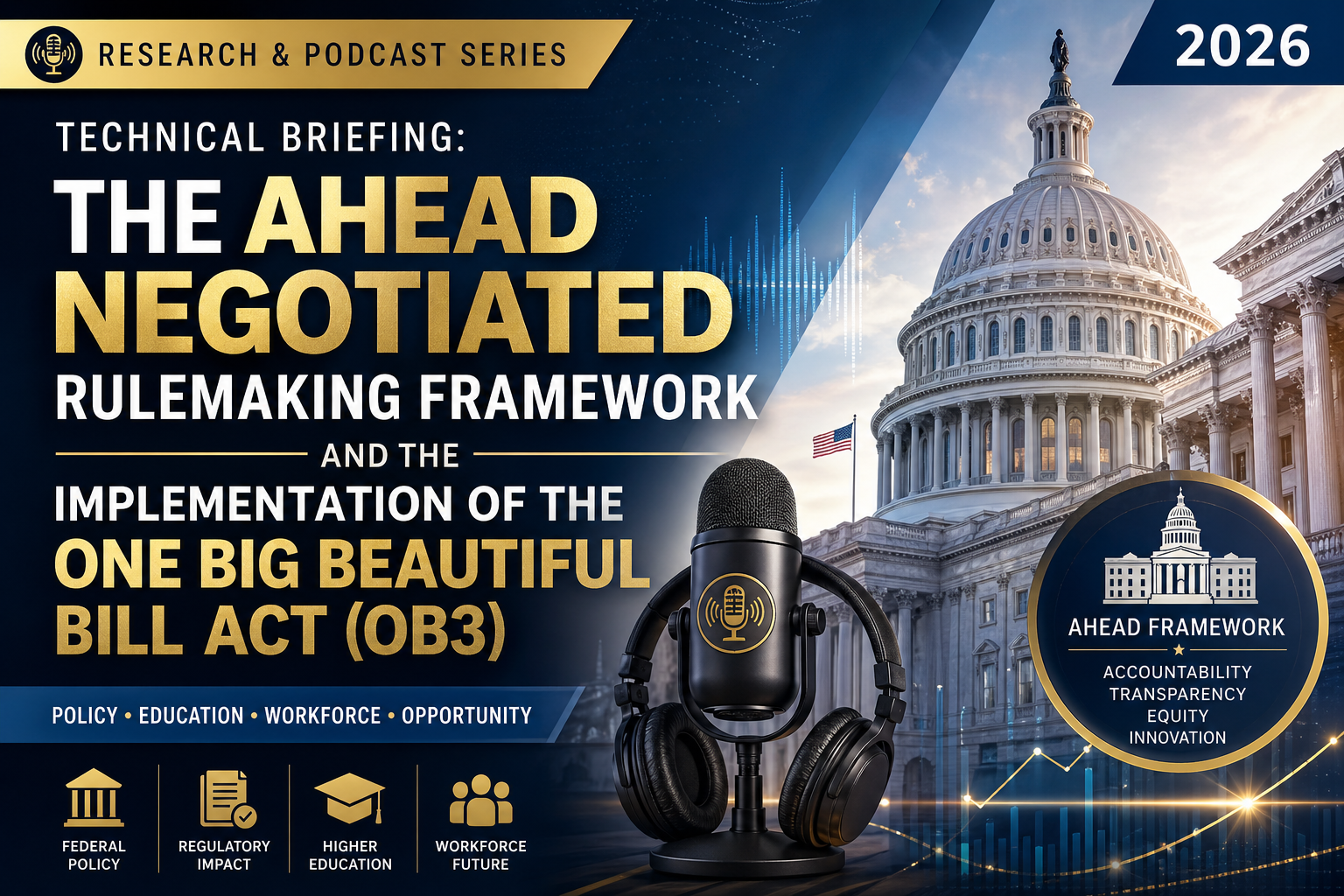
Technical Briefing: The AHEAD Negotiated Rulemaking Framework and the Implementation of the One Big Beautiful Bill Act (OB3) – RESEARCH & PODCAST SERIES 2026
The AHEAD Framework & OB3
2025–2026 Negotiated Rulemaking: The Future of Workforce Pell & Accountability
What is AHEAD?
AHEAD (Accountability in Higher Education and Access through Demand-driven Workforce Pell) is the U.S. Department of Education’s mechanism to regulate the expansion of Pell Grants to short-term programs. Under the One Big Beautiful Bill (OB3), the goal is to tie Title IV eligibility to immediate workforce outcomes.
Legal Authority
HEA Section 487 / 2025 Negotiated Rulemaking Landing Page
- • Interacts with RISE Committee data.
- • Affects proprietary & vocational sectors.
The STATS Framework
The “Student Tracking and Accountability for Title IV Success” draft implements a pass/fail earnings test for all undergraduate certificates.
The “Do-No-Harm” Test
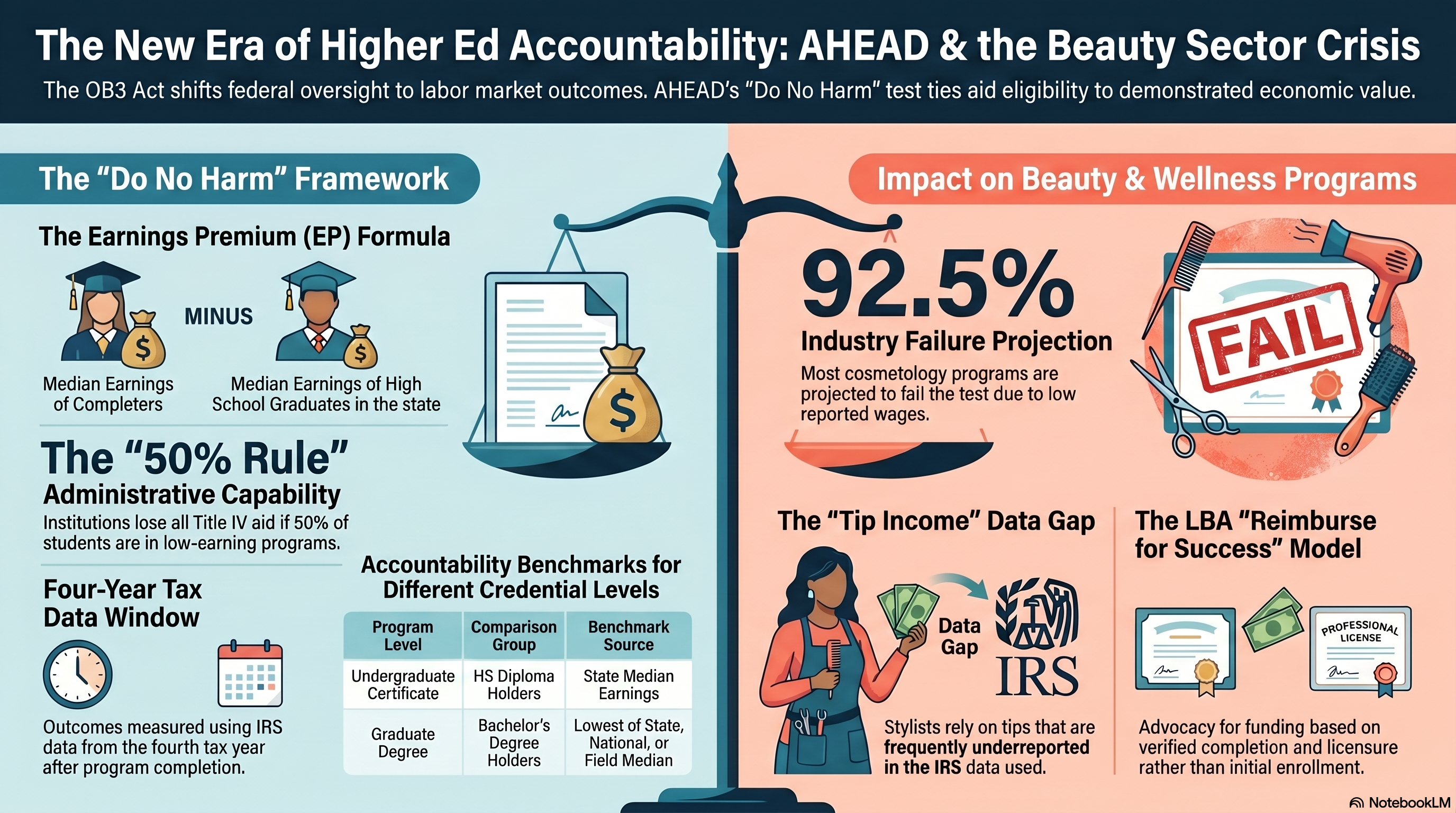
The AHEAD committee’s primary lever is a metric comparing graduate earnings to a state-level high school graduate benchmark. Failing this test means immediate loss of Title IV eligibility.
Critical Flaw Identified:
The benchmark uses W-2 data for 25-34 year olds, while most beauty/wellness grads are entry-level (18-22) and rely on tips/1099 income not captured in IRS aggregates.
Impact on Beauty & Wellness
Why the High Failure Rate?
Regional Wage Levels: Federal benchmarks ignore lower cost-of-living state medians.
Program Length: 1,500-hour programs are judged as 4-year degrees in outcome data.
Industry Alerts: AACS and FACT (Florida) have modeled that 92% of programs fail on year-3 W-2 data alone.
Rulemaking Timeline
Case Study: Louisville Beauty Academy (LBA) Model
Advocating for “Reimburse Completion, Not Enrollment”
Guaranteed Success
By only releasing funds upon verified completion and licensure, schools are forced to prioritize quality over recruitment volume. LBA’s debt-free outliers prove this model works.
Anti-Inflationary
Linking funds to completion prevents the “Tuition Inflation” caused by guaranteed front-loaded Title IV checks. This creates a level playing field for low-cost schools.
How to Influence the NPRM
Target Comment Themes
- 1. Completion-Based Funding: Base Title IV on graduation/employment, not day-1 enrollment.
- 2. Debt-Free Models: Recognize schools like LBA that operate with low/no student debt as “Safe Harbor” programs.
- 3. Data Integrity: Demand the inclusion of 1099 and tipped-income estimates in earnings tests.
- 4. Competition Neutrality: Put Title IV and non-Title IV schools on the same benchmark field.
Contact for Advocacy
Official Docket
Docket ID: ED-2025-OPE-XXXX
Key Email Contacts
OPE_Rulemaking@ed.gov
Secretary@ed.gov
Submit comments via Regulations.gov once the NPRM is formally published (Spring 2026).
Disclaimer (Policy Research & Public Comment Context)
This document is a policy research and advocacy briefing developed by the New American Business Association (NABA) and shared for educational, informational, and public comment purposes. It is intended to contribute to ongoing federal and state policy discussions, including but not limited to higher education accountability and workforce development frameworks.
This material does not constitute legal advice, regulatory guidance, or an official interpretation of any statute, rule, or agency position. All references to federal or state laws, regulations, and rulemaking processes (including U.S. Department of Education initiatives) are subject to change and formal agency interpretation.
Any positions expressed reflect analytical and policy perspectives based on available information at the time of writing. Readers, institutions, and stakeholders are strongly encouraged to verify all regulatory requirements directly with the appropriate governing authorities or qualified legal counsel before making compliance or operational decisions.
The landscape of federal higher education oversight is currently experiencing a foundational shift, transitioning from a system primarily concerned with institutional inputs to one focused almost exclusively on labor market outcomes. This transformation is crystallized in the Accountability in Higher Education and Access through Demand-driven Workforce Pell (AHEAD) negotiated rulemaking process. Established to implement the higher education provisions of Public Law 119-21, commonly known as the One Big Beautiful Bill Act (OB3), the AHEAD committee is tasked with codifying a sector-neutral accountability framework that ties federal financial aid eligibility to the demonstrated economic value of academic programs.1 This report provides a technically precise analysis of the AHEAD process, the “Do No Harm” earnings premium metrics, the Student Tuition and Transparency System (STATS), and the specific vulnerabilities of undergraduate certificate programs within the beauty and wellness sectors.
Legislative Foundation and the AHEAD Administrative Process
The One Big Beautiful Bill Act, signed into law on July 4, 2025, represents a massive fiscal and policy package that significantly amends the Higher Education Act of 1965 (HEA).4 While much of the public discourse surrounding OB3 focused on tax provisions and border security, Title VIII of the Act introduced sweeping changes to Title IV federal student aid.4 These changes include the permanent simplification of loan repayment plans, the elimination of the Graduate PLUS loan program for new borrowers, and the creation of a new category of federal funding: the Workforce Pell Grant.1
To implement these statutory mandates, the U.S. Department of Education (ED) invoked the negotiated rulemaking process required under Section 492 of the HEA.1 On July 24, 2025, the Department announced the formation of two distinct committees to handle the diverse mandates of OB3 7:
- The Reimagining and Improving Student Education (RISE) Committee: Charged with addressing federal student loan programs, including new annual and aggregate loan limits, the definition of “professional student,” and the transition to the Repayment Assistance Plan (RAP).6
- The Accountability in Higher Education and Access through Demand-driven Workforce Pell (AHEAD) Committee: Charged with institutional and programmatic accountability, the implementation of Workforce Pell, and the overhaul of transparency reporting.3
The AHEAD committee was uniquely positioned to bridge the gap between traditional academic oversight and workforce development, with the Department of Labor (DOL) playing an active role in crafting the consensus language for Workforce Pell.1 This interagency collaboration underscores a primary goal of the OB3: ensuring that federal investments in short-term trade programs yield a measurable return for both students and taxpayers.1
Table 1: Regulatory Scope and Committee Charges under OB3 Implementation
| Feature | RISE Committee Jurisdiction | AHEAD Committee Jurisdiction |
| Primary Statutory Mandate | Loan Repayment & Limits (OB3 Title VIII) 4 | Accountability & Workforce Pell (OB3 Title VIII) 1 |
| Legal Authority | HEA Section 492 Negotiated Rulemaking 1 | HEA Section 492 Negotiated Rulemaking 1 |
| Core Accountability Metric | Individual Borrower Eligibility & Lifetime Caps 6 | “Do No Harm” Earnings Premium Test 2 |
| Funding Instruments Affected | Direct Subsidized/Unsubsidized Loans, PLUS Loans 6 | Pell Grants, Workforce Pell, Direct Loans 1 |
| Transparency System | Loan Disclosure Requirements 6 | STATS (Student Tuition and Transparency System) 2 |
The interaction between AHEAD and other concurrent rulemaking processes, such as the Accreditation, Innovation, and Modernization (AIM) committee, signifies a multi-pronged effort to modernize Title IV eligibility.14 While AIM addresses the institutional “gatekeepers” (accreditors), AHEAD establishes the quantitative benchmarks that programs must meet regardless of their accreditation status.2
Technical Parameters of the “Do No Harm” Earnings Premium Test
The centerpiece of the AHEAD accountability framework is the “Do No Harm” test, a metric designed to operationalize the statutory requirement that postsecondary programs provide a positive economic return.11 This metric marks the transition from the “Debt-to-Earnings” (D/E) ratios—which dominated the Gainful Employment (GE) debates of the previous decade—to a more direct “Earnings Premium” (EP) measure.2
Metric Definition and Calculation Methodology
The Earnings Premium is defined as the difference between the median annual earnings of a program’s completers and a specific comparison benchmark.2 Under the draft STATS framework, the Department will calculate this measure using the following parameters:
- Cohort Period: The Department will identify students who completed a program during a specific two-year or four-year window.3
- Earnings Measurement Period: The Department will obtain median annual earnings for these completers during the fourth tax year following their completion.2 This four-year window is intended to allow for a period of initial career stabilization.3
- Data Sourcing: Earnings data will be sourced directly from a federal agency with access to tax information, primarily the Internal Revenue Service (IRS).3
The passing threshold is determined based on the credential level of the program and the geography of the institution. For undergraduate programs, the threshold is the median earnings of working adults aged 25 to 34 who hold only a high school diploma (or equivalent) in the state where the institution is located.11

If more than 50% of the students enrolled in a program are from outside the institution’s home state, or if the school is a foreign institution, the Department applies a national median earnings benchmark for high school graduates.17 For graduate programs, the benchmark is more stringent, comparing completers to the median earnings of bachelor’s degree recipients.6 The Department employs a “lowest-of” logic for graduate programs, selecting the lowest value among the state median for bachelor’s holders, the state earnings for the specific field of study, or the national earnings for that field.17
Table 2: Accountability Thresholds by Program Level under STATS
| Program Level | Comparison Group | Age Range | Benchmark Source |
| Undergraduate Certificate | HS Diploma Holders 6 | 25–34 17 | State Median (or National if >50% out-of-state) 17 |
| Associate/Bachelor’s Degree | HS Diploma Holders 6 | 25–34 17 | State Median 17 |
| Graduate Certificate/Degree | Bachelor’s Degree Holders 6 | 25–34 17 | Lowest of State, National, or Field-Specific Median 17 |
Evolution from Gainful Employment (GE) and Financial Value Transparency (FVT)
The 2026 AHEAD framework essentially absorbs and overhauls the 2023–2024 GE/FVT regulations.2 The pre-existing FVT framework has been formally renamed the Student Tuition and Transparency System (STATS).2 The most critical departures from the previous regulatory attempts include:
- Elimination of the Debt-to-Earnings (D/E) Metric: Negotiators agreed that the Earnings Premium alone is a sufficient measure of value under the OB3 statute, removing the D/E reporting requirements that institutions found burdensome and often distortive.2
- Harmonized Penalties: While the 2023 GE rules primarily penalized for-profit and certificate programs, the AHEAD framework applies the “Earnings Accountability” standard (Subpart S) to nearly all Title IV programs.2 However, the primary consequence for most programs remains the loss of eligibility for federal Direct Loans rather than all Title IV aid.2
- The “50% Administrative Capability” Rule: In a significant escalation, the draft rules introduce a new standard of administrative capability under § 668.16(t). An institution may lose all Title IV eligibility, including Pell Grants, if more than 50% of its students are enrolled in “low-earning” programs or if more than 50% of its Title IV volume is tied to such programs.16
The Implementation Timeline: From Consensus to Enforcement
The timeline for the AHEAD process is driven by the July 1, 2026, effective date established by the One Big Beautiful Bill Act.12 Unlike many previous rulemaking cycles, the AHEAD committee reached a formal consensus on all major issue papers, which significantly constrains the Department’s ability to deviate from the agreed-upon language in the subsequent Notice of Proposed Rulemaking (NPRM).2
Key Dates in the AHEAD Rulemaking Cycle
The AHEAD committee convened for two intense sessions to hammer out the regulatory text:
- December 8–12, 2025: Negotiators reached consensus on the Workforce Pell package, including definitions for “eligible workforce programs” and the role of state governors in the approval process.1
- January 5–9, 2026: The committee reached consensus on the broader accountability framework, the STATS reporting requirements, and the “Earnings Accountability” penalties.9
Following these sessions, the Department began publishing the required NPRMs for public comment:
- March 9, 2026: Publication of the NPRM for “Pell Grant Exclusion Relating to Other Grant Aid; and Workforce Pell Grants.” Public comments were due by April 8, 2026.21
- April 20, 2026: Publication of the NPRM for “Student Tuition and Transparency System (STATS) and Earnings Accountability.” Public comments for this high-stakes rule are due by May 20, 2026.3
Table 3: Regulatory Timeline and Effective Dates
| Event | Date | Significance |
| OB3 Enactment | July 4, 2025 | Establishes statutory mandate for “Do No Harm” and Workforce Pell.4 |
| AHEAD Session 1 | Dec 8-12, 2025 | Consensus on Workforce Pell definitions and 70/70 metrics.1 |
| AHEAD Session 2 | Jan 5-9, 2026 | Consensus on STATS and Earnings Premium accountability.9 |
| STATS NPRM | April 20, 2026 | Formal proposal of accountability metrics and the “50% Rule”.3 |
| Comment Deadline | May 20, 2026 | Final opportunity for stakeholders to influence the final rule.3 |
| Final Rule Target | Spring 2026 | Expected publication of final regulations.12 |
| Effective Date | July 1, 2026 | Regulations go into effect; reporting requirements begin.12 |
| First Enforcement | July 1, 2028 | Earliest date for loss of aid after two consecutive failing years.23 |
The Department intends to provide institutions with their first “informational” earnings premium results in early 2027 based on data from the preceding years.23 However, no program will lose funding until it has failed the metric for two out of three consecutive award years, placing the first potential termination actions in the summer of 2028.2
Implications for Undergraduate Certificate Programs: The Beauty and Wellness Crisis
Undergraduate certificate programs—particularly those in cosmetology, barbering, massage therapy, and esthetics—are among the most vulnerable cohorts under the AHEAD “Do No Harm” test.19 Industry advocates and independent researchers have modeled the potential impact, revealing a looming crisis of eligibility for the sector.23
The “92% Figure” and Industry Failure Projections
The most widely cited statistic in the sector originates from an analysis by the Associated Skin Care Professionals (ASCP), which estimated that 92.5% of cosmetology and personal grooming students are currently enrolled in programs that would fail the earnings premium test.23 Other researchers have corroborated this, suggesting that between 75% and 98% of Title IV cosmetology programs could fail the benchmark.19
The sensitivity of these programs to the earnings premium test is driven by several structural factors:
- High Tuition vs. Entry-Level Wages: The typical cost of a comprehensive cosmetology program ranges from $15,000 to $20,000, while the reported median earnings for stylists often hover near or even below the median for high school graduates in many states.24
- Short Program Duration: Unlike four-year degrees where students have more time to secure higher-paying roles before their outcomes are measured, certificate completers are often only one or two years into their professional life when the data is captured, and the four-year tax window may not reflect the full trajectory of a stylist’s career.23
- Tip Income and Underreporting: A core argument of associations like the American Association of Cosmetology Schools (AACS) is that stylists rely heavily on tips that are frequently underreported to the IRS.19 While a federal court in October 2025 dismissed these concerns, citing studies that suggest underreported tips only account for an 8% earnings gap, industry advocates maintain that this does not reflect the reality of independent booth renters and small salon operators.19
- Demographic Exposure: The sector is predominantly female and includes many working parents who may choose part-time employment for flexibility, which lowers the median annual earnings used in the federal calculation.18
Advocacy Framing and State Association Alerts
State associations, such as the Florida Association of Cosmetology & Technical Schools (FACTS), have issued urgent alerts and guidance to their members regarding the AHEAD rulemaking.18 The framing of these concerns typically focuses on three “levers”:
- Access and Equity: Arguing that these rules disproportionately impact institutions serving low-income, minority, and non-traditional students who rely on Title IV aid to enter a skilled trade.18
- Regulatory Overreach: Challenging the Department’s authority to impose a “one-size-fits-all” earnings metric that does not account for the nuances of service-based, tip-heavy occupations.18
- Economic Impact: Warning of a “death sentence” for hundreds of beauty colleges, which could lead to a significant shortage of licensed professionals and the expansion of an unlicensed “shadow” market.18
FACTS and AACS have encouraged members to use draft comments provided by organizations like NASFAA to help articulate the technical flaws in the “lowest-of” logic and the use of the 25–34 age cohort as a comparison group.17
Intersection of Completion and Enrollment Accountability
The AHEAD process and the One Big Beautiful Bill Act fundamentally reorient the “unit of accountability” from the point of enrollment to the point of completion and employment.1 This pivot is most evident in the draft rules for Workforce Pell and the new administrative capability standards.20
Completers vs. Enrollees in Metric Calculations
A critical distinction in the draft rules is which students “count” for accountability purposes.
- Earnings Premium (STATS): This metric only measures the outcomes of completers.11 Students who enroll but withdraw are excluded from the median earnings calculation. This creates an incentive for programs to only graduate students with high earning potential.11
- Administrative Capability (The 50% Rule): This standard, however, considers all Title IV recipients and total Title IV volume.16 An institution’s entire eligibility is threatened if 50% of its students are in programs whose completers fail the earnings test.16 This linkage ensures that schools cannot simply ignore the “harm” done to enrollees by maintaining high-cost, low-value programs.
Outcome-Based Reimbursement and Pay-for-Success
While federal aid is traditionally disbursed based on attendance (e.g., after the “census date”), the AHEAD committee explored—and in some cases codified—mechanisms for outcome-based eligibility.1
For the new Workforce Pell Grants, the law and draft rules (Subpart R) establish the most direct “pay-for-success” model in Title IV history 1:
- Verified Completion Rate: Programs must maintain a completion rate of at least 70% within 150% of the normal program length.26
- Verified Job Placement Rate: Programs must demonstrate a job placement rate of at least 70%.26
- Value-Added Earnings: The Department will calculate a “Value-Added Earnings” measure specifically for Workforce Pell, which acts as a secondary hurdle for eligibility.1
Negotiators debated whether to exclude students who continue their education from the “not working” category in placement calculations, but the Department ultimately maintained a strict employment-focused standard.26 This shift suggests a future where institutional reimbursement may eventually be tied to verified licensing and job entry rather than first-day enrollment.27
Formal Levers for Public Influence and the Power of Consensus
The negotiated rulemaking process provides a structured, albeit narrow, window for public influence. The AHEAD process is currently in the “notice and comment” phase, which is governed by the Administrative Procedure Act (APA).
Table 4: Key Dockets and Points of Contact for Public Comments
| Rulemaking Topic | Docket ID / Federal Register Reference | Primary Contact |
| Workforce Pell Grants | ED-2026-OPE-0133 28 | Nicholas Kent (Under Secretary) 29 |
| STATS & Earnings Accountability | ED-2026-OPE-0100 3 | Joe Massman (OPE) 3 |
| Negotiator Nominations | 90 FR 35264 10 | negreghearing@ed.gov 10 |
The Impact of Consensus
When a negotiated rulemaking committee reaches consensus—meaning no negotiator dissents on a final regulatory package—the Department is required to publish that exact consensus language as its proposed rule.2 Because the AHEAD committee reached consensus on both Workforce Pell (Dec 2025) and Accountability (Jan 2026), the NPRMs published in March and April 2026 reflect the negotiated agreement.1
However, the Department still has flexibility in the following areas:
- Directed Questions: The NPRMs include dozens of “Directed Questions” where the Department explicitly asks for data or feedback on specific implementation details (e.g., the use of IRS data, the 50% rule thresholds, or the treatment of out-of-state students).3
- Technical Corrections: The Department can make non-substantive technical edits to the language before the final rule.31
- Waiver of Master Calendar: The OB3 Act allows for the waiver of certain timeline requirements, but the Department must still justify its final decisions based on the “administrative record,” which includes every public comment submitted.12
Case Study: The Louisville Beauty Academy and Debt-Free Models
The Louisville Beauty Academy (LBA), under the leadership of founder Di Tran, has become a prominent model for how small vocational schools can survive—and thrive—under an outcomes-based regime.24 LBA’s “humanized” education philosophy provides a blueprint for advocacy focused on completion over enrollment.27
Completion-Based Reimbursement Advocacy
LBA and its associated organization, the New American Business Association (NABA), have advocated for a “reimburse for completion” model.27 Under this proposal:
- Federal or state funds are only released to the institution (or as a credit to the student) once the student has verified completion and, in many cases, licensure.27
- This model eliminates the “enrollment bubble” where schools are incentivized to keep students only long enough to secure the first disbursement of federal aid.24
Competition-Neutral Treatment of Non-Title IV Schools
A significant portion of LBA’s advocacy centers on the recognition of “low-dependency” or non-Title IV schools.24 LBA operates on a cash-based, discounted tuition model that intentionally avoids reliance on federal loans.34 LBA argues that:
- Debt-Free as a “Positive Outlier”: Any accountability framework should automatically grant “safe harbor” status to programs whose tuition is low enough to be covered without student loans, as these programs by definition “do no harm” in terms of student debt.24
- Leveling the Playing Field: By basing eligibility on outcomes like completion and licensing rather than institutional accreditation (which can cost $50,000+), the government can foster a more competitive market of affordable trade education.27
The LBA case study suggests that if the Department truly wants a “sector-neutral” framework, it must create pathways for low-cost, innovative providers to receive recognition for their outcomes without the crushing overhead of traditional Title IV compliance.24
Recommended Comment Themes for Beauty and Wellness Coalitions
As the May 20, 2026, deadline for the STATS/Accountability NPRM approaches, beauty school owners, small businesses, and professional associations should focus their public comments on the following themes to advocate for a completion-focused, fair accountability regime.
- Shift to Outcome-Based Disbursement: Recommend that the Department move toward a model where institutional reimbursement is tied to verified completion and licensure. Emphasize that “reimbursing completion, not enrollment” is the most effective way to prevent tuition inflation and ensure that federal dollars only support successful student transitions into the workforce.
- Challenge the “Administrative Capability” 50% Threshold: Argue that the 50% rule is an arbitrary “death penalty” that could close high-performing, high-value programs simply because they are part of a larger institution with some struggling programs. Suggest a more nuanced, program-level enforcement mechanism.
- Request a “Low-Tuition Safe Harbor”: Advocate for an exemption from the earnings premium test for any program whose total cost is below a certain threshold (e.g., $10,000 or 1.5 times the maximum Pell Grant). This recognizes that low-cost programs, like the LBA model, do not create the same debt risks as high-tuition institutions.
- Address Tip Income and “Shadow Earnings”: Provide data on the discrepancy between IRS-reported earnings and actual take-home pay for stylists. Demand that the STATS framework include an “alternate earnings appeal” process that allows schools to provide independently verified wage data for tip-heavy professions.
- Critique the 25–34 Age Cohort Benchmark: Highlight the inequity of comparing a 19-year-old certificate completer to a 34-year-old high school graduate with 15 years of experience. Propose a benchmark based on “entry-level” or “five-year” career medians for high school diploma holders.
- Emphasize stackability and career pathways: For Workforce Pell comments, urge the Department to count students who immediately enroll in a higher-level degree or certificate as “successful” rather than “not working” in job placement calculations.
Actionable Contact Information for LBA-Style Advocacy
To advocate for the “Louisville Beauty Academy Model” of reimbursement for completion, submissions should be sent to:
For STATS and Accountability (Docket ED-2026-OPE-0100):
- Submit via Regulations.gov:(https://www.regulations.gov/commenton/ED-2026-OPE-0100-0001) 3
- Direct Inquiries/Letters: Joe Massman, Office of Postsecondary Education (Joe.Massman@ed.gov) 30
For Workforce Pell and Grant Aid (Docket ED-2026-OPE-0133):
- Submit via Regulations.gov:(https://www.regulations.gov/docket/ED-2026-OPE-0133) 28
- Direct Inquiries/Letters: Nicholas Kent, Under Secretary (Nicholas.Kent@ed.gov) 29
By coordinating around the theme of “reimburse for success, not just attendance,” the beauty and wellness sector can pivot from a defensive posture to a proactive role in shaping the future of workforce-aligned higher education.
Works cited
- U.S. Department of Education Concludes Negotiated Rulemaking Session to Implement the New Workforce Pell Grant Program, accessed April 27, 2026, https://www.ed.gov/about/news/press-release/us-department-of-education-concludes-negotiated-rulemaking-session-implement-new-workforce-pell-grant-program
- 2026 Gainful Employment – nasfaa, accessed April 27, 2026, https://www.nasfaa.org/ge_2026
- Accountability in Higher Education and Access through Demand-Driven Workforce Pell: Student Tuition and Transparency System and Earnings Accountability – Regulations.gov, accessed April 27, 2026, https://www.regulations.gov/document/ED-2026-OPE-0100-0001
- One Big Beautiful Bill Act (2025) – WCET & SAN Policy Tracker, accessed April 27, 2026, https://policytracker.wiche.edu/federal-statute/one-big-beautiful-bill-act-2025
- ONE BIG BEAUTIFUL BILL? A PRELIMINARY ASSESSMENT | Brookings Institution, accessed April 27, 2026, https://www.brookings.edu/wp-content/uploads/2026/03/OBBBA_Preliminary_Assessment_2026-03-23-1.pdf
- Frequently Asked Questions About the One Big Beautiful Bill Act – NAICU, accessed April 27, 2026, https://www.naicu.edu/policy-advocacy/advocacy-resources/reconciliation-advocacy-center/frequently-asked-questions-about-the-one-big-beautiful-bill-act/
- Negotiated Rulemaking | U.S. Department of Education, accessed April 27, 2026, https://www.ed.gov/topic/negotiated-rulemaking
- How to Engage: Negotiated Rulemaking with the Department of Education – Duane Morris, accessed April 27, 2026, https://www.duanemorris.com/alerts/how_engage_negotiated_rulemaking_department_education_0825.html
- 2025-26 Negotiated Rulemaking Committees – nasfaa, accessed April 27, 2026, https://www.nasfaa.org/2025negreg
- Public Hearing; Negotiated Rulemaking Committees – Federal Register, accessed April 27, 2026, https://www.federalregister.gov/documents/2025/07/25/2025-13998/public-hearing-negotiated-rulemaking-committees
- New accountability framework will help ensure higher education …, accessed April 27, 2026, https://www.ihep.org/new-accountability-framework-will-help-ensure-higher-education-provides-strong-outcomes-for-all-students/
- One Big Beautiful Bill Act impact on Financial Aid – JMU, accessed April 27, 2026, https://www.jmu.edu/news/notices/2026/03-03-one-big-beautiful-bill-act-impact-on-financial-aid.shtml
- ED Proposed Accountability in Higher Education Through Demand …, accessed April 27, 2026, https://advocacy.sba.gov/2026/04/22/ed-proposed-accountability-in-higher-education-through-demand-driven-workforce-pell-grants/
- Negotiated Rulemaking for Higher Education 2026 | U.S. Department of Education, accessed April 27, 2026, https://www.ed.gov/laws-and-policy/higher-education-laws-and-policy/higher-education-policy/negotiated-rulemaking-higher-education-2026
- Advocacy quick hits – AACC, accessed April 27, 2026, https://www.aacc.nche.edu/2025/12/11/advocacy-quick-hits-80/
- Advocacy Quick Hits – AACC, accessed April 27, 2026, https://www.aacc.nche.edu/2026/04/23/advocacy-quick-hits-86/
- AHEAD Committee Kicks Off Second Neg Reg Session Focused on New Accountability Framework – nasfaa, accessed April 27, 2026, https://www.nasfaa.org/news-item/37943/AHEAD_Committee_Kicks_Off_Second_Neg_Reg_Session_Focused_on_New_Accountability_Framework
- Legislative – Florida Association of Cosmetology & Technical Schools, accessed April 27, 2026, https://floridabeautyschools.org/legislative/
- Uncategorized Archives – Louisville Beauty Academy, accessed April 27, 2026, https://louisvillebeautyacademy.net/category/uncategorized/
- Negotiators Reach Consensus on Accountability Framework – Third Way, accessed April 27, 2026, https://www.thirdway.org/blog/negotiators-reach-consensus-on-accountability-framework
- Workforce Pell – WCET & SAN Policy Tracker, accessed April 27, 2026, https://policytracker.wiche.edu/federal-regulation/workforce-pell
- ACCOUNTABILITY IN HIGHER EDUCATION AND ACCESS THROUGH DEMAND-DRIVEN WORKFORCE PELL: PELL GRANT EXCLUSION RELATING TO OTHER GRANT AID – Federal Register, accessed April 27, 2026, https://www.federalregister.gov/documents/2026/03/09/2026-04520/accountability-in-higher-education-and-access-through-demand-driven-workforce-pell-pell-grant
- Will 92% of Beauty Schools Close in 2027? A Deep Study on the …, accessed April 27, 2026, https://ditranuniversity.com/?p=660
- Weekly Monitoring: Beauty/Cosmetology Schools Under Financial Value Transparency & Gainful Employment Pressure (Week of Mar 17–23, 2026) – RESEARCH SERIES 2026 – New American Business Association (NABA) – Louisville, KY, accessed April 27, 2026, https://naba4u.org/2026/03/weekly-monitoring-beauty-cosmetology-schools-under-financial-value-transparency-gainful-employment-pressure-week-of-mar-17-23-2026-research-series-2026/
- beauty school compliance Archives – Louisville Beauty Academy, accessed April 27, 2026, https://louisvillebeautyacademy.net/tag/beauty-school-compliance/
- Department of Education Panel Reaches Agreement on Proposed …, accessed April 27, 2026, https://ticas.org/accountability/ahead-neg-reg-session-1-recap-dec-2025/
- Di Tran Archives – Louisville Beauty Academy, accessed April 27, 2026, https://louisvillebeautyacademy.net/tag/di-tran/
- NCSL Comments on Workforce Pell, accessed April 27, 2026, https://www.ncsl.org/resources/details/ncsl-comments-on-workforce-pell
- Comments to the Department of Education on the Workforce Pell Program | Third Way, accessed April 27, 2026, https://www.thirdway.org/letter/comments-to-the-department-of-education-on-the-workforce-pell-program
- 91 FR 21088 – Accountability in Higher Education and Access Through Demand-Driven Workforce Pell: Student Tuition and Transparency System (STATS) and Earnings Accountability – Content Details – 2026-07666 – GovInfo, accessed April 27, 2026, https://www.govinfo.gov/app/details/FR-2026-04-20/2026-07666
- Negotiated Rulemaking for Higher Education 2025 | U.S. Department of Education, accessed April 27, 2026, https://www.ed.gov/laws-and-policy/higher-education-laws-and-policy/higher-education-policy/negotiated-rulemaking-for-higher-education-2025-2026
- Louisville Beauty Academy & Founder Di Tran: Elevating Beauty Education and Small Business Advocacy to the National Level – National Small Business Association (NSBA), Washington, D.C. – SEPTEMBER 2025, accessed April 27, 2026, https://louisvillebeautyacademy.net/louisville-beauty-academy-founder-di-tran-elevating-beauty-education-and-small-business-advocacy-to-the-national-level-national-small-business-association-nsba-washington-d-c-s/
- Louisville Beauty Academy: Becoming One of the Most Admired Rising Models in Ethical, Accessible, Debt-Disciplined, Human-Centered Beauty Education – RESEARCH & PODCAST SERIES 2026, accessed April 27, 2026, https://naba4u.org/2026/04/louisville-beauty-academy-becoming-one-of-the-most-admired-rising-models-in-ethical-accessible-debt-disciplined-human-centered-beauty-education-research-podcast-series-2026/
- Financial Aid Options and Payment Model at Louisville Beauty Academy, accessed April 27, 2026, https://louisvillebeautyacademy.net/financial-aid-options-and-definition/
- Federal Register/Vol. 88, No. 97/Friday, May 19, 2023/Proposed Rules – Regulations.gov, accessed April 27, 2026, https://downloads.regulations.gov/ED-2023-OPE-0089-0001/content.pdf
Discover more from New American Business Association (NABA) - Louisville, KY
Subscribe to get the latest posts sent to your email.