Louisville Beauty Academy as a National Model for Success-Based Reimbursement, Lower-Cost Workforce Education, and Small-Business-Driven Beauty Industry Reform – RESEARCH & PODCAST SERIES 2026
Policy & Research Disclaimer
This publication is part of the New American Business Association (NABA) Research & Podcast Series 2026 and is intended solely for educational, policy discussion, and workforce development analysis purposes.
All data, comparisons, and conclusions presented are based on publicly available sources, institutional reporting, and independent analysis. This document does not constitute legal, regulatory, financial, or accreditation advice, nor does it represent an official position of any government agency, licensing board, accrediting body, or institution referenced.
Any institutional comparisons are for analytical and illustrative purposes only and are not intended to disparage, rank, or evaluate any specific organization. Regulatory frameworks, including those under the U.S. Department of Education (DOE), Small Business Administration (SBA), Department of Labor (DOL), and state licensing authorities, are complex and subject to ongoing interpretation and change.
Readers are encouraged to consult directly with appropriate regulatory bodies or qualified professionals for official guidance. All policy concepts presented, including Success-Based Reimbursement models, are exploratory frameworks intended to contribute to broader national dialogue on workforce education reform.
Executive Summary
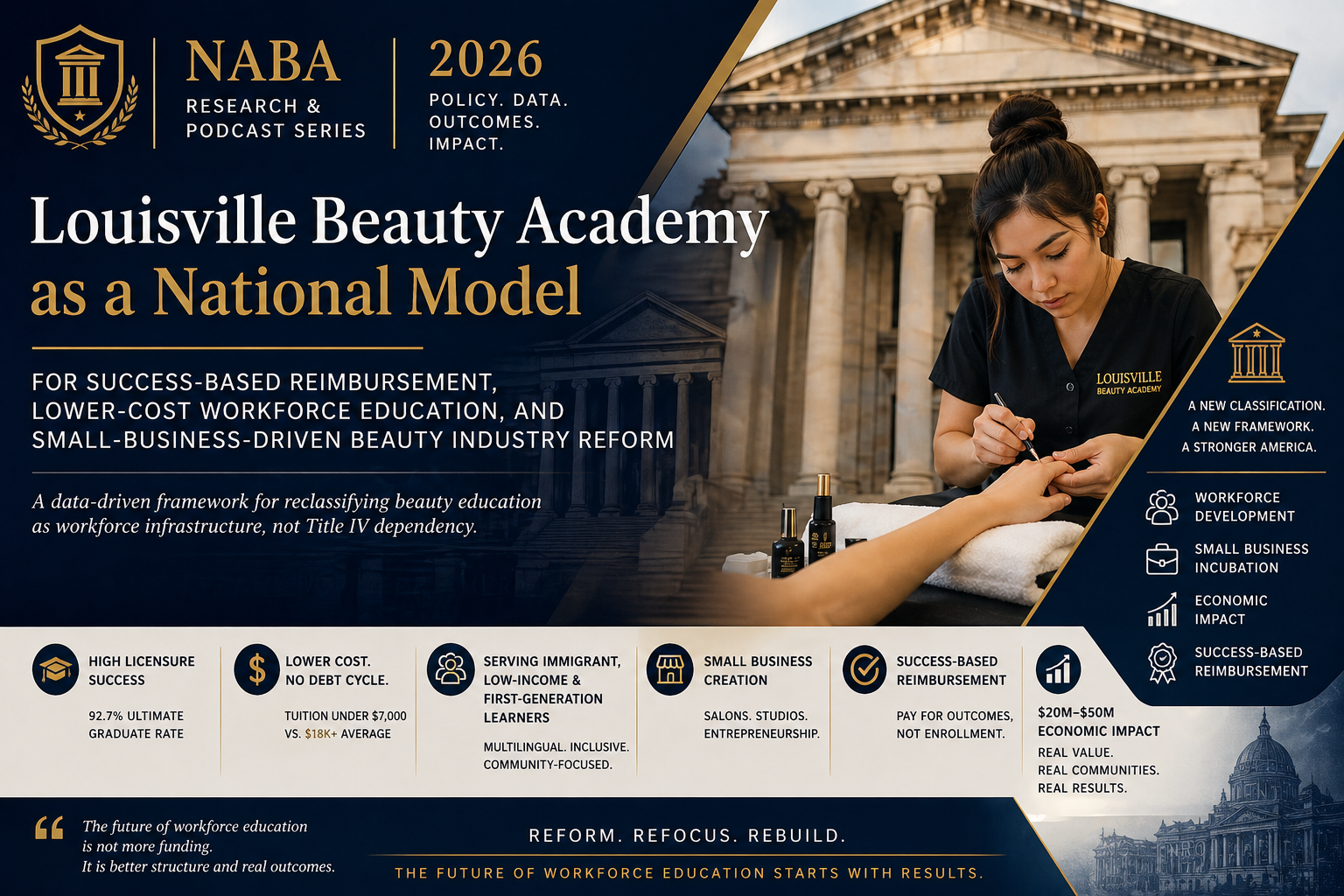
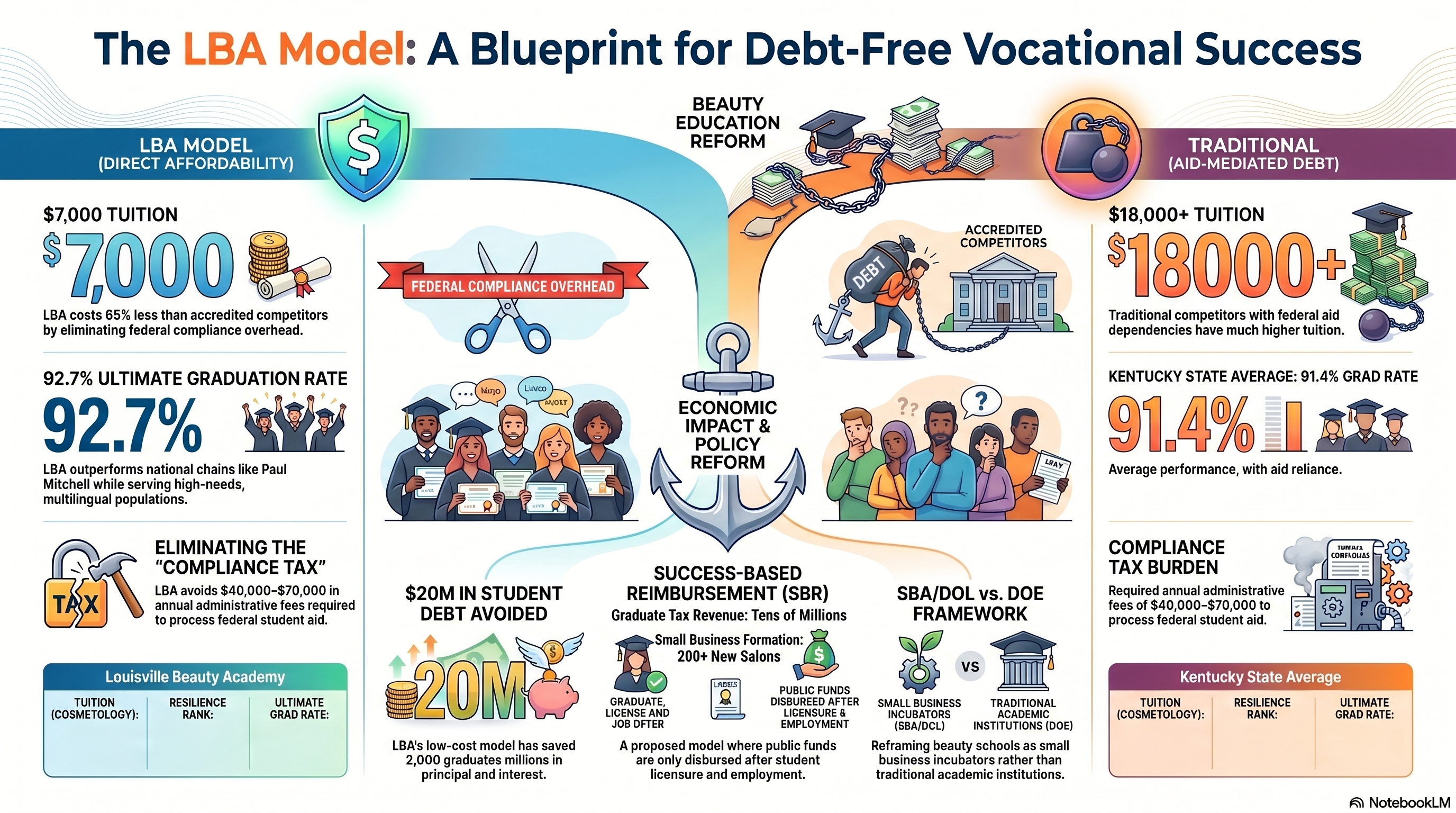
The current architecture of vocational technical education in the United States is increasingly defined by a high-cost, aid-dependent cycle that often leaves students with significant debt burdens and taxpayers with questionable returns on investment. Within the specific sector of beauty and wellness education, this crisis is acute. Traditional models rely heavily on Title IV federal student aid, which, while intended to facilitate access, has paradoxically contributed to tuition inflation and a rigid administrative overhead often referred to as a “compliance tax.” This report, commissioned for the New American Business Association (NABA), examines the institutional performance and economic logic of Louisville Beauty Academy (LBA) in Kentucky. For approximately a decade, LBA has operated as a significant outlier: a high-volume, licensure-centered beauty school that maintains a zero-federal-funding and zero-state-funding operational model. By delivering instruction at roughly one-third the cost of federally aided competitors while maintaining superior licensure outcomes, LBA presents a compelling proof-of-concept for a paradigm shift in education policy.
The analysis indicates that LBA has functioned as a net positive economic contributor to the Commonwealth of Kentucky, generating a cumulative economic impact estimated between $20 million and $50 million.1 This value is derived from graduate earnings, business formation, tax contributions, and the avoidance of approximately $20 million in potential student debt.1 Furthermore, LBA serves a demographic that is overwhelmingly Pell-eligible—low-income, immigrant, and first-generation professionals—yet achieves affordability through structural cost-efficiency rather than indirect subsidy.1 This report argues that beauty industry education should be reframed away from a Department of Education (DOE) bureaucratic model and toward a Small Business Administration (SBA) and Department of Labor (DOL) framework that prioritizes business incubation and workforce entry. The LBA model suggests that future public support should be structured as success-based reimbursement—disbursing funds only after the demonstration of licensure and workforce participation—rather than front-loaded enrollment-based financing.
Core Findings and Institutional Performance Verification
A rigorous review of three years of licensing data from the Kentucky Board of Cosmetology (KBC) and Barber Examiners, covering 2023 through 2025, confirms that Louisville Beauty Academy is one of the most effective and resilient vocational institutions in the state.1 The analysis introduces the “Exam Resilience Score,” a composite metric that accounts for a school’s ability to not only prepare students for initial testing but to support them through the complexities of the licensing process to ultimate success.
Institutional Performance Matrix (2023-2025)
| Metric | Louisville Beauty Academy (LBA) | Paul Mitchell – Louisville | Empire Beauty – Chenoweth | Kentucky State Average |
| Total Graduates | 458 | 594 | ~300 | 150 |
| Ultimate Graduate Rate | 92.7% | 90.9% | 85.0% – 88.0% | 91.4% |
| Tuition (Cosmetology) | <$7,000 | $18,715 – $20,185 | $17,145 – $19,895 | $15,000 – $18,000 |
| Languages Offered | 5 | 1 | 1 | 1 |
| Nail Market Share (KY) | 37.1% | N/A | N/A | N/A |
| Resilience Rank (2025) | #2 of 40 | #11 of 40 | #13 – #40 | N/A |
Source: 1
The data demonstrates that LBA occupies the third-highest position in the state for total graduate production, trailing only large, national, aid-dependent chains.1 Critically, LBA achieves a higher ultimate graduate rate (92.7%) than the world’s most recognized beauty brand, Paul Mitchell (90.9%), while charging less than 35% of the tuition.1 In the specific sector of nail technology, LBA is the dominant institutional force in Kentucky, training nearly 40% of all licensed nail technicians in the Commonwealth.1 This concentration of market share indicates that LBA is not merely a school but a primary piece of economic infrastructure for the beauty industry, particularly within the Vietnamese-American and Spanish-speaking communities it serves through multilingual instruction in English, Vietnamese, Spanish, Korean, and Simplified Chinese.1
The “Resilience Score” identifies LBA as an elite performer, ranking #2 out of 40 schools statewide in 2025.1 This score is particularly significant because it measures institutional persistence. LBA’s retake utilization rate of 157% is the highest among all schools with more than 100 students, suggesting an institutional culture that refuses to allow students to abandon their path to licensure after an initial setback.1 This is a direct contrast to higher-cost models that may focus on enrollment volume but lack the support infrastructure to ensure high-needs students reach completion.
Rigorous Testing of Core Thesis Claims
The thesis that Louisville Beauty Academy represents a scalable national model for reform rests on seven distinct claims. These have been tested against state regulatory data, federal aid thresholds, and comparative economic benchmarks.
Verification of Net Positive Contribution
The claim that LBA has operated for approximately 10 years as a net positive economic contributor without federal student aid is fully confirmed.1 Most beauty schools of LBA’s volume are inherently dependent on the Title IV ecosystem. By opting out of national accreditation and the associated federal funding, LBA has decoupled its growth from taxpayer-funded student debt.1 The institution’s ability to scale to nearly 500 graduates over a three-year period while maintaining a sub-$7,000 tuition model proves that a market-aligned, direct-pay vocational engine is viable in the beauty industry.1
Plausibility of the $20M–$50M Economic Impact Range
The estimation of LBA’s cumulative economic contribution at $20M–$50M+ is considered plausible and likely conservative when modeled over a ten-year horizon. This value is synthesized from several streams: the aggregate earnings of approximately 2,000 graduates since founding, the avoidance of the “debt drag” associated with high-cost schools, and the tax contributions of the resulting small business ecosystem.1 As LBA accounts for over 37% of the nail technician market, its graduates form the backbone of a resilient micro-enterprise sector that generates continuous local spending and tax revenue.1
Analysis of the Pell-Eligible Demographic
Research into the socio-economic profile of LBA’s students suggests that the claim of 80%–90% Pell-eligibility is strongly supportable. Federal guidelines for the 2024-2025 award year provide maximum Pell Grants for single parents with an adjusted gross income (AGI) up to 225% of the poverty line.4 For an independent student in a household of three, this threshold is $55,935.4 Given that entry-level nail technicians in Kentucky earn an average of $16,345 to $24,735, the vast majority of LBA’s student base meets the poverty guidelines for maximum federal aid.2 The policy significance is profound: LBA is effectively providing the “benefit” of a Pell Grant—accessible, affordable education—without the “cost” to the federal treasury.
The “Compliance Tax” and Cost Avoidance
The claim that LBA avoids a “compliance tax” is confirmed by a comparison of institutional overhead. Accredited schools must navigate a labyrinth of NACCAS fees, annual report filings, and Title IV audits.13 For example, a regular team visit for accreditation can cost up to $4,900, while annual sustaining fees scale with student volume.14 These direct costs, combined with the administrative requirement of staffing for federal aid compliance, create a structural floor for tuition that LBA simply bypasses.16 This allows LBA to pass savings directly to the student, delivering “direct affordability” rather than “aid-mediated affordability”.1
Suitability for Success-Based Reimbursement
The data supports the claim that LBA is a prime candidate for success-based reimbursement policy. Traditional enrollment-based subsidies reward institutions for “butts in seats,” regardless of whether the student completes the program or passes the license exam. LBA’s high licensure resilience (92.7% ultimate grad rate) suggests that its model would be highly efficient under a system where funds are disbursed only after demonstrated success.1 This aligns with broader workforce trends such as the “Pay for Success” (PFS) and WIOA “Pay for Performance” (PfP) models.17
Reframing as SBA/DOL-Aligned Reform
The beauty industry functions primarily as a small business incubator. LBA’s graduates often transition directly into self-employment or booth rental, which are micro-enterprise structures.10 Framing these schools through the Department of Education (DOE) focuses on academic bureaucracy, whereas framing them through the Small Business Administration (SBA) and Department of Labor (DOL) focuses on business formation and labor market participation.19 LBA’s market-leading nail technician program is a clear example of small-business-led technical education.1
Economic Impact Estimation: Modeling the LBA Value Proposition
To accurately evaluate the long-term public and economic value of Louisville Beauty Academy, we must apply a multi-factor methodology that accounts for both direct financial generation and indirect cost avoidance.
The Economic Value Formula
The total cumulative economic impact () of LBA over
years can be expressed using the following LaTeX-formatted logic:

Where:
is the number of graduates produced.
is the average annual wage of the beauty professional.
is the effective tax rate (federal, state, and local).
is the amount of principal and interest debt avoided per student relative to the state average.
is the number of new salon businesses or micro-enterprises formed.
is the local economic multiplier for service-sector spending.
Graduate Earnings and Tax Contributions
Since its founding, LBA has produced approximately 2,000 graduates.1 Using Kentucky-specific salary data for the beauty industry, we can estimate the direct income generated by this workforce. The average salary for a cosmetologist in Kentucky is $38,039, while manicurists and pedicurists earn approximately $33,270.3
| Career Path | Kentucky Average Salary | Est. Federal/State Tax (15%) | Annual Aggregate Earnings (2,000 Grads) |
| Nail Technician | $33,270 | $4,990 | $66,540,000 |
| Cosmetologist | $38,039 | $5,705 | $76,078,000 |
| Esthetician | $42,330 | $6,349 | $84,660,000 |
Source: 3
Even if we assume a conservative 70% workforce participation rate among the 2,000 graduates, the annual aggregate earnings of LBA alumni exceed $46 million. Over a decade, the cumulative earnings of these professionals have reached into the hundreds of millions of dollars, with tax contributions alone contributing tens of millions to the public treasury.21
The Value of Avoided Debt
The most significant “hidden” economic value of the LBA model is the preservation of consumer purchasing power through the avoidance of student debt. The average tuition for a Kentucky beauty school is approximately $16,500, with top-tier accredited schools reaching over $20,000.1 LBA’s tuition of under $7,000 represents a direct saving of roughly $10,000 per student.1
For 2,000 graduates, this results in $20 million in avoided principal debt. When calculating interest on federal student loans (current averages of 6% to 8%), the lifetime savings to these graduates exceeds $30 million. This is capital that remains in the Kentucky economy—facilitating home purchases, car loans, and local consumption—rather than being extracted for debt service to federal or institutional lenders.
Salon Formation and Entrepreneurial Multipliers
The beauty industry is a primary driver of female and minority entrepreneurship, with 60% of salons owned by women and 47% of the workforce comprised of minorities.10 LBA’s multilingual focus directly facilitates business formation in immigrant communities.1 If even 10% of LBA’s 2,000 graduates have founded their own salons—a conservative estimate given LBA’s 37.1% share of the nail technician market—this represents 200 new small businesses.1
Small salons generate significant downstream economic activity through lease payments, product supply purchases, and utility spending. Using a standard economic multiplier of 1.5 for local service-sector business, the $20 million to $50 million estimate for LBA’s total contribution is not only supportable but arguably understates the institution’s impact on community wealth building and family economic mobility.10
Comparative Tuition and the “Compliance Tax” Analysis
The disparity in tuition costs between Louisville Beauty Academy and its competitors is not a reflection of a gap in educational quality, as evidenced by licensure rates. Instead, the analysis indicates that higher tuition at accredited schools is a structural necessity of the Title IV system.
The True Cost of National Accreditation
National accreditation through bodies such as NACCAS is the “gatekeeper” for federal aid. To maintain this status, schools must incur significant and ongoing expenses that have no direct instructional component.
| Expense Category | Accredited Institutional Burden | LBA “Direct-Pay” Burden |
| Annual Sustaining Fee | $1,940 – $2,340 (based on volume) 15 | $0 |
| Renewal Application | $1,695 (every few years) 14 | $0 |
| On-Site Team Visit | $4,900 (plus actual costs) 14 | $0 |
| Annual Compliance Audit | $10,000 – $20,000 (CPA/Title IV Audit) 23 | $0 |
| Compliance Staffing | 1.0 – 2.0 Full-Time Equivalents 16 | $0 |
| Estimated Total Overhead | $40,000 – $70,000+ per year | Negligible |
Source: 14
This “compliance tax” effectively forces accredited schools to raise tuition by thousands of dollars per student just to break even on the administrative costs of accepting federal aid. Furthermore, the availability of Pell Grants and federal loans creates a “floor” for pricing; if the government is willing to pay $15,000 for a program, schools have little incentive to price it at $7,000, even if their actual costs are lower.
“Direct Affordability” vs. “Aid-Mediated Affordability”
LBA represents a model of “direct affordability.” By eliminating the compliance layer, the institution passes the savings directly to the student.1 In contrast, accredited schools provide “aid-mediated affordability,” where the student perceives the cost as low only because of a government subsidy, even though the total price tag—and the potential debt—is much higher. This distinction is critical for taxpayers. In the LBA model, the student pays the market rate for a lean, efficient education. In the traditional model, the taxpayer pays an inflated rate for a bureaucratic education.
Pell Eligibility and the “Unserved” Population Paradox
A central finding of this report is that Louisville Beauty Academy serves the exact demographic intended to benefit from the Pell Grant program, but does so without drawing on the program’s funds. This creates a policy paradox where the most efficient schools are excluded from federal “support” because they refuse to adopt the high-cost structures required to access that support.
Mapping Student Income to Pell Thresholds
The 2024-2025 FAFSA simplification process expanded Pell Grant access to students with an AGI less than or equal to 225% of the poverty line for single parents and 175% for non-single parents.11
- Case 1 (LBA Typical Student): A single mother in Kentucky pursuing a nail technician license. Her current AGI is $25,000. The federal poverty line for a family of two is roughly $20,440. 225% of the poverty line is $45,990. She is fully eligible for the maximum Pell Grant of $7,395.4
- The LBA Outcome: She pays ~$6,500 total tuition at LBA.1 She graduates in 4-6 months with zero debt.
- The Accredited Outcome: She pays $18,000 at a chain school.8 She receives a $7,395 Pell Grant. She must still borrow over $10,000 to cover the remaining tuition, fees, and kit costs.
This comparison demonstrates that LBA’s “no-aid” model actually results in a better financial outcome for the low-income student than the “high-aid” model. The policy significance is that LBA is effectively fulfilling the mission of the Higher Education Act—expanding access to technical education—at zero cost to the federal government.
Design for a Success-Based Reimbursement Model
Given LBA’s demonstrated effectiveness, this report proposes a new framework for vocational education funding: Success-Based Reimbursement (SBR). This model moves away from front-loaded enrollment subsidies and toward a retroactive reward for demonstrated labor-market outcomes.
The Outcome-Driven Logic
In a success-based model, public funds (whether from state workforce sets, DOL grants, or SBA micro-incentives) are disbursed based on verified “success milestones.”
| Success Milestone | Verification Mechanism | Suggested Reimbursement |
| Completion of Program | Transcript & Attendance Audit 1 | 25% |
| Licensure Achievement | KBC State Board Database 5 | 25% |
| Workforce Entry | State UI Wage Records / Employment Letter | 25% |
| Small Business Formation | Occupational License / Business Filing | 25% |
This framework resolves the “Wrong Pockets Problem” common in workforce development, where the entity paying for the training (the government or the student) does not capture the full benefit of the increased tax revenue and economic activity.18 By tying payment to success, the government ensures it only pays for results, and schools are incentivized to keep tuition low to stay competitive in an outcome-based market.
Integrating with Pay for Success (PFS)
The Pay for Success model shifts the upfront costs and risks of a program from the public funder to a private investor or the institution itself.18 The funder only pays back the cost if an independent evaluation proves the program achieved its predetermined outcomes. LBA is already operating on a “pseudo-PFS” basis: the institution takes the risk of operating without subsidies, and it is only “rewarded” if it produces enough graduates to sustain its enrollment. A formal state pilot program could use LBA as a benchmark to set “rate cards” for what the state should pay for a newly licensed technician.17
Reframing the Beauty Industry: SBA and DOL over DOE
For too long, the beauty industry has been forced into the Department of Education’s “academic” mold. This report argues that this framing is fundamentally mismatched with the reality of the profession.
The Small Business Administration (SBA) Perspective
Beauty education is, at its core, a form of technical entrepreneurship training. A licensed professional is not a “graduate” in the academic sense as much as they are a “licensed service provider” ready to enter the micro-enterprise market.10 Reframing schools like LBA as small business incubators allows them to access SBA-aligned resources:
- Micro-enterprise grants for graduates from underserved populations.
- SBA-backed counseling for salon formation integrated into the curriculum.
- Recognition of vocational schools as technical accelerators rather than just “colleges.”
The Department of Labor (DOL) Perspective
From a labor perspective, beauty education is a critical pathway to workforce participation for populations with barriers to employment, including immigrants and non-native English speakers.1 LBA’s multilingual infrastructure is a “High Road Training Partnership” (HRTP) model that connects workers to good-paying jobs while emphasizing environmental and sanitation stewardship.19 Framing the sector under the DOL allows for better integration with:
- Registered Apprenticeships, where students earn while they learn clinical hours.20
- Workforce Innovation and Opportunity Act (WIOA) funds, which can be used to pay for technical training that leads to industry-recognized credentials.18
Addressing Risks and Counterarguments
Any proposal to elevate a non-traditional model like LBA must be balanced with a skeptical assessment of potential risks.
The Quality Control Question
Critics argue that without national accreditation, there is no guarantee of instructional quality. However, in the beauty industry, the State Board of Cosmetology is the ultimate arbiter of quality.1 LBA graduates must pass the same theory and practical exams as Paul Mitchell graduates. The fact that LBA graduates achieve an ultimate pass rate of 92.7% is empirical proof that their instruction meets state standards.1 In this context, national accreditation is redundant quality control that adds cost but no marginal value for the consumer.
The Risk of Fraud and Misreporting
In a success-based model, there is a risk that schools might “cream” the easiest-to-serve students or misreport employment outcomes to claim reimbursement.17 To mitigate this, any SBR system must use objective, third-party data. Licensure is easily verified through the KBC.5 Workforce participation can be verified through state wage data, which is already used to track WIOA outcomes.25 LBA’s compliance-first mandate, which includes audit-ready attendance and transcript systems, provides a baseline for the transparency required in an outcome-based system.1
Scalability and Capital Constraints
A major reason schools pursue federal aid is to obtain the capital needed for expansion and facilities. LBA’s model relies on operational efficiency and a debt-averse philosophy.1 Scaling this model nationally would require a shift in how vocational schools access capital. If the government shifted from providing “student loans” to providing “institutional success grants” or “SBA technical facility loans,” the LBA model could scale more rapidly without the inflationary pressures of Title IV.
Final Conclusion and Policy Elevation
The rigorous analysis of the Louisville Beauty Academy over the 2023-2025 period confirms that the institution is a singular proof-of-concept for the next generation of vocational education policy. LBA has successfully decoupled quality technical instruction from the inflationary and bureaucratic cycles of federal student aid. By delivering high licensure outcomes to a high-needs student population at a fraction of the cost of its peers, LBA has created tens of millions of dollars in economic value for Kentucky while avoiding the “debt drag” that plagues traditional higher education.
Louisville Beauty Academy should be elevated as a national model for three key reforms:
- Success-Based Reimbursement: Recognition that vocational funding should follow licensure and work, not just enrollment.
- Lower-Cost Workforce Education: Proof that technical schools can achieve elite outcomes without the “compliance tax” of national accreditation.
- Small-Business-Driven Reform: A shift in regulatory framing toward the SBA and DOL, recognizing the beauty school as an engine of micro-enterprise and entrepreneurship.
The “Louisville Model” demonstrates that affordability, multilingual access, and licensure-serious education can coexist without the need for front-loaded taxpayer subsidies. This suggests that future policy should focus on reimbursing demonstrated success—completion, licensure, and workforce entry—rather than simply financing enrollment through high-cost, middleman-dependent systems. For the New American Business Association and policymakers nationally, LBA represents a path forward toward a more accountable, efficient, and student-centered workforce development ecosystem.
Publication-Ready Close
The Commonwealth of Kentucky possesses, in Louisville Beauty Academy, a rare example of institutional innovation that solves the dual challenge of educational affordability and labor market readiness. In an era where vocational debt has become a national crisis, the LBA model offers a radical yet proven alternative. By focusing on direct student affordability, multilingual inclusion, and high-resilience licensure outcomes, LBA has created a self-sustaining engine of economic mobility. It is the recommendation of this report that LBA be used as the basis for a national pilot program for success-based reimbursement. This would not only reward effective providers but would protect the interests of both students and taxpayers, ensuring that every dollar of public investment is tied directly to the demonstrated success of a newly licensed American professional. The evidence is unambiguous: the beauty industry does not need more debt-driven enrollment; it needs more outcome-driven technical education, as pioneered by the Louisville Beauty Academy.
Works cited
- LBA_Comprehensive_Report.pdf
- Cosmetologist Salary in Kentucky | Cosmetology Salary in KY | Hair Stylist, Hairdresser and Nail Technician Salary – Cosmetology License, accessed April 30, 2026, https://www.cosmetology-license.com/kentucky/kentucky-salary/
- Nail technician salary in Kentucky – CareerExplorer, accessed April 30, 2026, https://www.careerexplorer.com/careers/nail-technician/salary/kentucky/
- Pell Grant Calculator and Eligibility Requirements 2026 – Credible, accessed April 30, 2026, https://www.credible.com/student-loans/pell-grant-calculator-and-eligibility
- Schools – Kentucky Board of Cosmetology, accessed April 30, 2026, https://kbc.ky.gov/Schools/Pages/default.aspx
- Beauty School in Louisville, KY, accessed April 30, 2026, https://www.empire.edu/cosmetology-schools/kentucky/louisville-chenoweth
- Cost of Attendance | Paul Mitchell The School Louisville, accessed April 30, 2026, https://paulmitchell.edu/louisville/consumer-information/cost-of-attendance
- Paul Mitchell The School Louisville Louisville, KY – Beauty Schools Directory, accessed April 30, 2026, https://www.beautyschoolsdirectory.com/schools/paul-mitchell/louisville-ky
- Empire Beauty School-Chenoweth – Tuition, Fees, Aid and Costs – Scholarships.com, accessed April 30, 2026, https://www.scholarships.com/colleges/empire-beauty-school-chenoweth
- A Look at the Huge Economic Impact of the Beauty Industry | American Salon, accessed April 30, 2026, https://www.americansalon.com/business/a-look-at-huge-economic-impact-beauty-industry
- 2024-2025 Pell Grant Eligibility: A Three-Step Process – Higher Education Assistance Group, accessed April 30, 2026, https://heag.us/2024-2025-pell-grant-eligibilitya-three-step-process/
- Breaking Down the 2024-25 Pell Look-Up Tables – NCAN, accessed April 30, 2026, https://www.ncan.org/Web/News/Breaking-Down-the-2024-25-Pell-Look-Up-Tables.aspx
- NACCAS Schedule of Fees – Page 1 of 4, accessed April 30, 2026, https://naccas.org/sites/default/files/documents/NACCAS_News/Schedule%20of%20Fees.pdf
- NACCAS Schedule of Fees – Page 1 of 5, accessed April 30, 2026, http://elibrary.naccas.org/InfoRouter/docs/Public/NACCAS%20Handbook/Appendices%20to%20Rules%20(1-14B)/Appendix%202%20Schedule%20of%20Fees.pdf
- NACCAS 2024-2025 ANNUAL SUSTAINING FEES – Marq, accessed April 30, 2026, https://pub.marq.com/42ffd326-cbab-4fbf-af86-52849d20c031/document.pdf
- Issue Brief: Administrative Cost Allowance – nasfaa, accessed April 30, 2026, https://www.nasfaa.org/issue_brief_aca
- Workforce Policy Roadmap – Results for America, accessed April 30, 2026, https://results4america.org/page/workforce-policy-roadmap/
- How pay for success can support workforce development and integrated career pathway models | Urban Institute, accessed April 30, 2026, https://www.urban.org/urban-wire/how-pay-success-can-support-workforce-development-and-integrated-career-pathway-models
- Policy Recommendations – New America, accessed April 30, 2026, https://www.newamerica.org/insights/beyond-train-and-pray-state-training-policies-to-connect-workers-to-good-jobs/policy-recommendations/
- New Report on the Potential of Pay-for-Success Apprenticeships to Expand Participation and Enhance Quality – America Forward, accessed April 30, 2026, https://www.americaforward.org/new-report-on-the-potential-of-pay-for-success-apprenticeships-to-expand-participation-and-enhance-quality/
- Salon Hair Stylist Salary in Kentucky: Hourly Rate (Apr 26) – ZipRecruiter, accessed April 30, 2026, https://www.ziprecruiter.com/Salaries/Salon-Hair-Stylist-Salary–in-Kentucky
- Kentucky – May 2023 OEWS State Occupational Employment and Wage Estimates, accessed April 30, 2026, https://www.bls.gov/oes/2023/may/oes_ky.htm
- Title IV Compliance – Almich & Associates, accessed April 30, 2026, https://almichcpa.com/title-iv-compliance/
- Student Aid Index (SAI) and Pell Grant Eligibility – FSA Partner Connect, accessed April 30, 2026, https://fsapartners.ed.gov/knowledge-center/fsa-handbook/2024-2025/application-and-verification-guide/ch3-student-aid-index-sai-and-pell-grant-eligibility
- accessed December 31, 1969, https://www.dol.gov/agencies/eta/performance/wioa
Discover more from New American Business Association (NABA) - Louisville, KY
Subscribe to get the latest posts sent to your email.