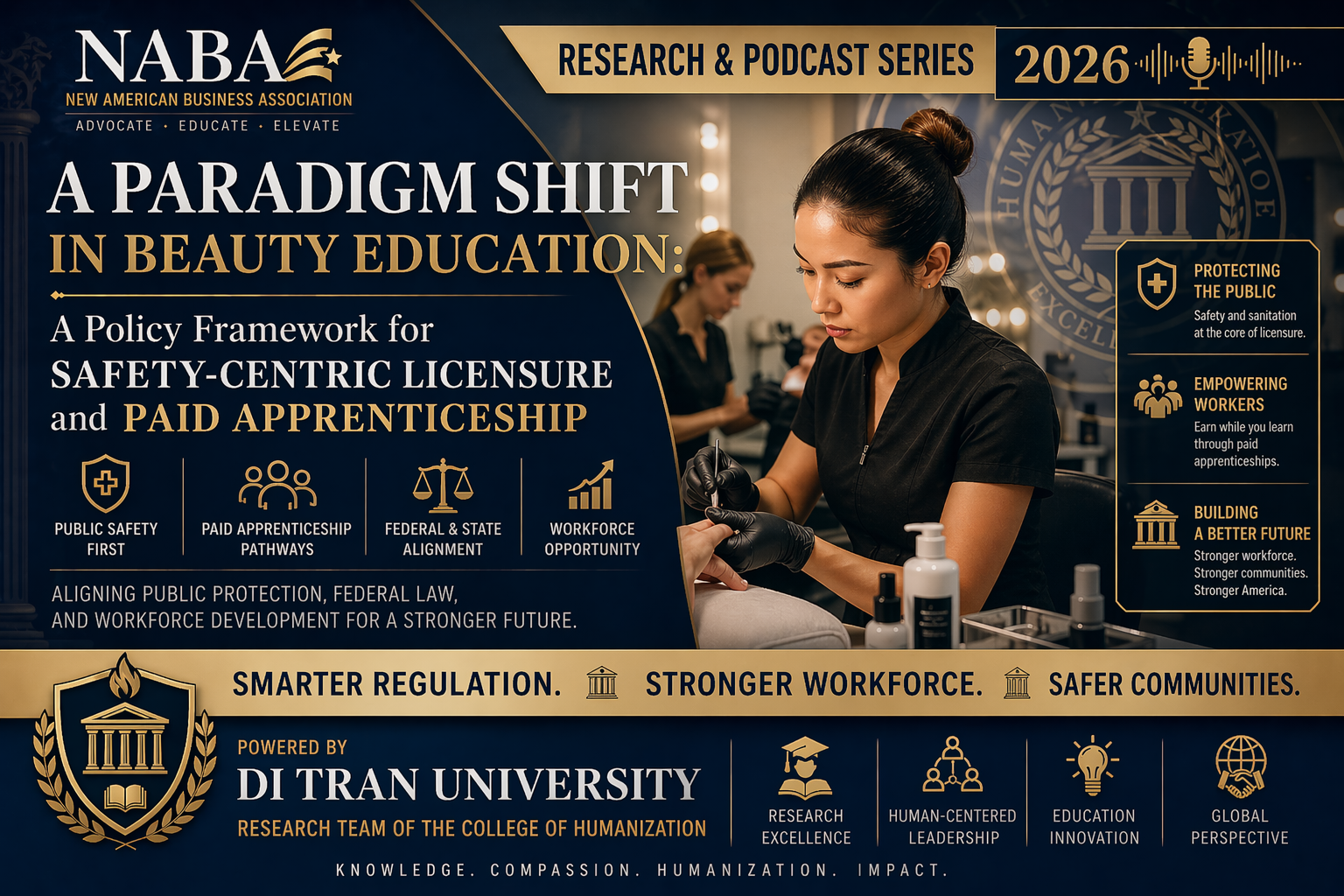
A Paradigm Shift in Beauty Education: A Policy Framework for Safety-Centric Licensure and Paid Apprenticeship – RESEARCH & PODCAST SERIES 2026
Executive Summary
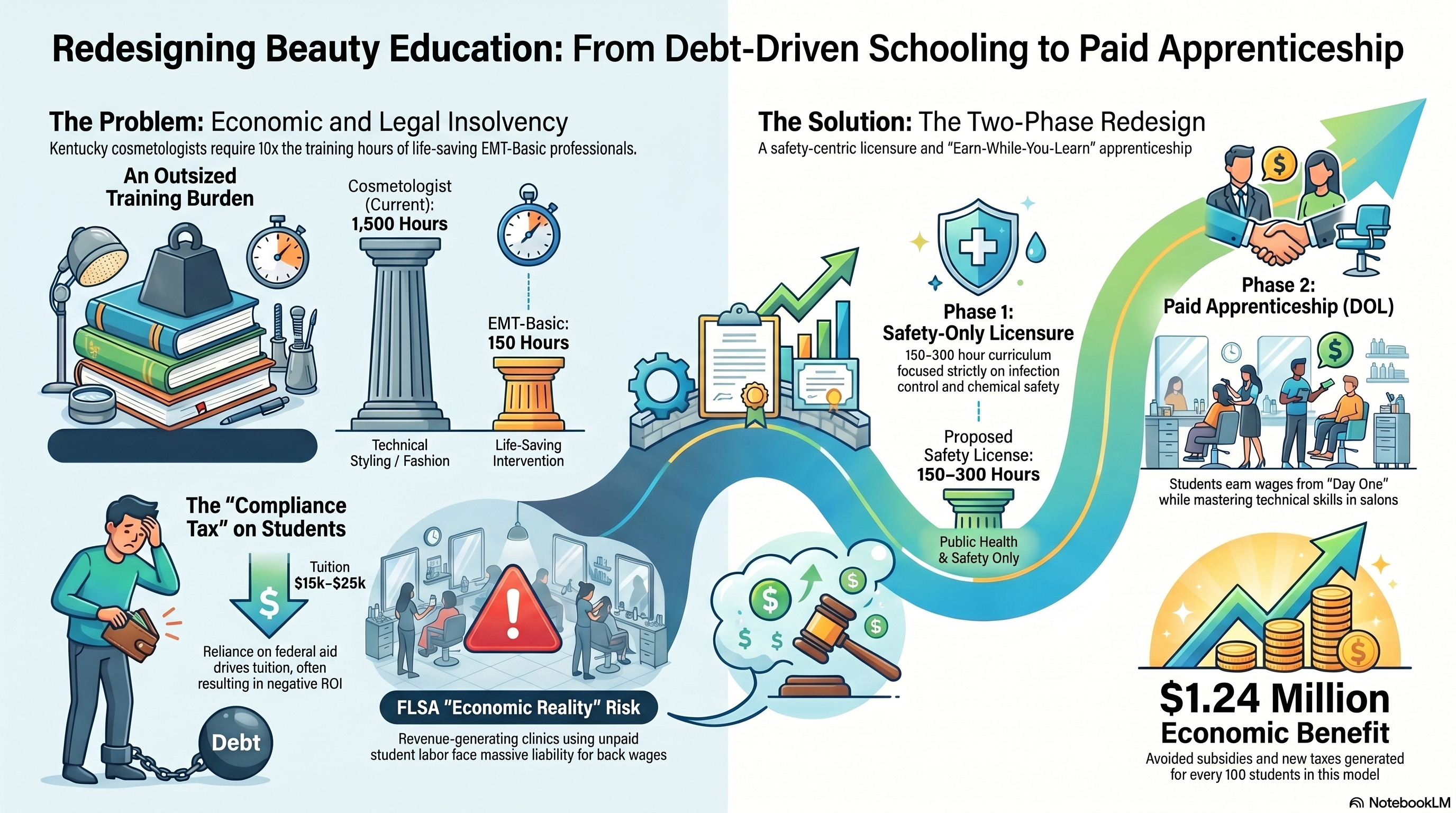
The beauty and personal care industry in the United States, currently governed by an antiquated 1,500-hour training model in states like Kentucky, stands at a precipice of legal and economic insolvency. This research report presents a comprehensive policy redesign aimed at decoupling state regulatory authority from technical vocational training. The proposed framework rests upon two essential pillars: the limitation of state licensure to public health and safety competencies (Phase 1) and the transition of all technical skill development into the United States Department of Labor (DOL) Registered Apprenticeship Program (Phase 2).1
The structural foundation of the existing school-based clinic model is inherently unstable under federal labor law. Specifically, the Fair Labor Standards Act (FLSA) mandates that individuals performing productive work for a for-profit entity must be compensated.3 Current beauty school clinics, which generate revenue from uncompensated student labor, navigate a precarious legal gray zone that risks massive liability for back wages and penalties.4 This report argues that the only fully compliant and economically sustainable models are those that utilize paid apprenticeships for technical training or maintain strictly non-productive, public-service-oriented educational environments.7
By reducing the state-mandated pre-licensure period to a safety-focused 150–300 hour curriculum, the regulatory burden is refocused on legitimate state interests: infection control, chemical safety, and the prevention of bloodborne pathogen transmission.9 This alignment with public health authorities mirrors the successful regulatory structures of other high-risk professions, such as Emergency Medical Technicians (EMTs) and Dental Assistants, where safety training is prioritized over lengthy, uncompensated practice.12
Economically, this shift addresses the escalating student debt crisis in the beauty sector, where many graduates carry debt loads that far exceed their earning potential.14 The “Earn-While-You-Learn” model of the Registered Apprenticeship Program accelerates workforce entry, reduces the cost of entry, and provides a robust talent pipeline for small business salon owners.1 Using the Louisville Beauty Academy (LBA) and its partnership with Harbor House of Louisville as a case study, this report demonstrates the replicability and public benefit of a service-oriented, safety-centric workforce design.8
Problem Statement: The Intersection of Legal Risk and Economic Inefficiency
The current architecture of beauty education in the United States is characterized by an internal contradiction between its regulatory mandate and its economic operation. In the Commonwealth of Kentucky, the Board of Cosmetology requires 1,500 instructional hours for a cosmetology license, a threshold that has remained largely static despite a growing body of evidence indicating that safety and sanitation competencies represent only a fraction of this duration.13
The Structural Mismatch of Training Hours
The disparity between the training required for beauty professionals and other safety-critical fields is profound. While an EMT-Basic can be certified to provide life-saving emergency care in approximately 150 hours, an aspiring cosmetologist in Kentucky must spend ten times that amount of time in school, much of it performing repetitive technical tasks on paying clients without compensation.12 This mismatch suggests that state licensing authority has expanded beyond the protection of the public and into the realm of mandatory vocational instruction, which is not a traditional exercise of the state’s police power.
| Profession | Kentucky Training Requirement (Hours) | Core Focus | Regulatory Oversight |
| Cosmetologist | 1,500 2 | Technical Styling / Safety | Board of Cosmetology |
| EMT-Basic | 150 – 190 13 | Life-Saving Intervention | Cabinet for Health/KBEMS |
| Dental Assistant | 8 – 300 (Task dependent) 22 | Safety / Expanded Duties | Board of Dentistry |
| Nail Technician | 450 2 | Technical Nails / Safety | Board of Cosmetology |
| Proposed Safety License | 150 – 300 | Public Protection Only | Department of Health |
This excessive hour requirement creates a “Risk Window” of economic dormancy for adult learners. For a period of 8 to 12 months, students are often unable to work full-time, yet they are incurring high tuition costs—often between $15,000 and $25,000—and performing revenue-generating services for the school.14 This delay in workforce participation creates artificial labor shortages and places a disproportionate burden on low-income and immigrant populations who lack the financial cushion to sustain such a long period of uncompensated training.1
The Collapse of the Title IV Model
The economic foundation of the traditional beauty school—reliance on federal Title IV student aid—is collapsing under the weight of federal accountability rules. New regulations, such as Financial Value Transparency (FVT) and Gainful Employment (GE), tie a program’s eligibility for federal loans to the debt-to-earnings ratio of its graduates.14 Analysis indicates that over 40% of all programs failing these federal benchmarks are in the cosmetology and personal grooming sector.14
Peer-reviewed research confirms that Title IV-funded programs often charge significantly more in tuition than non-Title IV programs for the same licensure outcomes, a phenomenon described as a “Compliance Tax” or “Glamour Tax”.14 When students graduate with high debt and enter a field where median wages often fall below those of high school graduates in other sectors, the return on investment (ROI) is negative.15

Under current models, the opportunity cost alone often exceeds the eventual wage premium, leading to high default rates and financial instability for the workforce.14 The transition to a safety-only licensure model followed by a paid apprenticeship eliminates this debt-driven cycle by allowing students to earn a wage while they master the technical skills of the trade.1
Federal Law Analysis: FLSA and the Apprenticeship Mandate
A critical legal conflict exists between federal labor law and the state-based beauty education model that relies on student-run clinics. The Fair Labor Standards Act (FLSA) requires that employees be paid the minimum wage and overtime, unless they fall under specific exemptions.3 For decades, beauty schools have operated under the assumption that students are not “employees” because they are the primary beneficiaries of their clinical training. However, recent jurisprudence and the evolving “primary beneficiary” test have made this assumption legally tenuous.4
The Primary Beneficiary Test in the Beauty School Context
In the landmark case Glatt v. Fox Searchlight, and subsequently adopted by multiple circuits in cases involving beauty schools such as Benjamin v. B & H Education, Inc., the courts have outlined a seven-factor test to determine the “economic reality” of the student-employer relationship.4
| FLSA Factor | Application to Beauty School Clinic Floor | Legal Reality/Implication |
| Expectation of Compensation | Students typically sign agreements stating they will not be paid. | Generally favors the school.26 |
| Educational Environment | Training should be similar to that given in an educational setting. | Weakens when the clinic floor focuses on volume and revenue.1 |
| Academic Integration | Clinical work must be tied to the student’s formal education program. | Strongly supported by state hour requirements.20 |
| Academic Calendar | The internship must correspond to the academic calendar. | Often violated by salons requiring weekend/holiday shifts. |
| Beneficial Learning Duration | The duration must be limited to the period of beneficial learning. | Violated when students perform repetitive tasks after achieving mastery.16 |
| Displacement of Employees | The student’s work must complement, not displace, paid staff. | Violated if students perform tasks usually handled by paid assistants.6 |
| Expectation of a Job | There is no entitlement to a job at the conclusion of training. | Generally favors the school.3 |
The most significant legal vulnerability arises from the displacement of employees and the duration of the training. If a beauty school clinic uses students to perform shampoos, basic cuts, and clean-up tasks that would otherwise require a paid employee, and if the school generates profit from those services while the student has already mastered the technique, the school is deriving an “immediate advantage”.4 Under these conditions, the student is legally an employee and the school is liable for back wages.4
Structural Instability of Unpaid Student Labor
The current school-based clinic model is structurally unstable because it relies on the state board’s hour requirements as a shield against FLSA claims. However, federal law is supreme. If a court finds that the “economic reality” of a 1,500-hour program is that the final 1,000 hours are predominantly productive work for the school’s benefit, the school’s defense collapses.3
The only fully compliant models under federal law are:
- Paid Apprenticeship: Where the trainee is classified as an employee from the moment they enter a commercial, revenue-generating environment.1
- Strictly Non-Productive Education: Where students perform services only on mannequins or in a 100% volunteer-based, non-commercial environment for public service, ensuring the school derives no “immediate advantage”.7
By redesigning the system to separate safety licensure from technical training, the state can move beauty education from a legally ambiguous “gray zone” to a clear, federally aligned “Earn-While-You-Learn” model.1
Public Health Justification: Refocusing Regulatory Authority
The legitimate exercise of state authority in the beauty industry is limited to the protection of public health. However, the current regulatory framework in Kentucky has conflated public safety with technical proficiency and fashion trends. To restore the integrity of professional licensure, the state must refocus its mandate strictly on infection control, sanitation, chemical safety, and public health protection.9
The Biological and Chemical Risks of the Beauty Profession
The beauty industry involves significant public health risks that warrant state intervention. These risks are not aesthetic failures, but biological and chemical threats to the citizenry.9
- Infection Transmission: Beauty professionals work with non-intact skin and mucous membranes. Improperly sanitized implements can spread MRSA, fungal infections, and viral pathogens between clients.9
- Bloodborne Pathogens: Procedures such as hair cutting, manicuring, and esthetics carry a “reasonably anticipated” risk of blood exposure. Compliance with OSHA’s Bloodborne Pathogen Standard (29 CFR 1910.1030) is a prerequisite for safety.11
- Chemical Exposure Risks: The use of high-pH hydroxide relaxers, oxidative hair colors, and monomer/polymer nail products requires a deep understanding of chemistry to prevent chemical burns, respiratory issues, and permanent hair or skin damage.9
- Cross-Contamination: The high volume of clients in a commercial salon requires rigorous knowledge of sterilization and disinfection protocols to prevent tool-to-client and surface-to-client contamination.9
Alignment with the State Department of Health
Given that these risks are purely clinical and environmental, the oversight of beauty safety and sanitation should be aligned with the state’s public health authority, such as the Kentucky Cabinet for Health and Family Services (CHFS).33 Currently, the CHFS already manages health regulations for similar high-risk, personal-service sectors, including:
| Profession/Area | Regulatory Authority in Kentucky | Focus of Oversight |
| Tattooing & Piercing | Dept. for Public Health / Public Safety Branch 34 | Bloodborne Pathogens & Sanitation |
| Food Service | Local Health Departments / Food Safety Branch 35 | Infection Control & Public Safety |
| Dental Assisting | Board of Dentistry (Health-aligned) 22 | Radiation & Infection Control |
| Proposed Beauty Safety | Department of Health (Public Safety Branch) | Infection, Chemicals, & Sanitation |
Moving beauty licensure oversight to the Department of Health provides several policy advantages. It standardizes safety requirements across similar industries, utilizes an existing workforce of public health inspectors, and removes the conflict of interest where licensing boards (often composed of industry members) mandate hours that serve as a barrier to competition rather than a protection for the public.16
Safety-Only Licensure Framework: Phase 1 System Design
The first phase of the redesigned system is the Safety-Only Professional License. This license is the state-issued credential that verifies a practitioner’s competency to perform services safely in a clinical or commercial environment.
Phase 1 System Design: The 150–300 Hour Curriculum
The Phase 1 curriculum is strictly non-technical and focuses on the scientific foundations of the profession. This training can be completed in a classroom, online, or in a simulated lab environment over 4 to 8 weeks.1
| Module | Curriculum Content | Maximum Hours |
| Infection Control | Bacteriology, Virology, Disinfection Standards, and Sterilization 10 | 75 |
| Chemical Safety | Product Chemistry, MSDS, pH Scale, and Hazard Communication 9 | 75 |
| Public Health Law | KRS 317A, 201 KAR, and State Health Regulations 10 | 40 |
| Anatomy & Safety | Skin/Hair/Nail Structure, Histology, and Disease Recognition 10 | 75 |
| Emergency Response | First Aid, OSHA Bloodborne Pathogen Protocol, and CPR 11 | 35 |
| Total Phase 1 | 300 |
Upon completion of these hours, the candidate must pass a state-administered safety and sanitation examination. The outcome is a “Safety-Based Professional License.” This license does not certify the holder’s ability to create a “current fashion look” or perform a “high-fade haircut”; it certifies that the holder will not transmit a communicable disease or cause a chemical burn while performing their work.13
Legitimate State Authority and Workforce Development
It is critical to explicitly state that these are the only elements tied to legitimate state regulatory authority. All additional technical training hours currently mandated by state boards are, in fact, workforce development activities. In a free-market economy, technical proficiency is governed by consumer demand, employer standards, and professional certification, not by the state’s police power.13 By separating these two functions, the state ensures public protection without stifling economic mobility or creating unnecessary barriers to entry.40
Paid Apprenticeship (DOL System): Phase 2 System Design
The second phase of the system transitions all technical skill development into a federally aligned Registered Apprenticeship Program (RAP). This model ensures that every hour of productive labor is compensated and that the trainee is protected under federal labor standards.1
Phase 2 System Design: The Apprenticeship Structure
Once an individual holds a Safety-Based Professional License, they enter the workforce as an Apprentice. This phase is conducted within a licensed salon or under an employer sponsor.
- Employee Status: Under the DOL RAP model, the apprentice is an employee from Day One. They must be paid a wage that is at least the federal or state minimum.28
- Training Environment: Technical skill development (haircutting, coloring, advanced esthetics, nail enhancements) occurs in the real-world environment of a commercial salon.27 This provides superior learning outcomes for “speed and efficiency” and “customer interaction” which cannot be replicated in a school-based clinic.1
- Employer Accountability: The salon owner or a designated “Journeyworker” (a licensed professional with 1-3 years of experience) serves as the on-site supervisor and mentor.43
Wage Progression and Competency-Based Advancement
The DOL system requires a “Wage Progression Structure,” where the apprentice’s pay increases as they gain skills. This motivates the apprentice and ensures the employer is paying for the value provided as the worker becomes more productive.28
| Step | Competency Milestone | Wage Rate (% of Journeyworker Wage) |
| Entry | Safety License + Basic Shampoo/Blow-dry 10 | 50% |
| Mid-Point | Proficiency in Core Technical Services (Cut/Color) 47 | 75% |
| Completion | Mastery of All Work Processes + Final Exam 28 | 100% |
The term of the apprenticeship can be measured in hours (typically 2,000 to 3,000 for a full cosmetologist) or via a “competency-based” model where the apprentice advances as soon as they can demonstrate mastery of the required work processes.45 This eliminates the economic inefficiency of “seat time” and focuses on actual skill acquisition.16
Economic and Workforce Development Impact
The transition to a safety-only licensure and paid apprenticeship model creates a profound shift in the economics of the beauty sector, benefiting workers, small businesses, and the state’s tax base.15
Macroeconomic Impact Analysis
Current beauty education models are effectively “linear,” where a student pays a set tuition for a set duration to receive a license. The proposed model is “compounding,” where the student enters the workforce faster, earns immediately, and can open their own business or become a journeyworker sooner.50
| Economic Variable | Traditional School Model | Proposed Redesign Model |
| Initial Cost to Student | $15,000 – $25,000 15 | $2,000 – $5,000 (Safety Phase) |
| Earnings during Training | $0 (Unpaid labor) 7 | $15,000 – $25,000 (Apprentice wages) |
| Time to Income Generation | 12+ Months 24 | 2–3 Months (Post-Safety Phase) |
| State Tax Contribution | Delayed 12+ Months | Immediate (Post-Safety Phase) |
| Federal Loan Reliance | Very High (Pell/Direct Loans) 15 | Zero to Low |
A 10-year case study model in Kentucky suggests that for every 100 students transitioned to a debt-free apprenticeship model, approximately $1 million in avoided federal subsidies and $240,000 in additional tax contributions are generated through earlier workforce participation.50 Furthermore, debt-free graduates demonstrate materially higher rates of “booth rental entrepreneurship” and salon ownership, as they are not burdened by loan repayments that consume their initial profit margins.50
Alignment with SBA and DOL Priorities
The Registered Apprenticeship model is the “gold standard” for workforce development and aligns perfectly with the U.S. Department of Labor’s priorities for high-growth, licensed sectors.1
- Small Business Incubation: Salons are overwhelmingly small businesses. The RAP model allows them to develop talent tailored to their specific market needs, reducing the “mis-hire” rate and increasing retention.1
- Expansion of Underrepresented Groups: The “Earn-While-You-Learn” path is a critical solution for ESL learners, career-changing parents, and immigrants who cannot afford to bypass income for a year. It democratizes access to professional licensure.1
- Sector Modernization: By using the RAPIDS database for tracking, the beauty industry joins modern trades like advanced manufacturing and healthcare in providing transparent, performance-based data to policy makers.49
Public Safety and Service Impact
Contrary to industry opposition, the reduction in state-mandated hours does not decrease public safety; it enhances it by focusing the regulatory spotlight on real risks rather than aesthetic outcomes.13
Higher Competency Outcomes
In the current 1,500-hour model, safety training is often “front-loaded” in the first 200 hours and then rarely revisited during the repetitive clinic hours.13 In the proposed redesign:
- Intensive Safety Focus: The 150–300 hour pre-licensure period is 100% safety-centric, ensuring a deeper level of knowledge than the current “10% safety” model.13
- Real-World Supervision: In a commercial salon (Phase 2), an apprentice is under the direct, one-on-one supervision of a journeyworker whose own license and business reputation depend on the safety of the apprentice’s work.43 This is superior to a school clinic where one instructor may oversee 15 to 20 students simultaneously.5
- Ongoing Compliance: Registered apprenticeships require continuous tracking of competencies, including safety and sanitation procedures, throughout the multi-year apprenticeship.48
The Role of Non-Commercial Public Service
For institutions that wish to remain in the education space without adopting an apprenticeship model, the only legally defensible path is the “strictly non-productive education” model.7 In this framework, students practice on “Live Models” who are not paying customers but community volunteers. Any fees collected cover only the cost of products and sanitation, ensuring the school derives no “immediate advantage” from the labor.7 This model, currently exemplified by the Harbor House partnership, transforms clinic hours into a genuine public good rather than a commercial revenue stream, protecting the student’s status as a learner under the FLSA.7
Case Study: The Louisville Beauty Academy (LBA) Model
Louisville Beauty Academy (LBA) serves as a proof-of-concept for the “Ethical Workforce Academy” model, demonstrating that safety-centric, service-oriented training is both viable and replicable.7
Ethical Economics and Debt Discipline
LBA has strategically decoupled from the Title IV federal aid system to prioritize “student economic sovereignty”.17 By eliminating the compliance costs associated with federal lending, LBA provides tuition that is 50% to 75% lower than the national average, often ranging from $3,800 to $6,250.15 This allows graduates to recoupe their educational investment within months, dramatically enhancing their ROI.15
Public Service and Humanization: The Harbor House Campus
A key component of the LBA model is its campus at Harbor House of Louisville, a facility serving elderly and disabled populations.8
- Public Service Delivery: At this location, 100% of services (hair, nails, skincare) are provided completely free to Harbor House participants and the general community.8
- Educational Purpose: This model ensures that student “clinic hours” are 100% volunteer-based and focused on “Humanization”—the master of tactile skills to uplift others.7
- FLSA Compliance: By removing all revenue from the clinical experience, LBA eliminates the “immediate advantage” to the institution, ensuring that students remain the “primary beneficiaries” of their labor as they learn to care for vulnerable populations.7
National Advocacy for Sector Reform
Through the New American Business Association (NABA), LBA leads national efforts to align beauty education with DOL standards.
- Standardized Compliance: NABA advocates for standardized record-keeping that aligns with RAPIDS, moving away from archaic state board documentation.1
- Inclusive Licensing: LBA utilizes multilingual AI support to provide tutoring and compliance tracking for diverse immigrant and refugee populations, ensuring they can achieve safety licensure regardless of linguistic barriers.17
- Sector Partnerships: LBA serves as a “Compliance Hub” for small businesses, providing the Related Technical Instruction (RTI) required for a Registered Apprenticeship while the salon provides the on-the-job training.1
Systems to be Eliminated: A Justification for Change
The implementation of the safety-only + apprenticeship model requires the systematic removal of four legacy structures that currently impede the beauty workforce.
- Unpaid Student Labor in Revenue-Generating Environments: This must be abolished to resolve the FLSA conflict. Any salon or school environment that charges the public for student services must pay that student a wage.3
- School-Based Clinic Models Relying on Non-Compensated Work: These models are legally unstable. Schools must transition to a non-commercial, public-service model or partner with the DOL for paid apprenticeships.1
- Inflated Hour-Based Education Systems: The 1,500-hour mandate is an arbitrary barrier that fuels debt and workforce shortages. It should be replaced by a 150–300 hour safety license.13
- Debt-Driven Training Structures: The industry’s reliance on high-interest student loans for low-ROI technical training is predatory. It must be replaced by the “Earn-While-You-Learn” RAP model.14
By removing these systems, the state reduces legal exposure for institutions, eliminates economic inefficiency for workers, and addresses the critical shortage of beauty professionals.1
Implementation Roadmap: State and Federal Coordination
Transitioning Kentucky to this redesigned system requires a multi-agency coordination strategy involving the Legislature, the Department of Health, and the Office of Apprenticeship.18
Phase 1: Legislative and Regulatory Realignment
The Kentucky General Assembly must act to refocus the Board of Cosmetology’s mission or transfer its safety oversight to the Cabinet for Health and Family Services.33
- Amend KRS 317A: Redefine “Professional Licensure” as a “Safety-Based Certification” limited to public health competencies.9
- Adopt the 300-Hour Cap: Set a statutory maximum of 300 instructional hours for pre-licensure training.53
- Mandate RAP Alignment: Formally recognize the DOL Registered Apprenticeship Program as the only state-sanctioned pathway for technical skill certification beyond the safety license.1
Phase 2: Workforce Infrastructure and Grant Utilization
Kentucky can utilize its share of federal State Apprenticeship Expansion Formula (SAEF) grants to build the infrastructure for this new model.51
- Establish a Consortium: Create a “Kentucky Beauty Apprenticeship Consortium” where academies like LBA serve as the compliance and theory (RTI) partners for salons across the state.1
- Modernize Data Systems: Fully integrate state licensure data with the RAPIDS database to allow for real-time tracking of apprentice progress and safety compliance.18
- Incentivize Small Businesses: Use grant funds to provide “Incentive Payments” to small salons that hire and train apprentices, covering the cost of workers’ compensation insurance and journeyman supervision.51
Phase 3: Stakeholder Integration
Coordinate between the Kentucky Board of Cosmetology and the Kentucky Career Center to ensure that existing schools can transition to the new model without total disruption.18 Existing schools should be encouraged to become “Registered RTI Providers,” focusing on the 150–300 hour safety curriculum and the ongoing theoretical instruction for apprentices working in local salons.1
Policy Recommendations and Final Conclusion
The transition from an unpaid, school-based training model to a safety-certified + paid apprenticeship model is not merely a preference; it is a legal and economic necessity for the survival of the beauty industry.
Final Recommendations for Policy Makers
- Refocus State Authority: Limit the “Police Power” of the state to its legitimate interest: public health, sanitation, and safety. Repeal all mandates for technical styling instruction.9
- Implement the Two-Phase Model: Mandate a 150–300 hour Safety-Only License followed by a paid DOL Registered Apprenticeship.1
- Prohibit Uncompensated Productive Labor: Ensure all commercial salons pay their trainees, aligning state practice with the Fair Labor Standards Act.3
- Leverage Public Health Expertise: Shift safety oversight to the Department of Health to utilize existing clinical and sanitation expertise.31
- Expand Debt-Free Pathways: Prioritize workforce funding for models that eliminate student debt and accelerate time-to-income for workers.15
Conclusion
The current system of beauty education in the United States is a relic of an era that ignored the economic rights of students and the regulatory boundaries of the state. By adopting a safety-centric licensure framework and a federally aligned apprenticeship system, Kentucky can establish a national model for workforce excellence. This redesign resolves the fundamental conflict with federal labor law, protects the public from genuine health risks, and provides a sustainable, debt-free path to middle-class earnings for a diverse workforce. The model provided by the Louisville Beauty Academy and the advocacy of the New American Business Association proves that this transition is not only possible but provides a “Certainty Engine” for economic stability and public health in the 21st century.1
Works cited
- A Blueprint for DOL-Backed Beauty Apprenticeships: How Licensed …, accessed April 20, 2026, https://naba4u.org/2025/12/a-blueprint-for-dol-backed-beauty-apprenticeships-how-licensed-beauty-education-can-power-americas-main-street-workforce/
- License Requirements – Kentucky Board of Cosmetology, accessed April 20, 2026, https://kbc.ky.gov/Licensure/Pages/License-Requirements.aspx
- Fact Sheet #71: Internship Programs Under The Fair Labor …, accessed April 20, 2026, https://www.dol.gov/agencies/whd/fact-sheets/71-flsa-internships
- Unpaid Intern Update: Significant Rulings From Two Circuit Courts – Skadden Arps, accessed April 20, 2026, https://www.skadden.com/-/media/files/publications/2015/10/070101503skadden.pdf
- Intern or Employee in Disguise? The Rise of the Unpaid Internship and the Primary Beneficiary Test – University of Missouri School of Law, accessed April 20, 2026, https://scholarship.law.missouri.edu/cgi/viewcontent.cgi?article=4368&context=mlr
- DOL Gives Credit to Unpaid Student Interns After Getting Schooled by the Courts – Ogletree, accessed April 20, 2026, https://ogletree.com/insights-resources/blog-posts/dol-gives-credit-to-unpaid-student-interns-after-getting-schooled-by-the-courts/
- America’s Ethical Workforce Academy™ Model – Louisville Beauty Academy, accessed April 20, 2026, https://louisvillebeautyacademy.net/americas-ethical-workforce-academy-model/
- Louisville Beauty Academy at Harbor House of Louisville – A …, accessed April 20, 2026, https://louisvillebeautyacademy.net/harborhousecampus/
- Tag: 201 KAR Chapter 12 cosmetology regulations – Louisville Beauty Academy, accessed April 20, 2026, https://louisvillebeautyacademy.net/tag/201-kar-chapter-12-cosmetology-regulations/
- 201 KAR 12:082 – Education requirements and school administration | State Regulations, accessed April 20, 2026, https://www.law.cornell.edu/regulations/kentucky/201-KAR-12-082
- Requirements for Bloodborne Pathogens Training | 360training, accessed April 20, 2026, https://www.360training.com/blog/bloodborne-pathogens-training-requirements
- Getting a cosmetology license takes 12 times longer than getting an EMT license., accessed April 20, 2026, https://www.heritage.org/insider/summer-2018-insider/getting-cosmetology-license-takes-12-times-longer-getting-emt-license
- EMT vs. Cosmetologist License FAQ – The Institute for Justice, accessed April 20, 2026, https://ij.org/report/license-to-work-3/emt-vs-cosmetologist-license-faq/
- Beauty Education Clarity Report 2026: A Student-Protection Analysis of Program Economics, Labor Trends, and Financial Transparency in U.S. Beauty Licensing – RESEARCH & PODCAST SERIES 2026 – Louisville Beauty Academy, accessed April 20, 2026, https://louisvillebeautyacademy.net/beauty-education-clarity-report-2026-a-student-protection-analysis-of-program-economics-labor-trends-and-financial-transparency-in-u-s-beauty-licensing-research-podcast-series-2026/
- Federal Aid, Licensure, and the Debt Crisis in Cosmetology Education – RESEARCH 2025, accessed April 20, 2026, https://naba4u.org/2025/12/federal-aid-licensure-and-the-debt-crisis-in-cosmetology-education-research-2025/
- New Report Uncovers the Shocking Student Debt Burden Beauty School Students Take On, accessed April 20, 2026, https://ij.org/press-release/new-report-uncovers-the-shocking-student-debt-burden-beauty-school-students-take-on/
- Louisville Beauty Academy: Becoming One of the Most Admired Rising Models in Ethical, Accessible, Debt-Disciplined, Human-Centered Beauty Education – RESEARCH & PODCAST SERIES 2026, accessed April 20, 2026, https://naba4u.org/2026/04/louisville-beauty-academy-becoming-one-of-the-most-admired-rising-models-in-ethical-accessible-debt-disciplined-human-centered-beauty-education-research-podcast-series-2026/
- Registered Apprenticeships – Kentucky Works, accessed April 20, 2026, https://kyworks.ky.gov/Services/Pages/Registered-Apprenticeships.aspx
- Title 201 Chapter 12 Regulation 082 • Kentucky Administrative Regulations, accessed April 20, 2026, https://apps.legislature.ky.gov/law/kar/titles/201/012/082/10348/
- 201 BOARDS AND COMMISSIONS Chapter – Louisville Beauty Academy, accessed April 20, 2026, https://louisvillebeautyacademy.net/wp-content/uploads/2021/11/KentuckyStateBoardOfCosmetology-Statue-11-15-2021.pdf
- Occupational Licensing and Student Outcomes – American University, accessed April 20, 2026, https://www.american.edu/spa/peer/upload/2022-2-17-peer-occupationa-licensing-final.pdf
- Course Approval Requirements – Board of Dentistry – Kentucky.gov, accessed April 20, 2026, https://dentistry.ky.gov/Continuing-Education/Pages/Approved-Courses.aspx
- Clinical Dental Assistant (Vouchers Included) – Northern Kentucky University, accessed April 20, 2026, https://careertraining.nku.edu/training-programs/clinical-dental-assistant-vouchers-included/
- Kentucky Cosmetology Laws & License Requirements [2026] – Consentz, accessed April 20, 2026, https://www.consentz.com/kentucky-cosmetology-laws-license-requirements/
- Beauty/Cosmetology Schools Under Financial Value Transparency & Gainful Employment Pressure (Week of Mar 17–23, 2026), accessed April 20, 2026, https://naba4u.org/2026/03/weekly-monitoring-beauty-cosmetology-schools-under-financial-value-transparency-gainful-employment-pressure-week-of-mar-17-23-2026-research-series-2026/
- Ninth Circuit Adopts Second Circuit’s Primary Beneficiary Test for Intern and Vocational Student FLSA Claims | Practical Law, accessed April 20, 2026, https://uk.practicallaw.thomsonreuters.com/w-012-4328?originationContext=knowHow&transitionType=KnowHowItem&contextData=%28sc.DocLink%29
- Registered Cosmetology Apprenticeship | DOL Sponsorship & Oversight | Indiana, accessed April 20, 2026, https://www.elevateforhumanity.org/programs/cosmetology-apprenticeship
- Setting Wages in Your Registered Apprenticeship … – Urban Institute, accessed April 20, 2026, https://www.urban.org/sites/default/files/publication/104473/setting-wages-in-your-registered-apprenticeship-program_0.pdf
- Infection Control Awareness Week for the Beauty & Wellness Industry. – Milady, accessed April 20, 2026, https://www.milady.com/infection-control-awareness-week
- Safe Work Practices during COVID-19 (and Beyond) | Milady Training, accessed April 20, 2026, https://www.miladytraining.com/pages/safe-work-practices-during-covid-19-and-beyond-eca
- Bloodborne Pathogen Training Fact Sheet, accessed April 20, 2026, https://www.chfs.ky.gov/agencies/dph/dphps/psb/Documents/Bloodborne-Fact-Sheet.pdf
- Bloodborne Pathogens – Occupational Health & Safety, accessed April 20, 2026, https://ohs.uky.edu/industrial-hygiene/bloodborne-pathogens
- Division of Public Health Protection and Safety – Cabinet for Health and Family Services, accessed April 20, 2026, https://www.chfs.ky.gov/agencies/dph/dphps/Pages/default.aspx
- Public Safety Branch – Cabinet for Health and Family Services, accessed April 20, 2026, https://www.chfs.ky.gov/agencies/dph/dphps/psb/Pages/default.aspx
- Food Safety Branch – Cabinet for Health and Family Services, accessed April 20, 2026, https://www.chfs.ky.gov/agencies/dph/dphps/fsb/Pages/default.aspx
- Welcome to the Food Safety Program | LouisvilleKY.gov, accessed April 20, 2026, https://louisvilleky.gov/government/health-wellness/welcome-food-safety-program
- 201 KAR 8:571 – Registration of dental assistants | State Regulations – Cornell Law School, accessed April 20, 2026, https://www.law.cornell.edu/regulations/kentucky/201-KAR-8-571
- New Study Shows That Heavier Licensing Burdens Do Not Improve Health and Safety, accessed April 20, 2026, https://ij.org/press-release/new-study-shows-that-heavier-licensing-burdens-do-not-improve-health-and-safety/
- OSHA Bloodborne Pathogens Training Requirements – American Red Cross, accessed April 20, 2026, https://www.redcross.org/take-a-class/first-aid/first-aid-training/osha-bloodborne-pathogen-training-requirements
- Occupational Licensing Reform Can Unlock Economic Abundance – Stand Together, accessed April 20, 2026, https://standtogether.org/stories/the-economy/occupational-licensing-reform-can-unlock-economic-abundance
- May 2025 Nationwide Cosmetology Deregulation Report: A 5-Year Legislative Review Across All 50 States – Published by Louisville Beauty Academy, Kentucky’s Center of Excellence in Beauty Licensing, Policy, and Education Reform, accessed April 20, 2026, https://louisvillebeautyacademy.net/may-2025-nationwide-cosmetology-deregulation-report-a-5-year-legislative-review-across-all-50-states-published-by-louisville-beauty-academy-kentuckys-center-of-excellence-in-beaut/
- Cosmetology Apprenticeship – College Catalog, accessed April 20, 2026, https://catalog.morainepark.edu/program-information/programs/cosmetology-apprenticeship/cosmetology-apprenticeship.pdf
- Occupational license information for Beauty Apprentice in US | CareerOneStop, accessed April 20, 2026, https://www.careeronestop.org/toolkit/Training/find-licenses-detail.aspx?keyword=&location=US&licenseId=15-BeautyApr
- Chapter 32-06-01 Apprenticeships, accessed April 20, 2026, https://ndlegis.gov/information/acdata/pdf/32-06-01.pdf
- Vasuda Cosmetology Apprentice Program – L&I, accessed April 20, 2026, https://lni.wa.gov/licensing-permits/apprenticeship/agenda-docs/015Vasuda.pdf
- Process Guide – MI Apprenticeship, accessed April 20, 2026, https://miapprenticeship.org/resources/process_guide.php
- Hair Stylist – ApprenticeshipStandardsDotOrg – Registered Apprenticeship Standards Library, accessed April 20, 2026, https://www.apprenticeshipstandards.org/occupation_standards/1d465b29-dbd2-483c-9efe-50daddf293b4
- APPRENTICESHIP PROGRAM STANDARDS adopted by KIMBERLY IRENE SALON APPRENTICESHIP PROGRAM (sponsor name) Occupational Objective(s) – L&I, accessed April 20, 2026, https://lni.wa.gov/licensing-permits/apprenticeship/agenda-docs/22-Kimberly-Irene-Salon.pdf
- Emerging Occupations in Registered Apprenticeship Fact Sheet – Mathematica, accessed April 20, 2026, https://www.mathematica.org/download-media?MediaItemId={22D75055-DC5F-45FD-9E34-D040B3F283EA}
- The Debt-Free Advantage: A 10-Year Macroeconomic Case Study in Kentucky – Medium, accessed April 20, 2026, https://medium.com/@lbeautyacademy/the-debt-free-advantage-a-10-year-macroeconomic-case-study-in-kentucky-ca452662786b
- US Department of Labor announces availability of $85M in grant funding to support Registered Apprenticeship expansion, modernization, accessed April 20, 2026, https://www.dol.gov/newsroom/releases/eta/eta20260413
- What is RAPIDS? – Apprenticeship.gov, accessed April 20, 2026, https://www.apprenticeship.gov/help/what-rapids
- Changes to the Beauty Industry: How New Law that Reduces Overall Training Time Increases Focus on Health and Safety, accessed April 20, 2026, https://thedcapage.blog/2022/01/31/changes-to-the-beauty-industry-how-new-law-that-reduces-overall-training-time-increases-focus-on-health-and-safety/
- WORK PROCESS SCHEDULE – Apprenticeship.gov, accessed April 20, 2026, https://www.apprenticeship.gov/sites/default/files/bulletins/Bul2004-02%20Occ-Career%20Development%20Tech.pdf
- Kentucky Registered Apprenticeship Programs, accessed April 20, 2026, https://elc.ky.gov/Initiatives/Pages/Kentucky-Apprenticeship-Programs.aspx
- State Apprenticeship Expansion Formula (SAEF) Grants – U.S. Department of Labor, accessed April 20, 2026, https://learnworkecosystemlibrary.com/initiatives/state-apprenticeship-expansion-formula-saef-grants-u-s-department-of-labor/
- State Apprenticeship Expansion Formula (SAEF) 2 Base Funding Opportunity Lead Applicant / Organization Name, accessed April 20, 2026, https://www.apprenticeship.gov/sites/default/files/KY%20-%20AttachmentForm_1_2-ATT2-1249-KY_SAEF_2_ABSTRACT_Base%20Formula%20v2_.pdf
- Welcome – Kentucky Board of Cosmetology, accessed April 20, 2026, https://kbc.ky.gov/Pages/index.aspx