⚠️ Watch for the Red Flags: Don’t Fall for the Beauty School Trap – RESEARCH 2025
As you research schools, stay alert. Too many students get fooled by surface-level glam and end up with lifelong debt. Here’s what to watch out for:
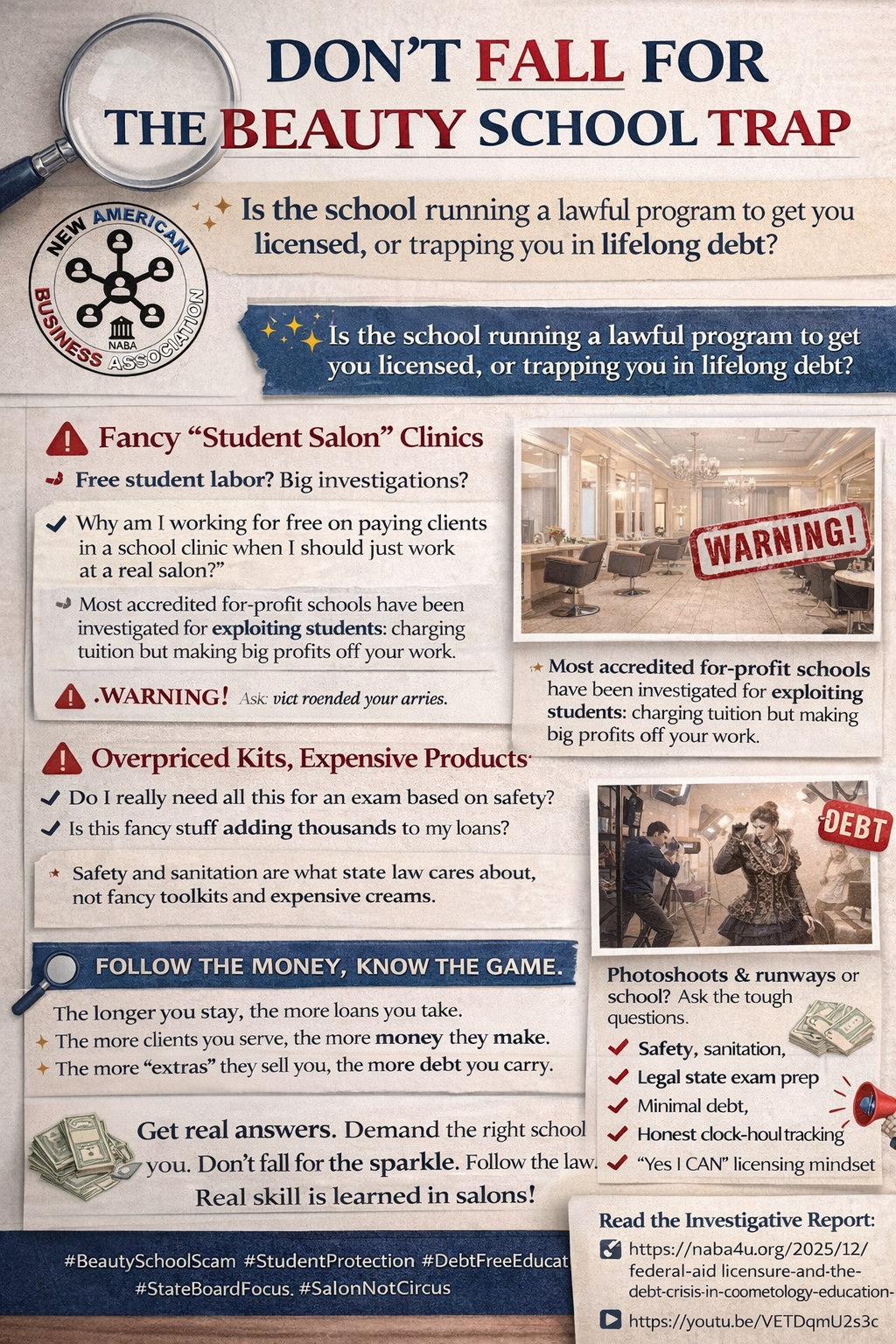
💄 1. Fancy “Student Salon” Clinics
If the school is showing off a luxurious salon space with trendy chairs, chandeliers, and dozens of service stations, ask yourself:
Are they running a school, or a business built on free student labor?
Many nationally accredited schools—especially for-profits—have been investigated for exploiting students by charging them tuition while making money from the services students perform.
👉 You’re paying to learn—not to work unpaid for their business.
Ask:
- “Why am I working on paying customers when I’m still trying to pass the state exam?”
- “Why can’t I just go work at a real salon and earn income legally while I finish my license?”
🧪 2. Overpriced Student Kits and Product Sales
Some schools sell students expensive kits, brand-name tools, and fancy products, saying it’s all “part of the training.” But if their curriculum isn’t focused on sanitation, disinfection, blood exposure, and passing the licensing exam, those kits don’t matter.
👉 State law doesn’t care if you use gold scissors—it cares if you clean them properly.
Ask:
- “Is all this required for the licensing exam, or just for appearances?”
- “How much of this is adding to my loan debt?”
🎭 3. Activities That Feel Like Theater, Not Education
Are they dressing you up, doing photoshoots, making you style hair and makeup like it’s a fashion show or circus? That might look fun—but it’s not why you’re in school.
👉 Your goal is not to become a salon mascot. Your goal is to become legally licensed, fast and safely.
Ask:
- “Does this help me pass the written and practical exam?”
- “Are you helping me or using me to promote your school’s image?”
💰 Follow the Money. Know the Game.
Many of these schools are part of a federal aid system where:
- The longer you stay, the more loans you take out
- The more clients you serve, the more money they make
- The more “extras” they sell you, the more debt you carry
But what do you walk away with?
Often: delayed graduation, poor exam prep, and $10,000–$25,000 in student loans.
Meanwhile, a school like Louisville Beauty Academy gets students licensed for under $7,000—without federal loans.
✅ Remember: the real school for skill is the salon.
Your beauty school should focus on:
- Safety and sanitation
- Legal clock-hour tracking
- State board exam preparation
- Graduation with minimal debt
- Helping you say: “YES I CAN”
Don’t fall for the sparkle. Follow the law. Protect your time, your money, and your future.
Ask every question. Demand real answers. Because you deserve more than debt—you deserve a license and a career.
📘 Full research: https://naba4u.org/2025/12/federal-aid-licensure-and-the-debt-crisis-in-cosmetology-education-research-2025/
🎥 Video: https://youtu.be/VETDqmU2z5c
❗ Questions Every Smart Student (and Parent) Should Ask a Beauty School
Before you enroll—ask these questions with confidence. If the school can’t answer them directly, that’s a red flag.
- How long have you been in business, and are you licensed by the state board?
- What’s the real average cost per student—not just the listed price?
- How long do most students actually stay enrolled?
- What’s the average loan debt carried by your graduates?
- Can I enroll without taking federal loans?
- If I want to go fast, can I skip breaks and holidays to earn hours quickly?
- Will you support me in studying for the licensing exam daily until I pass?
- Do you focus on theory, safety, sanitation, legal compliance, and passing the exam—every day?
- Do your instructors have actual salon experience, or just teaching licenses?
- Are you honest that real artistic skill comes from salon apprenticeship and work—not just school?
- Do you use students to work on paying customers for school profit before they’re licensed?
- Why should I stay in school 2+ years and take out loans, if I could be working in a salon and making money legally as a front desk worker or assistant now?
- Do you teach students the ‘YES I CAN’ mindset—confidence, courage, and speed toward the license and workforce?
- Do you help students graduate with minimal debt, maximum skill, and full legal readiness to serve safely?
#BeautySchoolScam #StudentProtection #RealLicensing #DebtFreeEducation #LBA #NABA #StateBoardFocus #SalonNotCircus #KnowBeforeYouEnroll #YesICan
REFERENCES
References
AVI Career Training. (n.d.). The importance of hands-on training in beauty education. Retrieved from https://avi.edu/the-importance-of-hands-on-training-in-beauty-education/
Bauer-Wolf, J. (2025, March 20). How cosmetology education cuts students’ dreams short. Republic Report. Retrieved from https://www.republicreport.org/2025/how-cosmetology-education-cuts-students-dreams-short/
Brink, M. (2022, July 14). Study: Cosmetology schools yield poor student outcomes. Inside Higher Ed. Retrieved from https://www.insidehighered.com/quicktakes/2022/07/15/study-cosmetology-schools-yield-poor-student-outcomes
Institute for Justice. (2021, July 7). Beauty school debt and drop-outs. Retrieved from https://ij.org/report/beauty-school-debt-and-drop-outs/
Inside Higher Ed. (2022, July 15). Cosmetology graduates earn an average of $16,600 annually… hold an average of $10,000 in student loan debt. Retrieved from https://www.insidehighered.com/quicktakes/2022/07/15/study-cosmetology-schools-yield-poor-student-outcomes
Kenneth Shuler School of Cosmetology. (2025, December 2). How real salon practice builds confidence at the Goose Creek Campus. Retrieved from https://kennethshuler.com/blog/how-real-salon-practice-builds-confidence-at-the-goose-creek-campus/
Kentucky Board of Cosmetology. (2022). Cosmetology candidate information bulletin: Program outline and safety/health requirements (KY). Retrieved from https://kbc.ky.gov/exams/Exam%20Instructions/KY%20CIB%20COS.pdf
Louisville Beauty Academy. (2025, May 7). Research report: Louisville Beauty Academy as a proven model for loan reform and workforce development – 2025. Retrieved from https://louisvillebeautyacademy.net/research-report-louisville-beauty-academy-as-a-proven-model-for-loan-reform-and-workforce-development-2025/
National-Interstate Council of State Boards of Cosmetology (NIC). (2022). NIC national cosmetology theory examination content outline. Retrieved from https://provexam.com/wp-content/uploads/2022/10/NIC_Cosmetology-Theory_ENG_CIB_Eff.-7.1.2022.pdf
New America. (2025, August 6). What the One Big Beautiful Bill means for cosmetology students (E. Obatuase, O. Cheche, & R. Fishman). Retrieved from https://www.newamerica.org/education-policy/edcentral/what-the-one-big-beautiful-bill-means-for-cosmetology-students/
New American Business Association. (2025, May 6). Reforming federal aid and accreditation: Lessons from Louisville Beauty Academy. Retrieved from https://naba4u.org/2025/05/reforming-federal-aid-and-accreditation-lessons-from-louisville-beauty-academy/
PJ’s College of Cosmetology. (2025, November 13). Your complete guide to passing the cosmetology state board exam: Tips, preparation, and what to expect. Retrieved from https://www.gotopjs.com/blog/your-complete-guide-to-passing-the-cosmetology-state-board-exam-tips-preparation-and-what-to-expect/
🔒 NABA Policy Disclaimer
The content provided in this infographic, research report, video, and all related posts by the New American Business Association (NABA) is intended solely for public education, student awareness, and policy advocacy purposes.
NABA is a nonprofit, research-driven organization focused on exposing systemic barriers in vocational education and promoting lawful, debt-conscious pathways to licensure. The information presented is grounded in published research, national data, government sources, and publicly available evidence. No claims are made about any individual school unless they are directly named in public investigations, court records, or government reports.
All examples and patterns referenced in our work refer to documented sector-wide issues, such as:
- Excessive student loan use
- Delayed graduation timelines
- Mismatches between curriculum and state licensing law
- And federal aid structures that may incentivize such outcomes
NABA does not accuse, defame, or single out any specific institution unless facts are publicly verified. The mention of positive models, such as Louisville Beauty Academy (LBA), is based on its own publicly available data, licensure track record, and its choice to avoid federal loan programs while maintaining state approval.
This content is not legal advice, and NABA disclaims any liability for actions taken based on the information provided. All students, families, and policymakers are encouraged to conduct their own due diligence and ask direct, respectful questions of any institution under consideration.
NABA advocates for lawful, transparent, and student-centered cosmetology education—nothing more, nothing less.
#YesICan #LBA #NABA #BeautySchoolReform #LicensingFast #StudentFirst #ComplianceOverCredit #DebtFreeCosmetology #SalonReady #StateBoardFocus #RealSkillsInSalons #CosmetologyTruths #VocationalEducationReform #KnowBeforeYouEnroll