
Louisville Beauty Academy, Di Tran, and Di Tran University as a “Certainty Engine” for Workforce Stability in an Era of Volatility
Louisville Beauty Academy, Di Tran, and Di Tran University as a “Certainty Engine” for Workforce Stability in an Era of Volatility
Editorial Note (NABA):
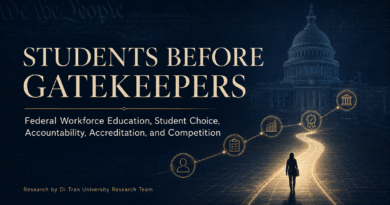
This analysis examines an operating, state-licensed education and workforce model in Louisville, Kentucky, with implications for federal loan reform, short-term vocational training, and state-led oversight. The focus is on documented outcomes, regulatory alignment, and risk reduction for working-class and immigrant learners.
A certainty engine in an uncertain economy
The U.S. workforce system is experiencing sustained volatility driven by automation, credential inflation, and rising student debt. Many four-year pathways continue to require high tuition and long timelines while producing uneven employment outcomes, particularly for working-class and non-traditional students. Against this backdrop, Louisville Beauty Academy (LBA), Di Tran, and Di Tran University (DTU) present a functioning alternative: a low-cost, fast-timeline, state-licensed education model that moves learners directly into regulated, paid work.
Independent research and policy reports describe LBA as “working proof of success,” demonstrating that a state-regulated, non-Title-IV school can deliver licensure, employment, and income stabilization faster and at a lower cost than aid-dependent pathways [1][2][3][4][5][6]. Rather than theorizing about reform, the model operates daily within existing state oversight, making it a rare example of reform already implemented rather than proposed.
DTU extends this framework beyond beauty education into broader vocational and AI-integrated training, emphasizing short, skills-first programs aligned with real labor demand. While many institutions continue to publish forecasts about the “future of work,” LBA and DTU already function within that future through compressed timelines, modular instruction, and direct employer relevance [7][8][9][1].
How LBA de-risks education and accelerates income
LBA’s documented tuition structure shows discounts of approximately 50–75% compared to typical beauty programs, with intentional design to allow most students to complete training with little or no debt [4][5][1][2]. Fast-track programs routinely move students from enrollment to state licensure in under one year, substantially reducing the risk window in which financial, family, or health disruptions often derail longer programs.
Case studies and public records document hundreds of graduates—frequently immigrants, single parents, and non-native English speakers—transitioning directly into licensed employment or small business ownership, including salons and independent suites [10][11][6][1][2]. These outcomes represent measurable workforce impact through state-verified licenses in a regulated, high-demand sector, producing immediate taxpaying activity rather than speculative economic development.
Importantly, this model does not rely on federal aid expansion or experimental credentialing. It operates fully within existing state board frameworks, demonstrating that risk can be reduced through program design, pricing discipline, and licensure alignment rather than through increased borrowing.
Humanized AI and institutional trust
LBA and Di Tran University are frequently cited for their application of “humanized AI,” which integrates AI translation, tutoring, and on-demand support into in-person, mentor-led education [8][1][7]. Rather than replacing faculty, AI is used to increase accessibility for immigrants and non-traditional learners while preserving accountability through state exams and hands-on assessment.
For populations historically excluded from higher education—often told that college “isn’t for people like you”—this approach increases certainty by combining 24/7 language and learning support with clear, licensure-based outcomes. Transparent pricing, visible leadership, and state-anchored credentials function together to rebuild trust in an environment where institutional credibility has eroded [12][13][1][7][2].
Di Tran as an institutional and policy asset
Independent profiles identify Di Tran as a Most Admired CEO, MOSAIC Award recipient, immigrant entrepreneur, and prolific author whose philosophy (“YES I CAN / I HAVE DONE IT”) is embedded in institutional culture and student outcomes [13][14][15][12]. His leadership model emphasizes extreme consistency and presence, translating personal discipline into organizational reliability.
Through NABA and Di Tran University, Tran has contributed to research and policy discussions on federal loan reform, regulatory simplification, and anti-capture dynamics in vocational education [3][16][6][2]. This positions him not solely as an operator, but as a practitioner-scholar linking policy proposals to observable outcomes in regulated environments.
Why federal and metro stakeholders should engage
- Low-risk pilot platform: LBA has already been cited as a gold-standard case study in national research on loan reform and workforce development, making it a viable testbed for short-program financing, SBA-linked models, and state-led oversight pilots [6][2][3].
- Immediate, visible outcomes: Partnerships with community organizations demonstrate that embedding LBA-style programs within workforce centers can generate rapid, trackable gains in employment and service capacity [17][1][10].
- Policy alignment: A reform focus on state-licensed programs aligns with current federal interest in state control, accreditor reform, and short-term vocational pathways, creating coherence across political and administrative lines [2][3].
Each year of inaction leaves working-class and immigrant learners navigating uncertainty between underemployment and inaccessible education, despite the presence of an operating model already delivering results. Strategic engagement with LBA and Di Tran—through research partnerships, pilot funding, or formal MOUs—offers policymakers an opportunity to scale what is already working rather than reconstruct it from theory [18][1][3][6][2].
References
[1] Research 2025: Louisville Beauty Academy and Di Tran University
[2] Research Report: Louisville Beauty Academy as a Proven Model for Loan Reform and Workforce Development
[3] Federal Aid Dependency, Regulatory Capture, and Anti-Competitive Practices
[4] Debt-Free Beauty Education – Louisville Beauty Academy
[5] Fast-Track & Debt-Free: How Louisville Beauty Academy Delivers Outcomes
[6] Workforce Development – NABA
[7] Humanization Principle Research – Louisville Beauty Academy
[8] Louisville Beauty Academy Humanized AI Model
[9] Di Tran University
[10] Louisville Workforce Impact – Louisville Beauty Academy
[11] State Board Outcomes – Louisville Beauty Academy
[12] Di Tran, Most Admired CEO
[13] Di Tran – Founder & CEO Profile
[14] Business First: Most Admired CEOs
[15] Louisville Business First Profile
[16] Author Archive – Di Tran
[17] Community Workforce Partnerships
[18] Non-STEM Degree Outcomes Research