Beauty Education as Workforce Infrastructure, Small-Business Incubation, and Human-Service Economic Policy: A Federal Research Agenda for SBA, Department of Education, DOL, and National Small-Business Stakeholders – RESEARCH & PODCAST SERIES 2026
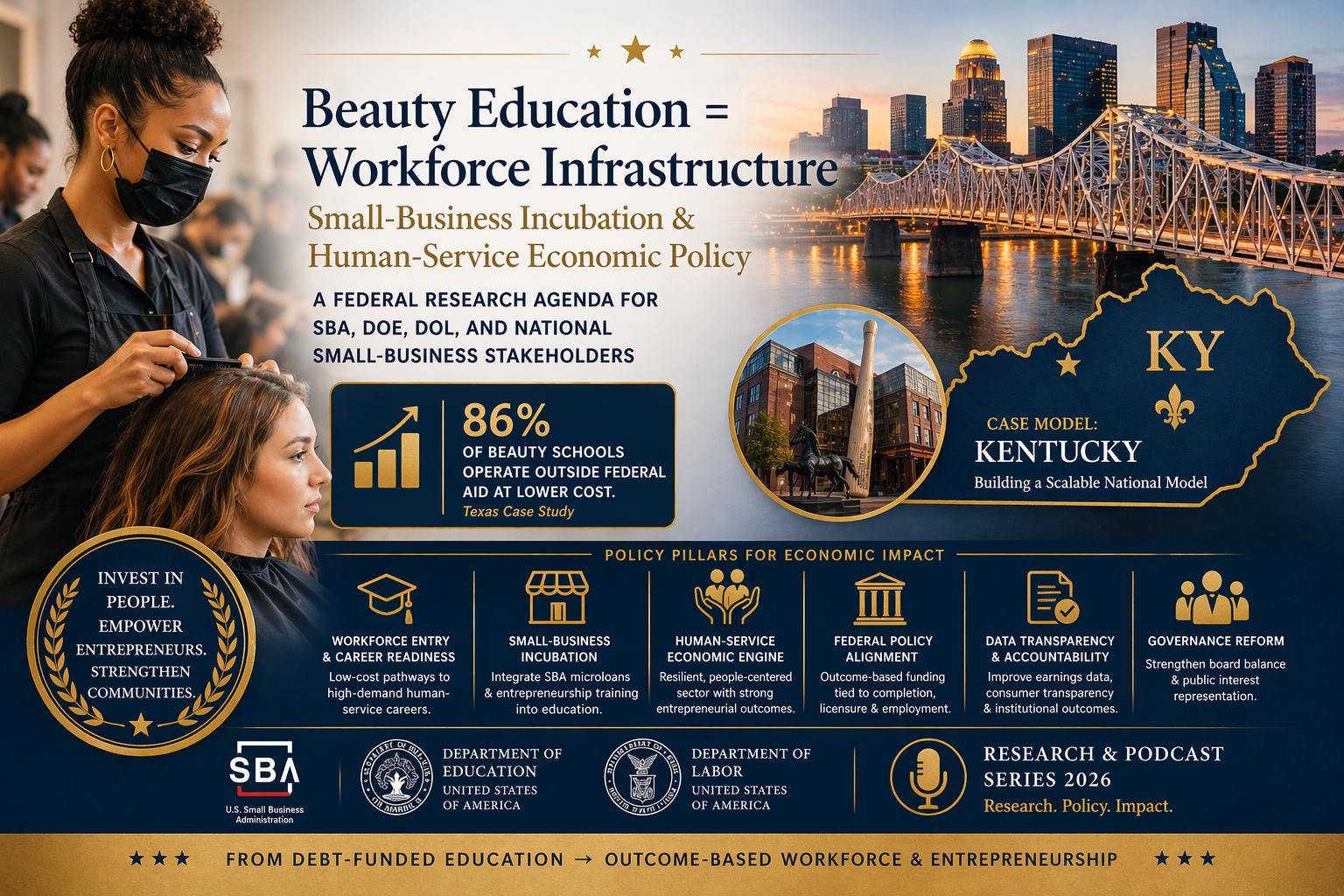
Beauty Education: Workforce Infrastructure & Small-Business Incubation
A Federal Research Agenda evaluating tuition distortion, licensure efficiency, and human-service resilience in the AI economy.
Policy Thesis
Current federal-aid structures treat beauty schools as Title IV higher-education providers rather than workforce-entry systems. This mismatch has contributed to significant tuition inflation while under-recognizing the sector’s primary output: micro-entrepreneurship.
Tuition Inflation (Title IV Effect)
Comparison of average tuition across institutional models. Evidence suggest Title IV eligibility acts as a price floor rather than a ceiling.
Professional Pathway Distribution
Analyzing beauty education as an entrepreneurship pipeline. Majority of graduates bypass traditional W-2 employment.
Workforce Pipeline & Field Retention
The “Master-of-None” broad licensure (Cosmetology) shows lower 1-year field retention compared to specialized, shorter-hour pathways like Esthetics or Nail Tech.
🚀 Proposed Federal Blueprint
Competition Neutrality
Allow lean, state-licensed models to compete on outcomes, not compliance overhead.
Results-Based Reimbursement
Tie federal support to verified licensure, job placement, and business formation milestones.
SBA Pathway Realignment
Treat beauty schools as small-business incubators with integrated entrepreneurial support.
The structural intersection of vocational education, federal financial aid, and small-business formation in the United States is perhaps nowhere more complex—or more misaligned—than in the beauty and personal appearance sector. For decades, the federal government has predominantly viewed beauty schools through the narrow lens of Title IV of the Higher Education Act, treating them as traditional post-secondary education providers rather than as critical workforce-entry systems and small-business incubators.1 This categorical treatment has facilitated a systemic distortion of tuition prices, created significant barriers to entry for low-income entrepreneurs, and fostered a regulatory environment that often prioritizes institutional enrollment over meaningful labor-market outcomes.2 As the national economy faces increasing pressure from automation and artificial intelligence, the personal appearance industry stands out as a uniquely resilient human-service sector.4 However, the current federal aid and regulatory framework risks stifling this resilience by imposing debt-heavy educational models on a workforce that is largely self-employed and minority-driven.6
The Title IV Market Distortion and the Texas Case Study
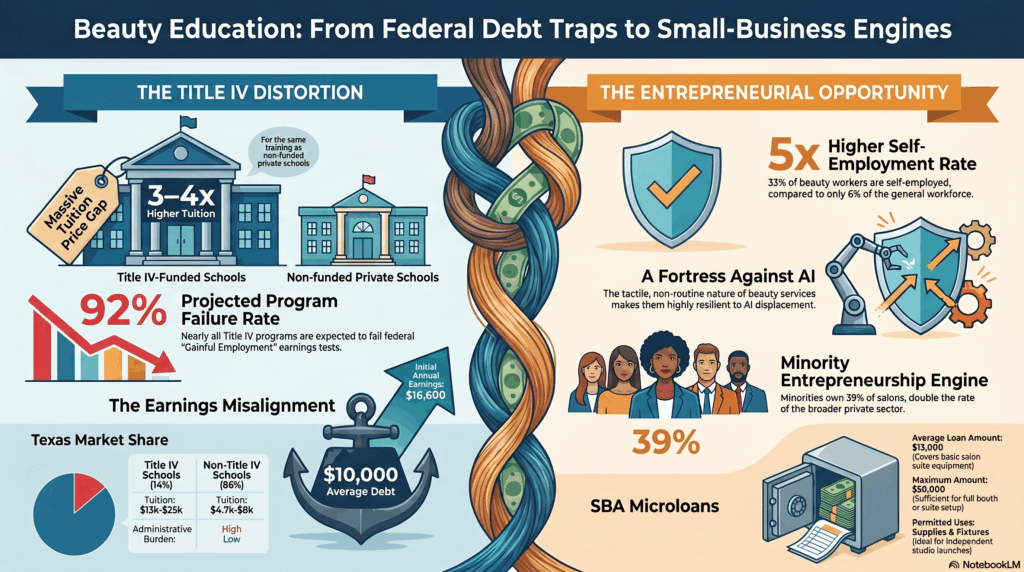
The prevailing assumption in federal education policy is that the “market” for cosmetology education is defined by institutions participating in the federal student aid system. Empirical data, however, indicates a massive shadow market of non-Title IV institutions that operates with significantly higher efficiency and lower costs to students. A comprehensive analysis of Texas licensure data reveals that of the 824 licensed cosmetology and barber schools in the state, only 14 percent—approximately 117 schools—participate in Title IV programs.1 This means that 86 percent of the sector in a major state operates entirely outside the federal taxpayer-funded system.1 The existence of hundreds of schools that thrive without federal aid challenges the thesis that federal subsidies are the primary driver of educational access. Instead, the data suggests that Title IV participation may actually act as a mechanism for price inflation.
In Texas, these non-Title IV institutions are not merely concentrated in urban hubs; they operate in 98 percent of the counties that have at least one licensed beauty school.1 This geographic ubiquity suggests that the non-Title IV model is more adaptable to diverse economic environments than the aid-dependent model, which often requires high tuition to offset the administrative costs of federal compliance.9 Furthermore, the pricing discrepancy between these two categories of institutions is dramatic and instructive. Title IV schools often charge tuition that is three to four times higher than their non-Title IV counterparts for the same state-mandated training hours.1
Comparative Tuition and Institutional Participation
The following data compares the financial footprint of institutions based on their relationship with the federal student aid system.
| Institutional Metric | Title IV Participating Schools | Non-Title IV Private Schools | Community/Technical Colleges |
| Typical Tuition (1,000 hrs) | $13,000 – $25,000 2 | $4,700 – $8,000 1 | $5,000 – $10,000 12 |
| Funding Mechanism | Pell Grants, Federal Loans 12 | Pay-as-you-go, Private Loans 11 | State Subsidies, Pell Grants 14 |
| Accreditation Requirement | National/Regional Accreditation 14 | State Licensure Only 1 | Regional Accreditation 14 |
| Administrative Burden | High (Audits, Reporting) 10 | Low (State Compliance) 15 | High (Institutional) 16 |
| Texas Market Share | 14% 1 | 86% 1 | Included in Title IV count |
The concentration of federal aid in a small subset of schools suggests that the availability of these funds provides a “price floor” rather than an “access ceiling.” This observation aligns with the Bennett Hypothesis, which suggests that increases in financial aid enable institutions to raise tuition blithely, confident that federal subsidies will cushion the impact on the student.17 In the cosmetology sector, where the majority of students are low-income and qualify for maximum Pell Grants, schools have a strong incentive to set tuition at a level that captures the full amount of both the Pell Grant and the maximum allowable federal student loan.2
Gainful Employment and the Earnings Misalignment Crisis
The misalignment between the cost of cosmetology education and the resulting labor-market earnings has reached a critical juncture with the introduction of the Department of Education’s Financial Value Transparency (FVT) and Gainful Employment (GE) rules. These regulations aim to hold career programs accountable by testing whether graduates earn more than the average high school graduate in their state.1 The projected impact on the cosmetology sector is catastrophic. Estimates suggest that 92.5 percent of cosmetology students will attend programs that fail this earnings test.21 Other data indicates that up to 98 percent of Title IV cosmetology programs would fail the proposed high school earnings threshold.1
This failure rate is not merely a reflection of “poor quality” instruction, but rather a fundamental mismatch between the Title IV funding model and the economic reality of personal appearance work. Cosmetology graduates average approximately $16,600 per year in initial earnings while carrying an average of $10,000 in student loans.2 In comparison, an average high school graduate without post-secondary education often earns more than a newly licensed cosmetologist, primarily because the beauty professional’s income is often under-reported (tips and cash transactions) and initially suppressed by the time required to build a stable clientele.13
Labor Market Outcomes and Debt Burdens
The financial viability of cosmetology as a Title IV pathway is undermined by the high cost-to-earnings ratio, as evidenced by the following indicators.
| Employment Metric | Average Cosmetology Graduate | High School Graduate (No Degree) |
| Annual Median Earnings | $16,600 – $26,000 2 | $28,000+ (Varies by State) 2 |
| Initial Debt Load | $7,100 – $10,000 2 | $0 |
| Time to Credential | 12 – 18 Months 13 | N/A |
| On-Time Graduation Rate | < 30% 3 | N/A |
| Projected GE Failure Rate | 92% – 98% 1 | N/A |
The “Pell Penalty” and the “3-Year Rule” under new federal guidelines mean that if a school’s graduates do not meet the earnings test for two out of three years, the institution loses access to federal loans and grants.20 Given that cosmetology is a high-turnover, low-initial-wage field, these regulations are likely to trigger a mass exodus of schools from the Title IV system. While critics argue this will reduce access, the Texas data suggests that students may simply migrate toward more affordable, non-Title IV options that offer the same licensing outcomes at a lower price point.1
The Ethics of Student Labor and Regulatory Capture
A significant but under-analyzed driver of high tuition and program length is the influence of beauty school owners on state licensure boards. In many states, the boards that set the required hours for licensure are composed of individuals with direct ties to for-profit beauty schools.23 This positioning creates an incentive to maintain or even increase the number of hours required for licensure—often as high as 1,500 hours—to ensure students remain enrolled for longer periods, continuing to pay tuition while providing free labor on the school’s “clinic floor”.2
This model effectively treats students as unpaid staff. On a typical clinic floor, students perform hair, nail, and skin services for paying members of the public, but the revenue from these services is kept by the school.19 Critics describe this as an exploitative system where students are forced to rely on tips while the institution profits from both their tuition and their labor.23 Furthermore, many students report “instructorless” classrooms where they are left to learn from one another due to high staff turnover at these schools.23
Clinic Floor Revenue and Operational Costs
The financial structure of a Title IV cosmetology school often relies heavily on student-generated service revenue to offset high operating costs.
| Revenue/Expense Category | Estimated Percentage of Budget | Policy Implications |
| Tuition Revenue | 70% – 85% 19 | Highly sensitive to Title IV rules |
| Clinic Service Revenue | 10% – 25% 19 | Dependent on unpaid student labor |
| Marketing & Recruitment | 60% of Revenue (Year 1) 19 | Drives tuition inflation to cover ads |
| Student Kit Costs | 80% of Tuition 19 | High upfront variable expense |
| Facility Lease/Build-Out | 30% – 40% of Startup 9 | High fixed costs drive enrollment pressure |
The reliance on student labor to maintain profitability creates a moral hazard: schools are incentivized to lobby for more hours of training rather than more efficient instruction. When states have lowered their required hours, schools have often shortened their programs accordingly, demonstrating that the higher hour requirements were not driven by educational necessity but by the desire to maximize tuition and labor capture.2
Beauty Education as a Small-Business Incubator
One of the most profound oversights in federal policy is the failure to recognize that beauty education is essentially small-business training. Unlike traditional college paths that lead to payroll employment, the cosmetology industry is a primary engine for entrepreneurship. Over 33 percent of all personal appearance workers are self-employed, a rate nearly five times higher than the overall U.S. workforce.6
This entrepreneurial capacity is particularly significant for women and minority communities. Women own 59 percent of employment-based salon businesses, compared to only 21 percent in the overall private sector.7 Minorities own 39 percent of salon businesses, versus 19 percent in the broader economy.7 For these populations, beauty school is not just a path to a job; it is a gateway to business ownership.
Small Business and Self-Employment Trends
The shift toward independent operation is accelerating with the rise of salon suites and booth rentals.
| Category | Personal Appearance Sector | Total U.S. Private Sector |
| Self-Employment Rate | 33% – 37% 6 | 6% – 7% 6 |
| Women Ownership | 59% – 61% 7 | 21% – 30% 7 |
| Minority Ownership | 39% 7 | 19% 7 |
| African American Ownership | 21% 8 | 7% 8 |
In the “booth rental” model, a professional rents a station within a salon and operates as an independent business owner, setting their own prices and managing their own clientele.24 The “salon suite” model takes this further, providing private, customizable studios for independent professionals.25 These micro-businesses are the primary destination for cosmetology graduates, yet the federal aid system is not designed to support them. A student who graduates with $10,000 in debt is less likely to qualify for an SBA microloan or have the working capital needed to start their own suite.26
AI Resilience and Human-Service Economic Value
In an era of rapid technological displacement, the “human-service” nature of the beauty industry provides a critical economic stabilizer. Bureau of Labor Statistics (BLS) research indicates that occupations involving non-routine manual tasks and high levels of social and physical dexterity are among the least susceptible to automation.4 While Generative AI may disrupt fields like legal services, accounting, and database administration, it cannot replicate the tactile feedback and sensory complexity required for hair styling, skin care, or massage therapy.5
Occupational Susceptibility to AI Displacement
The BLS and other labor researchers categorize occupations based on the replicability of their core tasks by AI.
| Occupational Group | Potential for AI Impact (2023–2033) | Reason for Rating |
| Personal Appearance Workers | Low 5 | Tactile, non-routine, social |
| Software Developers | Moderate/High 5 | Tasks replicable by GenAI |
| Legal Occupations | Moderate/High 5 | Document-heavy, rule-based |
| Financial Analysts | Moderate 5 | Data-driven, analytical |
| Office/Administrative | High 4 | Routine, digital tasks |
The high “career resilience” of beauty professionals suggests that beauty education is a high-value workforce infrastructure that protects against the volatility of the modern labor market.29 However, federal policy often penalizes these programs for low initial wages without accounting for the long-term economic stability and entrepreneurial upside they provide.2
Alternative Funding and Outcomes-Based Models
The “upfront payment for enrollment” model of Title IV aid has been identified as a primary cause of wasted taxpayer resources and high dropout rates in vocational training.3 In response, there is a growing movement toward “outcome-based” or “pay-for-success” funding models. These models propose that the government should only reimburse education costs when a student successfully completes a program, obtains a license, and secures employment.3
The Outcome-Based Aid Proposal
Under this proposed framework, the risk of educational failure is shifted from the taxpayer to the institution and private lenders.
| Milestone | Federal Reimbursement Increment | Logic |
| Program Completion | 50% of Tuition 3 | Ensures student gained basic skills |
| State Licensure | 25% of Tuition 3 | Incentivizes safety and board prep |
| Six-Month Employment | 25% of Tuition 3 | Validates labor-market value |
| Bonus: Hiring Success | Additional $500 Reward 3 | Encourages employer engagement |
This model would be particularly effective for short-term programs—such as nail technology or esthetics—that currently fall below the 600-hour Title IV threshold.3 It also mirrors successful employer-led models like Virginia’s “FastForward” program, which uses a pay-for-performance structure to achieve a 90 percent completion rate and a 67 percent credential attainment rate.30
Regulatory Compliance and the “Small School Tax”
Opening and operating a compliant beauty school requires a significant financial investment, much of which is driven by federal and state regulatory requirements. For a small school, the cost of accreditation and licensing can range from $15,000 to $40,000, while the total startup cost can exceed $500,000.9 Annual Title IV audits add an additional layer of expense and complexity, requiring schools to submit detailed financial statements to the Department of Education via the ez-Audit system.10
Estimated Startup and Operating Costs for a Cosmetology School
The financial burden of regulatory compliance often forces schools to scale up and raise tuition to remain viable.
| Expense Category | Minimum Cost | Maximum Cost |
| Facility Build-Out | $40,000 | $150,000 9 |
| Accreditation/Licensing | $15,000 | $40,000 9 |
| Equipment & Supplies | $50,000 | $200,000 9 |
| Initial Staffing (3-6 mo) | $75,000 | $200,000 9 |
| Surety Bond (KY Example) | $20,000 (Collateral) | N/A 15 |
| Annual Compliance Audit | $1,100 (Fixed/Mo) | Varies 19 |
These high fixed costs create a “compliance tax” that disproportionately affects small, independent schools. This often leads to industry consolidation, where large chains with the capital to handle federal paperwork dominate the Title IV market, while small, community-based schools are forced to either raise prices or operate as non-Title IV institutions.1
The Role of the SBA in Beauty Education Policy
The Small Business Administration (SBA) has a critical role to play in recognizing beauty education as a small-business incubation system. The SBA Microloan program, which offers loans up to $50,000 (with an average of $13,000), is perfectly sized for the capital needs of a new salon suite or booth rental business.31
SBA Microloan Parameters for Beauty Startups
For beauty professionals, the Microloan program offers a more realistic path to entrepreneurship than traditional bank loans.
| Parameter | Microloan Specification | Beauty Industry Fit |
| Maximum Amount | $50,000 31 | Sufficient for suites/booths |
| Average Amount | $13,000 31 | Covers basic equipment/inventory |
| Interest Rates | 8% – 13% 31 | Competitive for startups |
| Maximum Term | 7 Years 31 | Manageable monthly payments |
| Permitted Uses | Supplies, Furniture, Fixtures 31 | Ideal for salon setup |
| Target Audience | Underserved/Women/Minority 32 | High alignment with industry |
However, many beauty professionals are disconnected from these resources. Federal policy should aim to integrate SBA training and micro-capital options directly into the final months of the beauty school curriculum. Instead of focusing solely on passing the state board, the final 300 hours of a program could be used to draft a business plan and apply for an SBA-backed line of credit.3
Integrating Workforce Pell and WIOA Outcomes
The recent expansion of Pell Grant eligibility to short-term vocational programs (Workforce Pell) represents a major step toward recognizing the value of certificates that last 8 to 15 weeks.33 This shift allows students in high-demand fields like nail technology or esthetics to access aid for programs that lead directly to employment without the debt burden of a full 1,500-hour cosmetology degree.34
To maintain accountability, these programs must meet the “70-70 rule”—70 percent completion and 70 percent job placement.30 This outcomes-based focus aligns with modern workforce strategies like those found in the Workforce Innovation and Opportunity Act (WIOA). WIOA allows for “pay-for-performance” contracts where providers are only paid when participants obtain and retain good jobs.36
WIOA Performance-Based Contract Examples
Regional workforce boards have already begun experimenting with these models in other sectors.
| Region | Performance Incentive | Outcome Trigger |
| San Francisco | 10% Bonus Payment 36 | Placement in jobs above min wage |
| San Diego | Outcomes-based RFP 36 | County-wide youth career services |
| Ohio (Central) | 50/50 Split Payment 36 | 50% on enrollment, 50% on credential |
| Tennessee (Memphis) | Threshold Payments 36 | Eligibility, Completion, Retention |
Applying these WIOA-style incentives to beauty education would revolutionize the sector. It would force schools to move away from the “enrollment at all costs” mentality and toward a model that prioritizes the long-term economic success of the student.
Conclusions and Federal Research Agenda
The evidence suggests that the current federal aid structure has indeed distorted the beauty education market by treating vocational schools as traditional Title IV providers. This has led to a tuition-inflation cycle where high costs are decoupled from entry-level earnings, creating a debt crisis that disproportionately affects women and minority entrepreneurs. At the same time, the regulatory capture of state boards by school owners has artificially inflated program lengths, further increasing costs and exploiting student labor.
To realign federal policy with the economic reality of the beauty industry, the following research and policy agenda is proposed for the Department of Education, Department of Labor, and SBA:
1. Transition to Outcome-Based Aid for Vocational Certificates
The Department of Education should pilot a “Pay-for-Success” model for cosmetology and personal appearance programs. By releasing funds only upon licensure and documented employment, the federal government can eliminate wasteful spending on programs that fail to produce working professionals. This would also allow for the inclusion of short-term programs that are currently excluded from the Title IV system.
2. Decouple School Ownership from State Licensure Boards
The Department of Labor should issue guidance to state governors recommending that licensure boards be composed of a majority of active practitioners and public members, rather than school owners. This would help ensure that hour requirements are based on public safety rather than tuition maximization.
3. Recognize Beauty Education as Small-Business Incubation
The SBA should develop a “Cosmetology to Entrepreneurship” pipeline. This would include specialized microloan pools and business planning resources specifically for graduates of state-licensed beauty schools. By integrating startup capital options into the educational pathway, the government can help nascent entrepreneurs bypass the debt-trap and move directly into business ownership.
4. Expand Data Collection to Include Self-Employment Outcomes
Current GE and FVT metrics rely heavily on SSA and IRS data that may undercount the earnings of self-employed beauty professionals. The BLS should develop more nuanced longitudinal studies that track the “total economic value” of personal appearance work, including the entrepreneurial upside and community-level social impact.
5. Standardize Digital Transcripts and Reduce “Transcript Ransom”
To improve labor mobility, the Department of Education should advocate for the standardization of digital transcripts in the vocational sector. This would prevent schools from withholding transcripts as a means of debt collection, a practice that currently traps many students in low-wage cycles.
By shifting the federal perspective from “education-as-consumption” to “education-as-infrastructure,” policymakers can unlock the full economic potential of the beauty industry. This sector is not just a collection of trade schools; it is a vital human-service network and a powerful engine for minority-led small business formation that is uniquely resilient to the technological disruptions of the 21st century. Reforming the aid and regulatory structure to reflect this reality is a prerequisite for a more inclusive and resilient American economy.
Works cited
- Cosmetology Schools Everywhere – American University, accessed April 22, 2026, https://www.american.edu/spa/peer/upload/peer_cosmetology_b.pdf
- Federal Aid, Licensure, and the Debt Crisis in Cosmetology Education – RESEARCH 2025, accessed April 22, 2026, https://naba4u.org/2025/12/federal-aid-licensure-and-the-debt-crisis-in-cosmetology-education-research-2025/
- Outcome-Based Federal Student Aid Model: A Proposal for Pay-for-Success Funding – RESEARCH AUGUST 2025, accessed April 22, 2026, https://naba4u.org/2025/08/outcome-based-federal-student-aid-model-a-proposal-for-pay-for-success-funding-research-august-2025/
- Incorporating AI impacts in BLS employment projections: occupational case studies, accessed April 22, 2026, https://www.researchgate.net/publication/388800723_Incorporating_AI_impacts_in_BLS_employment_projections_occupational_case_studies
- AI impacts in BLS employment projections – Bureau of Labor Statistics, accessed April 22, 2026, https://www.bls.gov/opub/ted/2025/ai-impacts-in-bls-employment-projections.htm
- Economic Snapshot of the Salon Industry, accessed April 22, 2026, https://iahd.net/wp-content/uploads/2021/04/2020economicsnapshotofthesalonindustry.pdf
- Economic Snapshot of the Salon Industry – Reginfo.gov, accessed April 22, 2026, https://www.reginfo.gov/public/do/eoDownloadDocument?pubId=&eodoc=true&documentID=212246
- Economic Snapshot of the Salon and Spa Industry | Finance.Senate.gov, accessed April 22, 2026, https://www.finance.senate.gov/imo/media/doc/Professional%20Beauty%20Association-%202014%20Economic%20Snapshot%20of%20the%20Salon%20Industry.pdf
- What are Startup Costs for Cosmetology School?, accessed April 22, 2026, https://startupfinancialprojection.com/blogs/capex/cosmetology-school
- Title IV Audits | U.S. Department of Education OIG, accessed April 22, 2026, https://oig.ed.gov/non-federal-audits/title-iv-audits
- Weekly Monitoring: Beauty/Cosmetology Schools Under Financial …, accessed April 22, 2026, https://naba4u.org/2026/03/weekly-monitoring-beauty-cosmetology-schools-under-financial-value-transparency-gainful-employment-pressure-week-of-mar-17-23-2026-research-series-2026/
- Financial Aid for Cosmetology School – CSNM, accessed April 22, 2026, https://www.cosmetologyschoolsnearme.org/resources/financial-aid
- Is Cosmetology School Worth It? The Complete 2026 Guide with Real Data, accessed April 22, 2026, https://cosmetologyandspaacademy.edu/is-cosmetology-school-worth-it-what-you-should-know-before-enrolling/
- Guide to Student Loans for Cosmetology School – SoFi, accessed April 22, 2026, https://www.sofi.com/learn/content/student-loans-for-cosmetology-school/
- Understanding the Path: Bureaucratic Steps to Open a New Vocational/Beauty College in Kentucky (U.S.), accessed April 22, 2026, https://louisvillebeautyacademy.net/understanding-the-path-bureaucratic-steps-to-open-a-new-vocational-beauty-college-in-kentucky-u-s/
- A Student-Centered Funding Roadmap for Policymakers – Reason Foundation, accessed April 22, 2026, https://reason.org/policy-brief/student-centered-funding-roadmap-for-policymakers/
- Does Federal Financial Aid Drive Up College Prices? – American Council on Education, accessed April 22, 2026, https://www.acenet.edu/Documents/Heller-Monograph.pdf
- History of Student Loans: The Bennett Hypothesis – Saving For College, accessed April 22, 2026, https://www.savingforcollege.com/article/history-of-student-loans-the-bennett-hypothesis
- Cosmetology School Running Costs: $51K Monthly Budget; – Financial Models Lab, accessed April 22, 2026, https://financialmodelslab.com/blogs/operating-costs/cosmetology-school
- in 2027, 92% Beauty Schools are going to close under new Trump rules : r/Cosmetology, accessed April 22, 2026, https://www.reddit.com/r/Cosmetology/comments/1qtkdsu/in_2027_92_beauty_schools_are_going_to_close/
- Proposed Department of Education Rules Set to Impact Skin Care Schools’ Federal Financial Aid, accessed April 22, 2026, https://www.ascpskincare.com/updates/blog-posts/proposed-department-education-rules-set-impact-skin-care-schools-federal
- Cosmetology Training Needs a Make-Over – The Century Foundation, accessed April 22, 2026, https://tcf.org/content/report/cosmetology-training-needs-a-make-over/
- The Broken Promises of Cosmetology Education – New America, accessed April 22, 2026, https://www.newamerica.org/insights/cut-short-the-broken-promises-of-cosmetology-education/
- Salon Suite vs Booth Rental: Which Is Better for Stylists?, accessed April 22, 2026, https://phenixsalonsuites.com/salon-suite-vs-booth-rental/
- The Rising Demand for Salon Suites: Market Trends and Statistics, accessed April 22, 2026, https://salonrenter.com/rising-demand-salon-suites-market-trends-statistics/
- Beauty Salon Loans | Next Day Funding – SMB Compass, accessed April 22, 2026, https://www.smbcompass.com/beauty-salon-loans/
- Salon Suite Business Loans: The Complete Financing Guide for Beauty Suite Owners, accessed April 22, 2026, https://www.crestmontcapital.com/blog/salon-suite-business-loans
- Incorporating AI impacts in BLS employment projections: occupational case studies, accessed April 22, 2026, https://www.bls.gov/opub/mlr/2025/article/incorporating-ai-impacts-in-bls-employment-projections.htm
- Artificial intelligence awareness, career resilience, job insecurity and behavioural outcomes, accessed April 22, 2026, https://pmc.ncbi.nlm.nih.gov/articles/PMC12481535/
- Unpacking Workforce Pell: Learning from the States, accessed April 22, 2026, https://bipartisanpolicy.org/article/unpacking-workforce-pell-learning-from-the-states/
- Microloans | U.S. Small Business Administration – SBA, accessed April 22, 2026, https://www.sba.gov/funding-programs/loans/microloans
- SBA Microloans: Rates, Requirements, and How to Apply | Lendio, accessed April 22, 2026, https://www.lendio.com/blog/sba-microloans
- America’s Workforce: Short-Term Pell Unpacked – Bipartisan Policy Center, accessed April 22, 2026, https://bipartisanpolicy.org/event/americas-workforce-short-term-pell-unpacked/
- Workforce Pell Grants Expand Career Training for Young People, accessed April 22, 2026, https://www.aecf.org/blog/workforce-pell-grants-expand-career-training-for-young-people
- Short-Term Pell Accountability Measures – Bipartisan Policy Center, accessed April 22, 2026, https://bipartisanpolicy.org/article/short-term-pell-accountability/
- Performance-Based Contracts in WIOA | Results for America, accessed April 22, 2026, https://results4america.org/wp-content/uploads/2019/12/Performance-Based-Contracts-in-WIOA.pdf