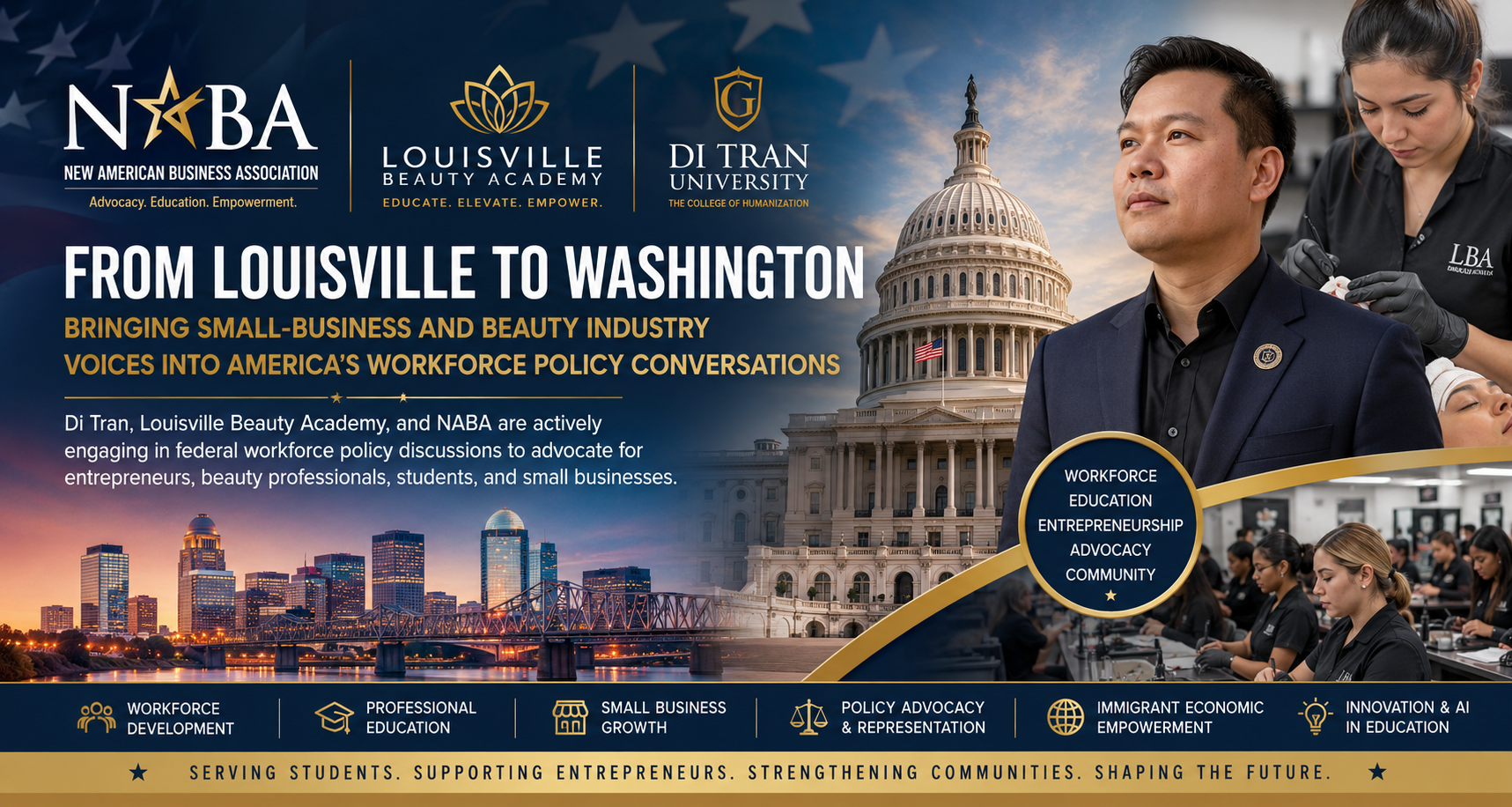
From Louisville to Washington: How Di Tran, Louisville Beauty Academy, and NABA Are Bringing Small-Business and Beauty Industry Voices into America’s Workforce Policy Conversations
NABA Research & Policy Leadership Series 2026
A Public Record of Advocacy, Workforce Leadership, and Entrepreneurial Representation
At the New American Business Association (NABA), we believe that public policy is strongest when it is informed by the people who live it every day.
Business owners.
Workers.
Students.
Educators.
Entrepreneurs.
Immigrants.
Licensed professionals.
Community leaders.
These individuals are often the first to experience the impact of regulatory decisions, yet they are frequently the last to be heard.
For that reason, NABA, Louisville Beauty Academy, and Di Tran University remain committed to participating in public discussions that affect workforce development, entrepreneurship, economic mobility, licensing, and small-business growth throughout the United States.
This article serves as a permanent public record of that commitment.
A Louisville Voice in National Workforce Discussions
On May 28, 2026, Di Tran, Founder of Louisville Beauty Academy, Founder of Di Tran University – The College of Humanization, and Executive Director of the New American Business Association (NABA), participated in a labor-policy roundtable hosted by the U.S. Small Business Administration (SBA) Office of Advocacy.
The discussion focused on proposed Department of Labor rulemaking concerning Independent Contractor classification and Joint Employer standards—issues with significant implications for small businesses, licensed professionals, entrepreneurs, educational institutions, and workforce-development organizations across the nation.
Following the roundtable, NABA and Louisville Beauty Academy prepared and submitted a formal policy brief providing field-based observations and recommendations regarding the potential impact of these proposed regulations on the beauty industry, workforce education, and small-business entrepreneurship.
Our participation reflects a belief that policymakers benefit from hearing directly from practitioners, educators, employers, and community organizations operating on the front lines of workforce development.
Why the Beauty Industry Matters
The beauty industry is frequently underestimated.
To many observers, it appears to be simply a service sector.
In reality, it is one of America’s largest and most accessible entrepreneurship ecosystems.
Every year, individuals enter the profession through state-licensed education and workforce training.
From there, many follow a pathway that looks remarkably similar to the American Dream:
Student → Licensed Professional → Employee → Booth Renter → Independent Practitioner → Salon Suite Operator → Educator → Salon Owner → Multi-Location Business Owner
This pathway has empowered countless individuals to build careers, support families, create jobs, and contribute to local economies.
For women, immigrants, first-generation entrepreneurs, and working adults seeking economic mobility, the beauty industry has long served as one of the most accessible routes to business ownership.
This reality deserves recognition within workforce and labor-policy discussions.
The Louisville Beauty Academy Perspective
Louisville Beauty Academy operates at the intersection of workforce education, professional licensing, entrepreneurship, multilingual accessibility, community engagement, and increasingly, artificial intelligence-enabled educational innovation.
Over the years, the institution has served thousands of students, graduates, and beauty professionals through Kentucky state-licensed programs.
Through this experience, Louisville Beauty Academy has observed firsthand how workforce education can transform lives.
The impact extends well beyond the classroom.
Graduates create economic activity through:
- Professional services
- Employment
- Self-employment
- Booth-rental businesses
- Salon-suite operations
- Product sales
- Tax generation
- Small-business ownership
- Community investment
When viewed collectively, the beauty industry is not merely a service sector.
It is a workforce sector.
It is a small-business sector.
It is an entrepreneurship sector.
It is a community-development sector.
NABA’s Position: Protect Workers and Protect Entrepreneurship
NABA supports legitimate worker protections.
Workers should be protected from:
- Misclassification
- Wage theft
- Exploitation
- Sham contractor arrangements
- Unlawful labor practices
Strong worker protections contribute to a healthy economy and fair marketplace.
At the same time, NABA believes worker protection and entrepreneurship are not opposing goals.
Both are essential.
Many licensed beauty professionals operate legitimate independent businesses.
They build clientele.
They manage schedules.
They purchase supplies.
They assume business risks.
They exercise professional judgment.
Where genuine independence exists, public policy should preserve the opportunity for entrepreneurship and business ownership.
America becomes stronger when pathways into ownership remain accessible.
Public Safety Standards Are Not Employment Control
One important perspective shared through our policy engagement concerns the distinction between public-safety requirements and employment relationships.
The beauty industry operates within a framework of licensing laws, sanitation requirements, inspection standards, and consumer-protection rules.
These regulations exist primarily to protect the public.
They are essential to maintaining professional standards and public confidence.
The existence of these safety requirements should not automatically be interpreted as evidence of employment control.
Public-health compliance and employment relationships are separate legal concepts and should be evaluated independently.
Clear distinctions help both workers and businesses better understand their obligations.
Supporting Small-Business Formation Through Flexible Models
Modern entrepreneurship often begins with flexibility.
Within the beauty industry, models such as booth rental, chair rental, and salon suites have created opportunities for professionals to transition gradually from employment into ownership.
These models allow entrepreneurs to develop their businesses without immediately assuming the financial burden associated with opening a full salon.
For many professionals, these arrangements serve as stepping stones toward larger business ownership opportunities.
NABA believes these pathways deserve thoughtful consideration in federal workforce and labor-policy discussions.
Immigrant Entrepreneurship and Economic Opportunity
As an organization founded by an immigrant entrepreneur and deeply connected to multilingual communities, NABA understands the importance of practical pathways into economic participation.
For many immigrants and first-generation Americans, professional licensing represents more than a credential.
It represents opportunity.
It represents stability.
It represents independence.
It represents the ability to support a family and contribute to the broader community.
Policies that provide clarity and encourage lawful entrepreneurship help strengthen both local economies and the nation as a whole.
Workforce Development Requires Collaboration
Workforce development does not happen in isolation.
Success requires collaboration among:
- Educational institutions
- Employers
- Mentors
- Workforce agencies
- Industry leaders
- Community organizations
- Government stakeholders
Louisville Beauty Academy and NABA have consistently supported initiatives that strengthen workforce participation, apprenticeship development, career pathways, and professional advancement.
Our engagement in policy discussions reflects a commitment to helping ensure that future regulations support innovation, opportunity, and economic mobility while maintaining appropriate protections for workers and consumers.
Why We Continue to Participate
Participation in public-policy discussions is not about politics.
It is about responsibility.
When organizations have direct experience serving students, workers, entrepreneurs, and communities, they possess insights that can contribute meaningfully to public conversations.
NABA, Louisville Beauty Academy, Di Tran University, and the many educators, graduates, students, professionals, and community members connected to our ecosystem believe that practical experience deserves a place at the table.
We are honored whenever opportunities arise to contribute those perspectives.
Looking Forward
NABA will continue engaging constructively in discussions involving:
- Small-business growth
- Workforce development
- Entrepreneurship
- Professional licensing
- Apprenticeship
- Economic mobility
- Artificial intelligence in education
- Community development
- Beauty-industry workforce policy
We are grateful to the SBA Office of Advocacy for providing opportunities for stakeholder participation and public engagement.
We remain committed to sharing practical, field-based perspectives whenever they may help inform discussions affecting workers, entrepreneurs, students, and small businesses.
From Louisville, Kentucky, to conversations taking place across the nation, our mission remains unchanged:
To serve.
To educate.
To advocate responsibly.
To strengthen entrepreneurship.
To support workforce development.
And to help create opportunities for future generations.
About the Organizations
Di Tran is Founder of Louisville Beauty Academy, Founder of Di Tran University – The College of Humanization, and Executive Director of the New American Business Association (NABA).
Louisville Beauty Academy is a Kentucky state-licensed beauty college dedicated to affordable workforce education, professional licensing, entrepreneurship, and community economic mobility.
The New American Business Association (NABA) advocates for small-business growth, workforce development, entrepreneurship, immigrant economic participation, and practical policy solutions that strengthen communities.
Disclaimer: This article documents stakeholder participation and public-policy engagement activities conducted by NABA, Louisville Beauty Academy, and affiliated leadership. References to federal agencies, public meetings, roundtables, and policy discussions are intended to accurately describe participation in public engagement processes. Publication of this article does not imply endorsement by, affiliation with, or representation of the U.S. Small Business Administration, the SBA Office of Advocacy, the U.S. Department of Labor, or any other governmental entity.