Direct-to-Individual Workforce Funding for Licensure-Based Human-Service Sectors: A Policy Framework for Affordability, Choice, Competition, and Public Value – RESEARCH & PODCAST SERIES 2026
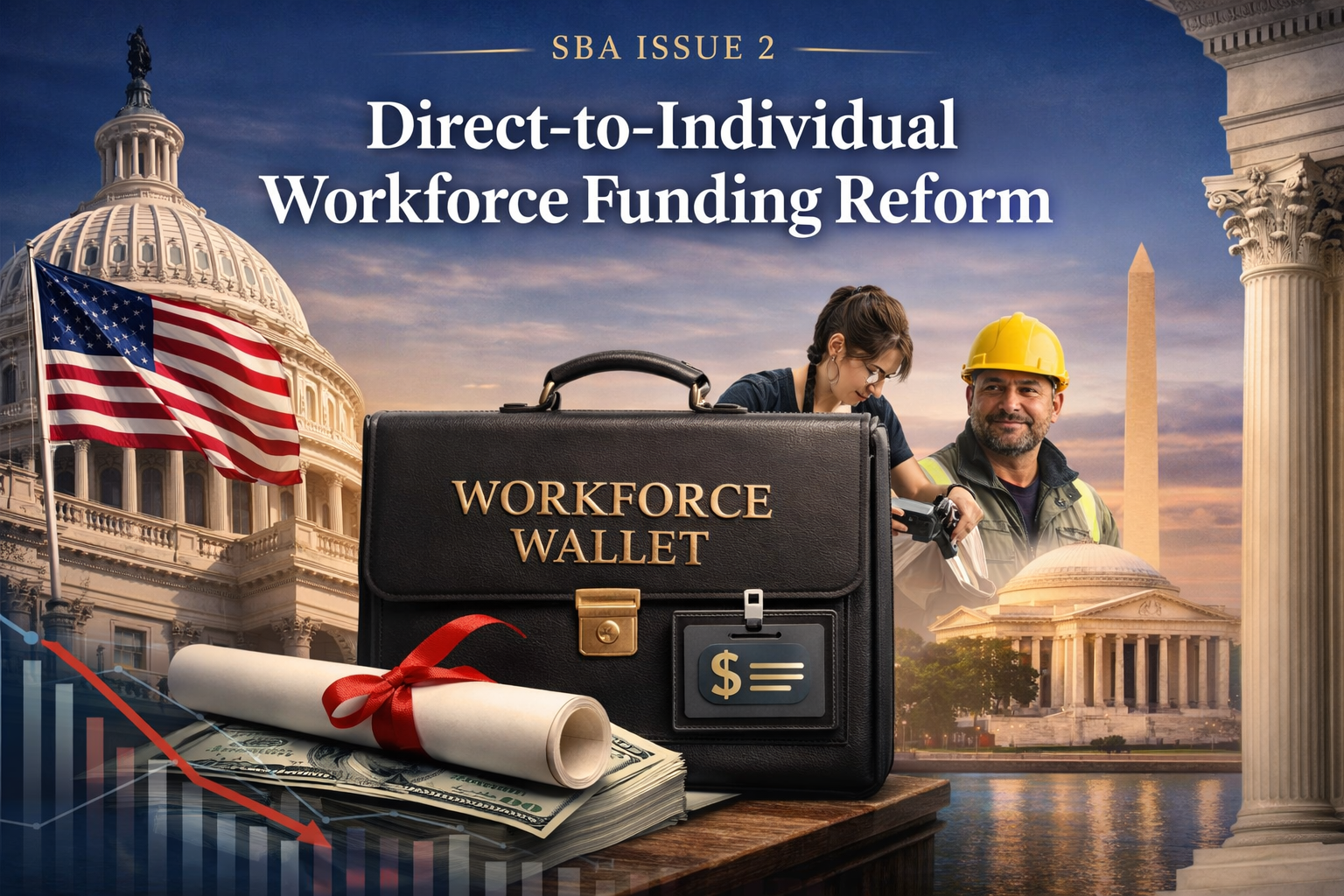
Direct-to-Individual Workforce Funding for Licensure-Based Human-Service Sectors
A Policy Framework for Affordability, Choice, Competition, and Public Value
1. Executive Summary
Current workforce funding architecture too often routes support through gatekept institutional structures. This reduces individual agency, weakens price discipline, and creates significant administrative “tax.”
Thesis: A direct-to-individual, portable funding model—restricted to qualified providers—aligns public support with consumer choice, provider accountability, and measurable workforce outcomes.
2. Limits of Legacy Models
Institutional gatekeeping creates “provider lock-in,” where funding is tied to the school rather than the student. This suppresses competition on tuition and quality.
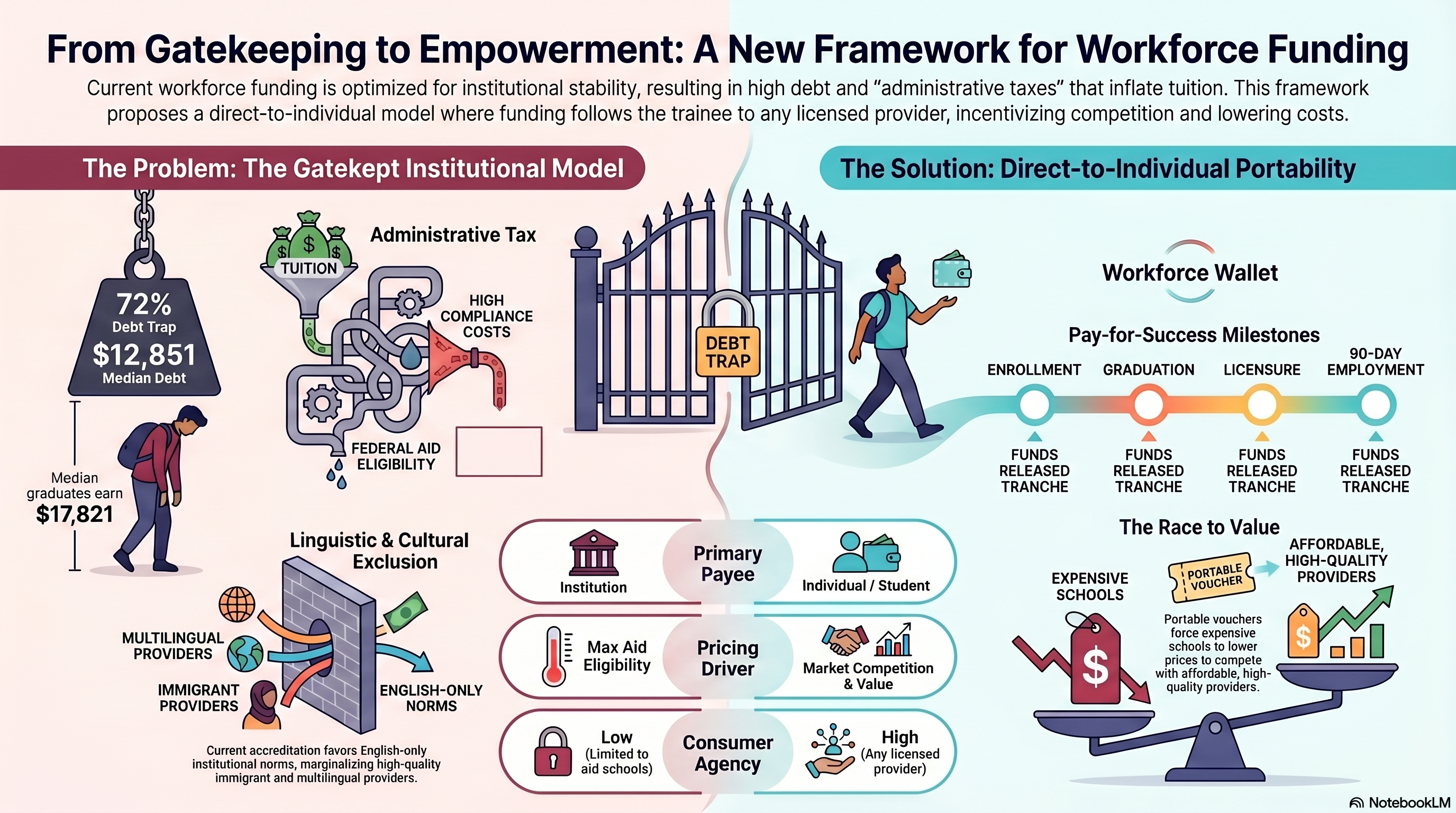
Fig A: Comparative Analysis of Fund Allocation Efficiency
3. The Portable Model
Funding follows the individual. Use is restricted to state-licensed or approved entities, ensuring safety without sacrificing flexibility.
This realignment forces providers to compete on value, as individuals can choose the most efficient path to licensure.
4. Beauty as a Demonstration Case
The beauty industry represents a high-volume, licensure-driven sector where rapid workforce entry is critical for immigrant and low-income mobility.
Louisville Beauty Academy (LBA)
LBA demonstrates that multilingual, affordable models can maintain high licensure standards while dramatically reducing the debt burden typically seen in gatekept institutions.
Economic Mobility Alignment
Affordability and workforce readiness are not mutually exclusive. Direct funding allows students to find the best local training fit for their specific language and schedule needs.
5. AI-Enabled Decision Support
Modern trainees no longer rely solely on institutional marketing. Digital tools allow for real-time comparison of pass rates, tuition, and alumni success.
Licensure Check
Real-time verification of provider legal status before fund release.
Fraud Prevention
Digital ledger tracking ensures funds reach verified tuition accounts.
Outcome Audit
Provider eligibility tied to licensure pass rates and placement data.
Executive Summary
The prevailing architecture of federal and state workforce funding in the United States is currently optimized for institutional stability rather than individual economic mobility. In licensure-based human-service sectors—most notably the beauty and wellness industry—public support remains tethered to a gatekept institutional model that prioritizes administrative compliance over student outcomes and market value. This research report argues for a paradigm shift toward a direct-to-individual, portable funding model. By decoupling support from specific institutional “gates” and placing it in the hands of the trainee, policymakers can catalyze a more efficient, competitive, and affordable workforce ecosystem.
The current system, largely governed by the Higher Education Act’s Title IV framework, imposes a significant “administrative tax” on providers and participants alike. Institutions are forced to maintain expensive accreditation and aid-processing infrastructures, costs that are invariably passed on to students through inflated tuition. This structure creates a “lock-in” effect that marginalizes affordable, innovative providers and disproportionately burdens low-income and immigrant populations who face linguistic and financial barriers. Evidence suggests that when funding is portable and restricted to qualified, licensed providers, it introduces healthy affordability pressure and empowers individuals to make informed choices based on real-world ROI rather than aid eligibility.
The beauty sector serves as an ideal demonstration case for this policy modernization. It is a licensure-driven industry where the path to legal work is clearly defined by state board exams, yet it is populated by a workforce that is frequently low-income, immigrant-heavy, and multilingual. High debt is not a prerequisite for professional competence in this field, as demonstrated by proof-of-concept institutions like the Louisville Beauty Academy, which provides high-quality, licensure-aligned training at a fraction of the cost of traditional, aid-dependent schools.
Furthermore, the emergence of AI-enabled decision tools and the advocacy of platforms like the New American Business Association (NABA) and Di Tran University provide the intellectual and technological foundation for this transition. A direct-to-individual model, supported by robust policy safeguards such as outcome-based tranches and digital identity verification, represents the next step in humanizing workforce systems. This transition shifts the focus from “paying for enrollment” to “paying for success,” ensuring that taxpayer dollars fund actual workforce entry and long-term public value.
Introduction: The Mismatch in Modern Workforce Formation
The American workforce development landscape is grappling with a fundamental disconnect between legacy funding mechanisms and the lived realities of 21st-century trainees. Nowhere is this more apparent than in licensure-based human services. These sectors, which include cosmetology, esthetics, and nail technology, require state-mandated training hours and examinations to ensure public safety and sanitation. However, the funding that supports this training is largely stuck in a mid-20th-century model of institutional gatekeeping.
Federal funding for postsecondary education and workforce development exceeds $58 billion annually when Pell Grants and veteran assistance are considered.1 Yet, the primary vehicle for this support—the institutional grant—often acts as a barrier to entry rather than a bridge. In the current “gatekept” architecture, an individual’s choice of training is dictated not by the quality or affordability of the provider, but by whether the provider possesses the administrative machinery to process federal aid. This has led to a market where tuition is often priced according to maximum aid eligibility rather than the actual cost of instruction or the earning potential of the graduate.2
This mismatch is particularly acute for “New Americans” and low-income populations. For an immigrant worker seeking a rapid path to a nail technician or esthetics license, a 1,500-hour comprehensive cosmetology program at an expensive, aid-eligible school is often an inefficient and debt-laden route. These individuals need focused, affordable, and often multilingual training that respects their time and financial constraints. However, the current system incentivizes institutions to push longer, more expensive programs that qualify for maximum federal subsidies, creating a “glamour tax” on the very people who can least afford it.4
The proposed policy shift toward a direct-to-individual, portable funding model addresses this inefficiency. By granting support to the individual—with the restriction that it be spent at legally qualified, state-licensed providers—policymakers can restore agency to the worker and price discipline to the provider. This report explores the limits of the status quo, the mechanics of the direct model, and why the beauty sector, supported by innovative platforms like Louisville Beauty Academy and Di Tran University, offers a blueprint for a more equitable and outcome-oriented workforce policy.
The Limits of Gatekept Institutional Funding
The traditional workforce funding model relies on a “triad” of oversight: state licensure, accreditation by a recognized body, and federal certification.5 While designed to protect students, this gatekeeping structure has evolved into a compliance-industrial complex that imposes significant hidden costs.
The Administrative Tax and Institutional Lock-In
For a small vocational school, the cost of participating in the federal financial aid system is immense. Administrative capability requirements mandate a dedicated staff to manage FAFSA verification, Title IV disbursements, and complex reporting on everything from campus security (Clery Act) to “Gainful Employment” metrics.6 Failure to comply with these Byzantine rules can result in fines as high as $71,545 per violation—a sum that can bankrupt a small, community-focused school.7
This “administrative tax” forces institutions to raise tuition simply to cover the cost of managing the aid that makes the tuition “affordable.” It creates a closed loop where only large, high-tuition institutions can afford to navigate the regulatory landscape. Smaller, leaner providers that offer high-quality instruction at lower price points are often excluded because they lack the “compliance capital” to participate. This results in “institutional lock-in,” where students are funneled into a handful of expensive providers, reducing competition and stifling innovation in curriculum and delivery.
The Bennett Hypothesis and Price Inelasticity
The economic impact of this model is well-documented through the “Bennett Hypothesis,” which posits that increases in federal financial aid allow institutions to “blithely raise their tuitions,” confident that subsidies will cushion the blow.3 In the vocational sector, particularly for-profit beauty schools, the correlation between aid availability and tuition inflation is especially strong.3 Because the “list price” is often fully covered by grants and loans, students become desensitized to cost. They do not act as rational consumers comparing value; they act as “aid-seekers” choosing the path of least resistance.
This price inelasticity is reflected in the debt-to-earnings ratios of cosmetology graduates. National data indicates that the median cosmetology graduate earns approximately $17,821 two years after graduation, yet carries a median student debt of $12,851.10 When nearly 72% of a graduate’s annual income is consumed by the “debt of entry,” the system has failed to provide true economic mobility. The gatekeeping model, by decoupling tuition from market reality, has created a debt trap for thousands of essential service workers.
Barriers to Innovative and Multilingual Providers
Gatekeeping also creates a linguistic and cultural barrier. Many immigrant entrepreneurs and educators are capable of providing world-class technical training in languages like Vietnamese, Spanish, or Chinese.11 However, the accreditation and federal certification processes are almost exclusively conducted in English and follow Western institutional norms. This “linguistic exclusion” prevents high-value, culturally competent providers from entering the federally supported market, forcing immigrant students into English-only institutions where they may struggle to master the theory required for licensure, despite their technical proficiency.13
| Feature | Gatekept Institutional Model | Direct-to-Individual Portable Model |
| Primary Payee | Institution | Individual / Student |
| Pricing Driver | Maximum Aid Eligibility | Market Competition / Value |
| Compliance Burden | High (Institution-wide) | Moderate (Verification of Licensure) |
| Consumer Agency | Low (Choice limited to aid-eligible schools) | High (Freedom to choose any licensed provider) |
| Price Sensitivity | Low (Shielded by loans) | High (Transparent use of voucher/grant) |
| Innovation Speed | Slow (Accreditation lag) | Fast (Market-responsive) |
The Direct-to-Individual Model: A Framework for Portability
A direct-to-individual funding model reverses the flow of authority. Instead of funding an institution and hoping students enroll, the state funds the individual and allows them to “purchase” the training that best fits their needs. This model is not a call for deregulation, but a call for re-alignment.
Mechanics of Individual Training Accounts (ITAs)
The concept of portable funding is not entirely new. The Workforce Innovation and Opportunity Act (WIOA) utilizes Individual Training Accounts (ITAs) to provide vouchers to eligible adults and dislocated workers.15 Expanding this model to all licensure-based human services would involve creating a digital “workforce wallet” for eligible individuals. This support can be used for:
- Tuition at any state-licensed beauty college.
- Required student kits and professional tools.
- State board examination and licensure fees.
The key to the success of this model is that the spending is restricted. The funds are not a “blank check”; they are only releasable to “Qualified Providers”—entities that have maintained state licensure and demonstrated successful licensure outcomes for their students.18 This ensures that public value is maintained while individual choice is expanded.
Outcome-Based Disbursement Tranches
To further protect public funds, a direct-to-individual model should be “Outcome-Based.” NABA has proposed a “Pay-for-Success” framework where funding is released in tranches tied to verifiable milestones.20 This prevents the “enrollment-churn” seen in some institutional models where schools receive full payment even if a student drops out after two weeks.
| Milestone | Disbursement Percentage | Verification Mechanism |
| Enrollment & Orientation | 10% | Verified Enrollment Agreement |
| Mid-Point Completion | 30% | Verified Clock Hours (State Board Log) |
| Program Graduation | 30% | Diploma / Final Transcript |
| State Licensure | 20% | Issuance of Professional License |
| 90-Day Employment | 10% | Employment Verification / Paystub |
This structure ensures that the provider and the student are both incentivized toward the ultimate goal: a licensed, working professional.20
Decoupling from Legacy “Gatekeepers”
By moving to a direct model, the state can bypass the multi-year, expensive accreditation process that currently acts as the primary gate for federal aid. In the beauty sector, the ultimate indicator of “quality” is the student’s ability to pass a state board exam. If a school consistently produces licensed professionals who find employment, it is a high-value provider, regardless of whether it employs a full-time compliance officer to manage federal paperwork. Portability allows these lean, high-performing schools to compete fairly with large institutional chains.
Why This Improves Choice and Competition
Empowering the individual with portable funding creates a “demand-side” pressure that is missing from the current system. When individuals have a choice, providers must compete on factors that actually matter to the student: price, quality, speed, and support.
Affordability Pressure and the “Race to Value”
In a gatekept system, a school that charges $20,000 for a program is effectively “protected” from lower-cost competitors because the lower-cost school might not be aid-eligible. If a student can only get “free” money at the expensive school, they will go there, even if it is inefficient.
Portable funding removes this protection. If a student receives a $6,000 workforce grant, they can choose to spend it at an expensive school (and take on $14,000 in debt) or spend it at an affordable school like Louisville Beauty Academy and graduate debt-free.11 This creates a powerful incentive for providers to lower their tuition to match the “voucher” amount, essentially creating a market-driven “cap” on tuition inflation.
Informed Consumer Choice and Digital Transparency
Choice is only effective if it is informed. Under a direct model, the state’s role shifts from “approving” a school to “providing data” about a school. Policymakers can leverage tools like the College Scorecard to ensure that individuals have access to clear metrics on completion rates, licensure success, and median earnings.10 When students are spending their “own” portable funds, they become more discerning consumers. They are more likely to ask: “Will this school actually help me pass the state board?” or “Does this school offer the multilingual support I need?”.11
Better Alignment with Practical Economic Mobility
Economic mobility is about the speed and efficiency of moving from “unskilled” to “licensed and earning.” The current institutional model often traps students in long, comprehensive programs that include hundreds of hours of training they may not need for their specific career goals. A direct funding model supports “modular” education. An individual can use their portable funding for a focused nail technology program (450 hours), enter the workforce, and then later use another tranche of funding for an esthetics program (750 hours) as they grow their career.11 This “stepped” approach to licensure is much more aligned with the financial realities of low-income workers than a single, expensive 1,500-hour block.
Why Beauty Is a Strong Demonstration Sector
The beauty and wellness sector provides a unique laboratory for testing direct-to-individual funding because of its clear regulatory structure and its diverse workforce.
The Licensure-Driven Meritocracy
Unlike many white-collar fields where “prestige” of the institution is a primary hiring factor, the beauty industry is a meritocracy based on licensure. To legally cut hair or apply skin treatments, one must have a license from the state board.13 This provides an objective, external “verification of value” that makes the industry safe for portable funding. The state does not have to worry that a student is spending their voucher at a “fake” school, because the student will only be able to obtain a license if the school meets state board standards.
Workforce Demographics and “New American” Realities
The beauty sector is a primary entry point for immigrants and first-generation Americans. In sectors like nail technology, over 79% of the workforce is foreign-born.23 These individuals often face linguistic barriers that make traditional, English-heavy institutional environments difficult. They also have a high rate of entrepreneurship, often moving from “employee” to “salon owner” within a few years.24
Direct-to-individual funding respects this entrepreneurial spirit. It allows an immigrant worker to find a provider like Louisville Beauty Academy that offers multilingual exams and study materials.11 It recognizes that the “public value” of a nail technician is not just their ability to provide a service, but their potential to become a small business owner who pays taxes and hires others.
The Efficiency of Short-Term Programs
One of the most compelling arguments for beauty as a demonstration sector is the efficiency of its training. As NABA research highlights, the 342 days of training required for a cosmetologist is often excessive when compared to the 36 days required for an EMT.13 This suggests that the beauty sector has “room to move” toward more efficient, intensive training models. A direct funding model encourages schools to innovate in how they deliver these hours—perhaps through evening classes, weekend intensives, or AI-assisted theory study—to get workers into the field faster.26
| Program Type | Required Hours (KY) | Path to Income | Ideal Funding Model |
| Cosmetology | 1,500 | Comprehensive Hair/Skin/Nails | Modular Tranches |
| Esthetics | 750 | Specialized Skincare/Facials | Direct Voucher |
| Nail Technology | 450 | Rapid Entry – Manicure/Pedicure | Direct Voucher |
| Shampoo Styling | 300 | Entry Level – Support Staff | Fast-Track Grant |
The varied lengths of licensure paths in the beauty sector allow for a “tiered” funding approach that matches the student’s career velocity.11
Louisville Beauty Academy as a Demonstration Case
The Louisville Beauty Academy (LBA) serves as a vital proof-of-concept for the direct-to-individual model. Founded on the principles of accessibility and affordability, LBA demonstrates that it is possible to provide state-licensed, high-quality education outside the high-tuition, aid-dependent institutional norm.
Affordability as a Policy Choice
LBA has intentionally positioned itself as one of the most affordable institutions in Kentucky. While many accredited beauty schools charge $18,000 to $25,000 for a cosmetology program, LBA offers the same licensure-aligned training for a discounted rate of approximately $6,250.11 This is not “cheap” education; it is “lean” education. By avoiding the overhead of federal aid administration and high-interest institutional debt, LBA proves that the “natural” cost of beauty education is far lower than the “subsidized” cost found in gatekept institutions.
Multilingual Access and Licensure Seriousness
LBA is an immigrant-founded institution that prioritizes “New Americans.” It was a lead advocate for the expansion of multilingual licensing exams in Kentucky, which as of March 2026, are available in English, Spanish, Vietnamese, Korean, Khmer, Portuguese, and Simplified Chinese.11 This focus on linguistic inclusivity ensures that a student’s career is determined by their technical competence, not their English proficiency.
Furthermore, LBA maintains a strict “Compliance-By-Design” philosophy. The school aligns its curriculum with the Kentucky State Board (KRS 317A) and uses industry-standard Milady CIMA resources.26 LBA demonstrates that a school can be “affordability-minded” without sacrificing “licensure seriousness.” In a direct funding world, LBA would be a premier choice for self-directed individuals seeking a high-ROI pathway.
The “Freedom Ecosystem” Approach
LBA is part of a broader framework envisioned by founder Di Tran—the “Freedom Ecosystem”.29 This model views workforce training not as an isolated event, but as part of a cycle of economic elevation.
- Train: High-demand skills (LBA).
- Mentor: Transition from student to professional identity.31
- House: Affordable housing for the workforce (NABA “Love Housing” model).32
- Launch: Small business support and AI technology for the new entrepreneur.25
This holistic approach, supported by Di Tran University’s research, shows that when funding follows the individual, it can be integrated into a larger ecosystem of community uplift rather than being trapped in a single institutional silo.
AI and the Modern Consumer/Trainee
A common historical justification for institutional gatekeeping was “information asymmetry”—the idea that a student could not possibly know if a school was good, so the government had to “accredit” the school for them. In the age of AI, this justification is increasingly obsolete.
AI-Enabled Decision Support
Today’s trainees have access to AI-driven tools that can analyze vast amounts of data to provide personalized recommendations. An individual can use an AI assistant to:
- Compare the total cost of ownership (TCO) of different schools.
- Analyze state board pass rates across providers.
- Predict future earnings based on specific local market labor data.35
These tools empower the individual to act as their own “quality control.” When a student uses an AI platform to upload a financial aid letter and compare it against an affordable provider like LBA, the AI can clearly show the long-term impact of debt versus debt-free education.36 This makes the institutional “gatekeeper” less relevant and the individual’s “informed choice” more powerful.
Personalization and Multilingual Study
AI also transforms the learning experience. Tools like VAPS AI and MagicSchool AI allow for personalized, adaptive instruction that can be delivered in a student’s native language.37 For a multilingual student at LBA, AI can translate complex theory into their native tongue, provide instant feedback on practice quizzes, and help them prepare for the state board exam in a way that a traditional classroom cannot.12
| AI Application | Impact on the Individual | Impact on Policy |
| Comparison Tools | Identifies best ROI providers. | Reduces need for rigid accreditation as a quality proxy. |
| Adaptive Tutoring | Speeds up mastery of theory. | Supports shorter, more intensive training paths. |
| Language Translation | Overcomes linguistic barriers. | Encourages funding for multilingual providers. |
| Audit Automation | Real-time tracking of hours. | Lowers administrative cost of oversight. |
AI serves as a force multiplier for individual agency, making the case for portable funding even more compelling.27
Policy Safeguards and Design
A move toward direct-to-individual funding must be accompanied by rigorous safeguards to prevent the “waste, fraud, and abuse” that can occur in any public subsidy system. Modern technology offers better tools for oversight than the legacy gatekeeping model.
Provider Qualification Rules
The state should maintain a list of “Eligible Training Providers” (ETP), similar to the WIOA ETPL.18 To be on this list, a provider must:
- Hold a valid, unexpired state license in the relevant discipline.
- Provide a curriculum that meets state-mandated hour requirements.
- Disclose verified outcome data (completion and licensure rates).
- Maintain general liability insurance and meet basic safety standards.42
Fraud Protection and Digital Audit Trails
Direct-to-individual funding should utilize “Unified Finance Platforms” that track every dollar from collection to disbursement.43
- Identity Verification: Using NIST Identity Assurance Level 2 (NIST IAL2) ensures that the person receiving the funding is the person sitting in the classroom.44
- Restricted Payment: Funds are disbursed via “Workforce Wallets” that can only be used at pre-approved merchant IDs (Qualified Providers).
- Real-Time Monitoring: Instead of an annual audit, the state can have real-time visibility into student attendance and progress through integrated Student Information Systems (SIS).40
Accountability through Outcome Measurement
The ultimate safeguard is the “No Success, No Final Payment” rule. By withholding a final portion of the provider’s payment until the student achieves licensure or 90 days of employment, the state aligns the provider’s financial interest with the student’s success.20 This is a far more effective accountability mechanism than an accreditation visit that occurs once every five years.
Strategic Policy Implications
Transitioning to a direct-to-individual model in licensure-based sectors offers significant gains for federal and state policymakers.
Affordability and Lower Public Waste
By introducing price competition, the state can serve more individuals with the same amount of funding. If the average “cost” of training drops from $15,000 to $6,000, a state can double the number of workers it trains without increasing its budget. Furthermore, outcome-based tranches ensure that the state never pays for a “dropout.”
Faster Workforce Entry and Economic Vitality
In a post-pandemic economy, speed to workforce is a priority. Human-service sectors like beauty are “recession-resistant” and provide immediate jobs in local communities. Direct funding supports “fast-track” models that get licensed professionals into salons and spas in months, not years, stimulating local tax revenue and reducing reliance on other social safety nets.32
Stronger Access for Historically Marginalized Populations
The “Administrative Tax” of the current system acts as a regressive tax on low-income and immigrant students. By removing the institutional gate and lowering the cost of entry, policymakers can unlock the human capital of “New Americans” and rural populations who are currently priced out or “gatekept” out of professional licensure.13
Conclusion: A Living Architecture of Empowerment
The current architecture of workforce funding in licensure-based human-service sectors is a relic of an era that valued institutional stability over individual agency. It has created a high-tuition, high-debt environment that disproportionately harms those it seeks to help. The solution is not to simply “increase aid,” which only fuels the cycle of tuition inflation, but to change the delivery model.
A direct-to-individual, portable funding model—restricted to legally qualified providers and governed by outcome-based milestones—represents a modernization of the American Dream. It recognizes that in a digital age, individuals are capable of making informed choices when empowered with the right tools and transparent data.
The beauty sector, through the demonstrative success of Louisville Beauty Academy and the strategic framework of Di Tran University and NABA, shows that this path is viable. We can have a system that is simultaneously more affordable, more competitive, and more inclusive. By shifting from “gatekeeping” to “empowering,” policymakers can ensure that every worker has the chance to earn a license, build a career, and contribute to the vibrant “Freedom Ecosystem” of the American economy.
This model deserves serious consideration from federal and state labor departments, small business advocates, and education reformers. It is a path toward a workforce system that is truly “True Work-Ready,” debt-disciplined, and human-centered.
Strategic Summary Table for Policymakers
| Policy Goal | Current Mechanism | Reform Recommendation | Expected Outcome |
| Affordability | Institutional Aid (Title IV) | Direct-to-Individual Vouchers | Lower tuition through price competition. |
| Choice | Accreditation-Gatekept | Portable “Workforce Wallets” | Empowerment of students to choose high-ROI schools. |
| Quality | Periodic Audits/Visits | Outcome-Based Tranches (Pay-for-Success) | 100% alignment between funding and licensure. |
| Access | English-Primary Systems | Multilingual/AI-Supported Support | Inclusion of “New American” and immigrant workers. |
| Innovation | Rigid Institutional Cycles | Modular, Short-Term Eligibility | Faster entry into high-demand specialized roles. |
This framework provides a roadmap for a more agile and equitable workforce future.20
Works cited
- Recommendations for a Fully Funded and Transformed Workforce Development System, accessed April 17, 2026, https://www.jff.org/idea/recommendations-for-a-fully-funded-and-transformed-workforce-development-system/
- College Tuition Inflation [2025]: Rate Increase Statistics – Education Data Initiative, accessed April 17, 2026, https://educationdata.org/college-tuition-inflation-rate
- New Report: Federal Aid Rarely Affects Tuition Policy at Colleges and Universities, accessed April 17, 2026, https://www.acenet.edu/News-Room/Pages/New-Report-Federal-Aid-Rarely-Affects-Tuition-Policy-at-Colleges-and-Universities.aspx
- Workforce Development – New American Business Association (NABA) – Louisville, KY, accessed April 17, 2026, https://naba4u.org/category/workforce-development/
- ED07: Simplify and Strengthen Institutional Eligibility and Certification for Participation in Federal Student Aid – UNT Libraries, accessed April 17, 2026, https://govinfo.library.unt.edu/npr/library/reports/ED7.html
- FSA Administrative and Related Requirements | 2024-2025 Federal Student Aid Handbook, accessed April 17, 2026, https://fsapartners.ed.gov/knowledge-center/fsa-handbook/2024-2025/vol2/ch3-fsa-administrative-and-related-requirements
- Six Ways Financial Aid Compliance Affects Your Entire School – nasfaa, accessed April 17, 2026, https://www.nasfaa.org/six_ways_compliance_affects_your_school
- Our Greedy Colleges, Revisited – Berkeley Economic Review, accessed April 17, 2026, https://econreview.studentorg.berkeley.edu/our-greedy-colleges-revisited/
- For-Profit Colleges and the Myth of Institutional Equity – New America, accessed April 17, 2026, https://www.newamerica.org/insights/for-profit-colleges-and-the-myth-of-institutional-equity/
- College Scorecard – Robert Kelchen, accessed April 17, 2026, https://robertkelchen.com/tag/college-scorecard/
- LICENSE YOUR BEAUTY TALENT TODAY —Enroll at Louisville …, accessed April 17, 2026, https://louisvillebeautyacademy.net/
- How to Translate Louisville Beauty Academy Online Content for Multilingual Theory Study, accessed April 17, 2026, https://louisvillebeautyacademy.net/how-to-translate-louisville-beauty-academy-online-content-for-multilingual-theory-study/
- Asymmetric Governance and the Inaccessibility of Administrative Justice: A Multidisciplinary Analysis of Occupational Licensing Enforcement in the United States Beauty Sector – RESEARCH & PODCAST SERIES 2026, accessed April 17, 2026, https://naba4u.org/2026/04/asymmetric-governance-and-the-inaccessibility-of-administrative-justice-a-multidisciplinary-analysis-of-occupational-licensing-enforcement-in-the-united-states-beauty-sector-research-podcast/
- Occupational Licensing as a Barrier to Entry for Immigrants – Federal Reserve Bank of Minneapolis, accessed April 17, 2026, https://www.minneapolisfed.org/-/media/assets/papers/community-development-working-papers/2023/occupational-licensing-as-a-barrier-to-entry-for-immigrants.pdf
- Area 8 Individual Training Account Policy (ITA) – Ohio Means Jobs, accessed April 17, 2026, https://ohioarea8wdb.org/wp-content/uploads/2024/08/Area-8-Individual-Training-Account-ITA.pdf
- Individual Training Accounts: Testing Models of Paying for Job Training – Mathematica, accessed April 17, 2026, https://www.mathematica.org/projects/individual-training-accounts
- Date: November 14, 2023 To: All WIOA Subrecipients of the Orange County Workforce Development Board From: Nancy Cook Direct, accessed April 17, 2026, https://workforce.ocgov.com/sites/cid/files/2024-02/ITA%20Policy%20Combined.pdf
- 20 CFR Part 680 Subpart D — Eligible Training Providers – eCFR, accessed April 17, 2026, https://www.ecfr.gov/current/title-20/chapter-V/part-680/subpart-D
- Eligible Training Provider Guidelines – NC Commerce, accessed April 17, 2026, https://www.commerce.nc.gov/media/8187/open
- Outcome-Based Federal Student Aid Model: A Proposal for Pay-for …, accessed April 17, 2026, https://naba4u.org/2025/08/outcome-based-federal-student-aid-model-a-proposal-for-pay-for-success-funding-research-august-2025/
- American Beauty and Trade School – College Scorecard, accessed April 17, 2026, https://collegescorecard.ed.gov/school/?490391
- LOUISVILLE BEAUTY ACADEMY – ADMISSIONS AND ENROLLMENT REQUIREMENTS, accessed April 17, 2026, https://louisvillebeautyacademy.net/admissions-and-enrollment-requirements/
- Perceived Benefits and Barriers to Implementing Occupational Health Recommendations Among Immigrant-Owned Nail Salons in the – CDC Stacks, accessed April 17, 2026, https://stacks.cdc.gov/view/cdc/207155/cdc_207155_DS1.pdf
- New American Business Association (NABA) – Louisville, KY …, accessed April 17, 2026, https://naba4u.org/
- Latest – New American Business Association (NABA) – Louisville, KY, accessed April 17, 2026, https://naba4u.org/category/latest/
- Products Archives – Louisville Beauty Academy, accessed April 17, 2026, https://louisvillebeautyacademy.net/category/products/
- Di Tran University, accessed April 17, 2026, https://ditranuniversity.com/
- Louisville Beauty Academy — Aesthetic/Esthetic 750 Clock Hours Curriculum, accessed April 17, 2026, https://louisvillebeautyacademy.net/louisville-beauty-academy-mastering-aesthetics-with-a-comprehensive-curriculum/
- Di Tran Enterprise – Empowering Growth, Creating Impact – Innovating AI, Workforce, and Business Excellence, accessed April 17, 2026, https://ditran.net/
- Di Tran — Founder & CEO | Visionary Leader in Workforce Education and Humanized AI, accessed April 17, 2026, https://www.youtube.com/watch?v=rkyzbioAQAY
- Uncategorized Archives – Louisville Beauty Academy, accessed April 17, 2026, https://louisvillebeautyacademy.net/category/uncategorized/
- Elevating Lives Through Workforce Development and Affordable Housing: New American Business Association Inc., accessed April 17, 2026, https://naba4u.org/2024/11/elevating-lives-through-workforce-development-and-affordable-housing-new-american-business-association-inc/
- Real Estate For Small Business – New American Business Association (NABA) – Louisville, KY, accessed April 17, 2026, https://naba4u.org/category/real-estate-for-small-business/
- Di Tran — Founder & CEO | Visionary Leader in Workforce Education, Humanized AI, and Immigrant Entrepreneurship – New American Business Association (NABA) – Louisville, KY, accessed April 17, 2026, https://naba4u.org/di-tran-founder-ceo-visionary-leader-in-workforce-education-humanized-ai-and-immigrant-entrepreneurship/
- AI-Driven Career Guidance to Reduce Vocational Students’ Career Path Anxiety through Skills Mapping, Adaptive Mentoring, and Labor Market Intelligence. – F1000Research, accessed April 17, 2026, https://f1000research.com/articles/15-298
- 6 AI Tools To Prepare Students for College and Career | OneGoal, accessed April 17, 2026, https://www.onegoal.org/about/blog/6-ai-tools-that-can-help-students-prepare-for-college-and-career/
- Top 5 AI Tools for Education Every School Should Use in 2026 – VAPS Group, accessed April 17, 2026, https://vapstech.com/ai-tools-for-education/
- Choosing the Right AI Tools for Education – The School House, accessed April 17, 2026, https://www.theschoolhouse.org/post/best-ai-tools-for-education-professionals
- Best AI tools for schools: What actually works for teachers – SchoolAI, accessed April 17, 2026, https://schoolai.com/blog/ai-tools-used-in-education
- Educational AI and School Management Tools: What Schools Need to Know in 2026, accessed April 17, 2026, https://factsmgt.com/blog/educational-ai-and-school-management-tools/
- Eligible Training Providers – Capital Area ANC, accessed April 17, 2026, https://capitalareancworks.com/resources/eligible-training-providers/
- CHARLOTTE WORKS TRAINING PROVIDER POLICY, accessed April 17, 2026, https://www.charlotteworks.com/wp-content/uploads/2020/09/Training-Provider-MOU-2020.pdf
- K-12 Fraud Risk Management: 6 Steps to Reduce School-Level Fraud – KEV Group, accessed April 17, 2026, https://kevgroup.com/blog/6-steps-to-reduce-school-level-fraud-risk/
- (APP-25-16) Significant Actions to Prevent Fraud through Identity Verification, accessed April 17, 2026, https://fsapartners.ed.gov/knowledge-center/library/electronic-announcements/2025-06-06/significant-actions-prevent-fraud-through-identity-verification