Beauty Workforce Development as Small-Business Incubation: A Policy Framework for Direct, Affordable, High-Value Human-Service Workforce Formation – RESEARCH & PODCAST SERIES 2026
Beauty Workforce Development as Small-Business Incubation
A Policy Framework for Direct, Affordable, High-Value Human-Service Workforce Formation
Executive Summary
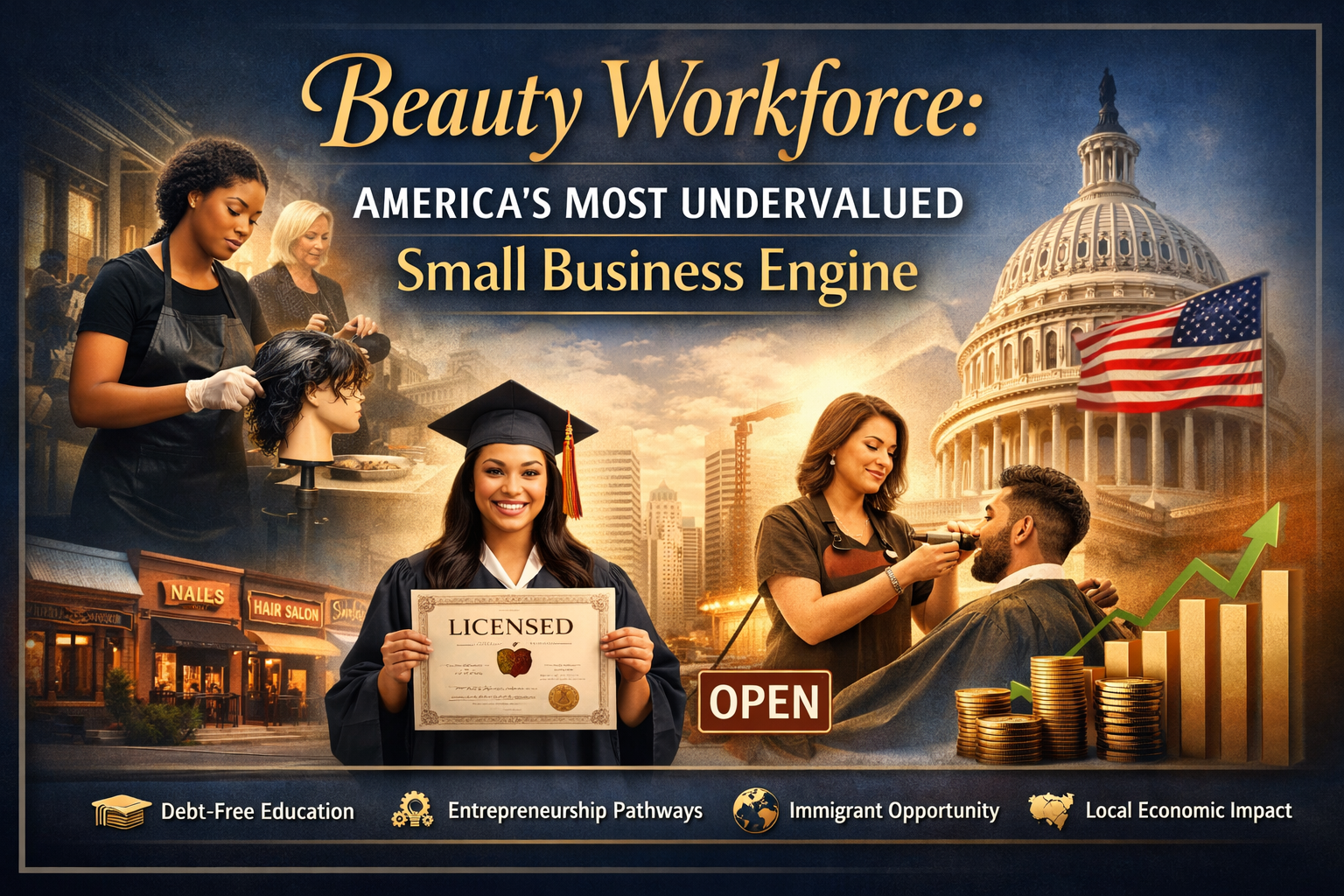
The beauty industry is traditionally categorized within narrow vocational or cosmetic educational silos. However, economic data and labor patterns suggest a different reality: the sector functions as a robust, distributed small-business incubation ecosystem.
This paper argues that beauty workforce development provides a unique, low-fragility pathway for economic mobility. By treating beauty licensees as future micro-entrepreneurs rather than terminal W-2 employees, federal and state policymakers can more effectively support immigrant integration, women-owned business growth, and future-resilient job creation in the age of AI.
1. The Mismatch in Perception
There is a significant mismatch between how beauty workforce development is perceived by regulators and how it actually functions economically. While often viewed as “simple training,” the process of obtaining a beauty license is effectively the first step in a business lifecycle.
Figure 1: The rapid transition from training to independent microenterprise (Booth/Suite Rental).
2. A Distributed Small-Business Ecosystem
Unlike many sectors where the goal is long-term corporate employment, the beauty industry encourages early independence. Booth rental, suite rental, and 1099 contractor status are not peripheral to the industry—they are its structural core.
Micro-Leasing Models
Licensees act as tenants within larger facilities, managing their own P&L, inventory, and branding from Day 1.
Capital Efficiency
The transition from student to independent operator requires minimal capital compared to traditional tech or retail startups.
3. Case Study: Louisville Beauty Academy (LBA)
Louisville Beauty Academy serves as a practical demonstration of this incubation logic. As a multilingual, affordable, and nationally recognized institution, LBA focuses on licensure-driven outcomes.
- Multilingual Accessibility: Lowering barriers for immigrant populations to enter the legal workforce.
- Compliance Priority: Ensuring graduates understand the regulatory environment necessary for legal business operation.
- Economic Velocity: Moving students from enrollment to income generation with minimal educational debt.
This model is supported by the Di Tran University (DTU) framework, which focuses on humanization and scalable systems for practical uplift, led by Di Tran’s experience in immigrant mobility and system building.
4. AI-Resilient Human Services
In the context of the Fourth Industrial Revolution, policymakers are concerned with job displacement. Beauty and wellness represent a “human-touch” sector that remains fundamentally resilient to AI automation.
Figure 2: Resilience of human-service microenterprises vs. automated sectors.
5. Strategic Policy Implications
Redefine Success Metrics: Department of Labor and SBA entities should measure beauty education success by Business Formation Rates, not just W-2 placement.
Support Affordable Pathways: Prioritize funding for institutions like LBA that provide low-barrier, high-access paths to licensure without standard debt-heavy collegiate models.
Inclusive Entrepreneurship: Utilize the New American Business Association (NABA) as a platform for organizing the beauty sector into a formalized small-business constituency.
The Evolution of Vocational Theory: From Education to Incubation
The American vocational landscape is currently navigating a period of profound structural transformation, transitioning from a static, credential-based model to a dynamic, reputation-based “proof-of-work” economy.1 Historically, the institutionalization of beauty education has been relegated to the periphery of workforce development policy, often viewed through the narrow lens of basic vocational training. However, contemporary economic data and the emergence of high-impact demonstration models suggest that this sector functions more accurately as a sophisticated small-business incubation ecosystem. The traditional sequential approach—where a learner first consumes capital through education and then produces capital in the workforce—is increasingly being replaced by the Concurrent Contribution Education Model.1 This model disruptions the legacy cycle by allowing learners to maintain labor market participation while pursuing state-regulated licensure, thereby generating tax revenue and economic value throughout the training period.1
At the heart of this paradigm shift is the recognition that beauty workforce development provides a direct, low-cost pathway to economic sovereignty. Unlike traditional higher education, which is frequently burdened by credential inflation and the disruptive potential of automation, the beauty sector is grounded in state-protected, tactile skills that remain resilient to the pressures of artificial intelligence.1 The institutional framework established by entities such as the Louisville Beauty Academy and Di Tran University demonstrates how a “license-first” approach can move individuals from economic dormancy to professional sovereignty in under twelve months.2 This velocity of entry is critical for high-constraint demographics, including immigrant populations and working-class adult learners, for whom the “risk window” of long-term education often leads to financial or life disruptions.1
The policy framework proposed herein argues for a radical decoupling from the “debt-extractive” cycle that has historically characterized proprietary trade schools.3 By eliminating the “Compliance Tax” associated with federal financial aid bureaucracy and the “Glamour Tax” of high-gloss marketing, institutions can deliver superior technical training at a fraction of the market cost.3 This transition reframes the beauty school not merely as an educational provider, but as a “Freedom Factory” that facilitates an identity shift from survival to professional mastery.1 This evolution is substantiated by the integration of informational economics and behavioral theory, which suggests that debt-free enablement and rapid licensure are the primary drivers of long-term economic mobility and community participation.1
Economic Analysis of the Human-Service Sector
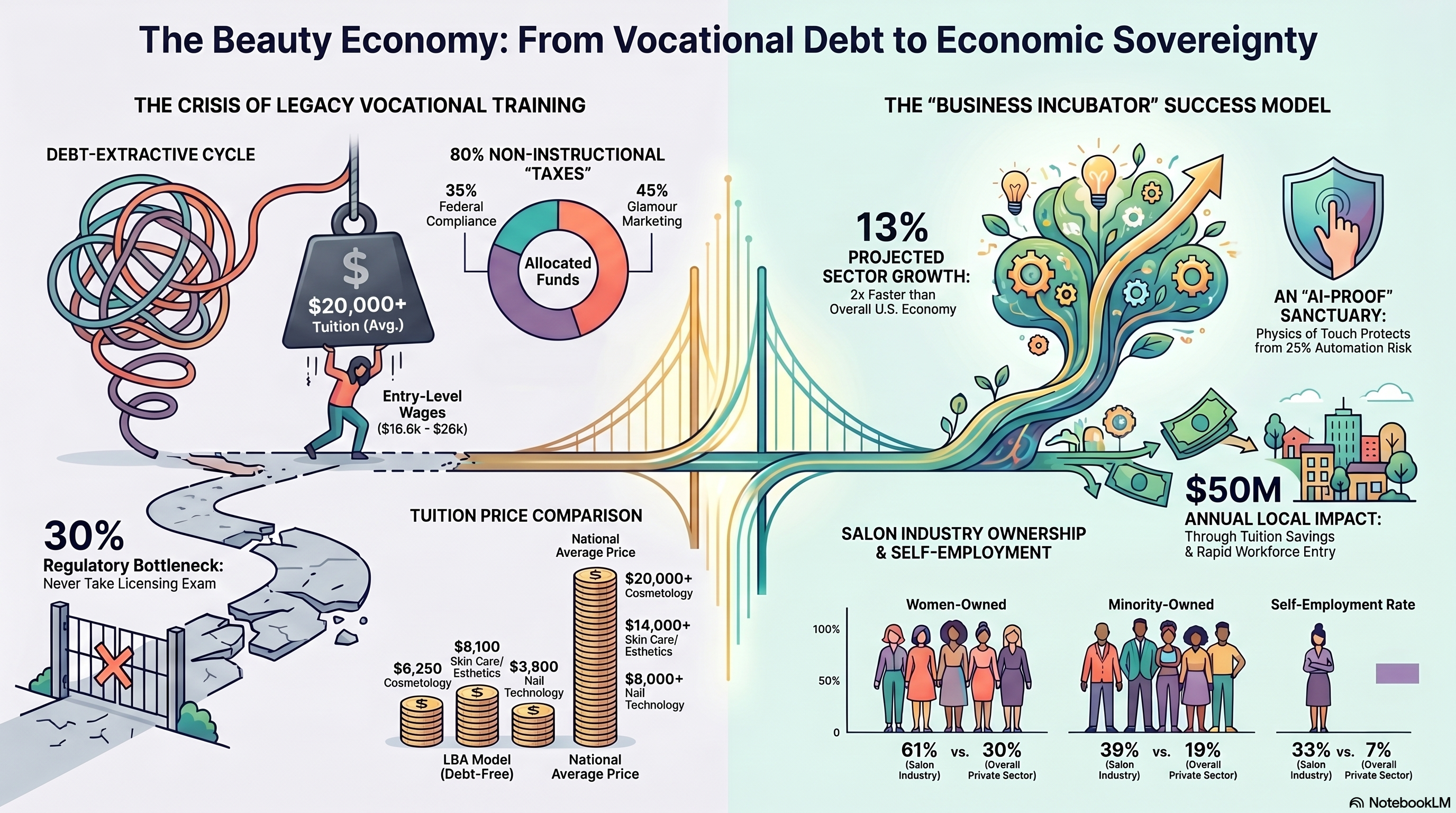
The salon and spa industry is a vibrant and expanding component of the United States economy, characterized by more than 1.2 million establishments and annual sales exceeding $62 billion.4 Despite the significant impact of the 2020 pandemic—which saw employment-based salon revenue plunge by nearly 26%—the sector has demonstrated a superior growth trajectory compared to the broader private sector.4 Bureau of Labor Statistics projections indicate that the number of personal appearance jobs will increase by 13% between 2021 and 2031, more than double the projected 5% growth for all U.S. employment.5
Table 1: Occupational Growth Projections and Economic Contribution
| Personal Appearance Occupation | Projected Job Growth (2021-2031) | 2024 Median Hourly Wage | 2024 Total Jobs |
| Manicurists and Pedicurists | 22% 5 | $16.81 6 | 172,300 (2023) 6 |
| Skincare Specialists | 17% 5 | $20.09 6 | 94,800 (2023) 6 |
| Hairdressers, Hairstylists, Cosmetologists | 11% 5 | $16.95 7 | 575,200 7 |
| Barbers | 8% 5 | $18.73 7 | 76,000 7 |
| Total Personal Appearance Jobs | 13% 5 | $17.03 (Median) 7 | 1,179,000 (2021) 5 |
The industry’s economic significance is further underscored by its role as an engine of job growth during periods of broader economic instability. During the “Lost Decade,” the salon industry added thousands of locations while other sectors shed jobs, showcasing its counter-cyclical resilience.8 This resilience is fundamentally linked to the industry’s demographic composition and its commitment to inclusivity. Women own approximately 60% of all salon businesses, compared to only 21% to 30% in the overall private sector.5 Furthermore, minority ownership in the salon industry stands at 39%, nearly double the 19% rate observed in total private sector businesses.5 These statistics suggest that beauty workforce development acts as a primary vehicle for economic participation for historically underserved populations.
Table 2: Comparative Small Business Ownership Rates
| Ownership Category | Salon Industry | Overall Private Sector |
| Self-Employment Rate | 33% 5 | 7% 5 |
| Women-Owned Businesses | 61% 8 | 30% 8 |
| African American-Owned Businesses | 21% 8 | 7% 8 |
| Asian-Owned Businesses | 22% 4 | 7% 4 |
The high rate of self-employment—37% for hairdressers and 36% for barbers—indicates that the completion of a beauty program is, in a majority of cases, the launching of a microenterprise.5 This transition from student to sole proprietor is facilitated by the industry’s unique “booth rental” and “salon suite” structures, which minimize entry costs for new entrepreneurs.9 Consequently, policy interventions aimed at improving the efficiency of the beauty workforce pipeline have a disproportionately high impact on local tax bases and community wealth generation.
The Debt-Extractive Crisis and Regulatory Misalignment
Despite the robust growth of the personal care sector, the educational infrastructure supporting it is currently facing a “debt-to-income” crisis.3 The institutionalization of beauty education has historically been tied to federal student aid programs, which have incentivized tuition inflation without a commensurate increase in graduate earnings.3 Research indicates that graduates of traditional beauty programs often find their entry-level wages—averaging between $16,600 and $26,000—insufficient to service median loan debts of $10,000 or more, leading to a pervasive sense of being “trapped” in a cycle of debt.11
The Mechanics of Tuition Inflation
The “Compliance Tax” represents the administrative overhead required to maintain federal Title IV eligibility, consuming 25% to 35% of tuition revenue.3 This includes the costs of financial aid officers, third-party data servicers, and rigorous annual CPA audits.3 Additionally, the “Glamour Tax” accounts for roughly 45% of tuition, covering high-gloss marketing, recruitment commissions, and lifestyle branding designed to sell the “prestige theater” of a luxury career.3 These costs are ultimately borne by the student, resulting in tuition rates that are significantly higher than the actual cost of technical instruction.11
Table 3: Deconstruction of the National Beauty Tuition Premium
| Cost Component | Percentage of Tuition | Function |
| Compliance Tax | 25% – 35% 3 | Federal aid administration and audits. |
| Glamour Tax | 45% 3 | Marketing, recruitment, and luxury branding. |
| Technical Instruction | 20% – 30% 3 | Core skills, safety, and sanitation training. |
The misalignment between program length and professional readiness also serves as a regulatory hurdle. In some states, cosmetologists must complete 1,000 to 1,500 hours of coursework, a requirement that often exceeds the training hours required for professions that deal with life-and-death situations.12 This prolonged duration increases the likelihood of attrition among adult learners who face competing family and financial obligations.1 Furthermore, nearly 30% of students who complete their school hours never actually take the state licensing exam, creating a significant bottleneck in the workforce pipeline.13 Addressing these systemic failures requires a policy shift toward outcome-based funding and debt-averse, discount-first educational models.14
The Louisville Beauty Academy Model: Technical Pillar Analysis
The Louisville Beauty Academy (LBA) represents a “category-of-one” framework for debt-free, license-first workforce education.2 Positioned as a flagship institution under Di Tran University, LBA eschews federal financial aid programs in favor of a model that prioritizes student economic sovereignty and public protection.2 This approach allows LBA to maintain tuition rates that are 50% to 75% lower than the national average.3
Table 4: LBA Program Efficiency and Debt Reduction
| Program (LBA Model) | Discounted Package Cost | National Average Sticker Price | Graduate Debt |
| Cosmetology | $6,250.50 2 | ~$20,000+ 3 | $0 3 |
| Skin Care / Esthetics | $6,100.00 2 | ~$14,000+ 2 | $0 3 |
| Nail Technology | $3,800.00 2 | ~$8,000+ 2 | $0 3 |
| Instructor Program | $3,900.00 2 | ~$12,000+ 2 | $0 3 |
LBA’s model is substantiated by several non-negotiable structural pillars:
- Structural Independence and Asset Ownership: LBA stabilizes its overhead by purchasing its facilities in cash.2 This eliminates market rent volatility and the “architecture of fear” associated with commercial leases, allowing the institution to pass savings directly to the students.2
- Pedagogical Rigor and Cognitive Efficiency: The academy utilizes the Zero Disruption Learning Environment (ZDLE), which applies Sweller’s Cognitive Load Theory to minimize extraneous cognitive load.2 By removing administrative friction and linguistic noise, students can focus their working memory on the germane loads required for tactile skill mastery.2
- Action Accumulation Theory: The curriculum is broken down into discrete units where students must demonstrate 80% to 90% mastery before advancing.3 This “Fail Fast” approach treats examinations as diagnostic tools rather than high-stakes failures, accelerating the timeline from enrollment to licensure.2
- Concurrent Contribution: Unlike traditional models, LBA allows students to continue working or managing family lives through flexible scheduling (days, evenings, weekends), ensuring they remain economic actors while they study.1
By moving students through the “Self-Efficacy Loop”—from mastering basic sanitation to passing state exams and entering the workforce—LBA has produced nearly 2,000 licensed graduates with an estimated annual local economic impact of $20 million to $50 million.1
The Living MBA: Microenterprise Formation and Vertical Integration
The true power of the beauty workforce model lies in its function as a “Living MBA,” where technical skill acquisition is inextricably linked to business literacy and real estate control.2 In the personal care sector, the pathway to high earnings is not through technician employment but through vertical integration.14 This process involves three distinct levels of ownership: owning the license (professional right to practice), owning the business (the revenue-generating asset), and owning the real estate (the physical asset).14
Table 5: Vertical Integration and Revenue Potential
| Level of Integration | Description | Estimated Annual Revenue Potential |
| Technician (Employee) | W-2 worker in a traditional salon. | $35,420 (Median) 7 |
| Independent Practitioner | Booth renter or salon suite owner. | $60,000 – $100,000+ 15 |
| Salon Proprietor | Multi-chair salon owner managing other artists. | $1,000,000 – $2,400,000+ 2 |
| Vertically Integrated Owner | Owns the license, the brand, and the building. | High Asset Wealth + Cash Flow 14 |
The LBA model facilitates this transition by training students to understand regulatory literacy and sanitation excellence as business protections.3 Graduates are prepared to transition from technician to salon proprietor, often launching microenterprises that contribute significantly to the local tax base.2 This entrepreneurial trajectory is supported by the industry’s shift toward salon suites, which function as “incubators” by providing professional infrastructure (utilities, Wi-Fi, laundry) without the corporate oversight of traditional salons.10
IRS and Tax Policy Implications for Microenterprises
The transition to independent entrepreneurship requires careful adherence to IRS guidelines on worker classification. The IRS uses a 20-factor test to determine “economic reality,” focusing on whether the worker or the owner controls pricing, hours, and product selection.15 Proper classification as an independent contractor (1099) allows the beauty professional to deduct 100% of chair rent and professional tools, significantly reducing their taxable income.15 For high-earning practitioners, the election to be taxed as an S-Corporation can save thousands in self-employment taxes by allowing for a “reasonable salary” combined with dividend distributions.15 Policy education in these areas is a hallmark of the Di Tran University framework, ensuring that graduates are not only skilled artists but savvy business managers.2
Immigrant Integration and the Architecture of Inclusion
The beauty industry is one of the most diverse professional sectors in the United States, serving as a primary mobility engine for immigrant and multilingual populations.20 In the workforce, immigrant women play critical roles as service providers; in 2017 alone, there were 1.2 million female immigrant entrepreneurs in the U.S., with over 105,000 owning beauty or nail salons.21
Table 6: Immigrant Entrepreneurship in the Beauty Sector (2017 Data)
| Demographic Group | Number of Immigrant Women Entrepreneurs | Key Success Sectors |
| All Immigrant Women | 1,200,000 21 | Main Street Businesses 22 |
| Beauty Salon Owners | 55,072 21 | Personal Care Services |
| Nail Salon Owners | 50,707 21 | Personal Care Services |
| Propensity for Ownership | 4.4% (vs 3.5% for U.S.-born) 22 | High-Growth Small Business |
Louisville Beauty Academy recognizes that language is often the primary barrier to legal licensure. Through the advocacy of Di Tran and the New American Business Association (NABA), Kentucky implemented Senate Bill 14, which mandates multilingual licensing exams.14 This “Architecture of Inclusion” ensures that professionals from diverse backgrounds are tested on critical sanitation and safety standards in a language they fully comprehend, thereby reducing barriers to legal entry and improving public safety.20
Di Tran’s lived experience as an immigrant has enabled culturally aware program design that reduces dropout and attrition rates in these cohorts.23 By providing 24/7 multilingual tutoring and real-time translation tools, LBA bridges the linguistic gap for non-native English learners, moving them from “survival mode” to high-value workforce participation.1 This inclusive approach not only supports the individual but rejuvenates local economies, especially in areas that have seen signs of decline.22
Technological Resilience: Humanized AI and the Physics of Touch
In an era where artificial intelligence is projected to automate 25% of all work hours in the United States, the beauty industry represents a critical “AI-proof sanctuary”.14 Research from Goldman Sachs and Anthropic indicates that AI displacement risk is most concentrated in knowledge-based, professional, and remote sectors such as Computer & Mathematical, Office Support, and Business & Financial.26
Table 7: Comparative AI Displacement Risk by Occupation
| High AI Exposure (High Risk) | Low AI Exposure (High Resilience) |
| Computer & Mathematical 27 | Personal Care & Service (Beauty) 26 |
| Office & Administrative Support 27 | Construction & Skilled Trades 25 |
| Business & Financial Operations 27 | Home Healthcare Services 25 |
| Sales & Creative Contexts 25 | Agricultural Field Work 26 |
The “Physics of Touch”—the essential human connection inherent in tactile service professions—remains beyond the reach of current AI capabilities.2 While AI can grade homework or represent data, it cannot manage a classroom or perform a chemical hair service.27 Di Tran University’s “College of AI” does not seek to replace the human element but rather to use “Humanized AI” as an operational multiplier to enhance instruction, compliance, and student support.2
By integrating AI into the administrative and documentation layers, Di Tran University liberates students and faculty to focus on the cultivation of human bonds and the mastery of manual skills.28 This ensures that beauty graduates are not only protected from AI-driven displacement but are also empowered by technology to run more efficient microenterprises.2 The future of work in the human-service sector lies in this synthesis of high-tech efficiency and high-touch empathy.28
Policy Frameworks for Outcome-Based Funding
The New American Business Association (NABA) and Di Tran have consistently advocated for federal and state policies that prioritize results over enrollment.14 The current federal student aid model is often criticized for being “enrollment-driven,” leading to waste when students fail to complete programs or obtain licenses.14
The Pay-for-Outcome Proposal
NABA proposes a shift in federal student aid toward a “Pay-for-Success” model, where the Department of Education disburses funds only upon the achievement of specific milestones.14
- Completion-Based Payments: Aid is released at the end of a semester or upon program graduation to address the high attrition rates in traditional vocational schools.14
- Licensure and Employment Bonuses: Additional funding increments are tied to the student passing the state licensing exam and obtaining employment in their field.14
- Short-Program Recognition: Expanding aid eligibility to high-demand programs under 600 clock hours (e.g., nail technology and esthetics) to speed talent into the small-business economy.14
- Third-Party Sponsorship: Utilizing local banks or credit unions to provide interest-free bridge loans that are repaid by federal aid only when the student successfully completes their training.14
Table 8: NABA Proposal for Outcome-Based Federal Student Aid
| Milestone | Disbursement Entity | Justification |
| Graduation | 50% of Total Aid | Ensures institution focuses on student persistence. |
| State Licensure | 25% of Total Aid | Official verification from state boards. |
| Job Placement | 25% of Total Aid | Verified via UI wage records or employer confirmation. |
| Equity Bonus | Variable Adjusted Metric | Rewards schools for graduating Pell-eligible students. |
This framework protects taxpayers from funding failed attempts and encourages institutions to adopt the “Certainty Engine” philosophy of high-velocity, high-quality instruction.2 By aligning financial incentives with graduate success, policy can foster an environment where small-business creation becomes the standard outcome of vocational education.
SBA and WIOA: Leveraging Federal Ecosystems for Local Impact
Integrating the beauty industry into the broader small-business support infrastructure requires collaboration with the U.S. Small Business Administration (SBA) and the utilization of the Workforce Innovation and Opportunity Act (WIOA).
SBA Community Navigator Pilot Program (CNPP)
The SBA’s Community Navigator Pilot Program utilizes a “Hub and Spoke” model to connect underserved small business owners to critical resources.30 This model is particularly effective for minority and immigrant-owned businesses that may lack traditional banking relationships or formal records.31 Organizations like NABA function as these community navigators, providing technical assistance in areas such as tax record preparation, bank statement analysis, and business plan development.32
Table 9: SBA Business Development and Support Programs
| Program Name | Target Audience | Primary Benefit |
| 8(a) Business Development | Socially/Economically Disadvantaged | Training, technical assistance, federal contracts. |
| HUBZone Program | Businesses in distressed areas | Preferential access to federal contracting. |
| CNPP Hub & Spoke | Historically underserved communities | Outreach, training, and capital access. |
| WOSB Federal Contract | Women-Owned Small Businesses | Access to reserved federal contracts. |
WIOA and Skills-Based Training
WIOA provides federally funded grants for individuals to acquire in-demand skills and secure sustainable employment.33 These funds cover tuition, books, and supportive services such as child care and transportation.33 Policy efforts should focus on ensuring that beauty programs are recognized as “Eligible Training Providers” within the WIOA system, particularly those that offer short-term pathways into self-sustaining entrepreneurship.35 By braiding WIOA funds with private resources and the debt-free LBA model, the cost barrier to professional licensure can be virtually eliminated for the most vulnerable job seekers.37
Fiscal Engine Analysis: The $50 Million Local Impact
The Louisville Beauty Academy model demonstrates that a lean, ethical, and outcomes-oriented institution can serve as a massive fiscal engine for its local community. Over a ten-year documented period, LBA has produced nearly 2,000 licensed graduates, contributing an estimated $20 million to $50 million annually to the Kentucky economy.2
The “Double Scoop” Economic Benefit
The fiscal impact of the LBA model is calculated through the “Double Scoop” theory of savings and income velocity 3:
- Scoop One (Tuition Savings): By paying $6,250 instead of $20,000 for a cosmetology program, a student retains $13,750 on “Day One”.3 Across 2,000 graduates, this represents a collective savings of over $27 million that remains in the pockets of the local workforce.
- Scoop Two (Time Gain): A student who graduates six months earlier than a peer in a traditional school gains six months of professional income.3 At an average rate of $18 to $28 per hour in the Louisville market, this time gain translates to thousands of dollars in immediate economic circulation.3
Table 10: Estimated Net Fiscal Impact of LBA (10-Year Model)
| Impact Category | Estimated Value (Annual) | Economic Mechanism |
| Direct Earnings of Graduates | $25,000,000 – $35,000,000 | Wages from licensure and ownership. |
| Small Business Launches | $5,000,000 – $10,000,000 | Alumni launching salons and suites. |
| Tax Revenue Contribution | $2,000,000 – $5,000,000 | Income tax and local payroll tax. |
| Public Savings | $1,500,000 – $3,000,000 | Zero reliance on Title IV aid/defaults. |
| Total Annual Impact | $20,000,000 – $50,000,000 | 2 |
This fiscal engine operates without the “architecture of fear” associated with high student debt. Instead, it creates a “Self-Efficacy Loop” where the validation of passing a state exam leads to immediate workforce entry and capital accumulation.1 This model proves that progress is made through disciplined action and that human potential expands when knowledge is used as a tool for service rather than a mechanism for debt.23
Conclusion: Nationalizing the Ethical Workforce Academy Model
The research presented here indicates that beauty workforce development is uniquely positioned to serve as a national blueprint for ethical, high-impact vocational training. America’s Ethical Workforce Academy™ Model, as demonstrated by the Louisville Beauty Academy, offers a transformative alternative to the traditional, debt-dependent system.38
By prioritizing ethical clarity, transparent community engagement, and zero student exploitation, this model establishes education as a moral act.38 Di Tran’s philosophy of “Humanization” asserts that individuals grow most when they are valued, empowered, and taught without the extracted labor value common in commercial student clinics.38 This model is not theoretical; it is proven in operation, scalable in design, and ready to be nationalized as America’s next generation of service-anchored training.38
The policy framework for the future of the beauty industry must include:
- Recognition of the Industry as a Small-Business Incubator: Moving beyond the “narrow training” label to appreciate the micro-enterprise formation rates.
- Expansion of Multilingual Access: Aligning regulatory systems with real workforce demographics to unlock immigrant human capital.20
- Implementation of Pay-for-Outcome Funding: Protecting taxpayer dollars and rewarding institutions that achieve high licensure and employment rates.14
- Strategic Investment in Tactile Professions: Securing the workforce against AI-driven displacement by focusing on the “Physics of Touch”.14
Di Tran University, Di Tran, and the New American Business Association represent credible demonstration entities that have already integrated these principles into a functioning reality.23 Through more than 150 published works and a decade of documented success, this model provides the “Certainty Engine” needed for workforce stability in an era of volatility.39 The ultimate goal of this framework is to uplift human dignity, restore the American Dream for working-class and immigrant families, and ensure that profit and humanity walk hand in hand toward collective advancement.23
Works cited
- Institutional Analysis of Vocational Innovation: The Louisville Beauty Academy Case Study in Workforce Humanization – Medium, accessed April 17, 2026, https://medium.com/@lbeautyacademy/institutional-analysis-of-vocational-innovation-the-louisville-beauty-academy-case-study-in-ccc85d154236
- The Louisville Beauty Academy Model: A Category-of-One …, accessed April 17, 2026, https://louisvillebeautyacademy.net/the-louisville-beauty-academy-model-a-category-of-one-framework-for-debt-free-license-first-workforce-education-research-podcast-series-2026/
- Louisville Beauty Academy: Becoming One of the Most Admired …, accessed April 17, 2026, https://naba4u.org/2026/04/louisville-beauty-academy-becoming-one-of-the-most-admired-rising-models-in-ethical-accessible-debt-disciplined-human-centered-beauty-education-research-podcast-series-2026/
- Economic Snapshot of the Salon Industry, accessed April 17, 2026, https://iahd.net/wp-content/uploads/2021/04/2020economicsnapshotofthesalonindustry.pdf
- Economic Snapshot of the Salon Industry – Reginfo.gov, accessed April 17, 2026, https://www.reginfo.gov/public/do/eoDownloadDocument?pubId=&eodoc=true&documentID=212246
- Hairdressers, Hairstylists, and Cosmetologists – Bureau of Labor Statistics, accessed April 17, 2026, https://www.bls.gov/oes/2023/may/oes395012.htm
- Barbers, Hairstylists, and Cosmetologists – Bureau of Labor Statistics, accessed April 17, 2026, https://www.bls.gov/ooh/personal-care-and-service/barbers-hairstylists-and-cosmetologists.htm
- Economic Snapshot of the Salon and Spa Industry | Finance.Senate.gov, accessed April 17, 2026, https://www.finance.senate.gov/imo/media/doc/Professional%20Beauty%20Association-%202014%20Economic%20Snapshot%20of%20the%20Salon%20Industry.pdf
- The Rising Demand for Salon Suites: Market Trends and Statistics, accessed April 17, 2026, https://salonrenter.com/rising-demand-salon-suites-market-trends-statistics/
- The impact of the gig economy on salon rentals – Designing Buildings Wiki, accessed April 17, 2026, https://www.designingbuildings.co.uk/wiki/The_impact_of_the_gig_economy_on_salon_rentals
- affordable beauty school Archives – Louisville Beauty Academy, accessed April 17, 2026, https://louisvillebeautyacademy.net/tag/affordable-beauty-school/
- Occupational Licenses Are Killing Minority Entrepreneurship – FEE.org, accessed April 17, 2026, https://fee.org/articles/occupational-licenses-are-killing-minority-entrepreneurship/
- Research – The Future of the Beauty Industry Coalition, accessed April 17, 2026, https://fbic.org/research/
- Louisville to Washington DC: NABA Founder Di Tran Joins NSBA’s …, accessed April 17, 2026, https://naba4u.org/2025/09/louisville-to-washington-dc-naba-founder-di-tran-joins-nsbas-national-advocacy-ranks/
- Tax Services for Salon & Barbershop Owners – Taxstra, accessed April 17, 2026, https://taxstra.com/salon-owners/
- Case Study: From Commission Stylist to Beauty Entrepreneur – How a Salon Studio Rental Can Significantly Boost Your Income, accessed April 17, 2026, https://indiesalons.com/boulder-commission-stylist-case-study/
- Salon Employee vs. Booth Renter: What Misclassification Could Cost You – Whirks, accessed April 17, 2026, https://www.whirks.com/blog/salon-employee-vs-booth-renter-misclassification
- Publication 4902 (2-2011) – IRS, accessed April 17, 2026, https://www.irs.gov/pub/irs-pdf/p4902.pdf
- Booth Renters vs. Employees: Tax Implications in the Salon Industry – Lightheart, Sanders, accessed April 17, 2026, https://lsa.cpa/2024/06/15/booth-renters-vs-employees-tax-implications-in-the-salon-industry/
- Tag: immigrant cosmetology workforce kentucky – Louisville Beauty Academy, accessed April 17, 2026, https://louisvillebeautyacademy.net/tag/immigrant-cosmetology-workforce-kentucky/
- Highlighting the Economic Contributions of Immigrant Women, accessed April 17, 2026, https://www.americanimmigrationcouncil.org/report/the-economic-contributions-of-immigrant-women/
- The Entrepreneurial Spirit: A Profile of Business Owners Across the United States, accessed April 17, 2026, https://immresearch.org/publications/the-entrepreneurial-spirit-a-profile-of-business-owners-across-the-united-states/
- Di Tran — Founder & CEO | Visionary Leader in Workforce …, accessed April 17, 2026, https://naba4u.org/di-tran-founder-ceo-visionary-leader-in-workforce-education-humanized-ai-and-immigrant-entrepreneurship/
- Amid Immigration Crackdowns, New Report Shows Role of Business Owners Who Are Immigrants, Women, People of Color, accessed April 17, 2026, https://immresearch.org/amid-immigration-crackdowns-new-report-shows-role-of-business-owners-who-are-immigrants-women-people-of-color/
- How Will AI Affect the US Labor Market? | Goldman Sachs, accessed April 17, 2026, https://www.goldmansachs.com/insights/articles/how-will-ai-affect-the-us-labor-market
- Labor market impacts of AI: A new measure and early evidence – Anthropic, accessed April 17, 2026, https://www.anthropic.com/research/labor-market-impacts
- Anthropic: AI’s influence over the labor market is only beginning to be felt | HR Dive, accessed April 17, 2026, https://www.hrdive.com/news/anthropic-ai-influence-over-the-labor-market-jobs/814670/
- Di Tran University, accessed April 17, 2026, https://ditranuniversity.com/
- Gold‑Standard Over‑Compliance, Ethical Automation, and Humanization in Beauty Education: Louisville Beauty Academy as an Observable Case Study – RESEARCH & PODCAST SERIES 2025 – Di Tran University, accessed April 17, 2026, https://ditranuniversity.com/gold-standard-over-compliance-ethical-automation-and-humanization-in-beauty-education-louisville-beauty-academy-as-an-observable-case-study-research-podcast-series-2025/
- Community Navigator Pilot Program Evaluation | U.S. Small Business Administration – SBA, accessed April 17, 2026, https://www.sba.gov/document/report-community-navigator-pilot-program-evaluation
- CNPP Brief – International Rescue Committee, accessed April 17, 2026, https://www.rescue.org/sites/default/files/2023-08/CNPP%20Brief.pdf
- SBA Has Opportunities to Evaluate Outcomes and Enhance Fraud Risk Mitigation – GAO, accessed April 17, 2026, https://files.gao.gov/reports/GAO-25-107067/index.html
- Workforce Investment and Opportunities Act (WIOA), accessed April 17, 2026, https://lwdsupport.tn.gov/hc/en-us/articles/360000045468-Workforce-Investment-and-Opportunities-Act-WIOA
- Workforce Innovation & Opportunity Act – Idaho Workforce Development Council, accessed April 17, 2026, https://wdc.idaho.gov/workforce-innovation-opportunity-act/
- Workforce Innovation and Opportunity Act – SC Works, accessed April 17, 2026, https://scworks.org/workforce-system/workforce-innovation-and-opportunity-act
- Workforce Innovation and Opportunity Act | NC Commerce, accessed April 17, 2026, https://www.commerce.nc.gov/jobs-training/workforce-professionals-tools-resources/workforce-innovation-and-opportunity-act
- Beyond Job Placement: Reimagining WIOA for Economic Mobility and Workforce Resilience, accessed April 17, 2026, https://tcf.org/content/report/beyond-job-placement-reimagining-wioa-for-economic-mobility-and-workforce-resilience/
- America’s Ethical Workforce Academy™ Model – Louisville Beauty Academy, accessed April 17, 2026, https://louisvillebeautyacademy.net/americas-ethical-workforce-academy-model/
- Tag: vocational education podcast 2026 – Louisville Beauty Academy, accessed April 17, 2026, https://louisvillebeautyacademy.net/tag/vocational-education-podcast-2026/
- ADVOCACY – New American Business Association (NABA) – Louisville, KY, accessed April 17, 2026, https://naba4u.org/category/advocacy/
Discover more from New American Business Association (NABA) - Louisville, KY
Subscribe to get the latest posts sent to your email.