
Builders of the American Local Economy: A Comprehensive Economic, Cultural, and Workforce Analysis of Asian, Latino, and Immigrant Contributions to Kentucky’s Growth Engine — A Case Study Framework Anchored by Louisville Beauty Academy and the Di Tran University Model – RESEARCH & PODCAST SERIES 2026
Di Tran University — The College of Humanization
Research & Policy Development Division
Research & Educational Disclaimer
This publication is provided strictly for educational, research, and public information purposes. It does not constitute legal, financial, regulatory, or investment advice. All interpretations, analyses, and conclusions presented herein are derived from publicly available data, institutional case study methodologies, and independent research frameworks.
While every effort has been made to ensure accuracy, completeness, and integrity of the information, no guarantee is made regarding the absolute accuracy or future applicability of the findings. Readers, institutions, and policymakers are strongly encouraged to conduct their own independent due diligence and consult qualified professionals before making any decisions based on this material.
This publication does not represent the official position of any governmental agency, regulatory body, or third-party institution unless explicitly stated.
Executive Summary
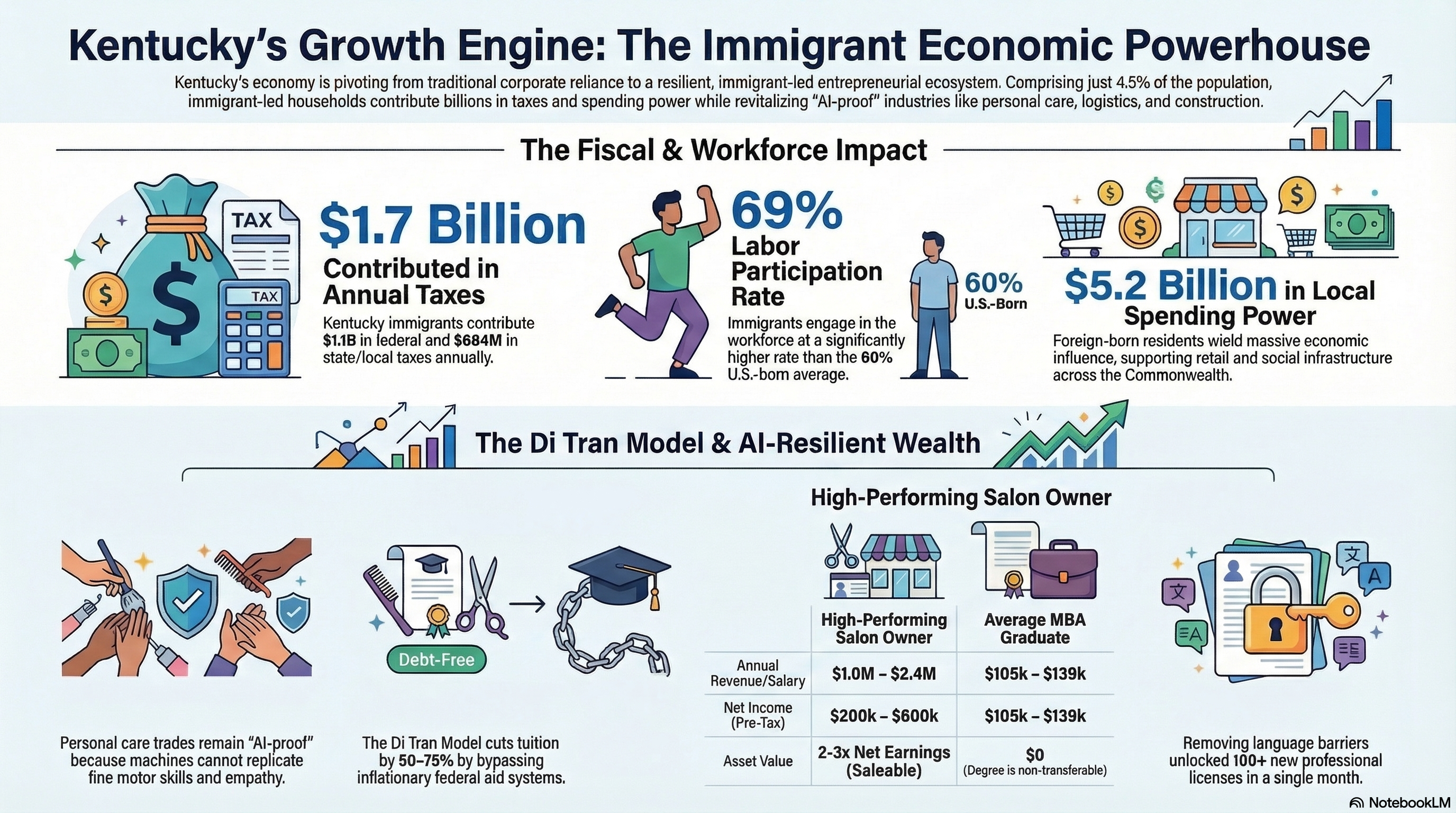
The economic architecture of Kentucky is undergoing a fundamental structural transformation, pivoting from a reliance on traditional corporate employment toward a resilient, immigrant-led entrepreneurial ecosystem. As of late 2025, Kentucky’s civilian labor force reached 2,117,499 individuals, yet the business environment is increasingly characterized by a “slow-hire/slow-fire” dynamic where large-scale firms remain reluctant to expand payrolls amidst persistent 3% inflation.1 In this cooling corporate climate, the immigrant population—comprising 4.5% of the state’s total residents—has emerged as a disproportionate driver of growth, job creation, and fiscal stability.3 Immigrant-led households in Kentucky contribute an estimated $1.7 billion in total annual taxes and wield $5.2 billion in spending power, effectively subsidizing the state’s social infrastructure while filling critical labor gaps in manufacturing, logistics, and personal services.3
This analysis identifies several ethnic corridors that serve as primary economic engines. The Vietnamese community has democratized the $8.8 billion national nail industry through a model of high-volume, affordable personal care, while the Korean community has established sophisticated, vertically integrated retail chains in the beauty supply sector.4 Simultaneously, the Japanese manufacturing sector, anchored by Toyota, continues to provide a blueprint for workforce stability through the Toyota Production System and “Raku” ergonomics.7 The Cuban and Latino populations have fundamentally reshaped Louisville’s labor market, providing the essential workforce for global hubs like GE Appliances, UPS, and Amazon.9
Central to the sustainability of this growth is the “Di Tran Model,” exemplified by the Louisville Beauty Academy (LBA). This framework rejects the extractive, debt-heavy traditional vocational school model in favor of a debt-free, compliance-first infrastructure.10 By integrating multilingual licensing (Kentucky SB 14), “Concurrent Contribution” work-study cycles, and transparent digital record systems, the Di Tran Model positions trade education as essential economic infrastructure.12 The findings of this report suggest that the future of the American local economy is increasingly driven by these immigrant-led ecosystems that produce skilled workforce participants rather than debt-dependent consumers.14
Key Findings
The following data sets summarize the primary indicators of economic contribution and workforce transformation in the Commonwealth of Kentucky as of the 2024–2026 period.
Table 1: Kentucky Immigrant Economic and Fiscal Contributions (2023-2025)
| Metric | General Immigrant Population | Undocumented Population | Likely Refugees |
| Total Residents | 202,900 3 | 52,900 3 | 20,200 3 |
| Total Household Income | $7.0 Billion 3 | N/A | N/A |
| Total Taxes Paid | $1.7 Billion 3 | $233.1 Million 3 | $141.9 Million 3 |
| Federal Taxes | $1.1 Billion 3 | $137.4 Million 3 | $79.8 Million 3 |
| State & Local Taxes | $684.7 Million 3 | $95.7 Million 3 | $62.1 Million 3 |
| Spending Power | $5.2 Billion 3 | $883.1 Million 3 | $467.4 Million 3 |
| Social Security Contribution | $712.6 Million 3 | N/A | N/A |
| Medicare Contribution | $184.3 Million 3 | N/A | N/A |
Table 2: Workforce Concentration and Educational Attainment Comparisons
| Industry / Metric | Immigrant Share (%) | U.S.-Born Counterpart | Key Finding |
| General Services | 11.5% 3 | N/A | Highest concentration in personal care.3 |
| Transportation/Logistics | 8.3% 3 | N/A | Critical for UPS/Amazon hubs.15 |
| Construction | 8.1% 3 | N/A | Backbone of infrastructure projects.9 |
| Manufacturing | 6.3% 3 | N/A | Flocking to GE and Ford plants.9 |
| STEM Workers | 7.5% 3 | N/A | Disproportionate high-tech contribution.3 |
| Labor Participation | 69% 16 | 60% 16 | Higher engagement than native-born.16 |
| Bachelor’s Degree + | 35.3% 3 | 27.4% 3 | Immigrants are more college-educated.3 |
Macro Context: Kentucky’s Structural Shift and the “Slow-Hire/Slow-Fire” Economy
The Kentucky economy in the mid-2020s is defined by a profound divergence between household-level employment gains and establishment-level payroll stagnation. In December 2025, the state’s seasonally adjusted nonfarm employment decreased by 300 jobs, even as the household survey indicated an increase of 4,928 Kentuckians in the workforce.1 This anomaly suggests a rising trend in self-employment, independent contracting, and small-scale entrepreneurship, much of which is driven by the immigrant community. While the corporate sector reflects a “slow-hire/slow-fire” labor market—characterized by a reluctance to add new positions due to high tariffs and persistent inflation—the small business sector has become the primary source of net job creation.2 Between March 2022 and March 2023, small businesses accounted for 92.3% of Kentucky’s net job growth, contributing 46,739 new positions.17
The manufacturing sector, historically the bedrock of Kentucky’s economy, experienced a contraction in late 2025, losing 2,400 positions compared to the previous year.1 Conversely, the construction sector grew by 6.7% over the same period, fueled by significant infrastructure investments and the growth of Latino-owned contracting firms.1 The logistics industry also remains a dominant force, with Kentucky sitting at the center of a 34-state distribution area in the Eastern U.S..15 Projects like Kroger’s $391 million distribution center in Simpson County and the expansion of the Amazon Air Hub in Northern Kentucky are creating thousands of jobs that require the steady, reliable labor force provided by immigrant communities.15
The fiscal health of the Commonwealth is increasingly tied to the economic activity of its 202,900 foreign-born residents.3 Immigrants in Kentucky are not only consumers but significant taxpayers, supporting Medicare and Social Security at rates that outpace their population share.3 The transition from a manufacturing-heavy “extraction” economy—where value is often captured by out-of-state corporations—to a “contributory” ecosystem of immigrant-owned small businesses is essential for long-term stability.14 This shift is catalyzed by vocational institutions like the Louisville Beauty Academy, which produce skilled practitioners who contribute to the tax base immediately upon licensure.11
Vietnamese Contribution: The Economics of Personal Care and Market Accessibility
The Vietnamese American community has fundamentally democratized the beauty and nail salon industry, transforming it from a luxury service into an accessible, multi-billion-dollar sector of the American economy. Nationally, Vietnamese Americans own over 51% of all nail salons, a presence that began with a program initiated by actress Tippi Hedren in 1975 to settle refugee women.21 This initial investment in trade skills blossomed into an $8 billion to $12.9 billion industry.6 In Kentucky, this sector is a vital component of the “General Services” industry, which employs 11.5% of the state’s immigrant workforce.3
The Vietnamese nail industry model is built on high-volume, low-margin accessibility. By implementing efficient family-based shop models, Vietnamese technicians lowered the price of manicures from $50 in the 1970s to as low as $20 in the modern era, dramatically expanding the consumer base.4 This accessibility turned nail care into a regular wellness routine for over 20 million Americans.4 The economic multiplier effect of these salons is significant; they occupy retail spaces in shopping centers, draw foot traffic to neighboring businesses, and support an extensive secondary supply chain of beauty products and salon construction.4
Despite the low-wage perception of the industry, high-performing salons generate substantial revenue. An established salon with 10 to 20 technicians can produce annual gross revenues between $1 million and $2.4 million.24 With relatively low costs of goods sold (COGS), these businesses offer profit margins of 15% to 25%, often providing the owner with a draw far higher than the average salary of a corporate mid-manager or even an MBA graduate.24 This “Million Dollar Paradox” illustrates the wealth-building power of licensed trade ownership within immigrant communities.
Table 3: The “Million Dollar Paradox” — Licensed Ownership vs. Corporate Employment (2024 Estimates)
| Metric | High-Performing Salon Owner | Average MBA Graduate | Corporate Mid-Manager |
| Annual Revenue/Salary | $1,000,000 – $2,400,000 24 | $105,000 – $139,000 24 | $85,000 – $120,000 24 |
| Net Income (Pre-Tax) | $200,000 – $600,000 24 | $105,000 – $139,000 24 | $85,000 – $120,000 24 |
| Asset Value | 2-3x Net Earnings (Saleable) 24 | $0 (Degree non-transferable) 24 | $0 24 |
| Debt Load | Asset-Backed Business Debt 24 | $60k – $150k Student Loans 24 | Consumer/Mortgage Debt 24 |
| Job Security | High (Control of Asset) 24 | Low (At-will Employment) 24 | Medium/Low (AI Threat) 24 |
The industry’s structural resistance to artificial intelligence—the “physics of touch”—ensures its long-term viability.6 While AI may displace cognitive and administrative roles, it cannot replicate the fine motor skills and empathy required for a pedicure or manicure.24 This makes the beauty industry an “AI-proof sanctuary” and a critical harbor for workforce stability in Kentucky’s future.24
Beauty Education as Economic Infrastructure: The Louisville Beauty Academy Case Study
In the traditional vocational education system, schools often operate as “flash colleges” that prioritize enrollment over outcomes, capturing upwards of $1 billion in federal Title IV aid annually.10 Research indicates that Title IV-participating cosmetology programs charge approximately 78% more in tuition than non-participating schools, saddling students with debt that hinders their entrepreneurial potential.10 The Louisville Beauty Academy (LBA), founded by Di Tran, presents a disruptive alternative: a debt-free, compliance-first infrastructure that positions education as a public good rather than an extractive commodity.10
The LBA model is anchored by the “Concurrent Contribution Education Model,” which allows students to maintain labor market participation while simultaneously pursuing state-regulated licensure.11 This dual effect ensures that learners are generating tax revenue through their “side hustles” or current jobs while upgrading their professional credentials. By removing the bureaucratic overhead of the federal financial aid system, LBA offers tuition reductions of 50% to 75% compared to national averages.11
Table 4: Louisville Beauty Academy Success and Compliance Metrics
| Metric | Outcome | Significance |
| On-Time Graduation Rate | 95%+ 13 | Efficiency of the completion-first model. |
| Ultimate Licensure Rate | Nearly 100% 13 | Alignment with state regulatory standards. |
| Job Placement Rate | 90%+ 13 | Direct workforce pipeline creation. |
| Tuition Discount | 50% – 75% 11 | Elimination of the “Title IV Premium”.10 |
| Licensed Graduates | 2,000+ 13 | Substantial impact on regional labor pool. |
| Economic Contribution | $20M – $50M annually 11 | Direct fiscal impact on the local economy. |
The academy’s focus on “Compliance-by-Design” ensures that graduates are not only technically proficient but also literate in the laws, safety protocols, and ethics of the industry.25 This approach is particularly critical for Kentucky’s diverse workforce; LBA successfully advocated for Kentucky Senate Bill 14 (2024), which enabled the translation of beauty licensing exams into multiple languages, including Vietnamese, Spanish, and Korean.12 This legislative victory removed a significant barrier to legal licensure, improving public safety and increasing workforce participation among immigrant entrepreneurs.13
Furthermore, LBA utilizes a “Career Credit Score” framework, which leverages digital professional identity development and public-facing “proof-of-work” to bridge the information gap between graduates and employers.11 This system moves away from abstract credits toward verifiable skill attainment, fostering a “Self-Efficacy Loop” that boosts student confidence and entrepreneurial readiness.11 In September 2025, LBA was recognized as one of “America’s Top 100 Small Businesses” by the U.S. Chamber of Commerce, validating its role as a national benchmark for trade education.4
Korean and Japanese Contributions: Manufacturing Excellence and Retail Innovation
The contributions of the Japanese and Korean communities in Kentucky provide a structural foundation for industrial stability and retail sophistication. Japanese investment, particularly in the automotive sector, has introduced advanced manufacturing philosophies that prioritize long-term workforce harmony over short-term production gains.
Japanese Manufacturing and the Toyota Production System (TPS)
The Toyota Motor Manufacturing Kentucky (TMMK) plant in Georgetown serves as a global case study for “Respect for People” and “Continuous Improvement” (Kaizen).7 TMMK’s implementation of “Raku” (comfort or ease) ergonomics demonstrates how lean performance gains are achieved by improving the work itself rather than pushing laborers harder.8 Raku devices—such as the “raku seat” that allows technicians to work comfortably inside vehicles—were often inspired by team member suggestions, fostering a culture of ownership and innovation.8
Toyota’s approach to automation is “human-centric,” using robots as “co-working” devices to eliminate strenuous and repetitive tasks rather than replace human workers.8 This philosophy supports workforce stability and discipline by making roles accessible to a broader range of individuals regardless of their physical strength. The TPS principles of “Jidoka” (automation with a human touch) and “Just-in-Time” synchronization have been adopted by other Kentucky industries, creating a statewide culture of quality and efficiency.7
Korean Retail Dominance and the K-Beauty Boom
The Korean American community has successfully cornered the multi-billion-dollar market for ethnic beauty supplies, particularly hair extensions and wigs.5 This “ESM” (Ethnically Segmented and Misaligned) market is characterized by a sophisticated, vertically integrated supply chain where Korean Americans control manufacturing, distribution, and retail.5 Nationally, there are over 9,000 Korean-owned beauty supply stores serving a billion-dollar market for Black hair products.29
This retail dominance is being further accelerated by the “K-beauty” boom. In 2025, South Korea became the top cosmetics exporter to the U.S., with shipments reaching $5.5 billion in the first half of the year.30 The K-beauty model, driven by TikTok virality and innovative ingredients like snail mucin, has forced traditional U.S. retailers to adapt.30 Large chains like Ulta and Sephora are now dedicating space to Korean brands, reflecting a “retail arms race” that benefits Kentucky’s consumer economy and retail real estate.30
Table 5: K-Beauty Market Impact (2024-2025 Projections)
| Metric | Value / Percentage | Significance |
| U.S. K-Beauty Retail Sales | ~$2 Billion 30 | 37.2% growth YoY.33 |
| Korea Share of U.S. Imports | 22.4% 33 | No. 1 foreign supplier.33 |
| Global Export Value (2024) | $10.39 Billion 34 | Third largest globally after France/US.34 |
| Retail Growth Rate | 38% increase at Ulta 30 | Outperforming overall beauty market (7.7%).33 |
| Supply Chain Speed | 6 months (Conceptual to Sale) | Western brands take 1-3 years.35 |
While Korean dominance has faced criticism regarding the exclusion of other groups from the supply chain, the model’s efficiency and resilience provide a critical anchor for Kentucky’s retail corridors, particularly in urban and suburban shopping plazas.5
Latino and Cuban Contributions: The Engines of Logistics and Construction
The Latino and Cuban populations have become the primary labor force driving Kentucky’s boom in logistics and construction. Between 2017 and 2022, the number of Latino-owned employer businesses increased by 44.4%, a growth rate that significantly outpaced the national average.18 In Kentucky, Hispanics own 4.4% of businesses and make up 3.9% of the workforce, with a high concentration in the construction trades (8.1% of immigrant workers).3
The Cuban Transformation of Louisville’s Industrial Workforce
Louisville is now among the top 10 U.S. metropolitan areas for Cuban immigrants, with over 30,000 Cubans residing in Jefferson County.9 This community has offset a population decline of 770,000 in the region and transformed the workforce of major local employers.9 At GE Appliances’ Appliance Park, which employs 6,000 people, Cuban immigrants are vital union members represented by IUE-CWA Local 83761.9 They provide a steady labor force in a facility that faces perennial understaffing problems.9 Beyond GE, Cuban workers are essential to the operations of UPS, Amazon, and Ford.9
Table 6: Major Industrial Employers and Immigrant Labor in Louisville
| Employer | Total Workforce | Immigrant Contribution | Impact |
| GE Appliances | 6,000 9 | 1,000+ (Cuban, Haitian, etc.) 9 | Ensures production continuity.9 |
| UPS Worldport | ~20,000+ | Large Cuban/Latino share | Hub of global air cargo.15 |
| Amazon Air Hub | ~2,500+ | High immigrant concentration | 1.5M packages daily.15 |
| Ford (KTP/LAP) | ~12,000 | Growing minority workforce | Essential for truck/SUV production.9 |
Logistics and Real Estate Development
Latino-led entrepreneurship is also expanding into high-barrier sectors like industrial real estate and logistics. Firms like Logistic Properties of the Americas (LPA) deliver institutional-grade industrial space across the region, while other Latino entrepreneurs are revitalizing “ethnic grocery” and retail centers.36 These retail centers are emerging as “community anchors,” drawing multi-generational families and driving rental growth in neighborhoods that capital markets had previously overlooked.37
In construction, the growth of Latino-owned firms has helped buffer the Kentucky economy against national downturns. Without the job creation driven by Latino business owners between 2019 and 2022, the U.S. would have lost an estimated 619,655 jobs.18 In Kentucky, the construction sector saw a 6.7% increase in employment in late 2025, a growth spike heavily supported by the 8.1% of immigrant workers in the trade.1
Tax Contribution vs. Extraction: Analyzing the Contributory Model
A critical thesis explored in this analysis is the distinction between “extractive” and “contributory” economic models. Extractive models—often exemplified by large-scale corporations or debt-dependent vocational schools—capture more value from a community than they return, often leaving local workers with high debt and low asset ownership.14 Conversely, the immigrant-led small business ecosystem represents a “contributory” model where value is reinvested locally through taxes, job creation, and asset building.14
Immigrants in Kentucky are significant net contributors to the state’s fiscal health. In 2023, immigrant-led households paid $1.1 billion in federal taxes and $684.7 million in state and local taxes.3 Their contribution to the “General Services” sector alone provides essential tax revenue for municipal budgets.
Table 7: Kentucky Small Business and Minority Financing Data (2022-2024)
| Metric | Value | significance |
| Small Business Net Job Growth | 46,739 17 | 92.3% of state’s net job increase.17 |
| Loans to Small Businesses (<$1M) | $3.0 Billion 17 | Liquidity for entrepreneurial growth.17 |
| Lending to Businesses (<$100k) | $974.1 Million 17 | Support for “mom-and-pop” start-ups.17 |
| Immigrant Spending Power | $5.2 Billion 3 | Critical support for local retail.3 |
| Undocumented Tax Contribution | $233.1 Million 3 | Significant fiscal subsidy.3 |
The “Di Tran Model” further enhances this contributory effect by ensuring that students do not enter the workforce with the “hidden tax” of high-interest student debt.11 By graduating debt-free, a Louisville Beauty Academy alumna can immediately reinvest her earnings into her own business, purchase real estate, or contribute to her family’s stability.11 This creates an “antifragile” economic profile where the individual owns the state-protected license (the asset) rather than just a certificate of completion.6
The Di Tran Model (Case Study): A Philosophical and Technical Framework
The Di Tran Model, formalized through Di Tran University (DTU) and the Louisville Beauty Academy, is a holistic system designed to multiply economic mobility. It is built on four permanent pillars: the Gold-Standard (Student-First) model, the Public Library (Open Knowledge) model, structured public-facing research, and evidence-based academic integrity.25
1. Humanization and the “Self-Efficacy Loop”
At the core of the model is “humanization”—the belief that education must restore the dignity of human life. This is operationalized through a “Self-Efficacy Loop” where students move from mastering basic sanitation protocols (Immediate Win) to passing state exams (Validation) and finally entering the workforce as licensed professionals (Transformation).11
2. Regulatory Advocacy and Multilingualism
Di Tran’s advocacy led to the passage of Kentucky SB 14, which mandates multilingual licensing exams.12 This has had a direct measurable impact: by September 2024, over 100 new licenses were issued to individuals who previously faced language barriers.12 This policy shift aligns the regulatory system with the actual demographics of the Kentucky workforce, reducing the risk of underground, unregulated economic activity.13
3. AI-Resilience and Cognitive Displacement
The model explicitly prepares students for an AI-driven economy by focusing on high-touch, empathetic services that machines cannot replicate.6 While LBA integrates AI for scheduling, customer management, and virtual simulations, it emphasizes that the “Physics of Touch” remains a human-only domain.6
4. Economic Mobility via Vertical Integration
The model encourages students to look beyond entry-level employment toward “Licensed Ownership” and vertical integration.24 This involves owning the license (the right to practice), owning the business (the revenue asset), and owning the real estate (the physical asset).24 LBA graduates contribute an estimated $20 million to $50 million annually to the Louisville economy through this multi-layered approach.11
Cultural Economics: Resilience and the Immigrant Journey
The cultural economics of Kentucky’s immigrant communities are defined by a move from “Yes I Can” to “I Have Done It”.38 Di Tran’s own journey—from an immigrant with no English to a founder of multiple institutions—reflects the “faith in motion” that characterizes the state’s immigrant entrepreneurs.38 This mindset creates a “Career Credit Score” that is more valuable than traditional financial credit, as it is built on a public-facing track record of “proof-of-work”.11
In the Korean community, this resilience is seen in the “collaboration to stymie out-group insurgents,” a protective strategy that has allowed them to maintain dominance in beauty supply for over 50 years.5 In the Japanese sector, it is seen in “Nemawashi” (consensus-based decision making) and the “Raku” focus on human well-being in the factory.8 These cultural frameworks are not merely social traditions; they are sophisticated economic strategies that ensure workforce stability and market control.5
Policy Implications and Recommendations
To sustain Kentucky’s economic momentum and scale the Di Tran Model nationally, the following policy interventions are recommended for state and federal stakeholders.
1. Shift toward Outcomes-Based Educational Funding
Current federal aid structures incentivize tuition inflation and enrollment “churn.” Policymakers should support models that reimburse students or institutions only after graduation, licensure, and successful employment.26 This would eliminate the “debt-consumer” cycle and prioritize trade schools that meet real workforce needs.10
2. Removal of Arbitrary Licensing Barriers
Kentucky’s removal of the “3-attempt cap” on licensing exams via SB 22 (2025) should be replicated in other trade sectors.13 Furthermore, the state should expand multilingual exam offerings to all regulated trades, including plumbing and construction, to fully leverage the skills of the 129,000-strong immigrant labor force.3
3. Support for Small Business Real Estate Ownership
Since business ownership and real estate are the strongest levers for wealth building in immigrant communities, local development boards should offer tax incentives for small business owners who purchase their physical locations.4 The “NABA Love Housing” model, which integrates affordable housing with workforce development, provides a blueprint for this type of community co-investment.42
4. Integration of Digital “Proof-of-Work” Systems
Workforce boards should adopt transparent, digital record systems similar to LBA’s “Career Credit Score” to improve the matching process between skilled immigrants and employers.11 This would reduce underemployment among the 37.8% of college-educated immigrants currently working in jobs that do not require their degrees.3
National Scalability
The Di Tran Model is a replicable framework for the “Great Decoupling” of trade education from predatory fiscal systems.42 By positioning vocational schools as “Open Knowledge Infrastructure” rather than profit centers, Kentucky has created a model that can stabilize urban economies across the United States.25 The integration of humanized leadership, AI-resilient skill training, and multilingual compliance-first regulation provides the architecture of inclusion necessary for the 21st-century American economy.10
Infographic Suggestions
- The Debt-Free Pathway: A flow chart showing the LBA “Concurrent Contribution” cycle vs. the traditional student loan debt cycle.10
- The Million Dollar Paradox: A infographic comparing the long-term asset value of a beauty license vs. the depreciating value of a general degree.24
- Kentucky’s Immigrant Tax Subsidy: A visualization of the $1.7 billion in taxes paid by KY immigrants, highlighting their outsized contribution to Social Security and Medicare.3
- The Physics of Touch: A diagram showing AI’s impact on white-collar administrative roles vs. its inability to perform licensed personal grooming services.6
Media Headline Variations
- Mainstream: “The Silent Engine: How Immigrants are Driving Kentucky’s Record Economic Momentum.”
- Business: “The Million Dollar Paradox: Why a Trade License is Kentucky’s Most Valuable Economic Asset.”
- Policy: “From SB 14 to SB 22: How Kentucky is Leading the Nation in Occupational Licensing Reform.”
- Education: “The End of the Flash College: Why the Di Tran Model is the Future of American Vocational Training.”
LinkedIn Article: The Death of the Debt-Consumer
For too long, the American vocational system has been a factory for debt-consumers rather than skilled participants. In Kentucky, we are seeing the emergence of a new paradigm: the Di Tran Model. By rejecting the Title IV federal aid system—which research shows inflates tuition by nearly 80%—the Louisville Beauty Academy is proving that trade education can be high-quality, high-compliance, and entirely debt-free. In our latest research for the New American Business Association, we found that this model doesn’t just produce workers; it produces owners. With Kentucky SB 14 now allowing for multilingual exams, we’ve unlocked a workforce of thousands of immigrant entrepreneurs who are ready to build, own, and contribute. The era of “Yes I Can” is over; the era of “I Have Done It” has begun. #EconomicGrowth #WorkforceDevelopment #KentuckyStrong #ImmigrantExcellence
Medium Version: The AI-Proof Sanctuary of the American Local Economy
In the wake of the 2025 “slow-hire” labor market, one sector in Kentucky remains unstoppable: the immigrant-led personal service and logistics ecosystem. While AI threatens to displace cognitive labor across the globe, the “Physics of Touch” has created a sanctuary for licensed trades. From the Vietnamese nail salon to the Japanese “Raku” manufacturing floor, Kentucky is witnessing the power of “Humanized Labor.” The Di Tran Model at Louisville Beauty Academy is the vanguard of this movement, treating students as independent risk managers who graduate without the burden of student loans. This report for the New American Business Association (NABA) explores how we can scale this contributory model to every city in America, ensuring that the local economy is built by participants, not extracted by debt.
NABA Press Release
FOR IMMEDIATE RELEASE
NABA Report Identifies Immigrant Entrepreneurs as Primary Drivers of Kentucky’s $5.2B Local Spending Power
LOUISVILLE, KY — The New American Business Association (NABA) today released its 2026 National Economic Contribution Series report, identifying immigrant-led small business ecosystems as the “Growth Engine” of the Kentucky economy. The report, Builders of the American Local Economy, highlights that Kentucky’s 202,900 immigrants contribute $1.7 billion in annual taxes and sustain a $5.2 billion spending footprint.
The report features the “Di Tran Model” of the Louisville Beauty Academy as a replicable national framework for debt-free workforce education. Following the success of Kentucky Senate Bill 14, which NABA supported, the state has seen a surge in multilingual licensing, moving thousands of workers into high-demand regulated trades. “We are moving from a model of extraction to a model of contribution,” said NABA Founder Di Tran. “Our future depends on producing workforce participants who own their assets debt-free.”
Podcast Script: The Human Alpha
Host: Welcome to the NABA Research Series. Today, we’re talking about “The Human Alpha”—the structural resilience of the immigrant economy in Kentucky. Joining us is our PhD research team to discuss the “Million Dollar Paradox.”
Expert: Thanks for having us. We’ve found that despite the corporate “slow-hire” trends of 2025, the immigrant-led small business sector in Kentucky is growing at an unprecedented rate. Immigrants now account for 8.9% of entrepreneurs in the state, despite being less than 5% of the population.
Host: And the report focuses heavily on the beauty industry. Why is that?
Expert: Because of the “Physics of Touch.” AI can’t do a pedicure. But also, because of the “Di Tran Model.” LBA is proving that we can produce 2,000+ licensed graduates with zero student debt by simply bypassing the inflationary Title IV system. This is a “contributory” model—these graduates start paying taxes immediately and reinvest their earnings into local real estate.
Host: You also mention legislative wins like SB 14.
Expert: Exactly. By allowing exams in Vietnamese, Spanish, and Korean, Kentucky has unlocked human capital that was previously excluded. It’s the “Architecture of Inclusion,” and it’s why Kentucky’s future is looking so bright compared to other manufacturing states.
[Outro Music]
Works cited
- Kentucky Education and Labor Cabinet Releases December 2025 Unemployment Report, accessed March 23, 2026, https://www.kentucky.gov/Pages/Activity-stream.aspx?n=EducationCabinet&prId=806
- State of the Economy | Kentucky Chamber, accessed March 23, 2026, https://www.kychamber.com/state-economy
- Immigrants in Kentucky – American Immigration Council, accessed March 23, 2026, https://map.americanimmigrationcouncil.org/locations/kentucky/
- nail salon economic impact Archives – Louisville Beauty Academy …, accessed March 23, 2026, https://louisvillebeautyacademy.net/tag/nail-salon-economic-impact/
- Ethnically Segmented Markets: Korean-Owned Black Hair Stores – Digital Repository @ Maurer Law, accessed March 23, 2026, https://www.repository.law.indiana.edu/cgi/viewcontent.cgi?article=11443&context=ilj
- Tag: Vietnamese nail industry success – Louisville Beauty Academy, accessed March 23, 2026, https://louisvillebeautyacademy.net/tag/vietnamese-nail-industry-success/
- Toyota Production System | Vision & Philosophy | Company | Toyota Motor Corporation Official Global Website, accessed March 23, 2026, https://global.toyota/en/company/vision-and-philosophy/production-system/
- Toyota Raku and Lean Ergonomics: Respect for People in Practice, accessed March 23, 2026, https://www.leanblog.org/2025/03/toyota-raku-lean-ergonomics-respect-for-people/
- Kentucky Unions Stand Up to Halt Deportation of Two Hundred …, accessed March 23, 2026, https://labornotes.org/2025/04/kentucky-unions-stand-halt-deportation-two-hundred-workers
- The Architecture of Inclusion: A Strategic Policy Framework for Debt …, accessed March 23, 2026, https://naba4u.org/2026/03/the-architecture-of-inclusion-a-strategic-policy-framework-for-debt-free-vocational-beauty-education-and-immigrant-economic-empowerment-research-podcast-series-2026/
- Tag: economic participation model – Louisville Beauty Academy, accessed March 23, 2026, https://louisvillebeautyacademy.net/tag/economic-participation-model/
- About the Founder: Di Tran – A Journey from Humble Beginnings to Visionary Leadership, accessed March 23, 2026, https://ditranuniversity.com/founderditran/
- Vietnamese cosmetology exam Kentucky Archives – Louisville Beauty Academy, accessed March 23, 2026, https://louisvillebeautyacademy.net/tag/vietnamese-cosmetology-exam-kentucky/
- Better Than Business As Usual: How Smaller Businesses Can Fix the World (and Still Turn a Profit) | by Lauren Bacon | Design and Tech.Co | Medium, accessed March 23, 2026, https://medium.com/design-and-tech-co/better-than-business-as-usual-a73acb55a0c0
- Kentucky’s Logistics Industry is Creating Current & Future Economic Success, accessed March 23, 2026, https://www.areadevelopment.com/ContributedContent/Q4-2023/kentucky-logistics-industry-is-creating-current-future-economic-success.shtml
- Kentucky, accessed March 23, 2026, https://vera-institute.files.svdcdn.com/production/downloads/publications/KT_Immigrant_Population_Profile.pdf?dm=1748636047
- Kentucky 2024 – SBA Office of Advocacy, accessed March 23, 2026, https://advocacy.sba.gov/wp-content/uploads/2024/11/Kentucky.pdf
- Charting the surge in Latino or Hispanic-owned businesses in the US – Brookings Institution, accessed March 23, 2026, https://www.brookings.edu/articles/charting-the-surge-in-latino-or-hispanic-owned-businesses-in-the-us/
- Gov. Beshear: Kroger To Establish New $391 Million Distribution Center in Franklin and Create 430 New Full-Time Jobs – Kentucky.gov, accessed March 23, 2026, https://www.kentucky.gov/Pages/Activity-stream.aspx?n=GovernorBeshear&prId=2655
- Distribution and Logistics Industries in Kentucky, accessed March 23, 2026, https://newkentuckyhome.ky.gov/existing_industries/logistics_distribution
- Nail Industry – Origin and Correlation to Vietnamese Population today – Louisville Beauty Academy, accessed March 23, 2026, https://louisvillebeautyacademy.net/nail-industry-origin-and-correlation-to-vietnamese-population/
- Vietnamese Introduction into the Nail Industry | Comparative Studies 1100 – U.OSU, accessed March 23, 2026, https://u.osu.edu/introhumanitiesonline/2020/02/26/vietnamese-introduction-into-the-nail-industry/
- How Vietnamese families built community, revolutionized nail industry over 50 years, accessed March 23, 2026, https://www.houstonlanding.org/how-vietnamese-families-built-community-revolutionized-nail-industry-over-50-years/
- Tag: Vietnamese nail salon industry – Louisville Beauty Academy, accessed March 23, 2026, https://louisvillebeautyacademy.net/tag/vietnamese-nail-salon-industry/
- Louisville Beauty Academy: Our Direction Forward (2026 and Beyond), accessed March 23, 2026, https://louisvillebeautyacademy.net/louisville-beauty-academy-our-direction-forward-2026-and-beyond/
- Louisville Beauty Academy & Founder Di Tran: Elevating Beauty Education and Small Business Advocacy to the National Level – National Small Business Association (NSBA), Washington, D.C. – SEPTEMBER 2025, accessed March 23, 2026, https://louisvillebeautyacademy.net/louisville-beauty-academy-founder-di-tran-elevating-beauty-education-and-small-business-advocacy-to-the-national-level-national-small-business-association-nsba-washington-d-c-s/
- Mcgraw-Hill – The Toyota Way – 14 Management Principles From The World’S Greatest Manufacturer, accessed March 23, 2026, https://vietnamwcm.files.wordpress.com/2008/07/mcgraw-hill-thetoyotaway-14managementprinciples.pdf
- The Politics Behind the Black Beauty Store Industry Dominated by Koreans – MPR, accessed March 23, 2026, https://shoppeblack.us/black-beauty-store/
- Why Do Koreans Own The Black Beauty Supply Business? – MadameNoire, accessed March 23, 2026, https://madamenoire.com/104753/why-do-koreans-own-the-black-beauty-supply-business/
- TikTok and the Korean beauty boom are shifting global retail, accessed March 23, 2026, https://retail-merchandiser.com/news/tiktok-and-the-korean-beauty-boom-shifting-global-retail/
- How K-Beauty Supply Chains Power US Skincare Surge, accessed March 23, 2026, https://supplychaindigital.com/news/k-beauty-supply-chains-us-skincare-surge
- From snail slime to salmon sperm: the K-beauty boom hits UK high streets – The Guardian, accessed March 23, 2026, https://www.theguardian.com/business/2025/may/08/snail-slime-salmon-sperm-k-beauty-boom-hits-uk-high-streets
- The Rise of K-Beauty: It’s Impact on the US Market in 2025 and the next decade!, accessed March 23, 2026, https://bio2laserstudio.com/the-rise-of-k-beauty-a-comprehensive-analysis-of-its-impact-on-the-us-market-in-2025/
- How Korean beauty is Reshaping the Industry at a Global Scale ? | Asiance, accessed March 23, 2026, https://www.asiance.com/blog/how-korean-beauty-is-reshaping-the-industry-at-a-global-scale/
- How K-beauty went from a viral trend to an economic powerhouse, accessed March 23, 2026, https://policemc.gov.bh/en/news/how-k-beauty-went-from-a-viral-trend-to-an-economic-powerhouse/
- LPA – LPA delivers more than logistics spaces we build the bridges that power commerce across the Americas., accessed March 23, 2026, https://lpamericas.com/
- Latino Consumers Pave the Way for a Bright Future in Commercial Real Estate Development and the Retail Market | Press & Media | Allen Matkins, accessed March 23, 2026, https://www.allenmatkins.com/real-ideas/latino-consumers-future-cre-development-retail-market.html
- Meet Di Tran – Bold Journey Magazine, accessed March 23, 2026, https://boldjourney.com/meet-di-tran/
- Di Tran and Dr. Eli Capilouto: United in Service to Education and Workforce for Kentucky’s Brighter Future – Viet Bao Louisville KY, accessed March 23, 2026, https://vietbaolouisville.com/2025/03/di-tran-and-dr-eli-capilouto-united-in-service-to-education-and-workforce-for-kentuckys-brighter-future/
- What is kaizen and how does Toyota use it? – Toyota UK Magazine, accessed March 23, 2026, https://mag.toyota.co.uk/kaizen-toyota-production-system/
- Salon Requirements – Kentucky Board of Cosmetology, accessed March 23, 2026, https://kbc.ky.gov/Licensure/Pages/Salon-Requirements.aspx
- New American Business Association (NABA) – Louisville, KY – Small Business Life Coach – Find Your Business Direction and Strategy, accessed March 23, 2026, https://naba4u.org/
- RICK DYE, JR. — FRACTIONAL CFO, NEW AMERICAN BUSINESS ASSOCIATION, INC., accessed March 23, 2026, https://naba4u.org/rick-dye-jr-fractional-cfo-new-american-business-association-inc/
- Cash Flow as Stewardship: Underwriting for Tenant Stability and, accessed March 23, 2026, https://ditranuniversity.com/cash-flow-as-stewardship-underwriting-for-tenant-stability-and-institutional-resilience-in-the-2026-real-estate-cycle/
- Di Tran — Founder & CEO | Visionary Leader in Workforce Education, Humanized AI, and Immigrant Entrepreneurship – New American Business Association (NABA) – Louisville, KY, accessed March 23, 2026, https://naba4u.org/di-tran-founder-ceo-visionary-leader-in-workforce-education-humanized-ai-and-immigrant-entrepreneurship/