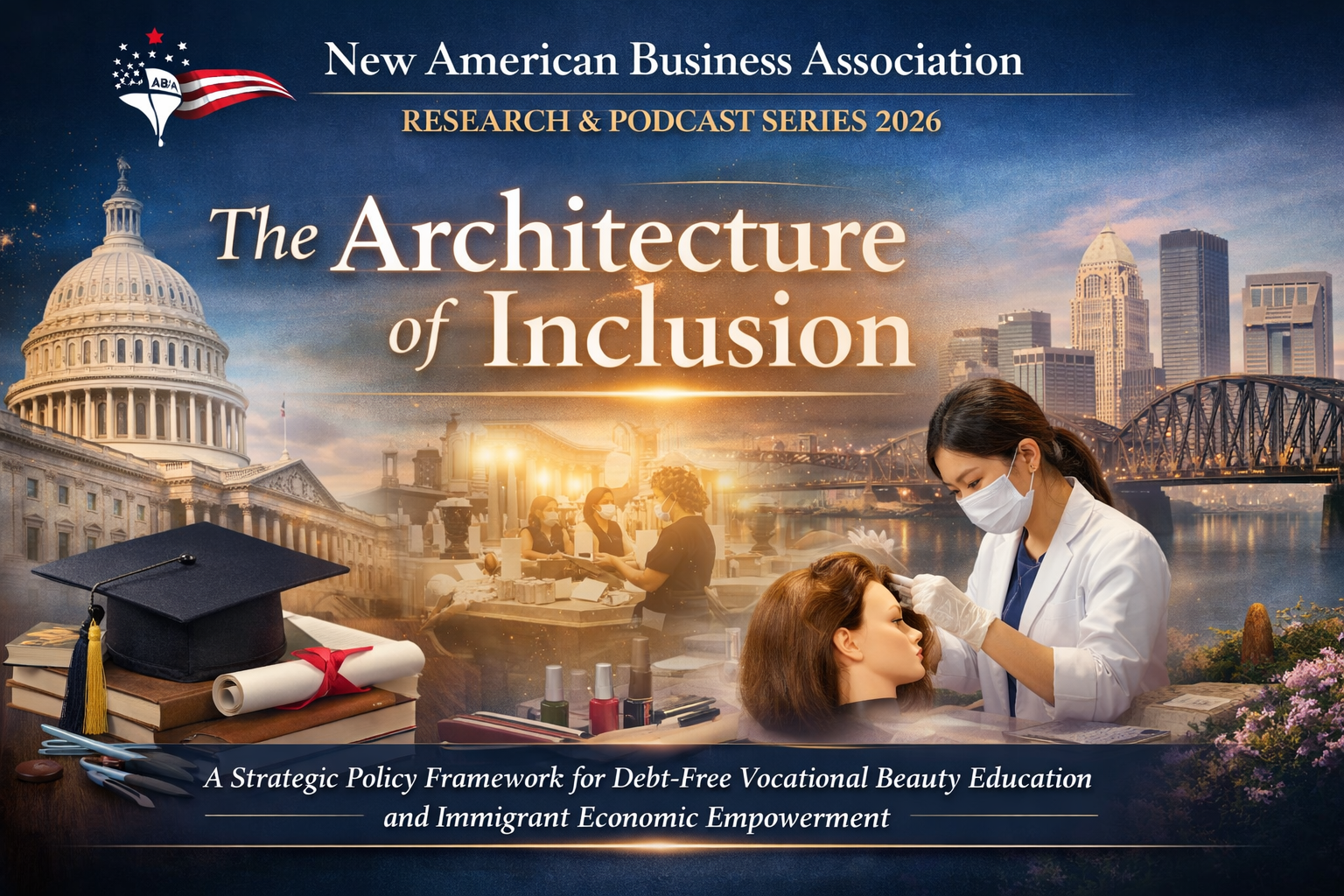
The Architecture of Inclusion: A Strategic Policy Framework for Debt-Free Vocational Beauty Education and Immigrant Economic Empowerment – RESEARCH & PODCAST SERIES 2026
Policy Research Disclaimer
This publication is an academic and policy-oriented research analysis produced by Di Tran University — The College of Humanization and published by the New American Business Association (NABA) for educational and policy discussion purposes.
The content reflects research, analysis, and interpretation of publicly available information, academic literature, historical regulatory frameworks, and economic data. It is intended to contribute to scholarly dialogue regarding vocational education, workforce development, occupational licensing policy, and immigrant entrepreneurship.
This publication does not constitute legal advice, regulatory guidance, financial advice, or official interpretation of any state or federal law or regulation, including but not limited to statutes administered by the Kentucky Board of Cosmetology or any other regulatory authority.
Any references to specific institutions, regulatory bodies, laws, or educational models are included solely for research, academic comparison, and policy analysis purposes.
The views expressed in this research are those of the authors and researchers and do not represent official positions of any governmental agency, licensing authority, or regulatory body.
Readers should consult qualified legal, regulatory, or professional advisors before making decisions related to compliance, licensing, or business operations.
This document is intended exclusively as scholarly research and public policy discussion.
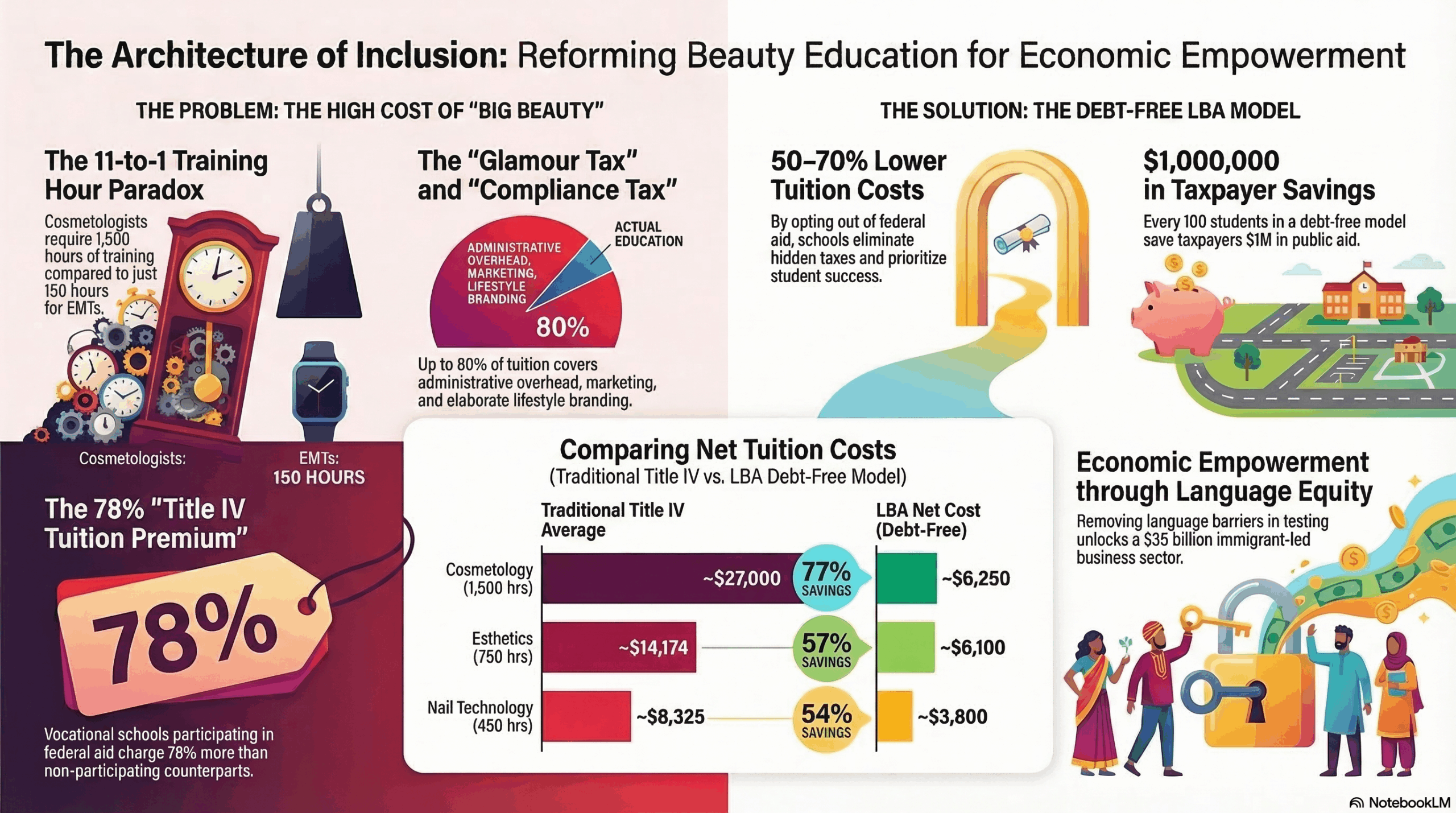
The contemporary landscape of vocational education in the United States, specifically within the professional beauty sector, represents a critical intersection of public health mandates, federal fiscal policy, and immigrant economic mobilization. For decades, the beauty industry has served as a primary vehicle for social mobility, particularly for refugee and immigrant populations who leverage low barriers to entry and culturally transferable skills to establish small businesses. However, this engine of empowerment is increasingly encumbered by a bifurcated regulatory environment: one that mandates extensive, hour-based training rooted in nineteenth-century sanitary theories, and another that incentivizes tuition inflation through the expansion of federal student aid. This analysis explores the structural distortions within the current beauty education system and proposes a strategic policy framework—typified by the Louisville Beauty Academy (LBA) model—that prioritizes debt-free pathways, regulatory over-compliance, and the decoupling of vocational training from predatory fiscal structures.
The professional beauty industry, often colloquially associated with the superficial ideals of aesthetics and “pampering,” operates as one of the most rigorously regulated sectors of the United States workforce.1 These regulations are historically rooted in the transition from medieval guilds to the refined public health mandates of the Progressive Era, a period when the government first recognized that the intimate contact inherent in beauty services could facilitate the transmission of virulent infectious diseases.1 The “hidden safety governance” of the beauty industry is built upon the premise that professional services involve significant biological and chemical risks, necessitating a high degree of state oversight to protect consumers from the invisible microbial world.1
The Historical Genealogy of Beauty Regulation: From Miasma to Microbes
To understand the current intensity of beauty licensing in the United States, it is necessary to examine the evolution of the industry from medieval guilds to the public health mandates of the Progressive Era. The professional beauty industry operates under a “hidden safety governance” built upon the premise that professional services involve significant biological and chemical risks.1 Historically, the regulation of barbering and cosmetology followed divergent trajectories. While cosmetology coalesced from ancient practices of holistic beautification dating back to 200 BCE, modern barbering descends from the medieval tradition of barber-surgeons who performed blood-letting and dentistry alongside grooming.2
The institutionalization of licensing was a direct response to the “Great Sanitary Awakening” of the mid-nineteenth century. Prior to this period, public health was dominated by miasma theory, which posited that diseases like cholera were spread by foul air and environmental filth.1 During this era, the skin began to be viewed through a Victorian lens as a “sanitary commissioner” of the body—an organ of drainage that required constant purging of waste materials like sweat and dirt to ensure both health and beauty.1
The transition to germ theory, pioneered by Louis Pasteur and Robert Koch between 1860 and 1885, fundamentally altered the state’s relationship with communal spaces like barbershops.1 Public health officials shifted their focus from “bad air” to microbial life, identifying the barbershop as a known vector for the “barber’s itch”—a highly contagious fungal infection.1 The adoption of Joseph Lister’s principles of antisepsis—originally developed for surgical theaters using carbolic acid in 1867—eventually became the bedrock of salon sanitation laws.1
Table 1: Historical Milestones in Public Health and Beauty Regulation
| Era | Key Development | Regulatory Impact | Source |
| Ancient Rome (200 BCE) | Holistic Grooming | Early employment of cosmetics as skin health regimens | 2 |
| Medieval Period (1308) | Guild Regulation | Regulation of barbery and surgery as a unified trade | 2 |
| Victorian Era (1840-1880) | Miasma Theory | Focus on “foul air” and environmental filth; skin as “sanitary commissioner” | 1 |
| 1867 | Lister’s Antisepsis | Principles of carbolic acid sterilization applied to public tools | 1 |
| 1880s | Germ Theory | Discovery of microbial vectors for “barber’s itch” | 1 |
| 1919 | Alabama Act 1919-658 | State Board of Health oversight of barbershop sanitation | 2 |
| 1938 | FD&C Act | Established FDA authority over ingredient safety and definitions | 3 |
| 1966 | FPLA | Mandatory informative labeling for consumer products | 3 |
| 1976 | CIR Panel | Expert panel formed to determine ingredient safety | 3 |
| 1978 | California License | California establishes 600-hour esthetics license | 3 |
| 1999 | Utah Two-Tier Model | Establishment of 1,200-hour advanced esthetics standard | 3 |
By the early twentieth century, states began codifying these requirements into statutes, such as Kentucky’s KRS Chapter 317A, which established a 1,500-hour training mandate for cosmetology.5 These high training hours were intended to build an intuitive understanding of infectious disease prevention and chemical toxicology, preventing the salon from becoming a focal point for community outbreaks.6 Unlike the healthcare sector, where hospitals and nursing homes face intense, multi-agency oversight including OSHA, the CDC, and state health departments, beauty establishments are primarily governed by state-specific Boards of Cosmetology or Departments of Licensing.1
The Regulatory State and Occupational Licensing: Analysis of KRS 317A
The governance of cosmetology in Kentucky is primarily managed through the Kentucky Board of Cosmetology (KBC), which acts as the gatekeeper of professional entry and conduct.7 The administrative regulations governing these operations are found in 201 KAR Title 12, which establishes inspection and health and safety requirements for all schools and salons.8 KRS 317A.060(1) requires the board to promulgate regulations governing the operation of schools of cosmetology, nail technology, threading, and esthetics to protect the health and safety of the public.8
The curriculum requirements in Kentucky are among the most stringent in the nation, reflecting the “sanitary evolution” of the Progressive Era.1 A cosmetology student must receive no less than 1,500 hours of instruction, including 375 lecture hours for science and theory and 1,085 clinic and practice hours.5 Estheticians require 750 hours, while nail technicians must complete 450 hours.5 These hours are strictly regulated; for example, a student is prohibited from performing chemical services on the public until they have completed at least 250 hours (for cosmetology) or 115 hours (for esthetics).5
The Training Hour Paradox: Comparing Risks
A central point of contention in occupational policy is the “11-to-1” training ratio between cosmetologists and emergency medical technicians (EMTs). While a national EMT certification requires approximately 150 clock hours, a cosmetologist in Kentucky must complete 1,500 hours—a disparity that has provoked significant political debate regarding over-regulation.6 Proponents of the current system argue that the educational objectives are fundamentally divergent: the EMT pathway is designed for rapid stabilization within a rigid clinical hierarchy under supervision, whereas the beauty professional operates as an independent risk manager responsible for the sanitation and chemical safety of their entire environment.6
Research indicates that the rationale for high-intensity training lies in the “independent” nature of the work. While a CNA or an EMT operates under the direct or indirect supervision of a physician or nurse, the licensed cosmetologist or barber is frequently the sole individual responsible for managing reactive substances—including hair colors, chemical relaxers, and permanent wave solutions—while utilizing sharp instruments such as razors and shears.6 Documented biological hazards in salons include genera such as Staphylococcus, Streptococcus, and Pseudomonas, which are associated with respiratory problems and chronic skin diseases.1
Table 2: Licensing Hour Requirements vs. Health and Safety Training (Kentucky)
| Occupation | Total Mandatory Hours | Health & Safety Portion (Est.) | Clinical vs. Theory | Source |
| Cosmetologist | 1,500 | ~150-375 Hours | 1,085 clinic / 375 theory | 5 |
| Esthetician | 750 | ~75-250 Hours | 465 clinic / 250 theory | 5 |
| Nail Technician | 450 | ~45-150 Hours | 300 practice / 150 theory | 5 |
| Apprentice Instructor | 750 | 325 Theory | 425 direct student contact | 5 |
| EMT (Basic) | ~150 | 100% | Acute life-saving focus | 6 |
| CNA | ~75-120 | 100% | Care and comfort focus | 6 |
Despite the public health justifications, evidence suggests that much of the training is unrelated to safety. A 2021 study found that only about 25% of barber and cosmetologist curricula and 40% of manicurist curricula teach about health and safety.14 The remainder of the time is typically spent on styling techniques and business practices—skills that consumers can judge for themselves.14 This misalignment has led to a growing reform movement, with states like Virginia and California reducing cosmetology requirements from 1,500 to 1,000 hours in 2022 and 2024.7
The Political Economy of Title IV and Vocational Education
The expansion of federal student aid under Title IV of the Higher Education Act has fundamentally reshaped the economics of beauty education. Vocational schools that participate in federal aid programs capture upwards of $1 billion annually as of the 2019–2020 academic year, creating a massive funding stream that incentivizes tuition inflation.7 A phenomenon known as the “Title IV tuition premium” has been observed, where participating schools charge significantly higher rates than non-participating counterparts.15
Peer-reviewed research, notably the 2014 study by Cellini and Goldin, found that Title IV-participating cosmetology programs charge approximately 78% more in tuition than non-participating schools.15 This inflation does not correlate with higher quality; instead, tuition appears to track the maximum available federal aid packages, effectively capturing the taxpayer subsidy for the institution rather than the student.15 Case studies in Dallas, Texas, revealed that a Title IV-eligible institution charged over $16,000 for a 1,000-hour program, while a nearby non-Title IV academy offered the same licensure training for $4,775—less than one-third of the cost.15
The 90/10 Rule and Institutional Manipulation
The 90/10 rule is a federal regulation for for-profit institutions mandating that no more than 90% of revenue may come from Title IV federal student aid.15 This rule is intended as a quality control mechanism, ensuring that at least 10% of funding comes from private sources, signaling that the school offers a valuable product. However, the impact of this rule has led to institutional manipulation; investigations suggest schools may inflate tuition to circumvent the spirit of the regulation.15 Furthermore, high dependency on this model has contributed to financial instability; as of late 2023, nearly 20% of institutions flagged for Heightened Cash Monitoring (HCM) by the Department of Education were cosmetology schools.15
The Mechanics of Cost Inflation: Compliance and Glamour Taxes
Analysis of the operational models of “Big Beauty” schools reveals that a substantial portion of tuition is diverted away from instruction toward administrative overhead and marketing. This can be categorized into two distinct “hidden taxes”:
- The Compliance Tax (25–35%): This represents the cost of navigating federal bureaucracy. Schools must employ dedicated financial aid officers to navigate complex regulations, verify student files, and process disbursements.16 It also includes third-party services and audits required for federal eligibility.16
- The Glamour Tax (45%): This encompasses high-gloss marketing, elaborate runway hair shows, and institutional branding designed to sell the image of a luxury lifestyle.16 While billed as educational, these events primarily serve as recruitment vehicles, with the costs passed directly to students.16
Table 3: Breakdown of the “Glamour Tax” and “Compliance Tax”
| Category | Estimated % of Tuition | Sub-Component | Mechanism | Source |
| Compliance Tax | 25% – 35% | Admin Overhead | Financial aid officers, audit fees, accreditation dues | 16 |
| Gap Financing | Interest/fees on institutional loans to cover the aid gap | 16 | ||
| Glamour Tax | 45% | Marketing/Ads | Google Ads, lead gen, admissions commissions | 16 |
| Performative Events | Hair shows, student competitions, mandatory travel | 16 | ||
| Facility Aesthetics | Maintaining high-end lobbies to impress tours | 16 | ||
| Student Kit Markup | Mandated proprietary kits with high retail markup | 16 |
This financial structure creates a “Cycle of Financial Fear” for students. High overhead leads to inflated tuition, which forces students to take on non-dischargeable debt.16 Because entry-level stylist wages are often comparable to or lower than state medians for high school graduates, the “earnings premium” of the education is frequently negative or negligible.15 The Department of Education estimates that up to 98% of cosmetology programs would fail the earnings premium threshold as currently structured.15
Immigrant Economic Mobilization and the Nail Industry
While the broader beauty industry faces regulatory and financial challenges, the nail salon sector provides a powerful case study in immigrant economic empowerment. This industry was sparked in 1975 when actress Tippi Hedren taught manicuring skills to twenty Vietnamese women in a refugee camp.18 Through family and community networks, the trade spread rapidly, transforming a luxury service into an affordable, ubiquitous commodity.20
Today, approximately 79% of U.S. nail industry workers are immigrants, and in states like Texas, 76% of the workforce is of Vietnamese descent.18 This dominance is attributed to cultural bonds, shared traumatic experiences like war, and a sponsorship system that allows new immigrants to bypass traditional networking hurdles and enter the workforce immediately upon arrival.21
Economic Contribution of Vietnamese-Owned Businesses
Vietnamese Americans are highly entrepreneurial, with an estimated 310,000 Vietnamese-owned businesses in the U.S. generating approximately $35 billion in annual revenue.18 These enterprises range from nail salons and restaurants to tech start-ups and professional services.18 The median annual income for Vietnamese-headed households was $86,000 in 2023, higher than the overall U.S. median but lower than the median for Asian-headed households.18
Table 4: Economic Profile of Vietnamese-American Entrepreneurship
| Metric | Reported Value | Economic Significance | Source |
| Total Businesses | ~310,000 | Pathways out of poverty for refugees | 18 |
| Annual Revenue | $35 Billion | Significant local and state tax base contribution | 18 |
| U.S. Nail Market Share | ~51% | Dominance in a specialized service sector | 19 |
| Median Household Income | $86,000 | Outperforming overall U.S. household median | 18 |
| Homeownership Rate | 68% | Wealth creation through property markets | 18 |
| Projected Annual Growth | 6% | Sustained demand for grooming services through 2030 | 22 |
Despite this success, immigrant professionals face unique barriers. Language barriers are a primary obstacle to licensure, as state board exams are frequently administered only in English or a limited number of other languages.23 Immigrant manicurists also face health disparities due to environmental exposures and limited access to multilingual health and safety training.25 Among those born outside the U.S., almost half have limited English proficiency, making them less able to avail themselves of occupational health assistance from governmental agencies.24
The Louisville Beauty Academy Case Study: A Debt-Free Model
In response to the tuition-debt crisis, the Louisville Beauty Academy (LBA) has developed an alternative model rooted in the “Humanization of Vocational Excellence.” By strategically opting out of the Title IV federal aid system, LBA has eliminated the “Compliance Tax” and the “Glamour Tax,” allowing for a direct-to-consumer pricing model that reduces tuition by 50–70%.16
The LBA model fundamentally redefines the relationship between the student and the public. Unlike traditional schools that market “discount salon services” to generate revenue, LBA frames its clinic floor as a volunteer opportunity driven by student learning needs.26 This removes the commercial pressure that often treats students as unpaid labor in a retail setting.26 The fees associated with services are described as contributions toward the cost of products, sanitation, and instructor supervision.26
Comparative Pricing: Freedom from Federal Debt
LBA’s tuition is typically 50% to 75% lower than the national average because it avoids the administrative overhead of federal compliance.15 Instead of high-interest proprietary loans or federal debt, LBA uses a “Certainty Engine” model with fixed costs and interest-free pay-as-you-go plans.16
Table 5: Tuition Comparison: Title IV vs. LBA (Net Cost)
| Program | Industry Average (Title IV) | LBA Net Cost (Discounted) | Savings % | Source |
| Cosmetology (1,500) | ~$27,000 | ~$6,250 | ~77% | 15 |
| Nail Tech (450) | ~$8,325 | ~$3,800 | ~54% | 15 |
| Esthetics (750) | ~$14,174 | ~$6,100 | ~57% | 15 |
| Certified Instructor | ~$12,675 | ~$3,900 | ~69% | 15 |
| Shampoo Styling | ~$5,890 | ~$2,890 | ~51% | 15 |
LBA follows a “license-first” philosophy, strictly adhering to state minimums rather than padding hours to meet federal aid eligibility thresholds.15 This allows for faster graduation and earlier workforce entry, creating a “Double Scoop” of success: money saved on tuition plus early earnings.15 Over a decade, LBA has graduated approximately 2,000 professionals without federal debt.15
Mathematical Modeling of Fiscal Impact
The fiscal impact of the debt-free model can be quantified through mathematical projections of “Taxpayer Savings” and “Tax Base Velocity.” Let be the standardized graduation cohort (100),
be the average public aid package ($10,000),
be the speed-to-market differential (6 months),
be annualized entry-level earnings ($30,000), and
be the aggregate effective tax rate (16%).28
The annual taxpayer savings () is calculated as:

Over five years, the model “saves” the taxpayers between $5 million and $5.8 million per 100 students.28 Furthermore, the extra tax generated by faster entry to the workforce () is:

For 100 graduates, this results in $240,000 in additional annual tax revenue.28 This model demonstrates that a self-funded approach creates a steady stream of revenue to the state that is not contingent upon federal grant availability.28
Regulatory Capture and Oversight Failures
The persistence of high hour requirements and the expansion of tuition-inflating aid is often attributed to “regulatory capture.” This occurs when state licensing boards are dominated by industry incumbents who have a financial interest in maintaining high barriers to entry.7 Independent research has identified a “Cosmetology Board Capture Index,” which correlates a lack of public representation on boards with longer training hours.7 In several states, industry associations choose the candidates for board appointments, effectively allowing the industry to choose its own regulators.7
Table 6: Cosmetology Board Capture Index and State Representation
| State | Board Structure (Industry/Public) | Capture Index Status | National Ranking Context | Source |
| Kansas | 5 Industry / 0 Public | Highly Captured | Zero public representation | 7 |
| New York | 5 Industry / 0 Public | Highly Captured | Zero public representation | 29 |
| Louisiana | 5 Industry / 0 Public | Highly Captured | History of high licensing barriers | 29 |
| Minnesota | 6 Industry / 1 Public | Captured | Majority industry control | 7 |
| Florida | 5 Industry / 2 Public | Captured | Majority industry control | 7 |
| Arizona | 4 Industry / 5 Public | Reform Leader | Public members hold majority | 29 |
| California | 4 Industry / 5 Public | Reform Leader | Public members hold majority | 29 |
Regulatory capture incentivizes boards to set higher barriers to entry, ensuring that students remain enrolled in schools—often represented by board members—for longer periods.7 The FTC has characterized this as a potential antitrust issue where licensing boards are being used to further private interests.29 Research finds little evidence that stricter licensing improves service quality or safety; instead, it is associated with less competition and higher consumer prices.30
Audit of the Kentucky Board: LRC Report No. 492
The state of Kentucky provides a poignant example of the friction between legislative intent and bureaucratic execution. A 2024 Legislative Research Commission (LRC) oversight report revealed systemic failures within the Kentucky Board of Cosmetology (KBC). The report found that the KBC was failing to meet its regulatory mandate to inspect establishments twice annually, with 46% of board files lacking a completed inspection form.26
Furthermore, the board was found to have inappropriately retained $374,200 in fine revenue that was statutorily required to be deposited with the State Treasury.31 The board had no electronic system for tracking fines, and paper files lacked documented justification for issuing fines.31 Average fines increased between 2019 and 2023 without clear policy guidance, creating an appearance of arbitrariness.32
Table 7: Key Findings of LRC Oversight Report No. 492 (2024)
| Metric / Issue | Finding | Recommended Corrective Action | Source |
| Inspection Consistency | 46% of files missing inspection forms | Adopt detailed written policies and electronic tracking | 27 |
| Fine Revenue | $374,200 inappropriately withheld | Return revenue to State Treasury General Fund | 31 |
| Enforcement | No guidance for remedying violations | Provide corrective measures in agreed orders | 31 |
| Tracking Systems | No electronic system for fines | Implement centralized digital database | 31 |
| Transparency | Fine ranges lacked set progression | Develop smaller ranges tied to specific offenses | 31 |
These oversight failures suggest that the current regulatory structure is more effective at capturing revenue and maintaining barriers than at protecting public health. This reinforces the argument for a “humanized” model like LBA, which focuses on regulatory over-compliance as a tool for student success rather than a profit center.26
Language Barriers and Testing Hurdles: The Invisible Wall
The path to licensure is further complicated by structural barriers that disproportionately affect non-English dominant candidates. Immigrants, particularly in the nail industry, face significant hurdles in accessing high-quality multilingual health and safety training.25 In Kentucky, the Board of Cosmetology records provide a granular view of student outcomes across institutions, revealing a high volume of theory retakes among populations that encounter testing barriers.33
LBA ranks #1 in Kentucky for total theory retake participation, indicating a student population that persists despite these barriers.33 However, state retesting regulations can be prohibitive. Under 201 KAR 12:030, students must wait six months after three failures and three years after five failures.31 While Senate Bill 14 (2024) amended these requirements for nail technicians to require only a one-month wait, administrative contradictions between the statute and board regulations remain a point of friction.34
Table 8: Retesting Requirements and Waiting Periods (Kentucky)
| Metric | Regulation (201 KAR 12:030) | SB 14 (Nail Technicians) | Policy Implication | Source |
| First Failures | Immediate Retesting (Up to 3) | Immediate Retesting | Allows for persistence | 31 |
| After 3 Failures | 6-month wait + course | 1-month wait | Significant barrier for ESL students | 31 |
| After 5 Failures | 3-year wait | No failure limit | “Terminal” barrier in regulation | 31 |
| Statutory Status | Contradicts SB 14 for nails | Mandates 1-month wait | Legal conflict creates uncertainty | 34 |
The studied barriers—time, legal status, and language—prevent immigrant professionals from making full use of their skills, often stranding them in underemployment.23 Regulators frequently lack the means to reliably assess the qualifications of foreign-educated professionals, further exacerbating the “brain waste” of skilled immigrants.35
Future Outlook: Workforce Pell and Regulatory Evolution
The regulatory landscape is entering a period of profound transition driven by the reintroduction of federal “Gainful Employment” (GE) and “Financial Value Transparency” (FVT) frameworks.36 Programs that fail to demonstrate that their graduates earn above a high school median wage risk losing Title IV eligibility.37 Historically, approximately 32% of cosmetology certificate programs failed or entered a “warning” zone under earlier iterations of these benchmarks.36
The One Big Beautiful Bill Act (OBBBA) and Workforce Pell
The “Workforce Pell Act” (authorized under OBBBA) represents a bipartisan effort to expand Pell Grant eligibility to short-term, workforce-oriented training programs.38 Effective July 1, 2026, students can use Pell Grants for programs as short as eight weeks (150–599 clock hours).39 This shift acknowledges that short-term programs often provide a higher return on investment than prolonged, debt-laden certificates.37
Table 9: Structural Comparison: Traditional Pell vs. Workforce Pell
| Feature | Traditional Pell Grant | Workforce Pell (OBBBA 2026) | Source |
| Program Length | Minimum 16 weeks / 600 hours | 8-15 weeks / 150-599 hours | 38 |
| Eligibility | Undergraduates w/o degree | Includes those with prior degrees | 38 |
| Performance Req | Standard SAP | 70% Completion / 70% Placement | 38 |
| Earnings Threshold | N/A | Must exceed 150% of poverty level | 39 |
| For-Profit Access | Included | Included (with concerns) | 39 |
| Cost Control | Maximum aid cap | Tuition must not exceed earnings gain | 39 |
However, the expansion of Pell to short-term programs at expensive for-profit schools could potentially strain the Pell budget and lead to further “white flight” to bachelor’s degrees while marginalized students are funneled into poverty-level wage credentials.41 Critics argue that the price-to-earnings metric sets a low bar, with some standards being below the minimum wage in 25 states.39
The Transition to STATS and RAP
Beginning in 2027, the Student Tuition and Transparency System (STATS) will succeed FVT/GE, further linking federal aid to measurable labor market outcomes.42 The Graduate PLUS loan program will terminate on July 1, 2026, capping federal financing for advanced certifications and forcing students to seek private education loans.42 Simultaneously, the Repayment Assistance Plan (RAP) will replace previous income-driven repayment options, with monthly payments calculated as a percentage of AGI.40
Policy Blueprint for National Reform
The research supports a fundamental restructuring of beauty education to prioritize the economic liberty of the practitioner and the safety of the public. The “Architecture of Inclusion” positions the LBA model as a national center for debt-free economics, regulatory over-compliance, and community-service-driven training.
Strategic Recommendations:
- Decoupling Tuition from Federal Credit: State legislatures should incentivize “direct-to-consumer” pricing models by providing state-level tax credits for schools that operate without federal Title IV programs. This removes the “Compliance Tax” and “Glamour Tax” that currently consume up to 80% of student tuition.16
- Mandatory Board Recomposition: States must move toward the Arizona model of majority-public boards to mitigate “regulatory capture” and ensure that licensing standards serve the public interest rather than industry incumbents.7
- Universal Recognition and Reciprocity: Adoption of universal recognition for out-of-state licenses would eliminate barriers to worker mobility and reduce the cost and time needed to attain a license when moving between states.44
- Competency-Based Licensure Pathways: Shift away from hour-based mandates toward competency-based exams that focus exclusively on health and safety. This would align the industry with other high-stakes public health professions like EMTs.6
- Language Equity in Testing: Mandatory provision of licensure exams in multiple languages (Vietnamese, Spanish, Arabic) to ensure that language proficiency does not act as a barrier to professional entry for skilled immigrants.23
- Accountability for State Boards: Implementation of mandatory annual “sunset reviews” for licensing boards to ensure their requirements are still necessary for public safety and that they are not inappropriately withholding fine revenue or failing in their inspection mandates.31
By embracing these reforms, the beauty industry can fulfill its historical role as an engine of economic empowerment while maintaining the high standards of sanitation and safety that the Progressive Era correctly identified as essential for the public good. The Louisville Beauty Academy model provides the empirical evidence that a debt-free, compliance-first approach is not only possible but fiscally superior for the graduate and the taxpayer alike.
Works cited
- Respect the License: Regulatory Intensity, Public Health Oversight, and the Hidden Safety Governance of the Beauty Industry – RESEARCH & PODCAST SERIES 2026 – Louisville Beauty Academy, accessed March 16, 2026, https://louisvillebeautyacademy.net/respect-the-license-regulatory-intensity-public-health-oversight-and-the-hidden-safety-governance-of-the-beauty-industry-research-podcast-series-2026/
- Historical Context: Alabama Board of Cosmetology and Barbering – For the Record, accessed March 16, 2026, https://fortherecordalabama.blog/2025/04/17/historical-context-alabama-board-of-cosmetology-and-barbering/
- Skin Care—Then and Now: Product and Professional Regulations, accessed March 16, 2026, https://www.skininc.com/business/regulatory/article/21880710/skin-carethen-and-now-product-and-professional-regulations
- Cosmetic Crisis: The Obsolete Regulatory Framework of the Ever, accessed March 16, 2026, https://repository.law.miami.edu/cgi/viewcontent.cgi?article=4709&context=umlr
- Title 201 Chapter 12 Regulation 082 • Kentucky Administrative Regulations – Legislative Research Commission, accessed March 16, 2026, https://apps.legislature.ky.gov/law/kar/titles/201/012/082/10348/
- Tag: cosmetology vs healthcare training comparison – Louisville Beauty Academy, accessed March 16, 2026, https://louisvillebeautyacademy.net/tag/cosmetology-vs-healthcare-training-comparison/
- The Architecture of Occupational Licensure: A Policy Analysis of …, accessed March 16, 2026, https://ditranuniversity.com/the-architecture-of-occupational-licensure-a-policy-analysis-of-u-s-cosmetology-education-and-workforce-training-systems-research-podcast-2026/
- Title 201 Chapter 12 Regulation 060 • Kentucky Administrative Regulations – Legislative Research Commission, accessed March 16, 2026, https://apps.legislature.ky.gov/law/kar/titles/201/012/060/
- Title 201 Chapter 12 Regulation 082 • Kentucky Administrative Regulations • Legislative Research Commission – Louisville Beauty Academy, accessed March 16, 2026, https://louisvillebeautyacademy.net/wp-content/uploads/2024/11/KYLaw-11-12-2024-Title-201-Chapter-12-Regulation-082-%E2%80%A2-Kentucky-Administrative-Regulations-%E2%80%A2-Legislative-Research-Commission.pdf
- EMT vs. Cosmetologist License FAQ – The Institute for Justice, accessed March 16, 2026, https://ij.org/report/license-to-work-3/emt-vs-cosmetologist-license-faq/
- Licensed Occupations Requiring Clock-Hour Training and Interstate Transferability – RESEARCH JUNE 2025 – Viet Bao Louisville KY, accessed March 16, 2026, https://vietbaolouisville.com/2025/06/licensed-occupations-requiring-clock-hour-training-and-interstate-transferability-research-june-2025/
- Title 201 Chapter 12 Regulation 082 • Kentucky Administrative Regulations – Legislative Research Commission, accessed March 16, 2026, https://apps.legislature.ky.gov/law/kar/titles/201/012/082/10893/
- CNA vs. EMT: What’s the Difference? (With Video) | Indeed.com, accessed March 16, 2026, https://www.indeed.com/career-advice/finding-a-job/cna-vs-emt
- Reform Spotlight: Barbering and Beauty Licensing – Institute for Justice, accessed March 16, 2026, https://ij.org/report/license-to-work-3/report/reform-spotlight-barbering-and-beauty-licensing/
- Beauty School Financial Transparency Report (2026 …, accessed March 16, 2026, https://louisvillebeautyacademy.net/beauty-school-financial-transparency-report-2026understanding-federal-aid-models-and-debt-free-vocational-education-research-podcast-2026/
- The Great Decoupling: How FAFSA Regulatory Mechanisms and the …, accessed March 16, 2026, https://naba4u.org/2026/01/the-great-decoupling-how-fafsa-regulatory-mechanisms-and-the-glamour-tax-are-reshaping-the-economics-of-beauty-education-research-jan-2026/
- Federal Aid, Licensure, and the Debt Crisis in Cosmetology Education – RESEARCH 2025, accessed March 16, 2026, https://naba4u.org/2025/12/federal-aid-licensure-and-the-debt-crisis-in-cosmetology-education-research-2025/
- Vietnamese Americans and Their Contributions to the U.S. Economy …, accessed March 16, 2026, https://vietbaolouisville.com/2025/09/vietnamese-americans-and-their-contributions-to-the-u-s-economy-research-september-2025/
- What percent of nail salons are Vietnamese? – SNS Pedicure Chair, accessed March 16, 2026, https://snschairs.com/blogs/news/what-percent-of-nail-salons-are-vietnamese
- A STUDY OF NAIL SALON WORKERS AND INDUSTRY IN THE UNITED STATES – UCLA Labor Center, accessed March 16, 2026, https://www.labor.ucla.edu/wp-content/uploads/2018/11/NAILFILES_FINAL.pdf
- How Vietnamese families built community, revolutionized nail industry over 50 years, accessed March 16, 2026, https://www.houstonlanding.org/how-vietnamese-families-built-community-revolutionized-nail-industry-over-50-years/
- Vietnamese American entrepreneurs Archives – Louisville Beauty Academy, accessed March 16, 2026, https://louisvillebeautyacademy.net/tag/vietnamese-american-entrepreneurs/
- AN ETHNOGRAPHY OF AFRICAN IMMIGRANT WOMEN WORKING IN HAIR BRAIDING SALONS IN HARLEM – Sauti Yetu, accessed March 16, 2026, https://sautiyetunyc.org/wp-content/uploads/2024/11/HairBraidMiss-FINAL.pdf
- Perceived Benefits and Barriers to Implementing Occupational Health Recommendations Among Immigrant-Owned Nail Salons in the – CDC Stacks, accessed March 16, 2026, https://stacks.cdc.gov/view/cdc/207155/cdc_207155_DS1.pdf
- Development of health and safety training for Vietnamese American nail salon owners and workers – medRxiv.org, accessed March 16, 2026, https://www.medrxiv.org/content/10.1101/2021.10.25.21265480v1.full-text
- Louisville Beauty Academy case study Archives, accessed March 16, 2026, https://louisvillebeautyacademy.net/tag/louisville-beauty-academy-case-study/
- The Humanization of Vocational Excellence: A Kentucky Case Study of Cosmetology Education, Safety, Sanitation Law, and the Louisville Beauty Academy Model for Compliance, Community Service, and Debt-Free Training – Research & Podcast Series 2026, accessed March 16, 2026, https://louisvillebeautyacademy.net/the-humanization-of-vocational-excellence-a-kentucky-case-study-of-cosmetology-education-safety-sanitation-law-and-the-louisville-beauty-academy-model-for-compliance-community-service-and-debt-f/
- Macroeconomic Analysis of Debt-Free Vocational Pathways: A …, accessed March 16, 2026, https://louisvillebeautyacademy.net/macroeconomic-analysis-of-debt-free-vocational-pathways-a-comparative-study-of-the-louisville-beauty-academy-and-federal-aid-dependent-models-in-the-commonwealth-of-kentucky-research-podcast/
- Policy Report – Center for the Study of Economic Liberty, accessed March 16, 2026, https://csel.asu.edu/sites/g/files/litvpz1671/files/2020-12/CSEL-2020-02-A-Cosmetology-Board-Capture-Index-11_02_20-v2.pdf
- Let’s Get to Work – Mackinac Center, accessed March 16, 2026, https://www.mackinac.org/S2023-08
- LOUISVILLE BEAUTY ACADEMY — PUBLIC RECORD LIBRARY – Kentucky Board of Cosmetology Oversight Reports (Published AS-IS for Educational Use) – Original Report Dates: November 14, 2024, accessed March 16, 2026, https://louisvillebeautyacademy.net/louisville-beauty-academy-public-record-library-kentucky-board-of-cosmetology-oversight-reports-published-as-is-for-educational-use-original-report-dates-november-14-2024/
- Board Of Cosmetology Oversight Functions Confidential Committee Draft November 7, 2024 – Legislative Research Commission, accessed March 16, 2026, https://apps.legislature.ky.gov/CommitteeDocuments/344/30790/2024-11-07%20LOIC%20Cosmetology%20Oversight-Committee.pdf
- Tag: Kentucky vocational education reform – Louisville Beauty Academy, accessed March 16, 2026, https://louisvillebeautyacademy.net/tag/kentucky-vocational-education-reform/
- Kentucky Board of Cosmetology Oversight Functions, accessed March 16, 2026, https://apps.legislature.ky.gov/CommitteeDocuments/344/30790/2024-11-14%20LOIC%20Cosmetology%20Slides.pdf
- Secretary of State Office of Professional Regulation Occupational Regulation and Migrant Professionals in Vermont: Reducing Barriers for Qualified Immigrants – Vermont Legislature, accessed March 16, 2026, https://legislature.vermont.gov/assets/Legislative-Reports/Act-114-2018-Sec.-10-Migrant-Professionals-Report.pdf
- beauty industry labor statistics Archives – Louisville Beauty Academy, accessed March 16, 2026, https://louisvillebeautyacademy.net/tag/beauty-industry-labor-statistics/
- Gainful Employment Rules and School Closures (2014–Present) – MAY 2025 STUDY, accessed March 16, 2026, https://naba4u.org/2025/05/gainful-employment-rules-and-school-closures-2014-present-may-2025-study/
- Workforce Pell Is (Finally) Law. Now What? | Richmond Fed, accessed March 16, 2026, https://www.richmondfed.org/region_communities/regional_data_analysis/community_college_survey/community_college_insights/2025/workforce_pell_finally_law_now_what
- Workforce Pell Expansion Explained | BestColleges, accessed March 16, 2026, https://www.bestcolleges.com/news/workforce-pell-grant-expansion-explained-adult-learners/
- Amendments to the Higher Education Act Made by PL 119-21, the FY2025 Budget Reconciliation Law – Every CRS Report, accessed March 16, 2026, https://www.everycrsreport.com/files/2026-01-08_R48727_b913e06158451ddb78c225a38c12ad6c4ca6f892.html
- Three Things House Members Must Know Before Voting on the Bipartisan Workforce Pell Act – New America, accessed March 16, 2026, https://www.newamerica.org/insights/three-things-house-members-must-know-before-voting-on-the-bipartisan-workforce-pell-act/
- Title IV eligibility beauty schools Archives – Louisville Beauty Academy, accessed March 16, 2026, https://louisvillebeautyacademy.net/tag/title-iv-eligibility-beauty-schools/
- One Big Beautiful Bill Act education Archives – Louisville Beauty Academy, accessed March 16, 2026, https://louisvillebeautyacademy.net/tag/one-big-beautiful-bill-act-education/
- Occupational Licensing – The Institute for Justice, accessed March 16, 2026, https://ij.org/issues/economic-liberty/occupational-licensing/
- Occupational Licensing in Nevada – The Institute for Justice, accessed March 16, 2026, https://ij.org/issues/economic-liberty/occupational-licensing/nevada/
- New Study Shows That Heavier Licensing Burdens Do Not Improve Health and Safety, accessed March 16, 2026, https://ij.org/press-release/new-study-shows-that-heavier-licensing-burdens-do-not-improve-health-and-safety/