Federal Warning Signals Students Away From Many Beauty Schools – DEC 7TH, 2025 – A New FAFSA Red-Flag System Raises National Concern
But Kentuckians Should Not Worry: Louisville Beauty Academy Has Long Provided a Truly Affordable, Transparent, Debt-Free Pathway Outside Federal Aid
NABA Analysis: Publicly Available Federal Data, Its Implications for Beauty Colleges, and Why Kentucky Still Has Reliable, Community-Based Options
Disclaimer: This article shares publicly available federal information for educational and consumer-awareness purposes only. The New American Business Association (NABA) does not endorse, oppose, or evaluate any institution. All statements below reference federal publications, data sources, and news reports cited at the end of this document. This analysis contains no opinions, judgments, or recommendations about any specific school.
Introduction
On December 7, 2025, the U.S. Department of Education began displaying a “Lower Earnings” warning inside the FAFSA system. The warning appears when selected colleges show post-graduation median earnings lower than the median earnings of high-school graduates in the same state or nationally.
This shift, though described by the Department as “informational only,” functions as a federal warning signal, shaping student perception at the exact moment they choose where to send their financial aid.
The New American Business Association (NABA) provides this overview so Kentucky families, workforce leaders, and policymakers can understand the public data—without fear, confusion, or misinformation.
What FAFSA Now Shows Students
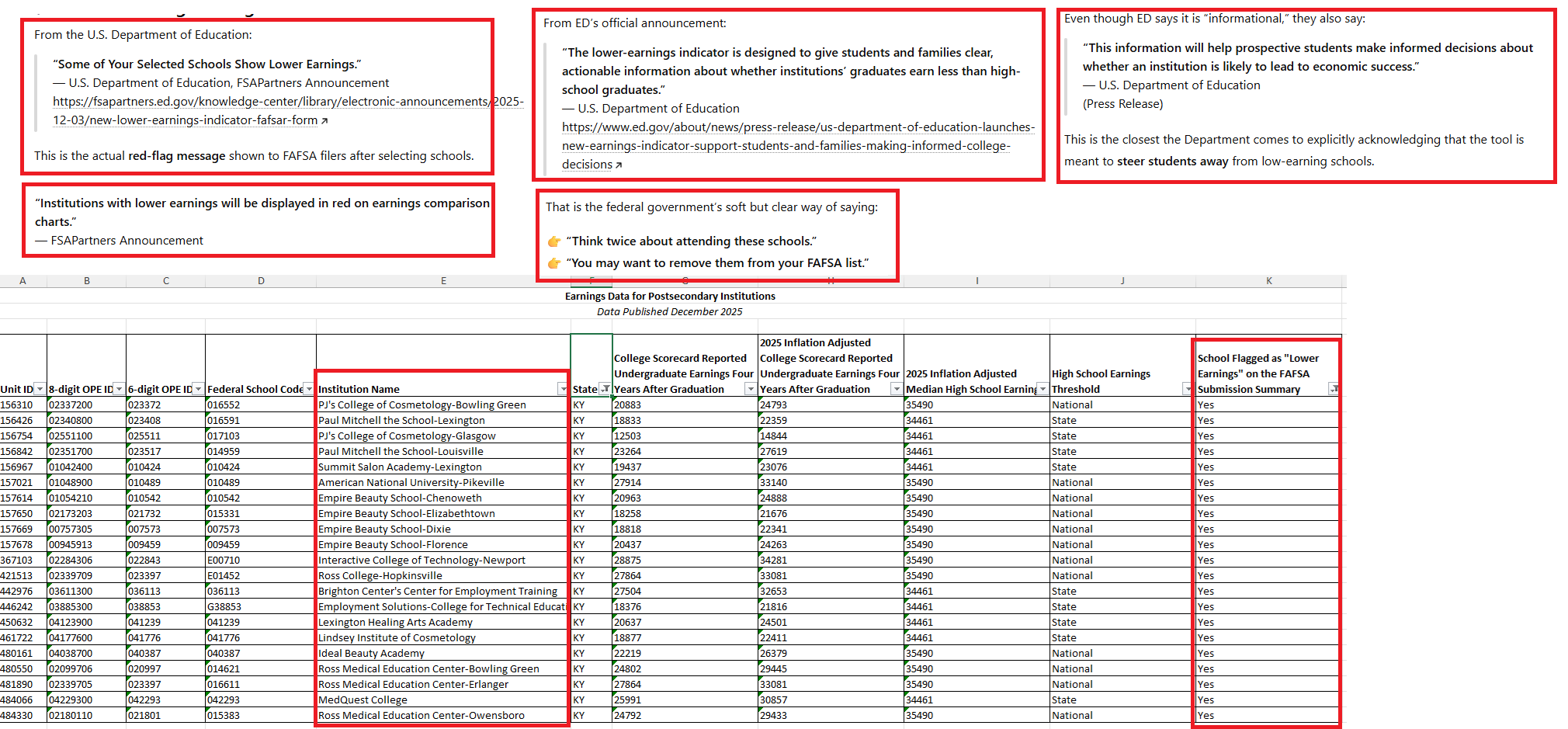
When a flagged (“lower earnings”) school is selected, FAFSA presents the following message:
“Some of Your Selected Schools Show Lower Earnings.”
— U.S. Department of Education, Federal Student Aid Announcement
The system then:
- Highlights the institution in red,
- Displays a comparison chart showing the school below the high-school benchmark, and
- Provides a trash-can “Remove School” button.
The Department explains:
“Institutions with lower earnings will be displayed in red on earnings comparison charts.”
— FSA Electronic Announcement
And further notes the purpose of this new feature:
“This information will help prospective students make informed decisions about whether an institution is likely to lead to economic success.”
— U.S. Department of Education, Press Release
NABA reiterates:
These statements are direct quotations from federal sources.
NABA provides no interpretation beyond the published text.
Which Kentucky Schools Are Flagged (“YES”)?
From the publicly available federal dataset, the following Kentucky schools were coded “YES,” meaning FAFSA will show the federal warning to students:
https://studentaid.gov/sites/default/files/fafsa-earnings-data.xlsx
Beauty & Cosmetology Colleges
- Paul Mitchell the School – Lexington — YES
- PJ’s College of Cosmetology – Glasgow — YES
- Paul Mitchell the School – Louisville — YES
- Summit Salon Academy – Lexington — YES
- Empire Beauty School – Chenoweth — YES
- Empire Beauty School – Elizabethtown — YES
- Empire Beauty School – Dixie Highway — YES
- Empire Beauty School – Florence — YES
Other Career-Focused/For-Profit Institutions Flagged
- American National University – Pikeville — YES
These findings come directly from the U.S. Department of Education’s public earnings dataset, not from NABA analysis or opinion.
Important Note
Being flagged does not indicate poor education quality, student satisfaction, licensure performance, or workforce relevance.
The indicator reflects only median reported earnings compared to high-school graduates, as defined by federal methodology.
Why This Should Not Alarm Kentuckians
Despite the attention this new indicator is generating nationwide, Kentucky has proven, community-rooted models that remain stable, affordable, and unaffected by FAFSA red-flagging.
The strongest example is Louisville’s own Louisville Beauty Academy (LBA).
🌟 A Kentucky Case Study: Louisville Beauty Academy (LBA)
Disclaimer: NABA does not endorse or promote any institution. The following are publicly available facts relevant to policy understanding.
Louisville Beauty Academy, an immigrant-founded and Louisville-based training institution:
- Does not participate in Title IV / Pell / FAFSA
- Therefore does not appear in any FAFSA warning system
- Has offered true affordability from day one—not through Pell-grant “net cost” calculations, but through:
- Direct tuition discounts
- Incentives for hard work and consistent study
- Structured programs enabling fast completion
A Decade of Impact
- Nearly 10 years of operation
- Close to 2,000 graduates
- Estimated $20–50 million annual economic impact generated by graduates’ services and small businesses
National Recognition
- U.S. Chamber of Commerce CO—100 Award (2025)
- National Small Business Association (NSBA) — Economic Education & Affordability Initiative (2025)
Educational Philosophy
LBA operates the College of Humanization™, emphasizing:
- Transparency
- Affordability
- Emotional support
- Workforce readiness
- Zero student debt
These characteristics existed years before national recognition.
Awards did not create LBA’s affordability model—they validated it.
What This Means for Kentucky Workforce & Policy
Kentucky should not interpret the FAFSA warning as a crisis. Instead, it highlights:
- The need for clear, honest cost structures
- The value of community-based, debt-free training pathways
- The importance of transparent workforce education
- The economic strength of small schools and immigrant-led institutions
Kentucky has long nurtured educational models that outperform national trends in affordability and access.
The FAFSA indicator simply underscores why these models matter.
NABA’s Disclaimer & Purpose
NABA does not endorse, oppose, or evaluate any institution.
We provide this article to:
- Summarize publicly available federal data
- Inform small businesses, students, and policymakers
- Support transparency and awareness
- Ensure Kentuckians understand the context of a major national policy shift
This report contains no opinions, judgments, or recommendations—only factual summary and publicly sourced information.
APA References
Federal Student Aid. (2025). Earnings data for postsecondary institutions. U.S. Department of Education. https://studentaid.gov/data-center/school/earnings
Federal Student Aid. (2025, December 3). New lower earnings indicator on the FAFSA® form (Electronic Announcement GENERAL-25-49). U.S. Department of Education. https://fsapartners.ed.gov/knowledge-center/library/electronic-announcements/2025-12-03/new-lower-earnings-indicator-fafsar-form
Schwartz, N. (2025, December 9). Education Department designates dozens of colleges as “lower earnings.” Inside Higher Ed. https://www.insidehighered.com/news/government/student-aid-policy/2025/12/09/ed-designates-23-colleges-lower-earnings
U.S. Department of Education. (2025, December 8). U.S. Department of Education launches new earnings indicator to support students and families in making informed college decisions. https://www.ed.gov/about/news/press-release/us-department-of-education-launches-new-earnings-indicator-support-students-and-families-making-informed-college-decisions
U.S. Department of Education. (2025, December 8). Introducing the new earnings indicator on the FAFSA® form. ED Homeroom Blog. https://www.ed.gov/about/homeroom-blog/introducing-new-earnings-indicator-fafsar-form