A Workforce-First Model for Beauty Licensing and Training – RESEARCH & PODCAST SERIES 2026
Executive summary
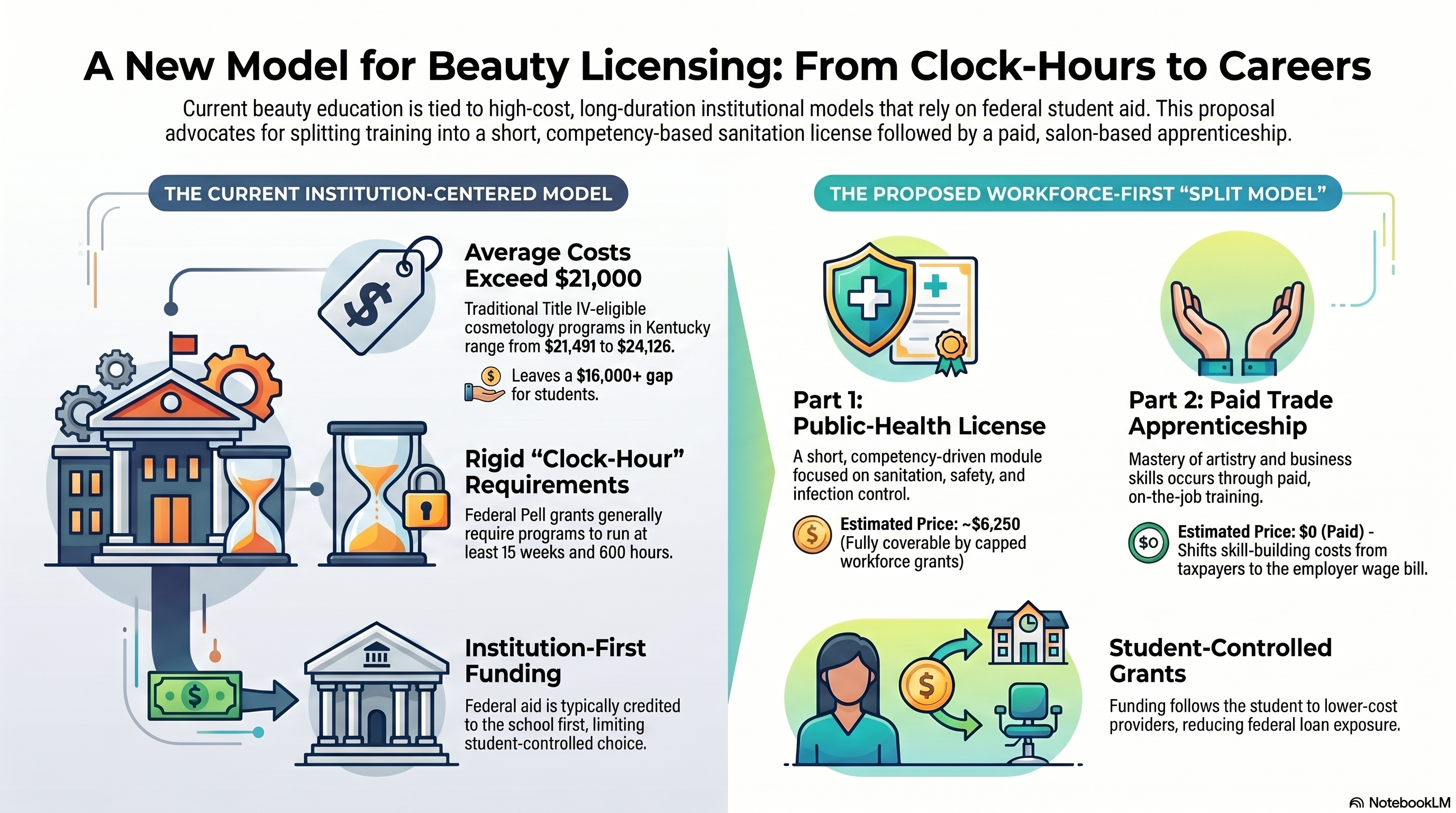
The strongest policy-grade case is not that the federal government can simply re-label current beauty-school Pell eligibility as workforce aid by executive action. Under current Higher Education Act and Title IV rules, Pell is tied to an eligible program at an eligible institution; proprietary schools must be legally authorized, accredited, and in operation long enough to qualify, and nondegree clock-hour programs generally must meet minimum length requirements that are poorly suited to a short sanitation-only module. By contrast, WIOA already uses participant-centered training finance through Individual Training Accounts, emphasizes consumer choice, and expressly allows individuals to use WIOA funds for registered apprenticeship training. The practical federal pathway, therefore, is a new student-controlled workforce grant outside Title IV, a WIOA-based pilot, or an explicit congressional amendment to HEA rather than a mere administrative reinterpretation of Pell.
The basic jurisdictional mismatch is between the institution-centered aid rules of the U.S. Department of Education and the participant-centered training tools of the U.S. Department of Labor. DOE’s current system pays through schools, with most institutions first crediting Title IV funds to the student’s account and only then sending any remaining credit balance to the student. DOL’s WIOA framework, by contrast, typically funds training through an ITA “payment agreement established on behalf of a participant,” which is much closer to a student-controlled voucher model.
The public-health case for splitting beauty training is materially stronger than the traditional “beauty school as college” frame. In Kentucky, the statutory and regulatory purposes of cosmetology oversight are explicitly about health, safety, sanitation, inspection, and protection against fraud or incompetent practice. Kentucky’s curriculum structure also already distinguishes theory, law, and restrictions on public chemical services until a student has completed a threshold amount of training. CDC evidence shows that beauty and adjacent personal-service settings can transmit infection when sanitation fails, including a nail-salon footbath outbreak and a likely HIV-transmission incident tied to an unlicensed cosmetic spa. That supports treating sanitation and infection control as a short, competency-driven public-protection license, with the rest of skill formation moved into paid work-based learning.
A DOL-aligned apprenticeship track is also legally plausible. DOL defines apprenticeship as paid on-the-job training plus classroom instruction, WIOA can fund registered apprenticeship through the eligible-provider system, and the federal apprenticeable-occupations list has long included cosmetologist and hair-stylist variants. Beauty apprenticeship is not theoretical: the Washington State Department of Licensing, the California Board of Barbering and Cosmetology, and the Maryland Department of Labor all maintain beauty apprenticeship pathways today. States that now hard-code school-hour routes would need statutory and regulatory amendments to adopt the split model.
The fiscal case is strongest when aid is decoupled from institution-based Title IV access and capped at actual tuition charged by an approved provider. Published prices show why. The cosmetology program at Louisville Beauty Academy is posted around $6,250.50 on the school’s pricing pages, and the school publicly states that it operates without NACCAS accreditation or Title IV aid. By comparison, Paul Mitchell The School Louisville posts total cosmetology costs of $24,126, and PJ’s College of Cosmetology posts a Kentucky cosmetology cost of attendance of $21,491.66. With the 2026–27 maximum Pell Grant still fixed at $7,395, a capped direct grant could fully cover LBA’s discounted price but would still leave a large funding gap at higher-priced Title IV schools. That means the savings argument is real but conditional: it depends on steering students toward lower-cost approved providers and shifting trade skill acquisition into employer-paid apprenticeship rather than trying to subsidize high institutional prices.
Legal and regulatory feasibility
Current federal law sharply limits the possibility of using Pell for a short, stand-alone sanitation credential. For proprietary and postsecondary vocational institutions, an eligible nondegree program generally must run at least 15 weeks and 600 clock hours; the shorter 300–599 clock-hour category is treated differently and, under the statute and regulation, is eligible only for the loan side of Title IV rather than the full Pell framework. This matters because a public-health licensing module designed on an EMT-like model would likely be much shorter than today’s full cosmetology-hour requirements. Under current law, such a module is therefore a bad fit for Pell unless Congress changes HEA.
Institutional gatekeeping is also deliberate and formal. A proprietary institution must be legally authorized by the state, provide an eligible program, be accredited, and have existed long enough to qualify. The state-authorization rules for for-profit providers also require a state approval or licensure process and institution-by-name approval. In practice, that means a state-licensed beauty school can legally exist and train students under state law without being able to access Title IV if it has not crossed the federal accreditation and participation thresholds.
WIOA is structurally different. Training services are “typically provided” through an ITA, which is a payment agreement on behalf of the participant, and the eligible-provider system is expressly built around informed consumer choice, provider accountability, and labor-market relevance. WIOA also makes clear that registered apprenticeship can appear on the state eligible-provider list and that individuals can use Title I training funds for registered apprenticeship, subject to normal limits and availability. That means a student-controlled beauty grant could be designed to look much more like an ITA than like Pell.
The legally feasible federal architecture is therefore a split one. The federal government can finance and regulate the workforce-development side through WIOA and apprenticeship. It cannot, by itself, rewrite state beauty licensing, because occupational licensure remains state law. States would need to decide whether a sanitation credential sits with a cosmetology board, a health department, or a joint structure. The cleanest federal role is to finance approved providers and apprenticeships, while state law defines the license that the public receives.
The table below summarizes the legal picture.
| Policy element | Status under current law | What would be needed |
|---|---|---|
| Pell for nonaccredited, state-licensed beauty schools | Not available under current Title IV institutional eligibility rules | Congressional amendment to HEA, or a new non-Title-IV grant authority |
| Pell for a short sanitation-only module | Poor fit; 300–599 clock-hour programs are treated as loan-only, while the ordinary nondegree threshold is 600 hours / 15 weeks | New statutory short-term grant authority or amended program-eligibility rules |
| Student-controlled beauty funding through workforce system | Broadly feasible in WIOA-like form because ITAs already fund training on behalf of participants | State/provider eligibility design, appropriations, and program rules |
| DOL-aligned paid salon apprenticeship | Feasible where state law permits apprenticeship routes and program registration requirements are met | State licensure changes in states that still require school-only routes |
| Shifting sanitation oversight to state health authorities | Not automatic federally; depends on state police-power choices | State legislation or interagency restructuring |
Sources: HEA Pell eligibility and institutional eligibility; federal program-length rules; WIOA ITA and eligible-provider rules.
Fiscal and incentive analysis
Today’s federal higher-education finance model is institution-centered, not student-controlled. Federal Student Aid guidance explains that schools commonly first credit Pell and other Title IV funds to the student’s account and only then pay a remaining credit balance to the student. Participation also carries ongoing administrative obligations, including annual Title IV compliance and financial-statement audits. For a small career school, those federal participation costs sit on top of state licensing, program reporting, and any accreditor fees.
Accreditation is not free. The National Accrediting Commission of Career Arts and Sciences is recognized by DOE as an institutional accreditor, and official NACCAS fee schedules available through its handbook materials show annual sustaining fees in roughly the $1,900 to $2,080 range for many schools, with separate initial-accreditation evaluation charges around $1,957 to $2,142, before counting audit, consulting, legal, staff, software, or reporting costs. Those figures are not catastrophic by themselves, but for very small providers they are meaningful fixed overhead.
A student-controlled grant model changes incentives in three ways. First, it makes provider price visible, because the student sees the grant cap against the published charge instead of seeing a school first bundle aid and tuition through an institutional finance office. Second, it forces competition on cost and outcomes, because the school must persuade the student that it is worth choosing. Third, if trade skill development moves into paid apprenticeship, some training cost shifts from the federal grant to the employer wage bill, reducing pressure to use federal aid for all skill formation. Those are the core mechanisms by which the model could save federal money. The inference is grounded in the structure of ITAs and apprenticeship, not in a single national beauty-school evaluation, so it should be tested in pilots rather than assumed.
The cost comparison below shows why the proposal has traction.
| Provider and pathway | Published price signal | Relationship to $7,395 max Pell | Policy implication |
|---|---|---|---|
| LBA cosmetology | $6,250.50 | Fully coverable by a Pell-sized cap; about $1,144.50 below max Pell | A capped student-controlled grant could finance completion without loans at a low-price provider |
| Paul Mitchell Louisville cosmetology | $24,126 total cost | Leaves about $16,731 uncovered at max Pell | Institutional price remains the dominant fiscal issue under Title IV-style delivery |
| PJ’s Kentucky cosmetology COA | $21,491.66 | Leaves about $14,096.66 uncovered at max Pell | Same conclusion: higher-price schools absorb far more aid without eliminating financing gaps |
Sources and note: Pell maximum from 2026–27 ED guidance; provider prices from school-published materials. Arithmetic is author calculation from cited figures.
A policy-grade version of the proposal should not make the student personally liable for full grant recapture every time a noncompletion occurs. That design would produce harsh outcomes for low-income students facing childcare, health, transportation, or domestic shocks, and it would encourage providers to cream-skim only the easiest students. The better design is milestone disbursement: a verified-hours or verified-competency release schedule, a modest student co-responsibility for exam attendance and disclosure accuracy, and stronger clawback from providers for false attendance, misrepresentation, or fraudulent billing. This mirrors the accountability logic already present in WIOA provider systems and apprenticeship performance tracking.
Public-health rationale and trade analogies
The public-health rationale is unusually strong in beauty regulation. The first thing to notice in state law is that cosmetology regulation is already written as a public-protection system. The mission statement of the Kentucky Board of Cosmetology emphasizes educational, health, and regulatory standards. Kentucky statutes require regulations that protect public health and safety and guard against incompetent, unethical, or fraudulent practice. Kentucky administrative rules separately establish inspection requirements and infection-control, health, and safety standards for licensed facilities.
That framing is not cosmetic rhetoric; it is tied to real hazards. A CDC-published investigation of a California nail-salon outbreak found mycobacteria in 29 of 30 whirlpool footbaths sampled across 18 salons after a customer outbreak, and CDC’s New Mexico spa investigation found likely HIV transmission associated with unlicensed platelet-rich-plasma microneedling procedures. CDC and NIOSH also continue to identify nail-salon chemical and workplace hazards, showing that infection control and occupational safety are not incidental topics.
Kentucky’s curriculum design already hints at a modular logic. The cosmetology program requires 1,500 hours, including 375 lecture hours for science and theory and 40 hours on Kentucky statutes and regulations, and students may not perform chemical services on the public until they have completed 250 hours of instruction. That is a strong indication that states already distinguish between early, safety-heavy preparatory knowledge and later, service-heavy skill execution. A split model would formalize that distinction rather than inventing it from scratch.
The analogy to EMT training is not that beauty services are medically identical to emergency care. The analogy is structural. The National Registry of Emergency Medical Technicians and federal EMS standards frame EMT preparation as a competency-and-safety credential, entered through state-approved education and certification examination, with periodic continuing education for recertification. That is much closer to how a sanitation-and-safety beauty credential would function than to the current clock-hour, school-first college-aid model.
The analogy to trucking is similarly structural. The Federal Motor Carrier Safety Administration sets baseline entry-level driver training requirements, but FMCSA guidance explicitly says there is no minimum number of theory or behind-the-wheel hours in ELDT; completion is based on the instructor’s assessment that the trainee can proficiently perform required elements, and state CDL issuance still depends on knowledge and skills testing. In other words, the public-safety system is centered on competence, testing, and regulated providers, not on a college-finance model.
Construction and HVAC add the final comparison. DOL’s apprenticeship model is paid, work-based, and paired with related instruction, and the official apprenticeable-occupation materials and apprenticeship data show a large national system serving hundreds of thousands of active apprentices. The logic for beauty is similar: public safety at the licensing front end, then skill accumulation in a real business setting where speed, customer service, retailing, scheduling, and revenue generation actually occur.
| Occupation model | Public-safety gate | Skill-development model | Core lesson for beauty |
|---|---|---|---|
| Proposed beauty model | Short sanitation / infection-control license under state public-health authority or joint board-health structure | Paid salon apprenticeship plus related instruction | Separate safety from artistry and business skill |
| EMT | State-approved education plus certification exam and recurring CE | Ongoing supervised field practice and continuing competence | Safety credentials can be shorter, competency-driven, and renewed |
| CDL | Federal baseline standards plus state knowledge and skills tests | Employer or provider training, often proficiency-based rather than hour-minimum-based | Competency can matter more than seat time |
| Construction / HVAC | State or local licensing where applicable | Registered Apprenticeship with paid OJT and related instruction | Trade mastery is well suited to earn-and-learn delivery |
Sources: EMS guidance and certification; FMCSA CDL/ELDT guidance; DOL apprenticeship materials.
Case study at Louisville Beauty Academy
LBA is useful because it illustrates the exact policy tension behind this debate. The Kentucky school directory lists the school as a state-approved provider offering multiple licensed beauty programs, and the directory includes public links to school reporting materials such as pass/fail-rate spreadsheets. That means the school operates inside the state licensure system even though it is not necessarily inside the federal Title IV system.
The school’s own public materials matter because they show what a low-price, state-licensed alternative looks like. LBA publicly presents itself as outside NACCAS and Title IV and highlights deep institutional discounts, including a cosmetology price around $6,250.50 and similarly low prices for other programs. Even allowing for the fact that these are school-published claims and may reflect particular discount structures, the price point is dramatically below many Title IV beauty-school charges.
What makes the case study policy-relevant is not merely that one school is cheaper. It is that, at a low-price state-licensed provider, the federal government could plausibly finance the entire educational price with a modest capped grant, while apprenticeship wages cover a much larger share of trade formation. At a high-priced Title IV beauty school, the same federal grant ceiling leaves a large gap and invites further borrowing or institutional aid packaging. The case therefore supports a student-controlled, price-sensitive funding model, not a blanket claim that all beauty education is already cheap.
Labor-market context also supports treating beauty as a workforce pipeline rather than as marginal higher education. The Bureau of Labor Statistics projects about 84,200 average annual openings for barbers, hairstylists, and cosmetologists, 14,500 for skincare specialists, and 24,800 for manicurists and pedicurists over 2024–2034. BLS also notes that standard wage data exclude the self-employed, which matters in beauty because entrepreneurship is common. The U.S. Census Bureau classifies barber and beauty shops within personal care services, and Census materials using NES data have shown more than 1.3 million nonemployer establishments in personal care services. That is exactly the kind of small-business-heavy labor market in which apprenticeship and entrepreneurship training inside real salons may outperform a purely school-based model.
Policy design and implementation roadmap
The report’s bottom-line recommendation is to build a two-part pathway:
- Public-health license: a short, exam-driven sanitation, infection-control, anatomy-for-safety, chemical-safety, contraindications, blood-exposure, and state-law module under state board/health oversight.
- Trade apprenticeship: paid salon-based apprenticeship, registered where possible, with related instruction focused on cutting, color, texture, customer management, speed, professionalism, retailing, and entrepreneurship.
That design matches the strongest strands of current law: state public-protection authority for licensure, WIOA-style consumer choice for funding, and apprenticeship for skill acquisition.
The diagram below shows the high-level architecture synthesized from existing Title IV, WIOA, licensing, and apprenticeship rules.
Current modelAccredited Title IV schoolSchool receives / credits aidStudent completes long clock-hour programState exam and licensureProposed split modelStudent qualifies for workforce grantState-approved safety and sanitation modulePublic-health licensing examApprentice license / supervised practicePaid salon apprenticeship plus related instructionFinal trade credential / full licenseShow code
Recommended federal design
The most defensible federal legislative option is a DOL-administered Beauty Workforce Grant or a WIOA-authorized demonstration rather than a Title IV waiver. The grant should be student-controlled but provider-directed: the student chooses the approved provider, but funds are not handed over as unrestricted cash. Instead, the student authorizes milestone disbursements to an approved sanitation-module provider and then to an approved apprenticeship sponsor or related-instruction intermediary. That preserves choice while reducing misuse risk.
The federal government should also require a zero-loan default setting for pilots. Students could use separate financing only if they affirmatively opt in after a standardized counseling step. That would test whether lower-price providers and earn-while-you-learn structures can reduce federal loan exposure without suppressing access. The rationale follows from apprenticeship’s wage-based model and from the large price spread across providers.
Recommended state design
States would need to adopt or amend a statutory framework that recognizes three statuses: student, public-health licensee, and apprentice. In Kentucky-like states, that means reducing the amount of education that must occur before any wage-earning pathway opens, while preserving strong sanitation, inspection, and examination rules. States could keep the cosmetology board in place, move the sanitation component into a health-department partnership, or create joint administration; the key is that public protection and infection control stay strong even as trade instruction moves into salons.
Fraud and abuse safeguards
A student-controlled grant will only be politically durable if it has stronger anti-fraud controls than today’s school-centered model. The minimum safeguards should include: state approval by name; mandatory provider bonds; attendance and competency uploads to a statewide system; exam-eligibility matching with the testing vendor; milestone disbursement rather than full upfront payout; mandatory public disclosure of tuition, completion, pass, and placement results; and focused recapture from providers for false attendance or misleading recruitment. Kentucky already uses public school listings and a contracted testing structure through PSI Services LLC, which shows that some of the data infrastructure already exists.
Risks and counterarguments
The biggest counterargument is quality. Institutional accreditation, whatever its flaws, creates a common compliance layer, and replacing it with state approval plus workforce oversight could invite weak providers if states underinvest in inspection and data systems. That objection is serious. The answer is not to deny the risk; it is to make provider performance, exam outcomes, and complaint rates the center of oversight rather than accreditor process compliance alone.
A second counterargument is that apprenticeship is not uniformly available. That is true. Salon microbusinesses may not have the administrative capacity to sponsor a registered apprenticeship on their own. A workable pilot should therefore allow group sponsors, intermediaries, associations, or local workforce boards to handle registration, related instruction, and reporting for clusters of salons. That is consistent with how apprenticeship ecosystems already scale in other sectors.
A third counterargument is equity. If the model becomes too punitive when students stop out, it could easily become a system that primarily funds already-advantaged students. That is why the better rule is earned disbursement by verified progress, not total forfeiture for any noncompletion. Supportive services, transportation help, childcare, and exam-fee support should also sit inside the pilot. WIOA’s participant-centered structure is a better starting point for that than Pell’s institution-centered structure.
The roadmap below shows a realistic sequence.
2027-01-012027-02-012027-03-012027-04-012027-05-012027-06-012027-07-012027-08-012027-09-012027-10-012027-11-012027-12-012028-01-01Create DOL grant authority or WIOA pilot guidanceAdopt modular licensing statuteApprove pilot states and intermediariesLaunch data and public dashboard rulesDefine sanitation exam and apprentice statusApprove providers and salon sponsorsEnroll first safety-module cohortBegin paid apprenticeshipsIssue first evaluation and fiscal reportFederalStateOperationsIllustrative implementation roadmapShow code
Suggested pilot metrics
The pilot should be judged on cost per employed licensee, not merely on enrollment. The core metrics should include: tuition charged; grant dollars disbursed; share of students requiring loans; sanitation-exam pass rate; full-license pass rate; apprentice wage growth; completion time; employment in the second and fourth quarters after exit; self-employment or new-business formation; complaint and sanitation-violation rates; provider closures; and student satisfaction. DOL’s apprenticeship data infrastructure, state exam data, and school/provider public disclosures can support much of this if pilots are designed carefully.
Open questions and limitations
This report supports the proposal on legal structure and policy design, but two empirical questions remain open. First, a national, beauty-specific estimate of current federal loan usage and repayment outcomes was not assembled here, so the fiscal comparison is strongest at the program-price level rather than at a full lifecycle federal-credit-cost level. Second, school-level pass-rate evidence is uneven and sometimes small-sample in public search results, so pilots should require standardized public outcome reporting from day one.
The highest-confidence conclusion is therefore narrow and actionable: beauty training is a better policy fit for workforce finance plus state public-health licensing than for an accreditation-gated higher-education aid model, but achieving that shift requires new federal authority or WIOA pilots, plus state licensing reform, not just a rhetorical move from “education” to “trade.”