A Unique Entity ID Is Not an Active SAM Registration: Four Federal Award States
Direct sources. Clear status. Practical public information.
Reviewed November 9, 2026 · United States federal award system · current SAM.gov registration and status pages.
SAM.gov allows an organization to request only a Unique Entity ID or to complete an entity registration for direct federal-award participation. Those are not the same state. A later application or offer is another record again.
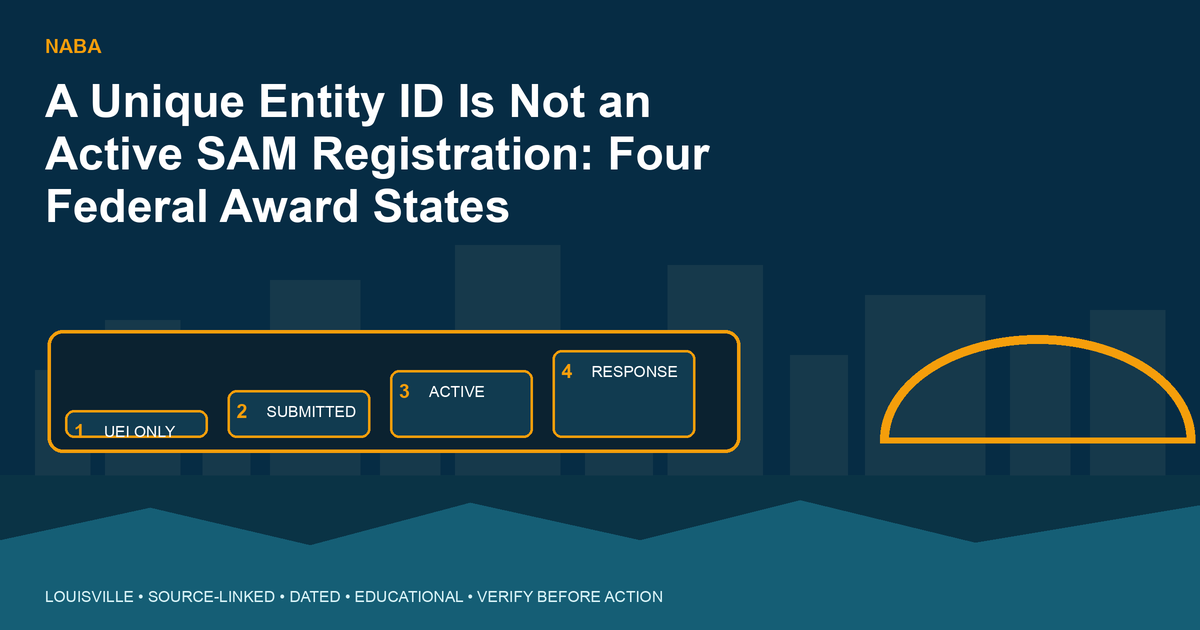
Four states that should never be collapsed
| State | Evidence to preserve | What it does not prove |
|---|---|---|
| 1. Unique Entity ID only | Legal name, physical address, assigned 12-character UEI, exact entity record | SAM.gov states that a UEI-only record cannot apply directly for federal awards. |
| 2. Registration work, submitted, or processing | Workspace owner, section status, submission date, validation notices, processing state | Submission or processing is not active registration, eligibility, or an opportunity response. |
| 3. Active registration | Exact entity, active date, expiration/renewal date, registration purpose, required representations and contacts | Active registration does not prove fit for a specific notice, completed submission, award, payment, or outcome. |
| 4. Opportunity response | Exact notice/solicitation, version, applicant/offeror, authorized submission, timestamp, files, and receiving receipt | A response is not selection, contract, grant award, cash received, spending, or impact. |
Current timing boundary
SAM.gov says registration must be renewed every 365 days to remain active. Its status guidance says a submitted registration may move through external reviews; processing time can vary. A deadline plan therefore needs the opportunity clock and the entity-registration clock kept separately. Do not wait for a specific deadline to discover that a UEI-only record or inactive registration is insufficient.
Reversible readiness card
- Confirm the exact legal entity that would apply or offer; do not borrow another organization’s identity.
- Record whether the entity has only a UEI or a full registration.
- Check the current registration status and expiration through the authorized SAM.gov workspace or status route.
- Read the exact opportunity’s eligibility, registration, representations, deadlines, and submission instructions.
- Preserve the opportunity-specific receipt and stop before claiming selection, funding, payment, or outcome.
Limits
This article does not inspect or certify any organization’s SAM.gov record, legal identity, tax data, banking data, exclusions, representations, eligibility, small-business status, application, offer, award, or payment. Private registration information should remain in the controlled federal system and authorized organizational records.
Official sources
- SAM.gov — Entity Registration and Unique Entity ID
- SAM.gov — Entity Status Tracker and status definitions
Public-information notice: This Pulse is a dated, source-linked research summary for general educational use. It reports what the cited sources state or what the identified public record shows as of the date reviewed. Citation does not mean endorsement, partnership, certification, or independent confirmation of every third-party assertion. This is not individualized legal, medical, tax, accounting, investment, insurance, cybersecurity, licensing, regulatory, procurement, employment, real-estate, or other professional advice. Rules, facts, availability, and eligibility can change. Verify the controlling source, jurisdiction, effective date, and your own facts, and consult the responsible agency or a qualified professional before a consequential decision. External links are provided for attribution and may change. Use this information and any reader-controlled checklist at your own discretion and risk.
Discover more from New American Business Association (NABA) - Louisville, KY
Subscribe to get the latest posts sent to your email.