
Occupational Licensing, Immigrant Entrepreneurs, and Plain-English Regulation
Plain-English occupational licensing education can help immigrant entrepreneurs and workers navigate regulated fields without weakening public standards.
Licensing Rules Shape Opportunity
Occupational licensing can protect the public, but it also shapes who can enter work, open a business, hire, renew, and comply. For immigrant entrepreneurs, unclear rules can become an unnecessary barrier even when the person wants to follow the law.
Plain-English Regulation Is Equal Access
A rule that exists only in technical language is harder for families, workers, and small businesses to use. Plain-English education does not lower standards. It helps people understand standards before mistakes happen.
Beauty Work as a Case Study
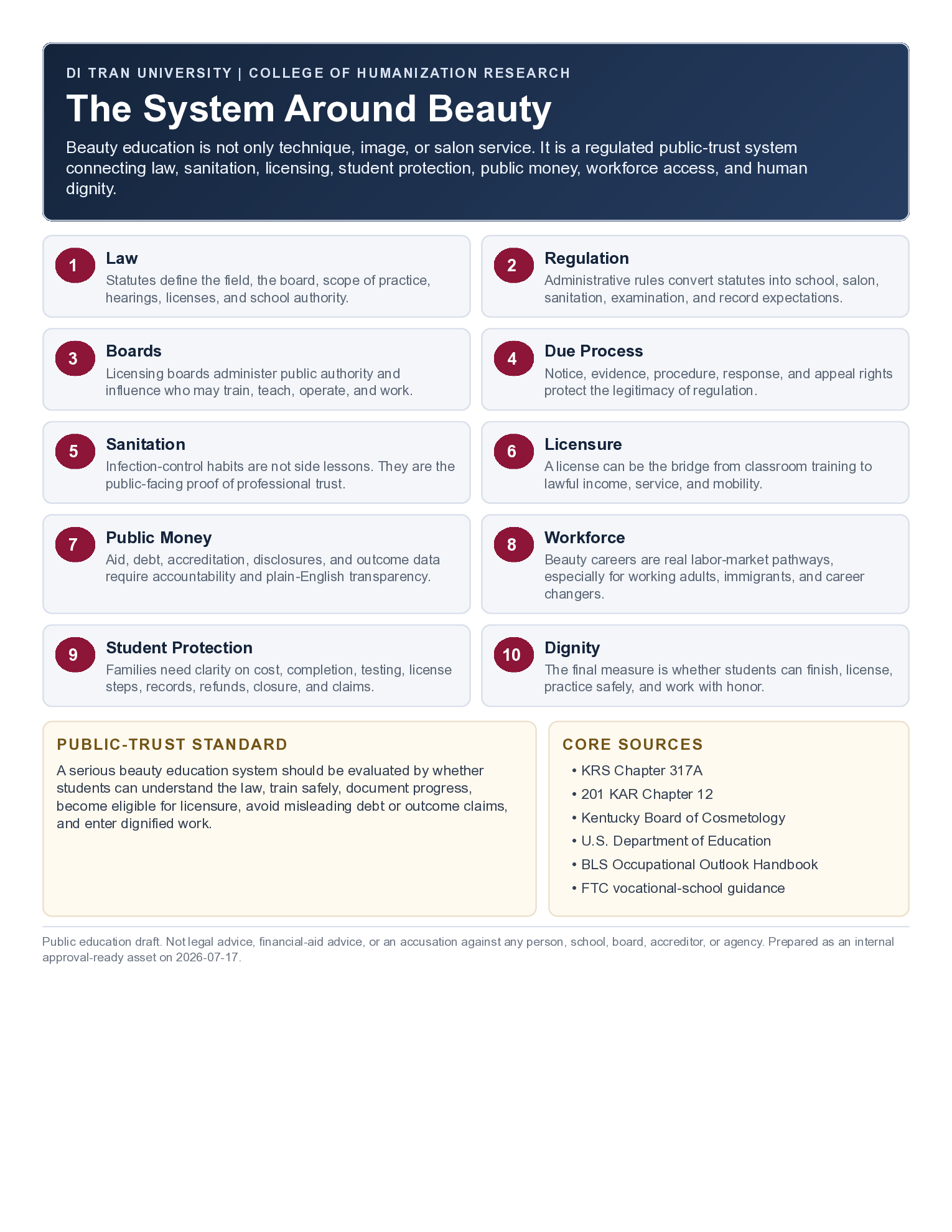
Beauty education shows why this matters. Students and workers must understand school requirements, training hours, sanitation, license steps, renewals, inspections, costs, and public expectations.
Public Trust and Small Business Dignity
NABA’s advocacy lane is not anti-regulation. It is pro-clarity, pro-fair process, pro-public trust, and pro-access for communities willing to work, learn, comply, and build.
Policy Questions Worth Asking
- Are rules understandable to first-generation entrepreneurs?
- Are requirements explained before enforcement becomes the only teacher?
- Are multilingual communities receiving practical public education?
- Does the system distinguish confusion from intentional misconduct?
- Can public safety and equal access rise together?
Public Sources
This article uses public education sources only. It is not legal advice, financial-aid advice, or an accusation against any person, school, board, accreditor, or agency.
- Kentucky Revised Statutes, KRS Chapter 317A
- Kentucky Administrative Regulations, 201 KAR Chapter 12
- 201 KAR 12:082, education requirements and school administration
- Kentucky Board of Cosmetology
- Kentucky Board of Cosmetology licensure information
- U.S. Department of Education, overview of accreditation
- U.S. Department of Education College Scorecard
- Federal Student Aid, Financial Value Transparency and Gainful Employment
- Federal Register, FVT/GE final rule
- U.S. Bureau of Labor Statistics Occupational Outlook Handbook
- BLS, Barbers, Hairstylists, and Cosmetologists
- BLS, Manicurists and Pedicurists
- Federal Trade Commission, choosing a vocational school or certificate program
Public Boundary
This article is advocacy and public education. It does not accuse any agency, board, business, or person, and it does not provide legal advice.