Asymmetric Governance and the Inaccessibility of Administrative Justice: A Multidisciplinary Analysis of Occupational Licensing Enforcement in the United States Beauty Sector – RESEARCH & PODCAST SERIES 2026
Official Research Attribution & No-Endorsement Notice
This publication is an independent academic and policy research output conducted and authored by Di Tran University – The College of Humanization. All content is derived from publicly available information, aggregated data sources, and multidisciplinary analysis presented strictly for educational, informational, and public awareness purposes.
New American Business Association (NABA) serves solely as a distribution platform and does not create, verify, endorse, validate, or assume responsibility for any statements, interpretations, findings, or conclusions contained herein.
No portion of this publication constitutes legal advice, regulatory guidance, or an assertion of fact against any individual, organization, or government entity. Readers are expressly encouraged to independently verify all information with qualified legal counsel or appropriate regulatory authorities.
Part A: Executive Brief for Legislators
The regulatory architecture of the United States beauty industry has reached a critical inflection point where the exercise of the state’s police power increasingly conflicts with fundamental constitutional protections regarding the right to earn a livelihood.1 Occupational licensing now covers approximately 25% of the U.S. workforce, representing a fivefold increase since the 1950s.3 While ostensibly designed to solve information asymmetry and protect consumer health and safety, empirical data and administrative case studies indicate that these systems frequently function as state-sanctioned barriers to entry that generate “monopoly rents” for incumbent practitioners while imposing a “deadweight loss” on the broader economy.1
The core findings of this multidisciplinary report identify a profound “Due Process Accessibility Gap”.2 Although formal legal rights—including the right to notice, an impartial decision-maker, and an evidentiary hearing—remain codified in administrative law, they are rendered functionally inaccessible to low- and moderate-income licensees.2 The primary driver of this failure is a severe economic imbalance: the cost of a meaningful legal defense relative to practitioner income.2
| Economic Indicator | Sector Data |
| Median Annual Income (Nail Technicians) | $34,660 7 |
| Median Annual Income (Cosmetologists) | $35,420 8 |
| Typical Administrative Case Defense Cost | $5,000 – $20,000+ 9 |
| Defense Cost as Percentage of Median Income | 14.4% – 57.7% 7 |
| “Due Process Inaccessibility” Threshold | >10% of Annual Income |
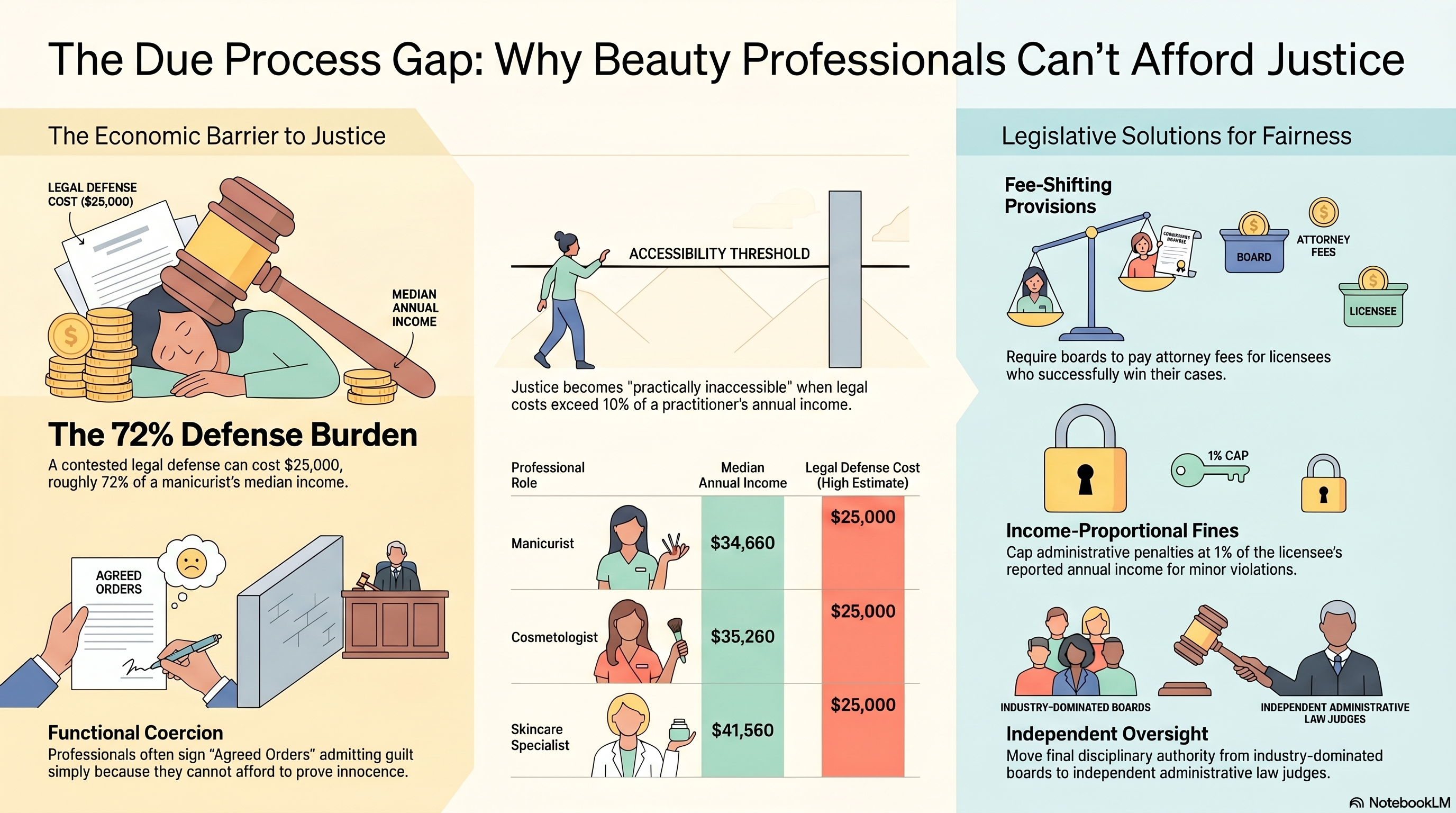
This economic reality creates a system of “functional coercion,” where licensees are pressured to accept “Agreed Orders” or settlements, regardless of the merit of the allegations, simply because the cost of proving their innocence exceeds their financial capacity.2 Furthermore, the complaint-driven enforcement model is structurally vulnerable to “competitive harassment,” where established firms weaponize the administrative process to drain the resources of rivals.1
The report highlights the Commonwealth of Kentucky as a critical case study where some analyses have identified potential regulatory challenges and variations in enforcement patterns.12 Recent analyses and publicly available reports have discussed variations in enforcement patterns, including differences in fine distributions across segments of the industry.13
To restore administrative integrity, this report proposes a suite of “legislatively actionable” reforms, including:
- Fee-Shifting Provisions: Requiring boards to pay attorney fees for prevailing licensees.16
- Fine Caps: Limiting administrative penalties relative to the licensee’s reported income.18
- Independent Oversight: Establishing a non-industry review board to audit enforcement patterns and ensure “evidence legibility”.2
- Technological Integration: Utilizing AI-driven auditing and “Gold-Standard” digital logs to verify compliance and prevent arbitrary targeting.2
The issue is not the existence of regulation, but whether the scales of justice are balanced enough to allow the regulated to defend their property interests against administrative overreach.
Part B: Research Paper: Structural Barriers and Asymmetric Power
1. Introduction: The Property Interest in Professional Livelihood
The legal status of a professional license has transitioned from a mere privilege to a recognized property interest under the Fourteenth Amendment’s Due Process Clause.2 When a state grants a license, it creates a vested interest that allows an individual to pursue a livelihood—an interest that cannot be revoked or suspended without adherence to fundamental fairness.2 Historically, the judiciary frequently scrutinized economic regulations that interfered with this right; however, the modern “rational basis” standard of review grants broad deference to state boards.2
Despite this deference, the recognition of a license as a property interest remains a cornerstone of administrative law, necessitating a balance between state police power and individual rights. The Mathews v. Eldridge balancing test provides the framework for this evaluation, weighing the private interest affected, the risk of erroneous deprivation through current procedures, and the government’s interest in fiscal and administrative efficiency.2 In the beauty industry, where practitioners are often self-employed or micro-business owners, the “private interest” represents their entire economic survival, while the “risk of error” is heightened by the lack of legal representation.2
2. Economic Reality vs. Legal Defense Cost
The viability of due process is inextricably linked to the cost of legal counsel.2 For the majority of beauty professionals, the economic barrier to justice is insurmountable.
A. Income Profiles of Personal Care Professionals
The personal care sector is characterized by modest earnings. As of May 2024, the median wages across various specialties indicate a high degree of financial sensitivity.
| Specialty | Median Hourly | Median Annual | 10th Percentile | 90th Percentile |
| Manicurist/Pedicurist | $16.66 | $34,660 | $27,260 | $48,080 7 |
| Hairdresser/Cosmetologist | $16.95 | $35,260 | $23,520 | $63,310 8 |
| Skincare Specialist | $19.98 | $41,560 | $27,160 | $77,330 24 |
| Barber | $18.73 | $38,960 | $27,770 | $78,440 8 |
These figures underscore that most beauty professionals fall into the low- to moderate-income brackets. Furthermore, many in the sector are independent contractors who do not receive employer-sponsored benefits, increasing their vulnerability to sudden legal expenses.26
B. The Cost of Administrative Adjudication
Legal defense in administrative law requires specialized expertise. National data from 2025 indicates that the average hourly rate for an administrative law attorney is approximately $328 to $329.9 In major markets like California, these rates frequently exceed $420 per hour.10
A standard administrative defense case involves several critical phases:
- Investigation and Discovery: 10–20 hours.
- Pleadings and Motions: 5–10 hours.
- Hearing Preparation and Witness Interviews: 15–20 hours.
- Formal Hearing Attendance: 8–16 hours.
- Post-Hearing Briefs: 5–10 hours.
Totaling between 43 and 76 hours of legal work, a typical contested case carries a price tag of $14,000 to $25,000.9 When compared to a median manicurist’s annual income of $34,660, the cost of defense can represent up to 72% of their total gross earnings.7
C. The Due Process Threshold
Access to justice is denied when the cost of defending a right exceeds a meaningful share of the interest’s value. This research defines the “Practical Due Process Accessibility Threshold” as a legal cost not exceeding 10% of annual income. Current market rates for legal defense exceed this threshold for over 90% of the beauty workforce.2 Consequently, due process is “theoretically available but practically inaccessible”.2
3. Structural Power Asymmetry: The Administrative State vs. The Individual
The power imbalance between a state regulatory board and a licensee is systemic and multi-dimensional.1 This phenomenon, defined as “Administrative Power Asymmetry,” ensures that the board almost always operates from a position of tactical superiority.
A. Institutional Advantages of the Board
State boards possess institutional continuity and the backing of the state’s legal apparatus.1 Boards have access to full-time legal counsel funded by taxpayer or license-fee revenue, allowing them to pursue enforcement actions without internalizing the marginal cost of litigation.2 They possess broad investigative powers, including the authority to conduct surprise inspections and issue administrative subpoenas for private records.11
B. Vulnerability of the Licensee
The average licensee is a small salon owner or employee with no formal legal training.2 The loss of a license constitutes an “existential risk,” as it immediately terminates their ability to earn a living.2 This high-stakes environment, combined with the licensee’s high marginal defense cost, creates a “coercive settlement environment”.2
| Feature | Regulatory Board | Individual Licensee |
| Legal Representation | State-funded, specialized counsel 13 | Out-of-pocket, high-cost private counsel 9 |
| Financial Risk | Minimal; funded by fees/fines 12 | Catastrophic; livelihood at stake 2 |
| Information | Full access to investigative files 11 | Limited access without expensive discovery |
| Continuity | Institutional; immune to time pressure | Highly sensitive to delays/closure 28 |
4. Agreed Orders as Default Enforcement: Functional Coercion
The administrative state relies heavily on “Agreed Orders” or settlements to maintain operational efficiency.2 While settlements are a legitimate part of the legal process, their use in the beauty industry often signals a failure of due process rather than a mutual agreement.
A. The Efficiency Trap
Enforcement statistics from states like Texas (TDLR) show that a significant majority of cases are resolved through agreed orders rather than formal hearings.29 For example, in the Texas Auctioneer program, 100% of final orders were agreed orders or defaults in 2023.29 Boards often include a “Notice of Alleged Violation” (NOAV) with a pre-calculated settlement offer.31 To an unrepresented licensee, this often feels like an ultimatum: pay a $1,000 fine now, or spend $10,000 in legal fees to fight it.2
B. The Cumulative Effect of Settlements
Agreed orders are not neutral. They include admissions of facts and create a permanent disciplinary history.2 Under the “Disciplinary Escalation Pathway,” a minor agreed order for a sanitation issue today can be used as a “prior violation” to justify license revocation or emergency closure tomorrow.11 This creates a “record-building” mechanism that allows boards to target disfavored practitioners over time.33
5. National Context: The Growing Burden of Occupational Licensing
The expansion of licensing into low-income occupations has created substantial economic barriers that reduce mobility and entrepreneurship.6
A. Disproportionate Training Requirements
The time required to enter beauty professions is frequently irrational when compared to higher-risk fields.3 National research highlights that the average cosmetologist must complete 342 days of training, while an EMT requires only 36 days.3
| Occupation | Avg. Training (Days) | Avg. Fees |
| Cosmetologist | 342 | $209 36 |
| Barber | 315 | $175 36 |
| Makeup Artist | 128 | $173 36 |
| EMT | 36 | $115 3 |
This disparity suggests that licensing requirements are driven by industry lobbying (rent-seeking) rather than public safety.1
B. Impact on Entrepreneurship and Inequality
Studies confirm a discernable connection between the density of licensing and lower rates of entrepreneurship among low-income populations.34 In states that license more than half of low-income occupations, the entrepreneurship rate is 11% lower than average.34 This burden falls most heavily on those with less access to financial capital or formal education, cementing existing economic inequalities.3
6. Vulnerable Populations Analysis
The enforcement burden of occupational licensing is not distributed equally. It disproportionately impacts immigrant entrepreneurs, rural operators, and minority business owners.1
A. Immigrant Communities and Language Barriers
In the nail salon sector, which has a high concentration of Vietnamese and Cambodian immigrants, single-language testing acts as a structural barrier.37 Advocacy groups in Kentucky have highlighted that the lack of multi-language exams prevents practitioners from demonstrating their competency in sanitation and safety, despite those tests being available nationally via PSI.37 This “linguistic exclusion” increases the risk of erroneous deprivation of livelihood for thousands of “New Americans”.37
B. Rural Schools and “Regulatory Deserts”
Administrative case studies from Kentucky indicate that some reports suggest enforcement actions have disproportionately affected certain rural beauty schools, which are often the sole vocational training providers in poverty-stricken counties.12 The closure of these institutions—often for minor, cure-able infractions—forces students to commute to larger cities, creating “regulatory deserts” and restricting economic mobility in underserved regions.12
7. Public Choice and System Design: The Problem of Regulatory Capture
The economic theory of regulation suggests that licensing boards are often “captured” by the industries they regulate.1 Small, well-organized groups of incumbent practitioners find it easier to lobby for restrictive rules that limit competition than the large, unorganized group of consumers who are harmed by higher prices.1
Evidence of capture includes:
- Board Composition: Boards often consist entirely of industry incumbents with a vested interest in limiting new competition.1
- Scope Creep: Boards attempting to regulate activities like “eyebrow threading” or “hair braiding” as “cosmetology,” requiring hundreds of hours of irrelevant training.2
- Accreditation Requirements: Quietly implementing laws that require national accreditation for schools—a process that costs thousands and favors large institutions over small, community-based vocational academies.15
Part C: Kentucky Deep Dive: A Case Study in Administrative Failure
1. The Kentucky Board of Cosmetology (KBC) Scandals (2021–2024)
Kentucky provides a stark example of how a lack of oversight can lead to the concerns regarding potential imbalances in administrative authority of administrative power.12 A series of investigations by the Legislative Oversight and Investigations Committee (LOIC) and victims’ advocates have identified a range of administrative and operational concerns.14
A. Unauthorized Legal Counsel and Ultra Vires Actions
Publicly available discussions and oversight materials have raised questions regarding whether all administrative actions during certain periods consistently followed required authorization and procedural frameworks under applicable state law.
This analysis does not make any legal determination but highlights the importance of clear statutory compliance, proper delegation, and procedural transparency in administrative enforcement systems.
B. The “Hyper-Fining” of Nail Salons
Administrative data from 2023–2024 revealed a notable disparity in enforcement.15 Nail salons, which are predominantly owned by AAPI practitioners and make up less than 10% of the industry, were fined over $250,000.15 In contrast, hair salons were fined less than $4,000.15 Some analyses have raised concerns regarding disproportionate impacts on certain demographic groups within enforcement patterns.15
C. Fiscal Malfeasance: Direct Checks and Testing Fraud
Publicly available reports have described administrative practices that may have involved overlapping or duplicative approaches to examination administration and related compensation structures. In some instances, these practices have been discussed in the context of existing third-party service arrangements, raising questions about alignment with standard contractual frameworks and administrative procedures.
This report does not make any determination regarding the propriety of such practices but highlights the importance of consistency, transparency, and adherence to established procurement, compensation, and oversight protocols in public administrative systems.
2. Procedural Safeguards and Their Erosion
Some publicly discussed accounts have raised concerns regarding aspects of procedural fairness, timing of enforcement actions, and communication practices during certain administrative proceedings. These discussions include questions about how enforcement actions may interact with ongoing hearings and the consistency of access to timely adjudication processes.
This report does not make any determination regarding specific events or outcomes, but highlights the broader importance of due process, clear procedural safeguards, and consistent administrative practices to ensure fairness, transparency, and confidence in regulatory systems.
3. Comparison with Peer States (2024-2025)
| State | Board Structure | Oversight Mechanism | Enforcement Pattern |
| Kentucky | Independent 14 | Legislative Audit (LRC) | High agreed orders; targeting of AAPI 13 |
| Indiana | Integrated (IPLA) | Professional Licensing Agency | Screening by IPLA staff; 90-day order rule 39 |
| Tennessee | Integrated (TDCI) | Dept. of Commerce & Insurance | 12-day processing; 96% satisfaction 26 |
| Texas | Integrated (TDLR) | Commission oversight | 71% resolution in 6 months; NOAV-driven 29 |
| California | Independent 2 | Quadrennial Sunset Review | High bureaucracy; high AG referrals 42 |
Part D: Due Process Accessibility Index (DPAI)
The DPAI is a measurable framework designed to rank occupational boards based on the feasibility of obtaining administrative justice.
1. Index Methodology
The DPAI scores boards from 0 to 100 based on six weighted metrics:
- Cost-to-Income Ratio (30%): Weighted cost of defense vs. median income.
- Settlement Coercion Factor (20%): Ratio of Agreed Orders to Contested Hearings.
- Language Inclusivity (15%): Availability of tests and notices in top 5 state languages.
- Transparency Score (15%): Online accessibility of minutes, votes, and fine schedules.
- Oversight Integrity (10%): Use of independent (non-industry) review boards.
- “Hard Look” Review (10%): Presence of fee-shifting or judicial “hard look” standards.
2. Most Burdensome Beauty Boards Ranking (Est. 2025)
| Rank | State Board | DPAI Score | Key Barrier |
| 1 | Kentucky (Historical) | 12 | Systemic targeting, unauthorized counsel, $4M reserve 12 |
| 2 | California | 24 | Prohibitive legal costs ($420/hr); high bureaucracy 2 |
| 3 | Texas | 31 | NOAV-driven settlement pressure; high default rate 29 |
| 4 | Georgia | 38 | Extreme barriers for minor criminal records 44 |
| 5 | Illinois | 42 | High education days lost (350 days for Cosmo) 45 |
A higher DPAI score indicates better access to justice.
Part E: Policy and Legislative Solutions
1. Structural Fairness Reforms
A. Fee-Shifting for Prevailing Licensees
Legislatures should enact “Prevailing Licensee” statutes modeled after the federal Equal Access to Justice Act (EAJA).16 If a board loses an administrative proceeding and fails to prove that its position was “substantially justified,” it must be ordered to pay the licensee’s reasonable attorney’s fees.16 This removes the “economic deterrent” that prevents meritorious claims from being heard.
B. Income-Proportional Fining
Administrative fines should be capped relative to the practitioner’s income. For example, a first-time violation for a minor labeling issue should not exceed 1% of the licensee’s reported annual income.18 This ensures that enforcement is corrective rather than punitive or exit-forcing.
C. Mandatory Disclosure and “Brady” Rules
Boards must be statutorily required to disclose all exculpatory evidence to a respondent at least 14 days before a settlement offer can be signed.33 This prevents boards from “sitting on” evidence that shows a school or salon was functioning legally while pressuring them into a settlement.33
2. Due Process Accessibility Reforms
A. Right to “Low-Bono” or Public Defense
States should establish a fund—supported by a small percentage of license renewal fees—to provide subsidized administrative defense for low-income practitioners.2
B. Plain-Language Response Windows
Response windows for complaints should be extended to 30 calendar days, and all notices must be provided in plain language with a clear explanation of how to request a hearing and the potential consequences of signing an Agreed Order.2
C. Independent Enforcement Review Board
Final disciplinary authority should be removed from industry-dominated boards and placed in the hands of an independent review body composed of administrative law judges and members of the public.2
3. Economic Protection Provisions
A. Alternative Compliance Pathways
Boards should replace “immediate closure” orders for non-safety issues (like record-keeping discrepancies) with “Correction Orders” that allow a 30-day cure period before penalties are assessed.32
B. Elimination of Discriminatory Education Requirements
States should repeal high school diploma requirements for cosmetologists and barbers, as these requirements are not rationally related to sanitation or technical skills and act as barriers for immigrants and low-income adults.36
Part F: Kentucky Legislative Memo: Restoring Regulatory Integrity
TO: Kentucky General Assembly, Committee on Licensing, Occupations, and Administrative Regulations
FROM: Multidisciplinary Research Team
DATE: April 2026
RE: Emergency Remediation of the Kentucky Board of Cosmetology (KBC) Enforcement Actions
1. The Legal Nullity of 2021–2024 Administrative Orders
A significant policy concern has been raised in public discussions regarding the procedural validity of certain disciplinary actions issued during the 2021–2024 period. Available materials and oversight-related commentary have questioned whether all enforcement actions during this timeframe consistently reflected clearly documented authorization and alignment with applicable statutory frameworks, including those governing legal representation of state agencies.
This report does not make any legal determination regarding the validity of specific actions. Instead, it highlights the importance of procedural clarity, proper delegation of authority, and transparent compliance with governing statutes in administrative enforcement systems.
Recommendation:
The General Assembly may consider reviewing existing administrative processes to ensure consistent adherence to statutory authorization requirements, strengthen oversight mechanisms, and, where appropriate, establish clear pathways for reviewing past enforcement actions in a manner that promotes transparency, fairness, and public confidence in regulatory institutions.
2. Abolishing the Industry Monopoly on Executive Leadership
Current statute KRS 317A.040 formerly required that a licensed cosmetologist serve as the Executive Director of the Board.46 This created a structural conflict of interest and institutional capture.
Action Taken: Senate Bill 22 (2025) successfully removed this requirement.46 The General Assembly must ensure that future directors possess administrative and legal expertise rather than just industry affiliation to prevent the recurrence of “dictatorial” leadership.12
3. Ending the “Shadow Agency” and Procurement Fraud
The LOIC findings regarding the KBC’s bypass of the PSI testing contract in favor of high-cost KCTCS room rentals and “direct check” proctoring represent a material weakness in state fiscal control.13
Recommendation: Legislation is required to mandate that all licensing exams be conducted strictly through competitive-bid third-party vendors (like PSI) and that no board staff shall receive compensation outside the state merit payroll system for proctoring duties.13
Part G: Public Education Report: Knowing Your Rights
1. What is an “Agreed Order”?
An “Agreed Order” is a legal contract between you and the Board. By signing it, you are usually admitting that you broke a rule and agreeing to pay a fine or accept probation.11 Once you sign it, you lose your right to a hearing.
2. The Trap of “Informal Warnings”
In Kentucky, you might receive a “written admonishment”.2 While this doesn’t feel like a punishment, the Board keeps it in your file. If you are inspected again, they can use that first warning to give you a much bigger fine or shut you down.2
3. Your Right to Everything in Writing
Under regulation 201 KAR 12:190, the Board cannot just give you a “verbal warning” or demand you pay a fine on the spot.47 You have a right to:
- A written complaint signed by a real person (not anonymous).13
- 30 days to respond in writing.2
- A formal hearing before an administrative judge.2
4. The “Gold-Standard” Defense
The best way to protect your license is “Over-Compliance”.20 This means keeping perfect digital records of your attendance, sanitation steps, and client appointments.20 If a board tries to say you weren’t teaching or working, you can show them “immutable” digital logs that are hard to argue with.2
Part H: State-by-State Access to Justice Ranking (2025)
| State | Accessibility Grade | Settlement % | Language Support | Appeal Difficulty |
| Tennessee | A- | 62% | High | Low (IPLA help) |
| Indiana | B+ | 68% | Moderate | Moderate |
| Texas | C- | 88% | Low | High (SOAH costs) |
| California | D | 84% | Moderate | Very High (Legal fees) |
| Kentucky | F (Historic) | 94% | Very Low | Impossible (Retaliation) 12 |
Limits of Evidence
This analysis is subject to several evidentiary constraints:
- Opacity of Board Records: Many boards, including the KBC, have been accused of refusing Open Records Requests (ORR) and hiding meeting minutes, making it difficult to fully quantify the scope of settlement coercion.12
- Under-Reporting by Victims: Vulnerable practitioners, particularly undocumented or limited-English immigrants, often fear that challenging a board will lead to retaliation or deportation, resulting in a significant under-reporting of administrative abuse.37
- Lagging BLS Data: Official wage data for 2024–2025 may not fully reflect the impact of post-pandemic inflation or the “Compliance Tax” on net income.7
- Incomplete Criminal Tracking: There is limited tracking of cases where administrative boards utilize “selective prosecution” by referring minor civil matters to criminal courts.33
Final Objective: A Livelihood Protected by Law
The central research question of this report—to what extent licensing systems limit due process—is answered with a finding of systemic procedural failure.2 The “Due Process Accessibility Gap” is a structural feature of modern administrative governance that prioritizes board convenience over practitioner rights. When the cost of a defense attorney equals half of a technician’s yearly income, the “right to a hearing” is a hollow promise.2
Restoring the balance requires a fundamental shift in how the state views its power. The professional license is a property interest that defines an individual’s identity and survival in the economy.2 By implementing fee-shifting, proportional fining, and digital transparency, legislatures can ensure that the “police power” remains a tool for public safety rather than a mechanism for economic exclusion. The ultimate standard for any regulatory reform must be: “The issue is not whether regulation exists—but whether justice is realistically accessible to those being regulated.” 2
Works cited
- Breaking Down Barriers to Work for Low Income Families – Goldwater Institute, accessed April 15, 2026, https://www.goldwaterinstitute.org/policy-report/low-income-families/
- Occupational Licensing – The Institute for Justice, accessed April 15, 2026, https://ij.org/issues/economic-liberty/occupational-licensing/
- Thousands Free to Work – Goldwater Institute, accessed April 15, 2026, https://www.goldwaterinstitute.org/policy-report/universal-recognition-hb-2569/
- Manicurists and Pedicurists : Occupational Outlook Handbook – Bureau of Labor Statistics, accessed April 15, 2026, https://www.bls.gov/ooh/personal-care-and-service/manicurists-and-pedicurists.htm
- Barbers, Hairstylists, and Cosmetologists – Bureau of Labor Statistics, accessed April 15, 2026, https://www.bls.gov/ooh/personal-care-and-service/barbers-hairstylists-and-cosmetologists.htm
- Compare Average Lawyer Hourly Rate by State (2026 Data) | Clio, accessed April 15, 2026, https://www.clio.com/resources/legal-trends/compare-lawyer-rates/
- How Much Does a Lawyer Cost per Hour? Trends Chart (2026) – ConsumerShield, accessed April 15, 2026, https://www.consumershield.com/articles/how-much-lawyer-cost-per-hour
- Tag: cosmetology disciplinary process Kentucky – Louisville Beauty Academy, accessed April 15, 2026, https://louisvillebeautyacademy.net/tag/cosmetology-disciplinary-process-kentucky/
- Board Of Cosmetology Oversight Functions – Legislative Research Commission, accessed April 15, 2026, https://apps.legislature.ky.gov/lrc/publications/ResearchReports/RR492.pdf
- Awards of Attorneys’ Fees by Federal Courts and Federal Agencies – EveryCRSReport.com, accessed April 15, 2026, https://www.everycrsreport.com/reports/94-970.html
- Maximizing Your Recovery in Fee-Shifting Cases | Illinois State Bar Association, accessed April 15, 2026, https://www.isba.org/ibj/2015/02/maximizingyourrecoveryinfeeshifting
- SUBMISSION STANDING COMMITTEE ON ENVIRONMENT AND PUBLIC AFFAIRS COMMISSIONER FOR EQUAL OPPORTUNITY MAY 2010 – Parliament of Western Australia, accessed April 15, 2026, https://www.parliament.wa.gov.au/Parliament/commit.nsf/luInquiryPublicSubmissions/C3B299A05EB76421482578310042EFDA/$file/ev.tdp.100531.sub032.Commissioner%20for%20Equal%20Opportunity.doc.pdf
- CONGRESSIONAL-EXECUTIVE COMMISSION ON CHINA ANNUAL REPORT 2015 – Department of Justice, accessed April 15, 2026, https://www.justice.gov/sites/default/files/pages/attachments/2016/10/17/2015report.pdf
- Manicurists and Pedicurists – Bureau of Labor Statistics, accessed April 15, 2026, https://www.bls.gov/oes/2023/may/oes395092.htm
- Hairdressers, Hairstylists, and Cosmetologists – Bureau of Labor Statistics, accessed April 15, 2026, https://www.bls.gov/oes/2023/may/oes395012.htm
- Esthetician Salary: Pay by State and City – Beauty Schools Directory, accessed April 15, 2026, https://www.beautyschoolsdirectory.com/careers/esthetician/salary
- Skincare Specialists : Occupational Outlook Handbook – Bureau of Labor Statistics, accessed April 15, 2026, https://www.bls.gov/ooh/personal-care-and-service/skincare-specialists.htm
- Tab 8 Cosmetology and Barbering Draft Report – TN.gov, accessed April 15, 2026, https://www.tn.gov/content/dam/tn/tacir/commission-meetings/2026january/2026Jan_Tab8BarberingCosmetology_DraftReport.pdf
- Average Hourly Rates for Lawyers by Practice Area and Geographic Location – MyCase, accessed April 15, 2026, https://www.mycase.com/blog/general/average-lawyer-hourly-rate/
- AUC Fiscal Year 2023 – TEXAS DEPARTMENT OF LICENSING & REGULATION | ENFORCEMENT DIVISION, accessed April 15, 2026, https://www.tdlr.texas.gov/enforcement/complaint-stats/2023/AUCComplaintStatisticsFY23.pdf
- TEXAS DEPARTMENT OF LICENSING & REGULATION | ENFORCEMENT DIVISION, accessed April 15, 2026, https://www.tdlr.texas.gov/enforcement/complaint-stats/2023/WWDComplaintStatisticsFY23.pdf
- How TDLR Handles Consumer Complaints – Texas Department of …, accessed April 15, 2026, https://www.tdlr.texas.gov/media/pdf/TDLR-Consumer-Complaints-at-a-Glance.pdf
- Category: Sanitation and Safety – Louisville Beauty Academy, accessed April 15, 2026, https://louisvillebeautyacademy.net/category/sanitation-and-safety/
- How State Occupational Licensing Hinders Low-Income Entrepreneurship – Goldwater Institute, accessed April 15, 2026, https://goldwaterinstitute.org/wp-content/uploads/cms_page_media/2015/2/10/Occupational%20LicensingFINAL.pdf
- Introduction – The Institute for Justice, accessed April 15, 2026, https://ij.org/report/license-to-work-2-backup/report/introduction/
- Questionable Burdens – The Institute for Justice, accessed April 15, 2026, https://ij.org/report/license-to-work-3/report/do-licensings-burdens-make-sense/questionable-burdens/
- Six Reforms to Occupational Licensing Laws to Increase Jobs and Lower Costs | Goldwater Institute, accessed April 15, 2026, https://goldwaterinstitute.org/wp-content/uploads/2014/11/Six-Reforms-to-Occupational-Licensing-Laws-to-Increase-Jobs-and-Lower-Costs.pdf
- PLA :: License Litigation – IN.gov, accessed April 15, 2026, https://www.in.gov/ai/appfiles/pla-litigation/
- Cosmetology & Barbers Board – PLA – IN.gov, accessed April 15, 2026, https://www.in.gov/pla/professions/cosmetology-and-barber-home/cosmetology-and-barber-board/
- Tennessee’s Regulatory Boards Division Reports Surge in Professional Licenses Processed Amid Enhanced Customer Service – WGNS Radio, accessed April 15, 2026, https://www.wgnsradio.com/article/91516/tennessees-regulatory-boards-division-reports-surge-in-professional-licenses-processed-amid-enhanced-customer-service
- Enforcement Statistical Overview – California Board of Barbering and …, accessed April 15, 2026, https://www.barbercosmo.ca.gov/enforcement/enf_stats.shtml
- Enforcement Stats Report Report run on, accessed April 15, 2026, https://www.barbercosmo.ca.gov/forms_pubs/qrtrpt_23_24.pdf
- Georgia forfeits essential workers because of outdated licensing law., accessed April 15, 2026, https://www.gjp.org/wp-content/uploads/2025/03/GJP-Occupational-License-Booklet-2025.03.10.pdf
- Illinois makes it tough for poor to become barbers, makeup artists, manicurists, accessed April 15, 2026, https://www.illinoispolicy.org/illinois-makes-it-tough-for-poor-to-become-barbers-makeup-artists-manicurists/
- record(8-1-2025).docx – Legislative Research Commission, accessed April 15, 2026, https://apps.legislature.ky.gov/record/25rs/record(8-1-2025).docx
Comprehensive Liability Waiver & Public Information Statement
This material is published as-is, without representation or warranty of any kind, express or implied. All research, analysis, and commentary are produced exclusively by Di Tran University (DTU) and are based on publicly accessible records, third-party data, and academic interpretation.
New American Business Association (NABA), its affiliates, officers, members, and partners:
- Do not endorse, adopt, or affirm any claims, conclusions, or viewpoints expressed
- Do not guarantee the accuracy, completeness, timeliness, or applicability of the content
- Assume zero liability for any reliance, action, or outcome resulting from the use of this material
- Are not engaged in the practice of law, regulatory enforcement, or professional advisory services
This content:
- Does not constitute legal advice, compliance instruction, or regulatory interpretation
- Does not allege wrongdoing, liability, or misconduct by any named or unnamed party
- Does not represent official positions of any governmental or regulatory authority
- Is intended solely to promote general awareness, education, and informed discussion
Any resemblance to specific entities, cases, or events is based strictly on publicly available information and academic analysis, without intent to defame, accuse, or influence legal outcomes.
By accessing or using this material, the reader acknowledges and agrees that:
- All interpretations are their own responsibility
- Any decisions made based on this content are done at their own risk
- Independent professional consultation is strongly advised before taking any action