The SBA Office of Advocacy: A Comprehensive Research Agenda for Policy, Regulatory Strategy, and Small-Business Protection
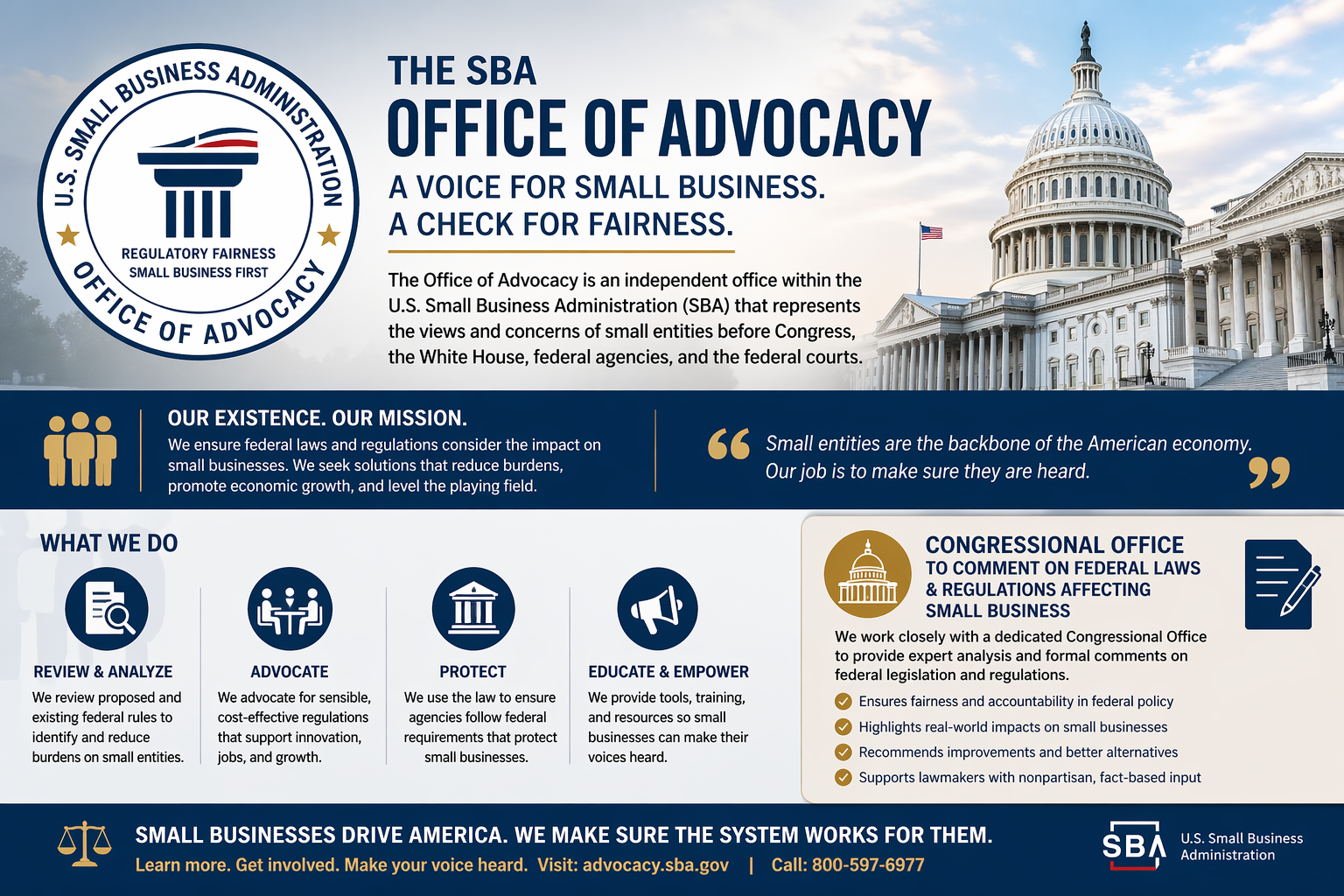
The SBA Office of Advocacy
An independent voice created by Congress to protect small businesses from harmful federal policy and regulatory burden.
What makes it unique?
Unlike the rest of the SBA, the Office of Advocacy is an independent voice. It reports to the President and Congress, focusing solely on the impact of federal regulations. It acts as a shield, ensuring that when agencies write rules, they consider the unique constraints of small operators.
Structural Influence Model
Breakdown of Advocacy’s formal influence channels based on statutory authority.
Myth vs. Reality
The office is often misunderstood. Here is what it is NOT.
- • It processes SBA Loans or Grants
- • it manages disaster relief funds
- • It handles government contracting awards
- • It acts as your personal private attorney
- • It files formal legal comments to stop bad rules
- • It produces economic studies to prove burden
- • It holds agencies accountable via Roundtables
- • It identifies less-burdensome policy alternatives
How to Engage Effectively
Top Channels for Small Business
When should you call them?
Advocacy is most effective when addressing broad patterns rather than isolated grievances.
A rule is proposed: That would impose massive new compliance costs on your industry.
Structural mismatch: A regulation is written for big corporations but applied to small shops.
Industry Blindness: Federal policymakers simply do not understand how your sector operates.
The “Red Tape Hotline”
Use the formal hotline or contact Regional Advocates to report specific regulatory hurdles. Prepare data and evidence before calling.
Preparation Checklist: What Advocacy Needs From You
Economic Impact
Estimates of how much a rule will cost your business in time or money.
Specific Pattern
Examples of how this issue affects others in your industry, not just you.
Better Models
Suggested alternatives that achieve the safety/policy goal with less burden.
The Institutional Genesis and Mandate of Independence
The regulatory landscape of the United States is defined by a fundamental tension between the necessity of federal oversight and the economic viability of the small business sector. To navigate this tension, Congress established the Office of Advocacy in 1976 under Public Law 94-305.1 This legislative action was born from the recognition that small entities—defined generally as independent businesses with fewer than 500 employees, non-profit organizations, and small government jurisdictions—face a disproportionate burden when complying with federal mandates.1 Unlike the broader Small Business Administration (SBA), which focuses on providing direct services such as loans, disaster assistance, and procurement support, the Office of Advocacy is designed to function as an independent “watchdog” within the executive branch.1
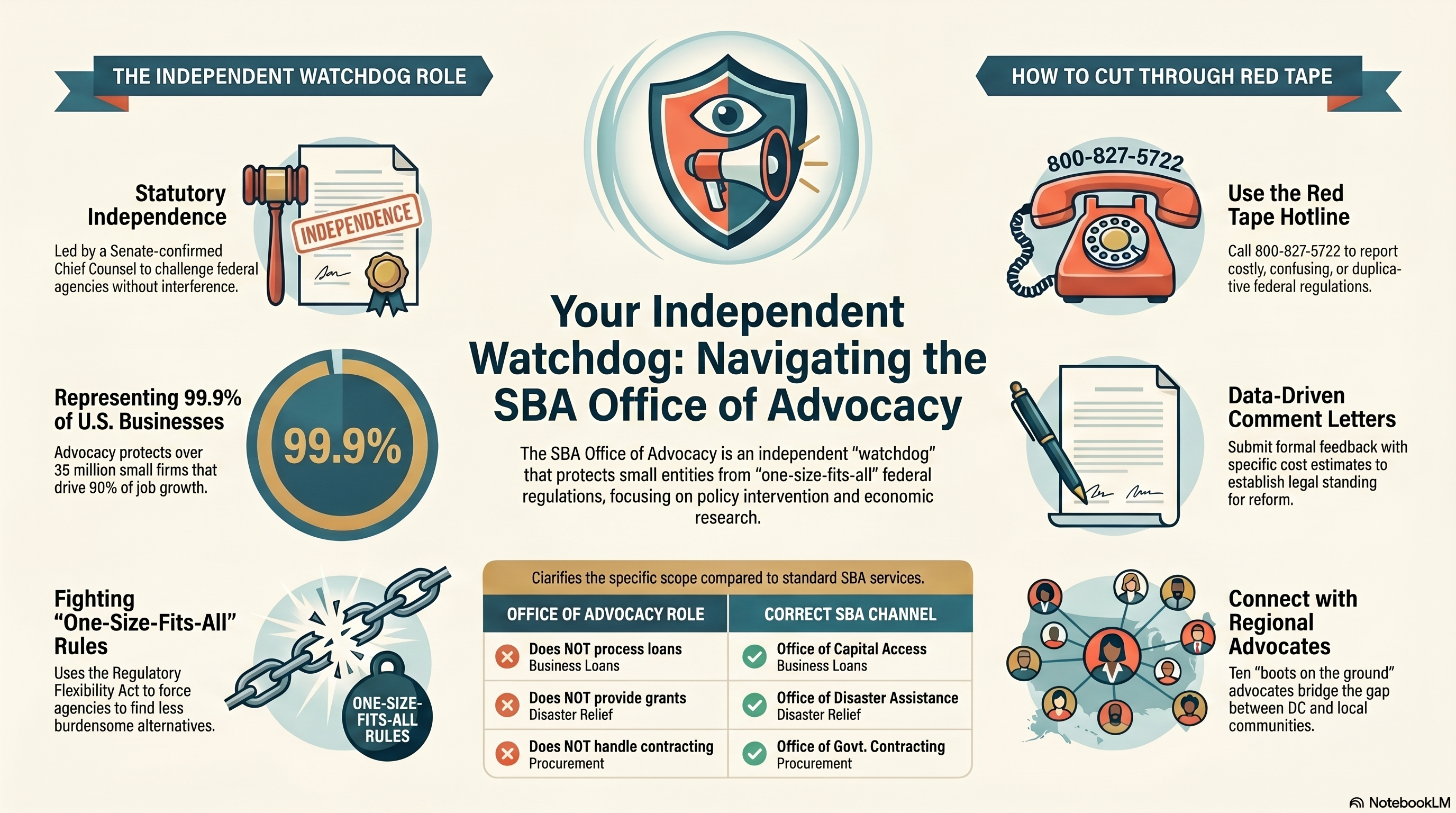
The mandate of the Office of Advocacy is to represent the views and concerns of small entities before every major branch of the federal government, including Congress, the White House, federal agencies, and the federal courts.2 This independence is codified in the appointment process of its leader: the Chief Counsel for Advocacy is appointed by the President from civilian life and must be confirmed by the U.S. Senate.1 This structure ensures that the office can challenge the very agencies it is housed near, including the SBA itself, should their policies inadvertently harm the small business ecosystem.8 The office currently operates with a specialized staff of approximately 50 members, including economists, attorneys, and policy analysts, and is supported by a network of ten regional advocates who serve as a bridge between Washington, D.C., and local communities.1
The existence of the Office of Advocacy is predicated on the “one-size-fits-all” fallacy in federal rulemaking. Large corporations often possess the legal and compliance departments necessary to absorb the costs of new regulations, whereas small firms must divert critical capital and time away from innovation and growth to manage paperwork and technical compliance.4 By intervening early in the regulatory development process, the Office of Advocacy attempts to rectify this imbalance, ensuring that federal agencies consider less burdensome alternatives before rules are finalized.1
The Legal Architecture: RFA, SBREFA, and Executive Mandates
The operational authority of the Office of Advocacy is grounded in two primary statutes and a critical executive order. These legal pillars provide the office with the “teeth” necessary to demand accountability from the federal bureaucracy.
The Regulatory Flexibility Act of 1980
The Regulatory Flexibility Act (RFA) is the foundational law that governs how federal agencies must treat small entities during the rulemaking process.1 The RFA requires agencies to explicitly consider the economic impact of their regulations and to seek out alternatives that minimize these impacts while still achieving the intended policy goals.1
| RFA Analytical Requirement | Description of Mandatory Agency Action |
| Initial Regulatory Flexibility Analysis (IRFA) | Agencies must identify potential impacts on small entities and consider regulatory alternatives at the proposal stage.10 |
| Final Regulatory Flexibility Analysis (FRFA) | Agencies must weigh public feedback, justify their final regulatory choices, and explain why less burdensome alternatives were rejected.10 |
| Rulemaking Review | Periodic review of existing rules to determine if they should be continued without change, amended, or rescinded.10 |
Executive Order 13272 further strengthens the RFA by directing federal agencies to establish written procedures for complying with the Act and to consider the Office of Advocacy’s formal comments as part of the official rulemaking record.10 This order also mandates that the Office of Advocacy provide training to agency rule-writers, ensuring they understand their statutory obligations to the small business community.10
The Small Business Regulatory Enforcement Fairness Act of 1996
While the RFA established the requirement for analysis, the Small Business Regulatory Enforcement Fairness Act (SBREFA) provided the mechanisms for enforcement and increased participation.12 One of the most significant aspects of SBREFA is the provision for judicial review, which allows small entities to sue federal agencies in court if they fail to comply with the RFA’s analytical requirements.3 This legal standing transforms the Office of Advocacy’s comments from mere suggestions into potential legal liabilities for non-compliant agencies.
SBREFA also created a unique “early warning system” known as Small Business Advocacy Review (SBAR) panels, or SBREFA panels.13 These panels must be convened by specific agencies—namely the Environmental Protection Agency (EPA), the Occupational Safety and Health Administration (OSHA), and the Consumer Financial Protection Bureau (CFPB)—before they issue a proposed rule that is expected to have a significant economic impact on a substantial number of small entities.8
| SBAR Panel Component | Function and Participants |
| Participants | Representatives from the SBA Office of Advocacy, the agency (EPA/OSHA/CFPB), and the Office of Management and Budget (OMB).13 |
| Small Entity Representatives (SERs) | Small business owners and stakeholders who provide direct advice and recommendations on the draft rule.13 |
| Outcome | A final report containing the panel’s advice and recommendations, which must be considered by the agency when drafting the proposed rule.13 |
Organizational Structure and Regional Outreach
The Office of Advocacy is structured to be both a high-level policy shop and a grassroots outreach organization. This dual identity is essential for capturing the diverse needs of the 36.2 million small businesses in the United States.4
The Office of the Chief Counsel
Led by the Chief Counsel for Advocacy, the headquarters in Washington, D.C., manages the office’s interactions with Congress and the White House.1 The Chief Counsel serves as a public spokesperson, delivering data-backed insights to policymakers and advocating for smarter, more responsive laws.1 The office relies on three primary pillars of activity: regulatory advocacy, economic research, and regional outreach.8
The Regional Advocate Network
A critical component of Advocacy’s effectiveness is its ten regional advocates, each assigned to one of the ten federal regions.1 These individuals are the “boots on the ground,” interacting with state and local governments, chambers of commerce, and individual business owners.1 Their primary role is to act as a liaison, identifying regional trends and specific challenges that may not be visible from the national capital.1
| Federal Region | Reach and Advocacy Role |
| National Coverage | 10 regions covering all 50 states and territories.4 |
| Engagement Activities | Hosting roundtables, attending business forums, and conducting local outreach.1 |
| Feedback Loop | Reporting “real-world” insights back to the Chief Counsel to inform formal comments and research.1 |
This regional presence is vital for the office’s mission because small business concerns are often industry-specific and geographically diverse. For example, a small logger in the Pacific Northwest faces vastly different regulatory hurdles than a tech startup in New York or a family farm in the Midwest.16 The regional advocates ensure that these localized perspectives are incorporated into the national policy debate.
The Economic Research Pillar: Quantifying the Main Street Experience
The Office of Advocacy is one of the premier sources of economic data on the small business sector in the United States. This research is not merely academic; it is a strategic tool used to educate policymakers on the reality of entrepreneurial life.1 By quantifying the role of small businesses in the economy, the office provides the empirical evidence necessary to advocate for policy changes.
Small businesses represent 99.9% of all U.S. businesses and have historically contributed to nearly 90% of net new job growth in certain years.7 Between 1998 and 2022, small business employment grew by 13.1%, reaching over 62 million employees.7 Furthermore, small firms are responsible for approximately 33% of all U.S. exports, demonstrating their importance to international trade.7
Key Research Products and Their Policy Utility
The office produces a variety of data-driven resources that are essential for both business owners and policymakers:
| Research Product | Content and Strategic Utility |
| Small Business Profiles | State and territory-level data on employment, firm size, and ownership demographics.1 |
| Small Business Facts | Brief, data-driven papers on topics like access to capital, startups, and demographic trends.4 |
| Economic Studies | Commissioned research on international trade, financing, and the cumulative cost of regulation.1 |
| FAQ on Small Business | A comprehensive overview of the small business sector used by researchers and government officials.1 |
One of the most critical findings from Advocacy’s research is the quantification of the paperwork burden. For example, research has shown that IRS Form 941, the Employer’s Quarterly Tax Return, represents the fifth largest paperwork burden in the federal government, totaling 470 million hours of compliance time.19 The Office of Advocacy has used this data to propose transitioning to yearly reporting, which could save small businesses an estimated $20.1 billion annually.19 This type of data-backed advocacy is essential for translating the frustrations of business owners into actionable policy recommendations.
Functional Analysis: What Advocacy Does and Does Not Do
To use the Office of Advocacy effectively, a business owner must understand the scope of its authority. Misidentifying the office’s role can lead to missed opportunities for regulatory relief or frustration when seeking services the office is not designed to provide.
The Scope of Regulatory Advocacy
The Office of Advocacy’s primary job is to ensure that small business voices are heard when federal agencies create new regulations, policies, or programs.4 This involves reviewing proposed rules, providing formal comment letters, and pushing for regulatory flexibility.4 The office also assists small entities in navigating the complex federal rulemaking process, offering guidance on how to submit effective comments and identify potential impacts.3
The office focuses on rules that are “unfairly harmful or burdensome” to small entities.4 This includes rules that are:
- Overly costly to implement relative to the firm’s size.4
- Confusing or poorly defined, leading to compliance errors.4
- Outdated or duplicative of existing state or federal mandates.17
- Based on “one-size-fits-all” assumptions that do not account for the operational realities of smaller firms.4
What the Office of Advocacy Does Not Do
It is equally important to understand what the office is not authorized to do. Advocacy is an independent voice for policy and regulation; it is not a direct service provider.1
| Feature | Office of Advocacy Stance | Correct SBA Channel |
| Loan Processing | Does not issue or process loans.1 | Office of Capital Access / District Offices.1 |
| Disaster Relief | Does not provide disaster grants or loans.1 | Office of Disaster Assistance.1 |
| Procurement | Does not handle government contracting or certification.1 | Office of Government Contracting.1 |
| Legal Representation | Does not provide direct legal counsel for private lawsuits.4 | Private Legal Counsel.4 |
The Office of Advocacy cannot “waive” a regulation or grant an individual exemption for a single business. Instead, it works to change the regulation itself or the agency’s general enforcement policy to benefit all small entities within a specific sector or across the economy.1
Case Studies: Regulatory Victories and Ongoing Challenges
The success of the Office of Advocacy is measured in “Small Business Victories”—instances where the office’s intervention led to a tangible reduction in regulatory burden.1 These case studies illustrate the types of issues where the office is most effective.
The Tier 4 Diesel Emissions Crisis
A prominent ongoing battle involves the EPA’s Tier 4 standards for diesel emissions.19 While intended to reduce pollution, the complexity of modern emissions hardware—such as Diesel Particulate Filters (DPF) and Diesel Exhaust Fluid (DEF) systems—has created a “quiet crisis” for small fleets, builders, and rural dealers.19 The equipment is often fragile and ill-suited for the stop-and-go usage patterns of many small business vehicles, leading to frequent breakdowns and massive repair costs.19
Advocacy’s research found that a forced regeneration for a light-duty work truck can cost $1,000, and a replacement DPF can cost up to $3,500 before labor.19 Small businesses, lacking the capital to maintain backup “shadow fleets,” face significant downtime when these systems fail.19 The Office of Advocacy has placed this issue on its “Most Wanted” list for reform, using these data points to argue for increased flexibility and more robust equipment standards from the EPA.19
Department of Justice Disability Access Rule
In early 2026, the DOJ issued a new rule requiring small governments (representing fewer than 50,000 people) to adopt high-level technical standards for digital accessibility.19 The Office of Advocacy intervened, highlighting that the transition to these standards is prohibitively expensive for small municipalities.19 Initial testing and remediation costs could reach $100,000 per city, with annual maintenance costs exceeding $21,000.19
Advocacy pointed out that these costs force small towns to make impossible trade-offs, such as choosing between website compliance and purchasing critical equipment like fire trucks.19 Furthermore, the rule exposes small governments to significant liability risks from private civil lawsuits.19 As a result of Advocacy’s efforts, the office is working to mitigate these impacts by seeking alternatives and extended compliance timelines for smaller jurisdictions.19
Sector-Specific Regulatory Triumphs
The office has achieved significant results across various sectors, often by securing exemptions or delayed compliance dates for small entities:
| Industry Sector | Regulatory Victory Description |
| Financial Services | The CFPB exempted small credit card issuers from certain penalty fee rules.19 |
| Healthcare | The FDA increased regulatory flexibilities in the Laboratory Developed Tests (LDT) rule for small health businesses.19 |
| Telecommunications | Small broadband providers were granted flexibility in adopting broadband consumer labels.19 |
| Retail | The FTC provided clarifications for the Combating Auto Retail Scams (CARS) rule, easing the burden on small motor vehicle dealers.19 |
| Energy | Small electric utilities secured flexibility for new standards regarding distribution transformer conservation.19 |
These victories demonstrate that when small businesses provide the Office of Advocacy with specific data on operational impacts, the office can successfully push agencies to adopt more balanced policies.4
Tactical Engagement: How Small Businesses Should Use the Office
For a small business owner, the federal government can seem like an impenetrable fortress. The Office of Advocacy provides three specific “doors” for engagement: the Red Tape Hotline, the Regional Advocates, and the formal rulemaking process.4
The Red Tape Hotline: Your Primary Feedback Loop
The Red Tape Hotline (800-827-5722, Option 3) is a direct channel for reporting federal regulations that are “costly, confusing, or outdated”.4 This is not just a complaint box; it is a strategic data-gathering tool.17 Every submission helps the Office of Advocacy build the evidence needed to push for reform.
Business owners can use the hotline to report:
- Significant compliance costs that threaten profitability.4
- Confusing or conflicting rules from different agencies.17
- Delays in federal permitting or licensing.17
- Excessive or duplicative paperwork requirements.17
Feedback can be submitted via phone, email (RedTape@sba.gov), or an online form.4 The Office of Advocacy also provides a “Hotline Toolkit” including posters and shareable messaging for trade associations to encourage their members to speak up.4
Participating in SBREFA Panels and Roundtables
For rules with massive impacts, such as those from OSHA or the EPA, the SBREFA panel process is the most powerful avenue for engagement.13 Small businesses can volunteer to serve as Small Entity Representatives (SERs), providing direct testimony to agency rule-writers before a rule is even proposed.13
Advocacy also hosts roundtables—both in Washington and virtually—to solicit feedback on specific deregulatory efforts or new rules.3 These roundtables allow business owners to interact directly with Advocacy attorneys and, often, representatives from the agencies themselves.3 Preparing for these sessions requires clear, data-backed evidence of how a rule affects your bottom line and operational efficiency.4
The Art of the Comment Letter
The most formal way to engage is through the public comment period for a Notice of Proposed Rulemaking (NPRM).10 Small businesses should monitor the Federal Register or sign up for Advocacy’s “Regulatory Alerts” to stay informed.4 When drafting a comment letter, the office recommends a structured, professional approach.4
| Comment Letter Section | Strategic Content Requirements |
| Introduction | State who you are and which rule you are addressing. Briefly describe your business’s relevance to the sector.4 |
| Detailed Analysis | List specific provisions you support or oppose. Be highly specific—avoid emotional language and focus on data.4 |
| Quantitative Data | Include cost estimates for equipment, additional staff time, or training needed for compliance.4 |
| Practical Solutions | Suggest modifications like delaying the effective date, providing a “small business exemption,” or clarifying vague terms.4 |
| Credibility | Mention your years of experience in the industry to establish yourself as an informed party.4 |
Coordination Strategies for Trade Associations and Groups
For a group like the New American Business Association (NABA), the Office of Advocacy is a critical partner. Trade associations act as “force multipliers” for small business advocacy, aggregating the concerns of thousands of members into a single, high-impact voice.22
Establishing a Liaison with Advocacy Attorneys
The Office of Advocacy relies heavily on trade associations to help them identify affected businesses.22 Advocacy attorneys often communicate directly with association leadership to set up meetings and roundtables.22 NABA members should view their association as the bridge to these high-level policy discussions. Associations can provide “briefing memos” that synthesize the most pressing concerns of their membership, allowing Advocacy to move quickly when a regulatory threat emerges.22
Leveraging the Regional Advocates for Local Impact
Trade associations should also coordinate with the ten regional advocates to host local “listening sessions” or business forums.1 These events provide a platform for small business owners who might not have the time or resources to travel to Washington.1 By bringing the Office of Advocacy into the community, trade associations ensure that the local perspective is never lost in the national regulatory debate.
Effective Data Aggregation
One of the most valuable services a trade association can provide is the collection of sector-specific data.4 When an agency proposes a rule, NABA can survey its members to determine the average cost of compliance across different firm sizes.4 Providing this data to the Office of Advocacy allows their economists to conduct a more robust Regulatory Flexibility Analysis, which can be used to challenge the agency’s assumptions.10
Why the Office of Advocacy is Underused
Despite its significant success and unique legal authority, the Office of Advocacy remains one of the most underused federal resources for small businesses. Understanding the barriers to use is essential for improving the office’s reach and effectiveness.
The Awareness and Branding Gap
A primary reason for underutilization is a simple lack of awareness. Many small business owners are overwhelmed by the day-to-day requirements of running their firms and have little bandwidth for monitoring the Federal Register.4 Furthermore, because the office is housed within the SBA, it is often confused with the SBA’s programmatic offices.1 When a business owner learns that Advocacy does not provide loans or grants, they may mistakenly believe the office has nothing to offer them, missing out on the long-term benefits of regulatory relief.1
Regulatory Complexity and Intimidation
The federal rulemaking process is inherently complex and can be intimidating for those without legal or policy training.4 Many business owners feel that their single voice will not make a difference against a large federal agency.4 The Office of Advocacy works to combat this by providing simplified guides and “plain English” resources, but the perception of the government as a monolithic and unresponsive entity remains a significant hurdle.4
The “Quiet Crisis” of Cumulative Burden
Regulatory burden is often a “death by a thousand cuts” rather than a single, catastrophic rule.19 A business might spend a few hours a week on one form and a few thousand dollars a year on another mandate. Individually, these burdens may not seem worth the effort of contacting a federal hotline. However, the cumulative impact is what hampers small business growth.1 The Office of Advocacy relies on business owners reporting even these smaller “red tape” issues so that it can identify broader trends and push for systemic reform.17
The Future Outlook: AI, Deregulation, and Emerging Sectors
As the economy shifts toward digital services and artificial intelligence, the Office of Advocacy is adapting its research and advocacy strategy to meet new challenges.
Artificial Intelligence and the Small Firm
Small businesses are increasingly experimenting with AI to bolster customer service and create cost-saving efficiencies.19 For example, veteran-owned firms are using AI tools to improve sales techniques and marketing strategies.19 However, the regulatory environment for AI is still in its infancy. The Office of Advocacy is monitoring how new data privacy rules and “sensitive personal data” restrictions might impact the ability of small firms to compete with larger tech giants who have more resources to manage complex data compliance.28
Deregulatory Initiatives and Efficiency
The office is also participating in broad deregulatory efforts, such as the Department of Health and Human Services (HHS) request for information on reducing the burden on the healthcare system.3 Small entities in the healthcare and food sectors have identified numerous opportunities for streamlining forms and clarifying compliance steps.3 For instance, food distributors have suggested that algorithmic inference of traceability codes—made possible by modern AI—should be allowed as an alternative to existing, more burdensome recordkeeping requirements.3
Strengthening the RFA Through Legislative Reform
There are ongoing legislative efforts to further enhance the authority of the Office of Advocacy. Proposed reforms, such as the Small Business Regulatory Flexibility Improvements Act, seek to expand the requirement for SBAR panels to all federal agencies, not just the EPA, OSHA, and CFPB.8 Such a change would represent a massive expansion of Advocacy’s “early intervention” power, ensuring that small business concerns are hard-wired into the development of all major federal regulations.8
Conclusion: A Practical Agenda for Small Business Protection
For the individual small business owner facing regulatory confusion, unfair process, or harmful policy design, the Office of Advocacy is not merely an optional resource; it is an essential partner in survival and growth. The “key practical question” of when and how to use the office can be answered through a three-pronged strategy of awareness, data, and coordination.
- When to Use Advocacy: The moment a federal rule—whether proposed or existing—impacts your operational costs, requires excessive paperwork, or seems to ignore the reality of your industry, the Office of Advocacy should be contacted.4
- How to Use the Hotline: The Red Tape Hotline (800-827-5722, Option 3) should be the first line of defense for reporting “red tape” and regulatory roadblocks.4
- The Power of Data: Engagement is most effective when backed by hard data. Quantifying the cost of compliance in terms of dollars and hours spent allows the Office of Advocacy to build a legally defensible case for reform.4
- Collective Action via NABA: Individual owners should coordinate through trade associations like the New American Business Association to leverage collective influence and gain access to the Office of Advocacy’s roundtables and legal expertise.22
The SBA Office of Advocacy exists because the American economy depends on the vitality of small entities.4 By serving as a data-driven, independent voice, it ensures that the “Main Street” perspective is not just an afterthought in Washington, but a statutory requirement in the federal rulemaking process. For NABA members and the broader small business community, using this office is not just about complaining—it is about participating in the democratic process to ensure a fairer, more competitive, and less burdensome business environment for all.17
Works cited
- Who We Are – Office of Advocacy – SBA Office of Advocacy, accessed April 22, 2026, https://advocacy.sba.gov/home/about/who-we-are/
- Office of Advocacy – Wikipedia, accessed April 22, 2026, https://en.wikipedia.org/wiki/Office_of_Advocacy
- Comment Letter – Health and Human Services’ Request for …, accessed April 22, 2026, https://advocacy.sba.gov/wp-content/uploads/2025/07/Comment-Letter_Advocacy-Comments-to-HHS-Deregulatory-RFI.pdf
- About – Office of Advocacy – SBA Office of Advocacy, accessed April 22, 2026, https://advocacy.sba.gov/home/about/
- SMALL BUSINESS ADMINISTRATION – GovInfo, accessed April 22, 2026, https://www.govinfo.gov/content/pkg/GOVMAN-1999-06-01/pdf/GOVMAN-1999-06-01-Pg667.pdf
- Oklahoma Small Business Development Centers: Home, accessed April 22, 2026, https://www.oksbdc.org/
- Office of Advocacy – The independent voice for small businesses and entities. – SBA, accessed April 22, 2026, https://advocacy.sba.gov/
- SBA Office of Advocacy: Overview, History, and Current Issues, accessed April 22, 2026, https://nationalaglawcenter.org/wp-content/uploads/assets/crs/R43625.pdf
- A Critical Guide to the Regulatory Flexibility Act – Duke Law Scholarship Repository, accessed April 22, 2026, https://scholarship.law.duke.edu/cgi/viewcontent.cgi?article=2804&context=dlj
- RFA Basics – Office of Advocacy – SBA Office of Advocacy, accessed April 22, 2026, https://advocacy.sba.gov/resources/regulatory-flexibility-act/rfa-basics/
- Regulatory Analysis Requirements – Administrative Conference of the United States, accessed April 22, 2026, https://www.acus.gov/sites/default/files/documents/COR-Copeland-Report-CIRCULATED.pdf
- SBREFA – SBA Office of Advocacy, accessed April 22, 2026, https://advocacy.sba.gov/resources/reference-library/sbrefa/
- Emergency Response Standard; Proposed Rule | Occupational Safety and Health Administration, accessed April 22, 2026, https://www.osha.gov/laws-regs/federalregister/2024-02-05
- Office of Advocacy FY 2026 Congressional Budget Justification and FY 2024 Annual Performance Report, accessed April 22, 2026, https://advocacy.sba.gov/wp-content/uploads/2025/07/Advocacy-FY2026-CBJ-Final-508.pdf
- FEDERAL REGISTER – GovInfo, accessed April 22, 2026, https://www.govinfo.gov/content/pkg/FR-2025-11-13/pdf/FR-2025-11-13.pdf
- Senate Report 107-19 – SUMMARY OF LEGISLATIVE AND OVERSIGHT ACTIVITIES DURING THE 106TH CONGRESS – GovInfo, accessed April 22, 2026, https://www.govinfo.gov/content/pkg/CRPT-107srpt19/html/CRPT-107srpt19.htm
- The SBA Red Tape Hotline – Angelo State University, accessed April 22, 2026, https://www.angelo.edu/live/news/19701-the-sba-red-tape-hotline
- Views & News – December 4, 2024 – ASLRRA, accessed April 22, 2026, https://www.aslrra.org/news/views-and-news/views-news-120424/
- Blog – Office of Advocacy – SBA Office of Advocacy, accessed April 22, 2026, https://advocacy.sba.gov/category/newsroom/news-articles/
- Extension of Compliance Dates for Nondiscrimination on the Basis of Disability; Accessibility of Web Information and Services of – ADA.gov, accessed April 22, 2026, https://www.ada.gov/assets/pdfs/2026-ifr.pdf
- Red Tape Hotline Poster, accessed April 22, 2026, https://www.arizonasbdc.com/wp-content/uploads/2025/09/Red-Tape-Hotline-poster-27×40-1.pdf
- Background Paper Office of Advocacy 2017-2020, accessed April 22, 2026, https://advocacy.sba.gov/wp-content/uploads/2021/02/Background-Paper-Office-of-Advocacy-2017-2020-web.pdf
- cpr-response-epa-rmp-sba-role-073021.pdf – AWS, accessed April 22, 2026, https://cpr-assets.s3.amazonaws.com/documents/cpr-response-epa-rmp-sba-role-073021.pdf
- Draft Proposed Rule to Specify that Children’s Upper Outerwear in Sizes 2T to 12 with Neck or Hood Drawstrings and Children’, accessed April 22, 2026, https://www.cpsc.gov/s3fs-public/pdfs/blk_pdf_drawstrings.pdf
- FY2020 Roundtable Report – National Women’s Business Council, accessed April 22, 2026, https://www.nwbc.gov/wp-content/uploads/2023/11/FY2020-Roundtable-Report-NWBC_Final.pdf
- Annual Report of the Chief Counsel for Advocacy on Implementation of the Regulatory Flexibility Act and Executive Order 13272, accessed April 22, 2026, https://advocacy.sba.gov/wp-content/uploads/2023/05/FY2022RFA_Final-508c.pdf
- Uncategorized Archives – Louisville Beauty Academy, accessed April 22, 2026, https://louisvillebeautyacademy.net/category/uncategorized/
- Preventing Access to U.S. Sensitive Personal Data and Government-Related Data by Countries of Concern or Covered Persons – Federal Register, accessed April 22, 2026, https://www.federalregister.gov/documents/2025/01/08/2024-31486/preventing-access-to-us-sensitive-personal-data-and-government-related-data-by-countries-of-concern