
Kentucky Workforce Education Proof Model: Low-Cost Licensure, Student Choice, and Reduced Red Tape
NABA policy note | Kentucky proof model | Student choice
Kentucky Workforce Education Proof Model: Low-Cost Licensure, Student Choice, and Reduced Red Tape
Louisville Beauty Academy should not be presented to public leaders as a request for special treatment. It should be presented as a Kentucky field example worth studying: state-licensed, multilingual, affordability-centered, document-focused, and nationally recognized for practical workforce impact.
The strongest public position is simple: when education policy leaders talk about returning decision-making closer to states, reducing unnecessary bureaucracy, improving workforce pathways, and giving students more practical routes into work, Kentucky already has a living small-business example in Louisville Beauty Academy.
That does not mean every rule should disappear. It does not mean any school should receive public trust without documentation. It means policymakers should study real institutions that are already doing the hard work of lowering cost, supporting working adults, respecting language difference, preparing students for state licensure, and documenting the student pathway in writing.
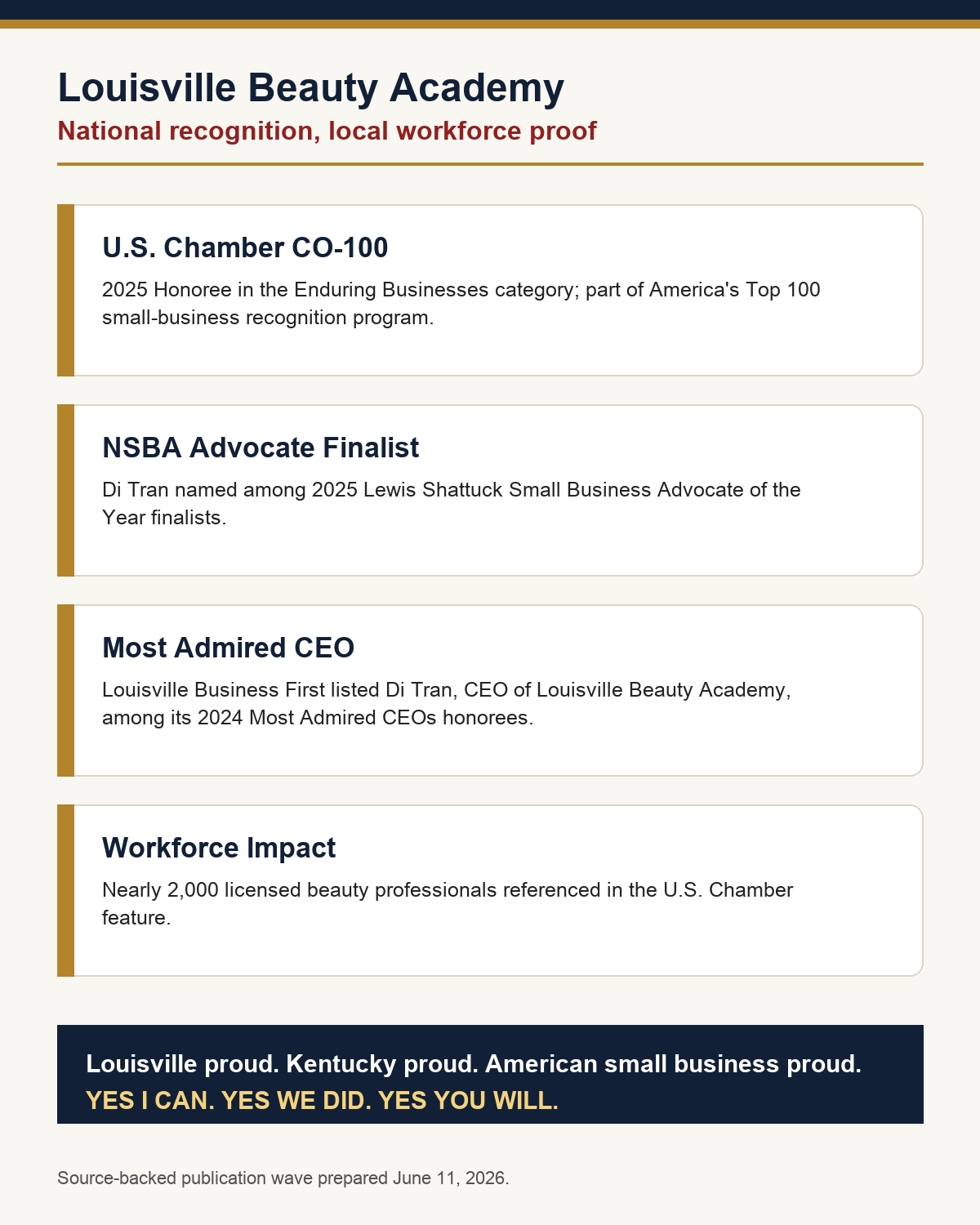
Louisville Beauty Academy is especially important now because the U.S. Chamber of Commerce has publicly featured the school as a CO-100 honoree in the Enduring Businesses category. The feature describes a model built around affordable, multilingual, state-licensed beauty education, practical licensure preparation, and nearly 2,000 licensed beauty professionals impacted. That recognition should be used carefully: not as entitlement, but as outside credibility for a Kentucky workforce-education model that deserves serious policy attention.
The Policy Point Is Not “Help One School”
The policy point is larger: if a state-licensed, community-rooted, lower-cost, multilingual workforce school can help adults move toward professional licensure without building the experience around debt, then public leaders should ask what that model teaches.
For students, the question is practical: can they understand the real cost, the written obligations, the licensing pathway, the schedule, the support structure, and the risks before signing? For policymakers, the question is structural: can public systems recognize and support accountable outcomes without forcing every useful school into the same expensive institutional mold?
NABA’s position is that student choice and public accountability can belong together. Funding, recognition, and public trust should be tied to written clarity, lawful operation, documented enrollment terms, attendance and completion records, licensure progress, graduate outcomes, complaint handling, and consumer protection. Support should follow real student value, not paperwork complexity alone.
Why This Matters Under The Current Federal Direction
The U.S. Department of Education’s public “Returning Education to the States” initiative emphasizes state and local responsibility, workforce alignment, career pathways, education choice, and reducing federal bureaucracy. The Department also describes an Education-Labor workforce partnership focused on better coordination of education and workforce-development programs.
That national direction makes Kentucky proof examples more valuable. If states are expected to lead, then states need real examples that can be examined, improved, and replicated responsibly. LBA gives Kentucky a concrete field case: not theory, not a consultant slide deck, but a working institution serving adult learners, immigrant families, working parents, and people seeking a practical licensure pathway.
The phrase “reduced red tape” should never mean reduced student protection. The better standard is reduced waste, clearer records, stronger transparency, faster review, better routing, and more accountable support for schools that can show real value.
How LBA Should Be Presented To Leaders
- As a Kentucky proof model for lower-cost, state-licensed workforce education.
- As a multilingual, immigrant-founder-led example of practical access.
- As a document-first institution that increasingly centers written clarity, student records, policy controls, and transparent routing.
- As a small-business workforce engine that can help students move toward licensure, work, salon employment, independent booths, entrepreneurship, and family economic mobility.
- As a public learning case for student-choice funding, outcome-aware reimbursement, and responsible state-led workforce education reform.
This is the right posture because it elevates Kentucky without making the article sound like a private appeal. Public leaders do not need another self-promotional institutional claim. They need a field example that helps them think better about affordability, workforce participation, student protection, and small-business mobility.
What LBA Should Not Claim
Claim-control guardrail: This article does not claim government endorsement, funding approval, accreditation status, guaranteed licensure, guaranteed employment, guaranteed income, guaranteed business ownership, guaranteed student aid, or any special entitlement for Louisville Beauty Academy.
Recognition by the U.S. Chamber is a credibility signal. It is not a promise of individual student outcomes. State licensure, school approvals, student obligations, funding eligibility, exam requirements, and public-support rules remain controlled by current written law, agency rules, official documents, and applicable processes.
A Better Ask
The best first-touch ask is not “fund us.” It is:
Please study this Kentucky-born model as one example of how state-licensed, lower-cost, multilingual workforce education can support student choice, licensure preparation, small-business formation, and economic mobility while preserving written accountability and consumer protection.
That is strong because it is humble and serious. It invites policymakers to learn, not to rescue. It gives Kentucky the hero role. It turns LBA’s recognition into public usefulness.
Read the June 3, 2026 U.S. Chamber feature on Louisville Beauty Academy
References
- U.S. Chamber CO— feature: “Louisville Beauty Academy Creates Opportunity Through Debt-Free Beauty Education,” published June 3, 2026.
- U.S. Chamber CO—100 profile for Louisville Beauty Academy.
- U.S. Chamber CO—100 Enduring Businesses category page.
- U.S. Department of Education: Returning Education to the States initiative.
- U.S. Department of Labor release on the Education-Labor workforce-development partnership.
NABA publishes this as public education and policy discussion. It is not legal advice, funding advice, student-aid advice, an accreditation claim, or a government-submission document.