
A Simple Fix for Kentucky’s Workforce: Why Standardizing Cosmetology Student Transcripts Matters – MARCH 2026
❓ What is the issue with cosmetology student transcripts in Kentucky?
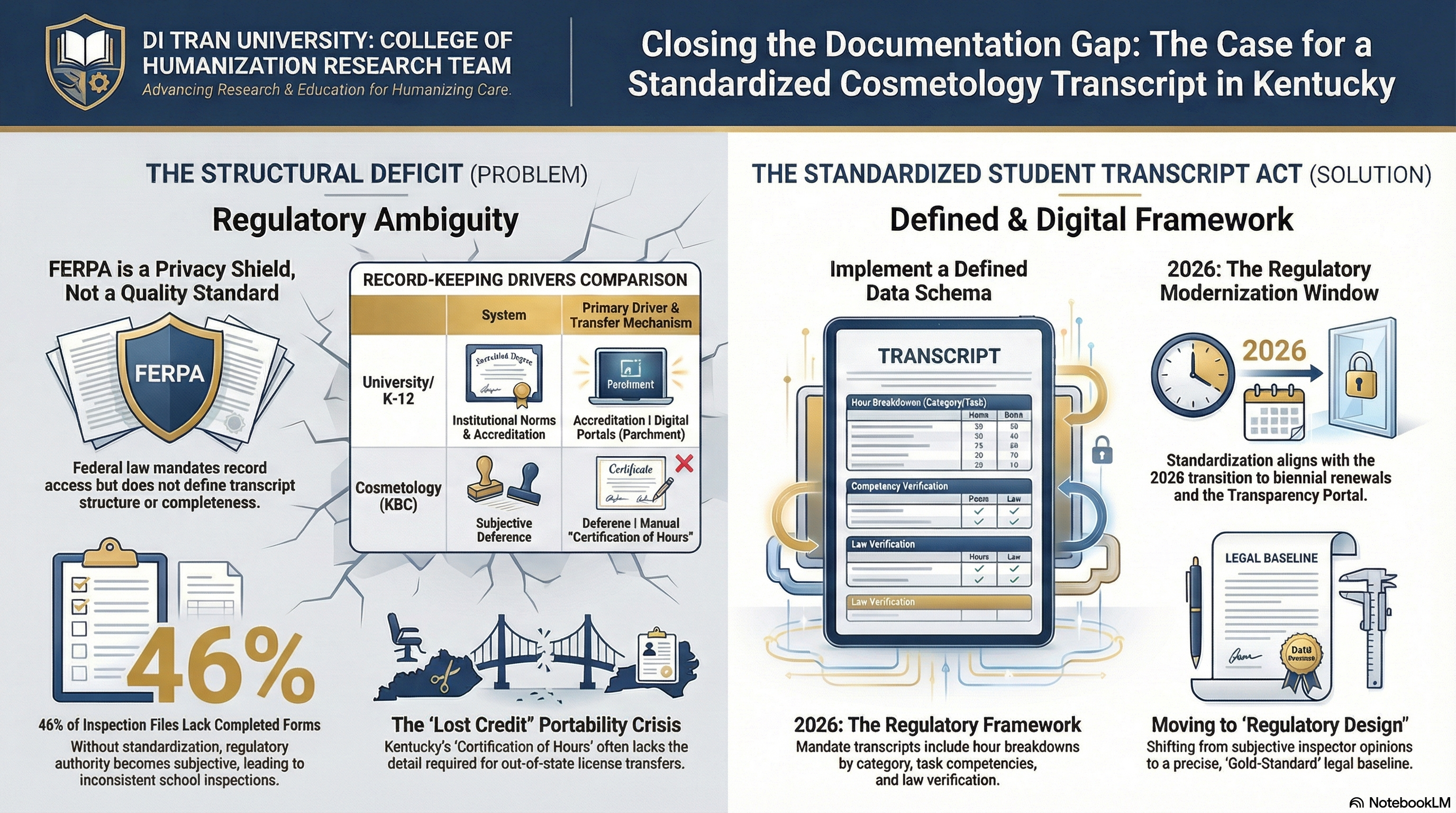
Kentucky requires cosmetology students to complete a set number of training hours for licensure, but there is no standardized format for how those hours are documented in a student transcript. This creates inconsistency in how education records are presented and verified.
❓ Why is a standardized student transcript important?
A standardized transcript ensures that a student’s training hours and competencies are clearly documented in a consistent format. This helps students prove their education, especially when transferring to another state or applying for licensure.
❓ Does Kentucky law require cosmetology schools to provide transcripts?
Kentucky law requires schools to maintain records and report student hours, but it does not define a specific standardized transcript format. This leaves schools to determine how records are structured.
❓ How does this affect cosmetology students?
Without a standardized transcript:
- Students may struggle to transfer their hours to another state
- Proof of education may be incomplete or unclear
- Long-term career mobility can be impacted
❓ How does this impact cosmetology schools?
Schools must interpret documentation requirements without a clear standard, which can lead to:
- Uncertainty in compliance
- Variability in record-keeping practices
- Increased administrative burden
❓ How does this affect inspections and regulators?
Without a uniform document:
- Inspections may vary depending on interpretation
- Regulators lack a consistent baseline for review
- Administrative efficiency is reduced
❓ What is the proposed solution?
The proposed solution is to establish a Standardized Student Transcript Framework that:
- Defines a clear format for documenting hours and competencies
- Is issued to every student upon completion
- Serves as the primary compliance and verification document
❓ Would this create more regulation for schools?
No. This proposal is not about adding new regulation—it is about clarifying existing requirements to improve consistency, transparency, and efficiency.
❓ How would this benefit Kentucky’s workforce?
Standardizing transcripts would:
- Improve workforce mobility
- Support student protection
- Reduce compliance confusion for businesses
- Strengthen regulatory consistency
❓ Is this a costly change for the state?
No. This is considered a low-cost, high-impact policy improvement because it builds on existing reporting systems and simply standardizes the output format.
❓ Who developed this research?
This concept is based on research conducted by Di Tran University — The College of Humanization, focusing on workforce development, education transparency, and regulatory clarity.
Kentucky has made strong progress in modernizing its workforce and licensing systems. In cosmetology education, the Commonwealth requires clear instructional standards, including defined training hours for licensure. However, one critical piece is missing—not in training, but in documentation.
Today, Kentucky law requires students to complete specific hours for cosmetology licensure. Yet, there is no standardized format for how those hours are documented in a student transcript. This creates a gap that affects students, schools, and regulators alike.
The Challenge
Without a standardized transcript framework:
- Students may face difficulty proving their education when transferring to another state
- Schools must interpret documentation expectations without clear guidance
- Inspections can vary depending on interpretation rather than a uniform standard
This is not a failure of the system—it is a natural gap that emerges when requirements for education exist, but the format of documentation is not clearly defined.
Why It Matters
For students, documentation is not just paperwork—it is proof of their time, effort, and investment. Without a consistent and structured record, their ability to move, grow, and work across state lines may be limited.
For schools, the lack of a defined standard creates unnecessary uncertainty in compliance. Even when acting in good faith, institutions may face inconsistent expectations simply due to the absence of a unified format.
For regulators, a standardized document would improve efficiency, consistency, and clarity in inspections and oversight.
A Practical, Low-Cost Solution
Kentucky has an opportunity to strengthen its workforce system through a simple, high-impact improvement:
👉 Establish a Standardized Student Transcript Framework for cosmetology education
This would:
- Define a clear and consistent format for documenting hours and competencies
- Ensure every student receives a complete, structured record upon completion
- Provide a reliable, uniform reference for schools and regulators
Importantly, this is not about adding new burdens. It is about clarifying and strengthening what already exists.
Aligning with Kentucky’s Workforce Goals
This approach aligns with recent efforts to improve licensing accessibility, reduce unnecessary barriers, and support workforce mobility. By standardizing documentation, Kentucky can further position itself as a leader in transparent, efficient, and student-centered workforce development.
Moving Forward
This research-based concept, developed by Di Tran University — The College of Humanization, highlights a practical path forward that benefits all stakeholders:
- Students gain protection and portability
- Schools gain clarity and consistency
- Regulators gain efficiency and standardization
We respectfully encourage Kentucky policymakers to explore this opportunity as a low-cost, high-impact modernization that supports both education and economic growth.
The New American Business Association (NABA) supports policies that strengthen workforce clarity, empower small businesses, and protect the long-term success of students across the Commonwealth.
🏛️ SAMPLE KENTUCKY BILL (DRAFT)
Workforce Education Transparency Act (WETA) – AN ACT relating to cosmetology education records.
Be it enacted by the General Assembly of the Commonwealth of Kentucky:
SECTION 1. A NEW SECTION OF KRS CHAPTER 317A IS CREATED TO READ AS FOLLOWS:
(1) As used in this section:
(a) “Board” means the Kentucky Board of Cosmetology;
(b) “School” means any licensed cosmetology school operating within the Commonwealth of Kentucky;
(c) “Standardized student transcript” means an official record issued by a licensed cosmetology school that documents a student’s enrollment, instructional hours, and completed curriculum in a uniform format established by the board.
(2) The board shall, by administrative regulation promulgated in accordance with KRS Chapter 13A, establish a standardized student transcript format to be utilized by all licensed cosmetology schools.
(3) The standardized student transcript shall include, at a minimum:
(a) The student’s full legal name and identifying information;
(b) The name, license number, and contact information of the school;
(c) The dates of enrollment, withdrawal, or completion;
(d) The total number of instructional hours completed;
(e) A breakdown of hours by subject area as required by administrative regulations;
(f) Verification of completed practical work or competencies required for licensure; and
(g) Any additional information deemed necessary by the board to ensure clarity, accuracy, and portability of student records.
(4) Each licensed cosmetology school shall issue a standardized student transcript to the student:
(a) Upon graduation or completion of the program;
(b) Upon withdrawal or dismissal from the program; or
(c) Upon request by the student, within a reasonable time not to exceed ten (10) business days.
(5) A standardized student transcript issued pursuant to this section shall be considered the primary official record of a student’s training for purposes of:
(a) Licensure verification;
(b) Transfer of hours within or outside the Commonwealth; and
(c) Compliance review by the board.
(6) Nothing in this section shall be construed to:
(a) Require additional instructional hours beyond those established by law or administrative regulation; or
(b) Impose unnecessary administrative burden beyond the standardization of existing record-keeping practices.
(7) The board may inspect supporting documentation, including attendance records and practical training logs, only as necessary to verify the accuracy of the standardized student transcript.
SECTION 2. The provisions of this Act shall take effect on January 1, 2027.
Discover more from New American Business Association (NABA) - Louisville, KY
Subscribe to get the latest posts sent to your email.