Evaluating Ethical, Legal, and Economically Sustainable Cosmetology Education Models – RESEARCH & PODCAST SERIES 2026
Executive Memorandum
To: Policymakers, Regulators, Beauty-School Operators, and Workforce Advocates From: Research and Analysis Team, New American Business Association Subject: Legal and Ethical Frameworks for Cosmetology Student Clinics, Unpaid Labor, and Institutional Accreditation
Executive Overview and Analytic Parameters
The American beauty education sector operates at the intersection of state occupational licensing, federal wage-and-hour law, and institutional accreditation. This memorandum evaluates the ethical, legal, and economic boundaries distinguishing a legitimate supervised educational clinic from an operational model that may inadvertently create wage-and-hour liabilities through the improper utilization of student labor. The analysis investigates the proposition that commercial volume alone dictates legal compliance, assessing how federal courts apply the “primary beneficiary test” to student clinic operations. Furthermore, the memorandum explores state-specific educational mandates, utilizing the Commonwealth of Kentucky as a primary case study, and examines recent federal scrutiny regarding institutional accreditation bodies.
What the Law Clearly Says: The Federal Wage-and-Hour Framework
Under the Fair Labor Standards Act (FLSA), the determination of whether a vocational student performing clinical work is a statutory “employee” entitled to minimum wage and overtime relies heavily on the “primary beneficiary test”1. The U.S. Supreme Court originally addressed the status of trainees in the 1947 decision Walling v. Portland Terminal Co., holding that railroad trainees were not employees because the employer received no immediate advantage from their activities4. Modern federal appellate courts have refined this precedent to address modern educational and vocational environments, recognizing that both the student and the institution may derive value from the relationship.
The U.S. Department of Labor (DOL) Wage and Hour Division, via Fact Sheet #71, outlines a flexible, seven-factor balancing test to examine the “economic reality” of the student-institution relationship2. The courts examine the extent to which the parties understand there is no expectation of compensation; the similarity of the training to an educational environment; the integration of the work with formal coursework and academic credit; the accommodation of the academic calendar; the limitation of the duration to the period of beneficial learning; the extent to which the student’s work complements rather than displaces paid employees; and the lack of entitlement to a paid job upon completion2.
Applying this framework, federal courts have consistently ruled that beauty school students performing clinical cosmetology services for academic credit are generally the primary beneficiaries of the work6. In Benjamin v. B&H Education, Inc. (involving the Marinello Schools of Beauty), the Ninth Circuit Court of Appeals held that students were the primary beneficiaries because their clinical practice allowed them to earn mandatory academic credit qualifying them for state licensing examinations7. The court observed that tasks such as sanitizing stations, dispensing products, and greeting patrons were relevant to professional preparation and, when performed “in small doses,” did not relegate the educational function of the clinic to a secondary, profit-driven status10. Similarly, the Second Circuit in Velarde v. GW GJ, Inc. affirmed that a student fulfilling state-mandated training hours by working without pay in a for-profit academy’s salon was not an employee4.
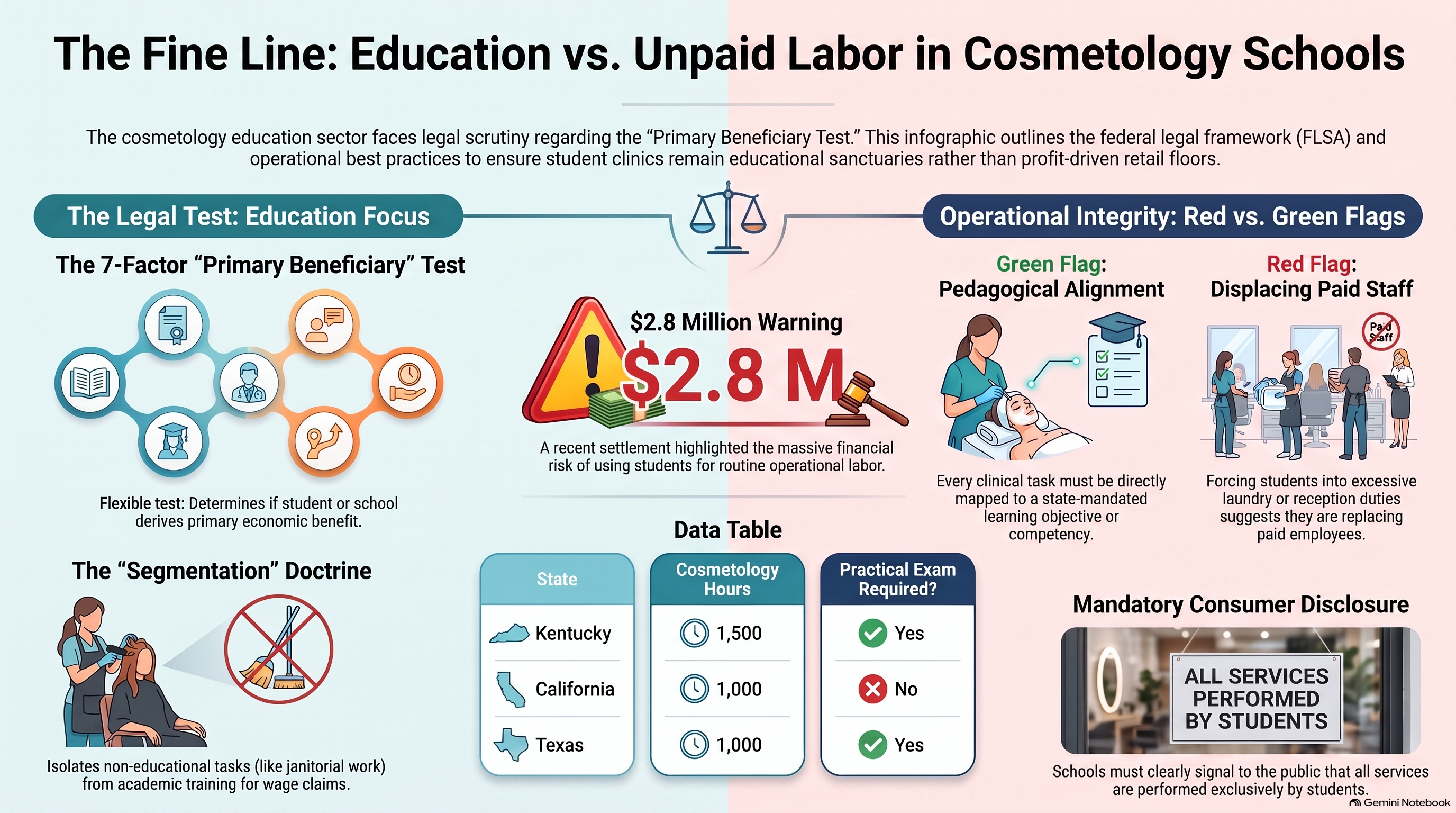
However, the Sixth Circuit Court of Appeals introduced a critical nuance regarding operational labor in Eberline v. Douglas J. Holdings, Inc.12. The court established that courts may “segment” non-educational tasks from the broader academic relationship12. The plaintiffs alleged they spent up to four hours per day performing extraneous janitorial tasks, such as laundry and restocking, which were disconnected from technical cosmetology training12. The Sixth Circuit ruled that the primary beneficiary test must be applied specifically to that segment of work to determine if the students displaced paid employees to the school’s commercial benefit13. This litigation ultimately resulted in a $2.8 million class-action settlement, though the defendant institution admitted no liability15. The legal consensus dictates that while clinical practice is educational, routine operational labor assigned to students to offset business overhead poses severe FLSA compliance risks.
What is State-Specific: Educational Purpose and Consumer Protection
The assumption that beauty school education is legally limited to fundamental safety and sanitation is factually incorrect. State statutes dictate comprehensive curricula, clinical-floor rules, and examination standards, which vary significantly across jurisdictions. While a school is legally distinct from a retail salon, state regulations explicitly permit schools to charge the public for student services to facilitate necessary clinical experience9.
The Commonwealth of Kentucky provides a representative regulatory framework. Under Kentucky Revised Statutes (KRS) Chapter 317A and Title 201, Chapter 12 of the Kentucky Administrative Regulations (KAR), cosmetology licensure requires 1,500 hours of training19. This encompasses a minimum of 375 lecture hours for science and theory, 1,085 clinic and practice hours, and 40 hours dedicated to Kentucky statutes19. The curriculum extends far beyond sanitation, mandating instruction in human anatomy, basic chemistry, properties of the hair and scalp, hair cutting, chemical texture services, and salon business management19.
Consumer protection and transparency are strictly enforced. Kentucky regulations stipulate that a cosmetology student shall not perform chemical services on the public until completing a minimum of 250 hours of foundational instruction19. Furthermore, 201 KAR 12:082 requires licensed schools to display a sign in the reception or clinic area reading “Work Done by Students Only,” with letters a minimum of one inch in height21. While the industry frequently utilizes terms such as “patron,” “client,” or “customer,” the regulatory framework establishes that a clinic patron is engaging in an educational service environment. The payments collected from these patrons offset the costs of chemical supplies, facility utilities, and instructional operations, rather than purchasing a guaranteed commercial aesthetic outcome. Nevertheless, schools and students retain nonwaivable legal and ethical duties regarding infection control, hygiene, and non-negligent supervision during all live-model interactions22.
What Remains Uncertain: Accreditation and Federal Student Aid
Institutional accreditation serves as the traditional gateway for institutions to participate in Title IV federal student aid programs. However, the federal oversight landscape is currently experiencing unprecedented volatility. On July 23, 2026, the National Advisory Committee on Institutional Quality and Integrity (NACIQI) voted 9–3 to recommend that the U.S. Department of Education deny the renewal of recognition for the National Accrediting Commission of Career Arts and Sciences (NACCAS), one of the largest accreditors of cosmetology programs24.
Federal staff reports and committee discussions cited a pattern of compliance concerns, weak oversight of member institutions, poor student outcomes regarding graduation rates, and high student debt relative to post-graduation earnings25. It is critical to legally distinguish that the NACIQI vote represents an advisory recommendation, not a final agency determination25. The ultimate decision regarding NACCAS’s recognition rests with the U.S. Department of Education’s Under Secretary26. The long-term implications for currently accredited institutions remain uncertain; a final denial would force hundreds of schools to secure alternative recognition to maintain federal aid eligibility, potentially disrupting the financial architecture of the sector25.
Recommended Best Practices
To navigate this complex regulatory and economic environment, beauty education institutions should adopt a student-first operational framework. First, institutions must document a direct pedagogical connection between every clinical assignment and a state-mandated learning objective, ensuring that live-model practice is educationally justified28. Second, operators must actively audit daily schedules to limit non-educational operational labor, such as sweeping or laundry, to the “small doses” necessary for salon management training, thereby avoiding the displacement of paid custodial staff11. Third, schools should implement explicit informed consent protocols for all volunteer models, clearly separating the permitted collection of supply fees from any implication of guaranteed service results. Finally, institutions should leverage state-approved mannequin-based competency pathways wherever legally feasible, granting students autonomy to fulfill practical requirements without relying exclusively on unpredictable public foot traffic29.
Long-Form Public Article
When Is a Beauty School a School? Student Clinics, Live Models, Unpaid Labor, and Ethical Cosmetology Education
The American beauty education sector is undergoing a profound structural correction. For decades, the industry’s economic engine has relied upon a combination of federal Title IV student loans, high published tuition costs, and expansive, school-operated public clinics. In these clinics, students gain practical experience while members of the public receive discounted haircuts, chemical treatments, and esthetic services. On its face, this arrangement appears mutually beneficial. However, a wave of recent federal wage-and-hour litigation, combined with intense regulatory scrutiny of accrediting bodies, has forced the industry to ask a critical question: When does a legitimate educational clinic cross the boundary into an operation improperly reliant upon unpaid student labor?
When a beauty school appears commercially busy, accepts members of the public for low-cost services, and relies heavily on students to perform those services, identifying the line between education and regulatory violation requires a nuanced understanding of the law. The answer lies not in the mere volume of patrons served, but in the “economic reality” of the student’s training environment.
The FLSA and the “Primary Beneficiary” Trap
Under the Fair Labor Standards Act (FLSA), covered employees must be compensated with at least the federal minimum wage. However, the law recognizes that vocational students practicing their craft to earn academic credit and qualify for state licensure are generally not statutory employees. To navigate this distinction, federal appellate courts rely on the “primary beneficiary test”1.
If the student is the primary beneficiary of the relationship—meaning they receive academic credit, direct instructor supervision, and the specific technical skills necessary to pass state board examinations—they do not require compensation6. The Ninth Circuit Court of Appeals affirmed this principle in Benjamin v. B&H Education, Inc., evaluating a class-action lawsuit brought by cosmetology students7. The court determined the students were the primary beneficiaries of their clinical work because the hands-on training was a mandatory prerequisite for state licensure, and the school did not prolong the program beyond what was necessary to complete the required hours7.
Yet, schools cannot simply label an environment a “classroom” to shield themselves from labor laws. The Sixth Circuit’s landmark ruling in Eberline v. Douglas J. Holdings, Inc. offered a critical warning regarding the misuse of student time12. The court established the doctrine of “segmentation,” noting that while clinical service provision is educational, routine janitorial tasks may not be12. If a student spends excessive hours washing the facility’s towels, restocking retail inventory, and scrubbing floors—tasks that clearly displace paid janitorial staff and provide negligible educational value—the school may be viewed as the primary beneficiary of that specific segment of labor12. The Eberline litigation concluded in a $2.8 million class-action settlement, serving as a powerful reminder that operational overreach carries massive financial risk15.
The Illustrated Hypothetical: Education vs. Operations
To comprehend how these legal concepts manifest on a clinical floor, consider a student assigned to a live-model service in a busy student clinic. It must be stated clearly: a busy clinic alone does not establish a legal violation. The distinction rests on the integration of pedagogy and practice.
Scenario A: The Compliant, Education-Centered Model A student requires ten documented chemical color applications to qualify for the state practical examination. A volunteer patron arrives and pays a $25 fee. This fee is clearly disclosed as covering the cost of the chemical products, sanitary supplies, and the clinic’s administrative overhead. The student’s licensed instructor evaluates the patron’s hair, guides the student through the chemical formulation process, and periodically monitors the application to ensure safety protocols are met. The patron signs a consent form acknowledging this is a supervised student practice session. The student receives academic credit, completes the required educational milestone, and cleans their immediate station—a standard state-board sanitation requirement.
Scenario B: The Fact Pattern Warranting Regulatory Review A student has already completed all state-required coloring competencies and successfully passed all internal mock examinations. Nevertheless, the school books the student for back-to-back commercial color appointments to meet the clinic’s daily revenue targets. The instructor remains in an administrative office, rarely checking the student’s work. Following the services, the school requires the student to spend three hours washing the facility’s bulk laundry, sweeping the retail lobby, and operating the reception cash register—tasks for which the school previously employed paid administrative staff.
Scenario A represents legitimate, ethically sound vocational training. Scenario B warrants immediate wage-and-hour review because the educational mission has been subordinated to the school’s profit-making operations11.
Consumer Protection and the Live-Model Disclosure
State licensing boards mandate strict boundaries to protect the public. A beauty school is an educational institution; it is not legally classified as a retail salon, even though it provides services to the public. In Kentucky, for instance, 201 KAR 12:082 requires schools to prominently display signage stating “Work Done by Students Only”21.
A live volunteer model must understand they are participating in supervised educational practice. Payments collected from patrons offset the costs of instruction and sanitation; they do not purchase a guaranteed commercial aesthetic outcome. However, this does not absolve the school or the student of liability. Educational institutions retain nonwaivable legal and ethical duties regarding health, hygiene, infection control, and non-negligent supervision. Consumer expectations must simply be properly aligned with the reality of an educational environment through clear, unambiguous disclosure.
The Shifting Tides of Accreditation and Licensure
The broader regulatory environment surrounding beauty education is shifting rapidly. State legislatures, analyzing workforce data, are actively reducing mandated training hours to lower barriers to occupational entry. California recently reduced its cosmetology requirement from 1,600 to 1,000 hours and eliminated its practical exam entirely32. Texas has similarly adopted a 1,000-hour standard30. Furthermore, the Multi-State Cosmetology Licensure Compact is gaining traction, facilitating interstate practice mobility for licensees34.
Simultaneously, the U.S. Department of Education is heavily scrutinizing the accreditors that act as gatekeepers for federal financial aid. In July 2026, the National Advisory Committee on Institutional Quality and Integrity (NACIQI) voted 9–3 to recommend denying the renewal of federal recognition for the National Accrediting Commission of Career Arts and Sciences (NACCAS)25. Committee reviewers cited profound concerns regarding high student debt levels, poor graduation outcomes, and weak institutional oversight25. While this vote is strictly an advisory recommendation and not a final Department of Education termination, it signals an era of intense accountability for the traditional debt-heavy beauty school model25.
Case Study in Alternative Models: Louisville Beauty Academy
In response to these pressures, some institutions are pivoting toward models centered on affordability and student autonomy. The Louisville Beauty Academy (LBA) provides a proposed case study in this transition. Public records indicate that LBA voluntarily discontinued its NACCAS candidate status in December 2025, electing to operate independently of federal Title IV financial aid36.
By operating outside the federal loan system, the academy relies on transparent, out-of-pocket tuition models—reporting an average tuition of approximately $6,250 compared to franchise averages exceeding $20,00037. The academy focuses heavily on strict adherence to Kentucky Board of Cosmetology sanitation rules, digital tracking of educational milestones, and providing students the option to utilize state-approved mannequin training rather than relying exclusively on live clinic models37. (Note: Internal outcome claims regarding specific licensure pass rates and completion metrics require ongoing third-party validation and have not been independently audited via federal datasets).
Ultimately, an ethical beauty school acts as an educational sanctuary, not a retail production floor. By centering student choice, protecting consumer transparency, rigorously documenting academic milestones, and limiting non-educational labor, the beauty education sector can evolve into a sustainable, legally compliant, and student-first ecosystem.
Legal and Regulatory Appendix
The following table synthesizes the primary legal precedents, agency actions, and statutory frameworks governing the intersection of student labor, educational clinics, and accreditation in the cosmetology sector.
| Source Type | Citation / Entity | Date / Jurisdiction | Parties / Subject Matter | Legal Test / Operational Rule | Outcome / Current Legal Status |
| U.S. Supreme Court | Walling v. Portland Terminal Co., 330 U.S. 1484 | 1947 (Federal) | Dept. of Labor v. Portland Terminal Co. | Established the foundational trainee exception to the FLSA. | Final Decision. Trainees receiving instruction without providing immediate advantage to the employer are not employees. |
| Federal Appellate | Schumann v. Collier Anesthesia, P.A., 803 F.3d 119938 | 2015 (11th Circuit) | Student Nurse Anesthetists v. Wolford College | Adopted the modern 7-factor Primary Beneficiary Test for clinical internships. | Vacated and Remanded to apply the flexible primary beneficiary test to clinical hours. |
| Federal Appellate | Benjamin v. B&H Education, Inc., 877 F.3d 11399 | 2017 (9th Circuit) | Cosmetology students v. Marinello Schools of Beauty | Applied the Primary Beneficiary Test to beauty school student salons. | Final Decision. Students are the primary beneficiaries of clinic work required for state licensure; not employees. |
| Federal Appellate | Velarde v. GW GJ, Inc., 914 F.3d 7798 | 2019 (2nd Circuit) | Cosmetology student v. The Salon Professional Academy | Reaffirmed the Primary Beneficiary Test in the for-profit vocational training context. | Final Decision. Student working without pay in a training salon to fulfill state requirements is not an employee. |
| Federal Appellate | Eberline v. Douglas J. Holdings, Inc., 982 F.3d 100613 | 2020 (6th Circuit) | Cosmetology students v. Douglas J. Institute | Established “segmentation” analysis for non-educational tasks (e.g., janitorial work). | Remanded for segmented analysis; led to a $2.8M class-action settlement (with no admission of liability)16. |
| Federal Agency | DOL Fact Sheet #712 | 2018 (U.S. Dept. of Labor) | Unpaid Interns and Students Under the FLSA | Formalized the 7-factor Primary Beneficiary Test evaluating the “economic reality” of the relationship. | Official Agency Guidance. Used by federal courts to evaluate wage-and-hour claims. |
| Federal Agency | NACIQI Review of NACCAS25 | July 2026 (U.S. Dept. of Education) | NACIQI v. NACCAS Recognition | Evaluated accreditor compliance under 34 CFR Part 602 regarding student outcomes and debt. | Advisory Action. Committee voted 9-3 to recommend denying renewal. Awaiting final Under Secretary decision. |
| State Statute | KRS Chapter 317A23 | Current (Kentucky) | Kentucky Board of Cosmetology | Defines cosmetology, esthetics, nail technology, salons, and schools. Establishes the regulatory authority. | Active State Law. Explicitly regulates all beauty services performed for the public or for consideration. |
| State Regulation | 201 KAR 12:08219 | Current (Kentucky) | Education requirements and school administration | Mandates 1,500 hours for cosmetology, specific curricula, and consumer disclosure (“Work Done by Students Only”). | Active State Regulation. Prohibits chemical services on the public prior to 250 hours of instruction. |
50-State Plus D.C. Educational Matrix
This matrix represents a verified cross-section of state licensing requirements, demonstrating the national variance in educational hours and examination standards.
| Jurisdiction | Cosmetology Hours | Esthetics Hours | Nail Tech Hours | Practical Exam Required? | Multi-State Compact Member? | Verification Status |
| Alabama | 1,50039 | 1,50039 | 75039 | Yes | Yes34 | Verified |
| Alaska | 1,65039 | 35039 | 12039 | Yes | No | Verified |
| Arizona | 1,60039 | 60039 | 60039 | Yes | Yes34 | Verified |
| California | 1,00032 | 60033 | 400 | No (SB 803)32 | No | Verified |
| Colorado | 1,60041 | 600 | 600 | Yes | Yes34 | Partially Verified |
| Delaware | 1,50042 | 600 | 300 | Yes | Yes34 | Partially Verified |
| Florida | 1,20041 | 260 | 240 | No | No | Verified |
| Georgia | 1,50041 | 1,000 | 525 | Yes | No | Verified |
| Iowa | 2,10041 | 600 | 325 | Yes | No | Verified |
| Kansas | 1,50042 | 1,000 | 350 | Yes | Yes34 | Verified |
| Kentucky | 1,50019 | 75019 | 45019 | Yes | Yes34 | Verified |
| Louisiana | 1,50039 | 75039 | 50039 | Yes | No | Verified |
| Maine | 1,50039 | 60039 | 200 | Yes | No | Partially Verified |
| Massachusetts | 1,00041 | 300 | 100 | Yes | No | Verified |
| New York | 1,00041 | 600 | 250 | Yes44 | No | Verified |
| Oregon | 2,10041 | 500 | 350 | Yes | No | Verified |
| Pennsylvania | 1,250 | 300 | 200 | No33 | Yes34 | Verified |
| Texas | 1,00030 | 75030 | 60030 | Yes30 | No | Verified |
| Washington | 1,60042 | 750 | 600 | Yes | Yes35 | Verified |
| Wisconsin | 1,55042 | 45045 | 300 | Yes45 | No | Verified |
(Note: Data requires state-specific legal review prior to operational implementation, as administrative rules update frequently. Hours reflect standard school tracks, excluding apprenticeship variants).
Fact-Check Table: Economic and Workforce Outcomes
| Proposed Claim | Verification Status | Best Source | Exact Evidence | Caveat | Safe Wording for Publication | Info Still Needed |
| “75% of cosmetology licensees do not use their license today.” | Partly Verified | Indiana PLA Data46 | Indiana reports 40,610 licensed cosmetologists, but only 9,730 employed (24% working, 76% not working). | This is state-specific to Indiana. It cannot be legally claimed as a universal national statistic without extrapolation risks. | “Data from states like Indiana indicate that over 75% of licensed cosmetologists may not be actively employed in the field.” | Nationwide BLS cross-referenced active licensure datasets. |
| “Non-federal-aid schools can graduate more than 90% of students at a 50–75% discount.” | Partly Verified | LBA Policy Publications11 | LBA claims a 95% licensure rate and a 50-75% discount compared to franchises ($6,250 vs $24,000). | Self-reported institutional data; lacks third-party Title IV audit verification for cohort comparisons. | “Certain non-federal-aid institutions report graduation rates exceeding 90% while offering published tuition up to 75% lower than national franchise averages.” | Independent IPEDS or State Board audit data on completion methodologies. |
| “A non-federal-aid school creates a 100% net-positive result.” | Not Verified | None | N/A | Highly subjective economic claim lacking rigorous econometric backing and defined metrics for “net-positive.” | “Proponents argue that schools operating without federal debt dependency reduce taxpayer exposure and lower student financial risk.” | Independent, peer-reviewed economic impact studies. |
| “A committee voted 9–3 regarding NACCAS recognition.” | Verified | Federal Register / Inside Higher Ed25 | NACIQI voted 9-3 on July 23, 2026, to recommend denying NACCAS’s renewal. | This is an advisory recommendation, not a final Department of Education termination26. | “A federal advisory committee (NACIQI) voted 9-3 to recommend denying renewed recognition to NACCAS, pending final Department action.” | Final U.S. Department of Education Under Secretary decision. |
Compliance Toolkit for Ethical Beauty Education
The following instruments provide an evidence-based framework for schools to implement “Ethical Beauty Education by Design,” ensuring adherence to the FLSA primary beneficiary test and state-specific consumer protection laws.
Table 1: Red Flags / Green Flags Compliance Checklist
| Indicator Type | Operational Practice | Legal/Ethical Implication |
| GREEN FLAG | The school tracks clinic tasks directly to state-mandated competencies using digital or physical logs. | Demonstrates that the clinical work is tied to the student’s formal education program, satisfying FLSA requirements28. |
| GREEN FLAG | Students are provided meaningful options to utilize mannequins to satisfy practical requirements when live models are unavailable. | Ensures student academic progression is not artificially halted by unpredictable public clinic volume29. |
| GREEN FLAG | Clinic signage and consent forms explicitly state the student’s training status and the educational nature of the service. | Protects consumer transparency and aligns expectations with the reality of an educational environment21. |
| RED FLAG | The school assigns students to extensive reception, laundry, or janitorial duties spanning multiple hours per day. | Creates high risk of “segmentation” under Eberline, where the school becomes the primary beneficiary of displaced paid labor13. |
| RED FLAG | Marketing materials promise patrons “guaranteed salon-quality results” or portray the clinic purely as a discount retail competitor. | Violates consumer protection principles and weakens the school’s defense that the clinic is primarily an educational laboratory. |
| RED FLAG | Students face academic or financial retaliation for raising safety concerns regarding a specific live-model assignment. | Undermines the pedagogical environment and creates potential liability for negligent supervision or hostile educational environments. |
Table 2: School Self-Audit Instrument
| Audit Category | Evidence Request | Scoring / Corrective Action |
| Hour Verification | Audit digital timeclocks and schedule records against state daily maximums (e.g., 8-10 hours/day). | Corrective Action: Adjust scheduling algorithms to prevent students from exceeding legally mandated daily or weekly instructional hours21. |
| Task Segmentation | Review daily task logs. Calculate the percentage of time spent on routine non-educational janitorial tasks. | Corrective Action: If non-pedagogical tasks exceed incidental “small doses,” the school must hire dedicated operational staff to avoid displacing paid workers12. |
| Instructor Supervision | Review client intake forms and chemical formulation logs for contemporaneous instructor signatures. | Corrective Action: Implement mandatory physical or digital instructor sign-offs prior to any chemical application on the clinic floor7. |
| Fee Transparency | Audit the published fee schedule for clinic patrons. Ensure fees correlate to supplies, sanitation, and overhead. | Corrective Action: Update consumer disclosures to separate permitted administrative/supply fees from any implication of a purchased commercial service. |
Table 3: Model Policies for Institutional Implementation
| Policy Type | Model Protocol Overview |
| Informed Consent Disclosure | All patrons must sign a form acknowledging: “This facility is an educational institution. Services are performed by students in training under licensed instructor supervision. Fees charged cover chemical products, sanitary supplies, and instructional overhead. Aesthetic results are not guaranteed. The school prioritizes health and safety and may decline service if safety protocols cannot be met.” |
| Student Assignment Policy | Students shall be assigned live-model practice only after completing prerequisite theoretical safety modules. Live-model assignments must connect directly to a documented learning objective required for graduation or licensure. |
| Mannequin Alternative Policy | If a live model is unavailable, unsuited to the learning objective, or presents a documented safety risk, the student shall be provided a state-approved mannequin alternative to demonstrate competency without academic delay or retaliation. |
| Non-Retaliation Protocol | The institution strictly prohibits academic, financial, or disciplinary retaliation against any student who in good faith reports safety concerns, sanitation violations, harassment, or suspected wage-and-hour operational overreach to the administration or state board. |
Communications Package
Article: Redefining the Beauty School: Moving From Unpaid Labor to Ethical Education
(700 Words)
For decades, the standard cosmetology school model has relied heavily on federal student loans and busy, school-operated public clinics. On the surface, student clinics appear to be a perfect symbiotic relationship: students gain essential hands-on experience, and the public receives discounted haircuts, manicures, and facials. But beneath the surface, a wave of federal litigation and intense accreditation scrutiny is forcing the beauty industry to ask a critical question: When does an educational clinic cross the line into unauthorized, unpaid labor?
The Fair Labor Standards Act (FLSA) provides a clear framework for this dilemma through the “primary beneficiary test.” In simple legal terms, if the student is receiving the primary benefit of the work—earning mandatory academic credit, receiving direct instructor guidance, and preparing for a state licensing examination—they are legally recognized as a student, not an employee. However, the law is equally clear that schools cannot exploit this classification to offset their own business expenses.
The Sixth Circuit Court of Appeals recently affirmed a vital legal doctrine known as “segmentation.” If schools require students to spend hours acting as unpaid janitors, laundry attendants, or receptionists—tasks that do not advance their technical cosmetology skills—the school becomes the primary beneficiary of that specific segment of labor. Such practices displace paid operational workers and can lead to severe financial penalties, as evidenced by recent multi-million dollar class-action settlements within the sector. Schools must ensure that non-educational tasks remain strictly limited to the “small doses” necessary to teach basic salon management.
Furthermore, consumer protection must remain paramount. A beauty school is a regulated educational institution, not a retail salon. State laws, such as those strictly enforced in Kentucky, mandate that schools clearly display signage indicating that all work is performed exclusively by students. When a volunteer model pays a fee in a student clinic, they are paying to cover the cost of chemical products, strict sanitization protocols, and the facility’s administrative overhead. They are not purchasing a guaranteed, salon-quality commercial outcome. Educational institutions and their students still carry immense legal and ethical duties to maintain hygiene and prevent negligence, but the consumer’s expectations must be transparently aligned with the reality of a learning environment.
Simultaneously, the federal accreditation landscape is demanding higher accountability. Federal advisory committees, such as NACIQI, have recently engaged in unprecedented scrutiny of major accreditors, citing systemic concerns over high student debt, low graduation rates, and questionable workforce outcomes. In response, independent institutions are actively exploring alternative models. By prioritizing direct affordability, offering robust mannequin-based competency alternatives when public clinic volume is low, and ensuring complete fee transparency, the next generation of beauty schools can protect both their students and the public. Ethical beauty education is entirely possible, but it requires a conscious design that always places the student’s learning objective above the clinic’s bottom line.
Press Statement
(250 Words)
FOR IMMEDIATE RELEASENew American Business Association Releases Comprehensive Report on Ethical Beauty Education and Student Labor
WASHINGTON, D.C. — The New American Business Association (NABA) has released a rigorous, 50-state research memorandum analyzing the legal and ethical boundaries of cosmetology education. The report, “Evaluating Ethical, Legal, and Economically Sustainable Cosmetology Education Models,” provides critical guidance for beauty schools, state regulators, and students regarding the Fair Labor Standards Act (FLSA) and the compliant operation of student clinics.
“As federal courts crack down on the misuse of student labor for non-educational operational tasks, and as federal agencies heavily scrutinize accreditation outcomes, the beauty education sector must adapt,” said a NABA spokesperson. “Our report clarifies the ‘primary beneficiary test,’ empowering schools to operate compliant clinics that genuinely prioritize student learning over retail profit.”
The comprehensive report includes a 50-state regulatory matrix, detailed legal case summaries regarding the FLSA, and a Compliance Toolkit featuring model informed-consent forms and self-audit instruments. NABA strongly urges state boards and school operators to adopt transparent live-model policies, minimize non-pedagogical labor, and focus strictly on documented educational outcomes. The full report and compliance toolkit are available for industry stakeholders aiming to design student-first educational environments.
Social Media Campaign
- 🛑 Is your beauty school clinic legally compliant? Federal courts say students aren’t employees only if the educational benefit outweighs the school’s profit. Learn the 7 factors of the FLSA Primary Beneficiary Test in our new report. #BeautyEducation #Compliance
- 💡 Did you know? In Kentucky, beauty schools must display a 1-inch sign reading “Work Done by Students Only.” Transparency protects consumers AND students. Read our ethical clinic guidelines today. #Cosmetology #ConsumerProtection
- 📉 With federal advisory committees heavily scrutinizing major beauty school accreditors over student debt and outcomes, the debt-heavy education model is under fire. Explore alternative, affordable education models in our latest research. #HigherEd #StudentDebt
- 🧹 Sweeping floors and doing bulk laundry for hours isn’t cosmetology training. Federal courts allow the “segmentation” of non-educational work in wage-and-hour lawsuits. Protect your school by reading our latest Compliance Toolkit. #StudentRights #FLSA
- 🎓 Students deserve an education, not just a job as an unpaid salon worker. NABA’s “Student Bill of Educational Rights” advocates for safe, supervised, and transparent clinical learning. Read the full framework now. #EthicalEducation #BeautyIndustry
Table 4: Bills of Rights for Students and Models
| Stakeholder Group | Core Principles |
| Student Bill of Educational Rights | 1. Education Over Operation: The right to a curriculum focused on technical competency, rather than functioning as unpaid operational labor. 2. Supervised Practice: The right to real-time, documented instructor supervision during all clinical practice. 3. Academic Alternatives: The right to demonstrate competency on state-approved mannequins when live models are unavailable or unsafe. 4. Institutional Transparency: The right to clear data regarding tuition costs, graduation rates, and state-board pass rates prior to enrollment. 5. Non-Retaliation: The right to report safety concerns or wage-and-hour violations without fear of academic or financial reprisal. |
| Live Model Bill of Transparency | 1. The Right to Know: The right to be clearly informed prior to any service that the facility is an educational clinic and services are performed by students in training. 2. Understanding Fees: The right to know that fees charged cover product, supply, and instructional overhead costs, not a guaranteed commercial outcome. 3. Instructor Oversight: The right to have all chemical formulations and technical procedures checked and approved by a licensed instructor. 4. Health and Safety: The right to a clean, sanitized environment complying strictly with all state-board infection control regulations. 5. The Right to Decline: The right to halt a service immediately if health, safety, or physical well-being is compromised. |
Claims We Cannot Support Yet
While this research memorandum provides a comprehensive analysis of the current legal and regulatory landscape, several specific claims cannot be verified as universal facts without further independent, peer-reviewed data:
- The claim that non-federal-aid schools inherently create a “100% net-positive result” remains a subjective economic argument requiring rigorous, independent econometric backing to be stated as fact.
- While state-specific data (such as the Indiana PLA data indicating 76% of licensees are not actively employed in the field) highlights severe workforce participation issues, extrapolating this exact 75% figure to the entire national workforce requires comprehensive cross-referencing with nationwide Bureau of Labor Statistics and active state licensure datasets.
- Institutional claims regarding completion rates and tuition discounts by specific independent academies require ongoing, third-party methodological auditing to ensure parity with federal IPEDS reporting standards.
Works cited
- FIELD ASSISTANCE BULLETIN NO. 2018-2 | U.S. Department of Labor, https://www.dol.gov/agencies/whd/field-assistance-bulletins/2018-2
- Fact Sheet #71: Internship Programs Under The Fair Labor Standards Act, https://www.dol.gov/agencies/whd/fact-sheets/71-flsa-internships
- DOL Says Hello to Primary Beneficiary Intern Test, Goodbye 6-Factor Test, https://www.hinshawlaw.com/en/insights/blogs/employment-law-observer/dol-says-hello-to-primary-beneficiary-intern-test-goodbye-to-6-factor-test
- VELARDE v. GW GJ INC (2019) – FindLaw Caselaw, https://caselaw.findlaw.com/court/us-2nd-circuit/1979436.html
- Compensation Obligations for Vocational Students and Unpaid Interns under the FLSA, https://www.mdmc-law.com/blogs/laborandemployment/compensation-obligations-vocational-students-and-unpaid-interns-under-flsa
- Ninth Circuit Adopts “Primary Beneficiary” Test To Determine If Students Were Employees, https://calemploymentlawupdate.proskauer.com/2018/01/ninth-circuit-adopts-primary-beneficiary-test-to-determine-if-students-were-employees/
- Ninth Circuit Adopts Second Circuit’s Primary Beneficiary Test for Intern and Vocational Student FLSA Claims | Practical Law, https://uk.practicallaw.thomsonreuters.com/w-012-4328?transitionType=Default&contextData=(sc.Default)
- Velarde v. GW GJ, Inc., No. 17-330 (2d Cir. 2019) – Justia Law, https://law.justia.com/cases/federal/appellate-courts/ca2/17-330/17-330-2019-02-05.html
- BENJAMIN v. EDUCATION INC (2017) – FindLaw Caselaw, https://caselaw.findlaw.com/court/us-9th-circuit/1883468.html
- Benjamin v. B&H Education, Inc., No. 15-17147 (9th Cir. 2017) – Justia Law, https://law.justia.com/cases/federal/appellate-courts/ca9/15-17147/15-17147-2017-12-19.html
- “Small Doses” of Non-Educational Work Did Not Turn Students into Employees, https://www.ebglaw.com/workforce-bulletin/small-doses-of-non-educational-work-did-not-turn-students-into-employees
- The Sixth Circuit Clarifies the FLSA Test for Educational Programs – Bodman PLC, https://www.bodmanlaw.com/news/workplace-law-lowdown-the-sixth-circuit-clarifies-the-flsa-test-for-educational-programs/
- Eberline et al v. Douglas J. Holdings, Inc. et al, No. 5:2014cv10887 – Document 157 (E.D. Mich. 2022) – Justia Law, https://law.justia.com/cases/federal/district-courts/michigan/miedce/5:2014cv10887/289223/157/
- In Case You Missed It Winter 2022 – Ohio State Bar Association, https://www.ohiobar.org/member-tools-benefits/practice-resources/practice-library-search/practice-library/section-newsletters/2022/in-case-you-missed-it-winter-2022/
- Michigan cosmetology school agrees to $2.8M settlement after unpaid labor dispute, https://www.sugarlaw.org/news/2024/1/8/michigan-cosmetology-school-agrees-to-28m-settlement-after-unpaid-labor-dispute
- Douglas J. Institute FLSA $2.8M class action settlement, https://topclassactions.com/lawsuit-settlements/closed-settlements/douglas-j-institute-flsa-2-8m-class-action-settlement/
- Title 201 Chapter 12 Regulation 030 • Kentucky Administrative Regulations – Legislative Research Commission, https://apps.legislature.ky.gov/law/kar/titles/201/012/030/12421/
- Cosmetology student was not an employee when working at the school’s training salon, https://www.rossrunkel.com/blog/cosmetology-student-was-not-an-employee-when-working-at-the-schools-training-salon
- Title 201 Chapter 12 Regulation 082 • Kentucky Administrative Regulations, https://apps.legislature.ky.gov/law/kar/titles/201/012/082/10348/
- Title 201 Chapter 12 Regulation 082 • Kentucky Administrative Regulations, https://apps.legislature.ky.gov/law/kar/titles/201/012/082/10638/
- Title 201 Chapter 12 Regulation 082 • Kentucky Administrative Regulations, https://apps.legislature.ky.gov/law/kar/titles/201/012/082/10893/
- Title 201 Chapter 12 Regulation 100 • Kentucky Administrative Regulations – Legislative Research Commission, https://apps.legislature.ky.gov/law/kar/titles/201/012/100/
- KENTUCKY BEAUTY LAW — REQUIRED SAFETY & SANITATION – VERBATIM STATUTES: KRS 317A.010 • 317A.020 • 317A.030 – AS OF DECEMBER 2025 – Louisville Beauty Academy – Louisville KY, https://louisvillebeautyacademy.net/kentucky-beauty-law-required-safety-sanitation-verbatim-statutes-krs-317a-010-317a-020-317a-030-as-of-december-2025/
- NACCAS.COM – Home, https://naccas.com/
- NACIQI Recommends Denying Recognition to Cosmetology Accreditor, https://www.aacrao.org/news/naciqi-recommends-denying-recognition-to-cosmetology-accreditor/
- The Accreditation Reckoning: Why NACCAS’s Fight for Survival Should Worry Every Beauty School Owner – Jackim Woods, https://www.jackimwoods.com/the-accreditation-reckoning-why-naccass-fight-for-survival-should-worry-every-beauty-school-owner/
- August 2026 | Council for Higher Education Accreditation, https://www.chea.org/policy-watch-august-2026
- Ninth Circuit Concludes Cosmetology Students Are Not Employees of School, https://www.duanemorris.com/alerts/ninth_circuit_concludes_cosmetology_students_not_employees_school_0118.html
- 201 KAR 12:020. Examination, Chapter 12. Board of Hairdressers, https://kyrules.elaws.us/rule/201kar12:020?selectdate=5/18/2026
- Texas cosmetology license: Requirements, hours & cost 2026 – Pabau, https://pabau.com/blog/texas-cosmetology-license-requirements/
- Ninth Circuit Adopts Primary Beneficiary Test to Determine Whether Vocational Students Are “Employees” Under the Fair Labor Standards Act – Payne & Fears LLP, https://www.paynefears.com/ninth-circuit-adopts-primary-beneficiary-test-determine-whether-vocational-students-are/
- California Cosmetology State Board Exam: All You Need, https://cosmetologyguru.com/california-cosmetology-state-board-exam/
- What to know about California’s Cosmetology License Changes, https://cosmetologyguru.com/blog/what-to-know-about-californias-cosmetology-license-changes/
- Cosmetology Compact – CSG National Center for Interstate Compacts, https://compacts.csg.org/compact/cosmetology-compact/
- WASHINGTON BECOMES 10TH STATE TO ENACT COSMETOLOGY LICENSURE COMPACT, https://cosmetologycompact.gov/2025/05/13/washington-becomes-10th-state-to-enact-cosmetology-licensure-compact/
- Accreditation, Federal Aid, and Beauty Education | LBA – Louisville Beauty Academy, https://louisvillebeautyacademy.net/accreditation-federal-aid-beauty-education-state-licensed-transparency/
- https://naba4u.org/2026/05/the-architecture-of-resilience-a-decadal-analysis-of-affordability-inclusion-and-the-future-of-beauty-education-in-kentucky/
- Schumann v. Collier Anesthesia, No. 14-13169 (11th Cir. 2015) – Justia Law, https://law.justia.com/cases/federal/appellate-courts/ca11/14-13169/14-13169-2015-09-11.html
- The Number of Cosmetology School Hours Required in Every State, https://cosmetologyguru.com/cosmetology-school-hours-every-state/
- Cosmetology License Requirements by State – Beauty Insurance Plus, https://www.beautyinsuranceplus.com/cosmetologist-state-requirements/
- Cosmetology License: State-by-State Requirements, Cost & How to Apply, https://beautylicenseguide.com/cosmetology-license/
- Cosmetology – The Institute for Justice, https://ij.org/issues/economic-liberty/cosmetology/
- Cosmetology License Requirements by State: Exams, Renewal, and Transfer Rules Explained, https://daltoninstitute.com/cosmetology-license-requirements-by-state-exams-renewal-and-transfer-rules-explained/
- nys department of state – division of licensing services cosmetology practical examination information, https://dos.ny.gov/general-practical-exam-information-cosmetology
- Wisconsin Cosmetology License Requirements (2026), https://beautylicenseguide.com/cosmetology-license/wisconsin/
- Cosmetology License vs. Specialized Beauty Licenses in Indiana: Why “Jack of All Trades, Master of None” No Longer Works – Louisville Beauty Academy, https://louisvillebeautyacademy.net/cosmetology-license-vs-specialized-beauty-licenses-in-indiana-why-jack-of-all-trades-master-of-none-no-longer-works/
Discover more from New American Business Association (NABA) - Louisville, KY
Subscribe to get the latest posts sent to your email.