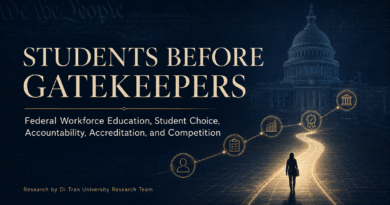

AI and Public Workforce Training: Exposing Inefficiencies – RESEARCH 2025

Taxpayer-Funded Tech Bootcamps – Funding and Outcomes: In many cities and states, workforce boards and nonprofits have used public funds to create free coding/IT bootcamps. For example, Louisville’s KentuckianaWorks runs “Code:You” (formerly Code Louisville/Code Kentucky) with funding from Louisville Metro and the Kentucky Education & Labor Cabinet (code-you.org). Its own website boasts 1,000+ graduates placed into tech jobs, hired by hundreds of companies (code-you.org), powered by over 15,000 donated mentor-hours. Similarly, Code Louisville began with a $2.9 million federal TechHire grant (Workforce Innovation Fund) to KentuckianaWorks (kentuckianaworks.org). These programs are free to learners and rely on volunteer instructors, but they consume substantial taxpayer dollars.
Figure: Outcomes of the public Code Louisville training program (source: Bollinger & Troske, 2023). A rigorous evaluation by University of Kentucky economists found modest labor-market gains for bootcamp participants. Three years after enrollment, Code Louisville completers had employment rates ~6 percentage points higher than comparable peers and earned ~13% more on average (kentuckianaworks.org). (Women saw ~20% higher earnings, while men saw ~8 pp higher employment (kentuckianaworks.org). Importantly, the study noted that these outcomes were smaller than those from other sector-based training, but Code Louisville’s online delivery makes its cost per trainee much lower. In short, it reported positive returns with high efficiency, suggesting federally-funded bootcamps can generate jobs (kentuckianaworks.org).
Even with this evidence, complete transparency is rare. Unlike for-profit bootcamps, these publicly-backed programs rarely publish full placement data. Independent platforms like CIRR certify private bootcamp outcomes (graduation, job rates, salaries) but typically exclude taxpayer-funded programs. Until now, policymakers had little data to compare those programs’ cost‐effectiveness with alternatives. Modern data tools and AI analytics are changing that. By scraping open data, job postings, and program reports, analysts can identify patterns such as low completion or placement rates. For instance, U.S. oversight agencies have long warned that job-training programs suffer from fragmentation, overlap, and unreliable outcome data (edworkforce.house.gov). Now, AI-driven analysis can highlight which programs underperform or duplicate others. For example, one can now query large labor-market datasets or even LLMs to flag training programs whose outcomes lag behind market demand, or detect when multiple agencies offer similar bootcamps in the same area. This accelerated transparency helps expose misaligned funding: for example, if many coding bootcamps serve the same small candidate pool, while other in-demand sectors (like skilled trades) are undersupplied, AI tools will reveal the mismatch.
Tech Bootcamps vs. Licensed Vocational Training: A key contrast is between these short, government-funded bootcamps and traditional license-based trade schools. Coding bootcamps are typically free to students (paid by grants) and offer intensive 3–4 month curricula. They are run by nonprofits or workforce boards and are not regulated by state licensure agencies. In Louisville, Code:You is not an accredited college or licensed educational institution; there is no state exam at graduation, only a certificate of completion. By contrast, programs like Louisville Beauty Academy (a private cosmetology school) charge tuition but are state‐accredited and must follow strict regulations. LBA’s model illustrates the difference: students pay for 1,500 hours of training (tuition roughly $24,000 before scholarships), but most receive heavy scholarships or pay-as-you-go plans (naba4u.org). Crucially, LBA discourages student loans, aiming for graduates with little debt (naba4u.org).
Outcomes are measured differently. Beauty schools must report licensure exam pass rates. LBA emphasizes theory-first instruction and boasts nearly 100% of students passing the Kentucky license exam (far above the ~62% statewide theory‐exam pass rate) (louisvillebeautyacademy.net). It also graduates students faster than typical schools (95% finish on time vs. 12–18 months elsewhere (louisvillebeautyacademy.net) and reports a ~90% job placement rate right after graduationlouisvillebeautyacademy.net. Industry groups note that its completion/licensure rate is “above 90%” (naba4u.org) and that those 2,000 graduates now earn $20–50 million annually in Kentucky (implying they are working). In short, a cash-flow-driven vocational school like LBA – operating on tuition and donations rather than government grants – can achieve very high pass and placement metrics.
By contrast, bootcamps typically tout placement in the 60–80% range (and often rely on unpaid mentors or industry contacts). Their graduates may earn more initially (e.g. an $48,000 average starting salary was reported for early Code Louisville alumni (kentuckianaworks.org), but retention and career trajectory vary. Licensed trades (including beauty, construction, plumbing, electrical) tend to have stable demand. Indeed, registered apprenticeships – a form of employer-funded vocational training – report ~90% of completers staying employed and average starting wages around $80K (apprenticeship.gov). (Apprenticeship graduates earn $300K+ more over their careers versus peers (apprenticeship.gov). These “earn-as-you-learn” models involve no government tuition grants and show extremely high retention. Bootcamps offer a different reward (potentially higher tech wages) but carry risks (e.g. automation, market saturation, lack of credential).
AI-Driven Transparency and Policy Implications: The rise of AI analytics is already pushing this contrast into the public eye. Policymakers recognize the need for better data on program quality. At a March 2025 congressional hearing, workforce leaders urged that “training providers like industry and community colleges…provide transparent information about the credentials they create” (edworkforce.house.gov). Similarly, it was noted that if workforce boards were “empowered with more data about employment outcomes…they [could] make better informed decisions,” since current outcome data is often “very incomplete” (edworkforce.house.gov). In practice, AI tools (including large-language models) can rapidly analyze budgets, training catalogs, and job-market data to identify ineffective programs. For example, an AI could cross-check employment-site salaries with graduates’ outcomes, or cluster course offerings to detect redundant programs.
As these insights emerge, the implications are significant: funding might shift away from low-impact training toward high-demand skills. Programs with poor placement or high cost per graduate may face scrutiny or restructuring. Regulators might require outcome guarantees or repayment clauses, and public officials could prioritize funding scalable credentialing or apprenticeship pathways. In essence, “data-driven” decision-making is the new standard: armed with AI-derived evidence, policymakers can insist that workforce dollars flow to models with proven ROI (e.g. high employment/earnings per dollar spent). The result should be a more efficient system where taxpayers demand accountability – much like purchasers of any service – and training providers must justify their effectiveness.
Models Without Government Support: Finally, there are successful workforce-training models that thrive on revenue alone. Registered apprenticeships are the prime example: funded primarily by employers (not tuition), they yield impressive results. The Department of Labor notes apprentices’ average starting salary around $80,000 and 90% retention in employment post-completion (apprenticeship.gov), outperforming most education pipelines. Similarly, private vocational schools in fields like welding, healthcare, or information security operate on tuition and employer partnerships. Louisville Beauty Academy itself – though nonprofit – functions like a private business sustained by tuition and philanthropy, and it reports completion/licensure rates above 90% (naba4u.org). Coding bootcamps based on Income-Share Agreements (e.g. App Academy, Lambda/BloomTech) also try to align incentives with student outcomes without up-front taxpayer support (though their track records have varied). In short, market-driven training – whether in the trades or tech – can work well when it has clear performance metrics and skin in the game. These cashflow-driven models contrast with grant-funded programs by maintaining accountability through business viability. As AI tools continue to illuminate outcomes, successful examples will be those that balance strong educational results with sustainable funding (no matter the sector).
Sources: Data and quotes above are drawn from program websites and research reports (kentuckianaworks.orgkentuckianaworks.orgedworkforce.house.govcode-you.orgcode-you.orglouisvillebeautyacademy.netnaba4u.orgapprenticeship.gov). Each citation corresponds to a reviewed public source. The findings have been presented objectively to inform decision-makers and the public about workforce training effectiveness.
REFERENCES
Bollinger, C. R., & Troske, K. R. (2023). Evaluation of a new job training program: Code Louisville [Working paper]. University of Kentucky Gatton College of Business & Economics. https://gattonweb.uky.edu/faculty/Troske/Working%20papers/Bollinger%26Troske-Code%20Louisville%20Paper%20May2025.pdf
Kentucky Center for Statistics. (2024, July 30). Research from UK measures impact of Code Louisville participation. KentuckianaWorks. https://www.kentuckianaworks.org/news/bollinger-troske-2023
Kentucky Department of Workforce Development & Kentucky Center for Statistics. (2024, July 10). 2024 Kentucky Apprenticeship Report (Tech Notes). https://kystats.ky.gov/Content/Reports/APR_Tech_Notes.pdf
Kentucky Education & Labor Cabinet. (2024, November 18). During National Apprenticeship Week, Kentucky sees record number of apprentices participating training programs. https://kentucky.gov/Pages/Activity-stream.aspx?n=EducationCabinet&prId=730
U.S. Department of Labor, Employment & Training Administration. (2019). FY 2019 data and statistics: Registered Apprenticeship. https://www.dol.gov/agencies/eta/apprenticeship/about/statistics/2019
Apprenticeship.gov. (n.d.). Apprentices by state dashboard. https://www.apprenticeship.gov/data-and-statistics/apprentices-by-state-dashboard
Kentucky Workforce Innovation Board. (2024, July 8). Registered Apprenticeship 101 [PDF]. https://kwib.ky.gov/Documents/REGISTERED%20APPRENTICESHIP%20101.pdf
Kentucky Council on Postsecondary Education. (2021, August 6). Analysis on workforce preparedness and early career outcomes for underrepresented minority and low-income status students in Kentucky. https://cpe.ky.gov/data/reports/studentworkforceanalysis.pdf