
The Debt Is Immediate. Forgiveness Is Conditional. – A National Policy Examination of Federal Student-Loan Reliability, Administrative Risk, and the Future of Ethical Beauty Education
Research by Di Tran University—The College of Humanization Research Team
Published by the National Association of Beauty Advocates
Institutional Foreword and Reader’s Guide
Why This Research Matters
A federal student loan can be created with a single signature, but its repayment, administration, and possible forgiveness may extend across ten, twenty, or thirty years.
During that time, a borrower may encounter changing repayment plans, evolving regulations, new legislation, court decisions, employment-certification requirements, servicing transfers, tax consequences, and information systems that must accurately preserve decades of payment history. For a student deciding whether to borrow today, the relevant question is therefore not simply whether federal loan forgiveness legally exists. It clearly does.
The deeper question is:
How much financial confidence should a student place in a benefit that depends on future eligibility, accurate administration, sustained documentation, qualifying conduct, and laws that may change over time?
That question is especially important in vocational and beauty education. Many students in these programs are working adults, parents, immigrants, first-generation college participants, English-language learners, career changers, or individuals seeking a faster and more affordable pathway into licensed work. They may have limited financial reserves and less room to absorb an unexpected payment increase, delayed correction, licensing interruption, or administrative dispute.
For these students, affordability is not an abstract policy concept. It is a human condition affecting housing, transportation, childcare, family stability, professional licensing, and the ability to begin earning without carrying excessive debt.
This report was developed to examine that condition with seriousness, neutrality, and respect.
The Central Finding
Federal income-driven repayment and Public Service Loan Forgiveness are real programs grounded in federal law. They have delivered meaningful relief to qualifying borrowers and remain important components of the federal student-loan system.
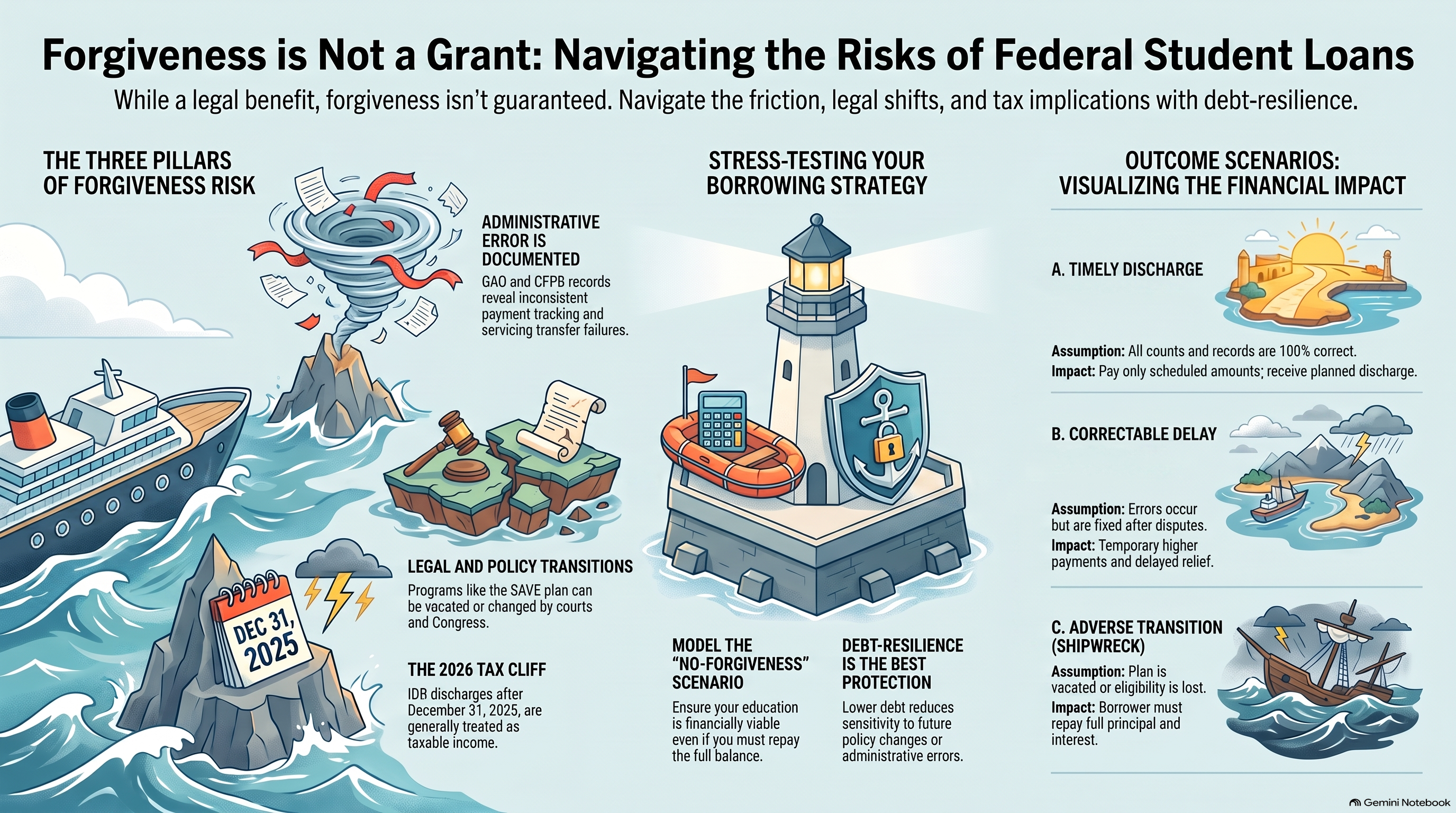
However, future forgiveness is not received when a student enrolls. The student receives debt immediately. Forgiveness may occur years or decades later only if the borrower, loan, repayment plan, payments, employment, documentation, and governing law satisfy the applicable requirements.
The central conclusion of this research is therefore measured:
Expected loan forgiveness should be evaluated as a contingent future benefit—not treated as a guaranteed reduction in tuition or as the assumption that makes otherwise unaffordable borrowing acceptable.
This report does not argue that federal forgiveness is fictional, that every borrower will experience an error, or that students should categorically reject federal financial aid. It also does not evaluate or rank individual institutions.
Instead, it asks students, families, educators, policymakers, and workforce leaders to distinguish carefully among three different realities:
- A benefit legally authorized by statute or regulation;
- A benefit accurately administered over many years; and
- A benefit that a particular borrower will ultimately qualify to receive.
Those realities are connected, but they are not identical.
What This Report Examines
This report provides a primary-source-grounded examination of:
- The development of Income-Contingent Repayment, Income-Based Repayment, Pay As You Earn, Revised Pay As You Earn, SAVE, and the Repayment Assistance Plan;
- The statutory and regulatory foundation of Public Service Loan Forgiveness;
- The operational relationship among the U.S. Department of Education, Federal Student Aid, contracted loan servicers, federal databases, employer certification, and borrower-facing records;
- Documented weaknesses involving payment-count transfers, historical repayment records, forbearance classifications, consolidation, manual reviews, application processing, and borrower visibility;
- Corrective measures, including the Limited PSLF Waiver, the IDR account adjustment, reconsideration procedures, regulatory revisions, and updated borrower tools;
- Litigation and legislative changes affecting SAVE, IDR, RAP, PSLF, borrowing limits, and the federal tax treatment of discharged balances;
- The distinction among verified facts, supported inferences, secondary reports, and unresolved questions;
- The particular implications of long-term federal borrowing for cosmetology, nail technology, skincare, barbering, and other vocational students; and
- A practical risk model through which prospective students can evaluate debt without inventing unsupported probabilities or assuming a future discharge.
The report concludes with recommendations for independent payment ledgers, auditable servicing transfers, restored accuracy oversight, public error reporting, correction rights, standardized dispute timelines, improved implementation coordination, clearer vocational-borrowing disclosures, and long-term preservation of borrower records.
Research Standard and Evidentiary Discipline
The research team prioritized enacted federal statutes, the United States Code, Federal Register rules, federal court decisions, Government Accountability Office reports, Consumer Financial Protection Bureau materials, Department of Education publications, Federal Student Aid guidance, and other official government records.
Verified facts are separated from supported inferences and unresolved matters.
Several reported servicing incidents from July and August 2026 were examined as possible indicators of current administrative conditions. Because a complete primary-source record could not be located by the research cutoff date, the report expressly states:
“These claims could not be independently verified from primary sources as of August 10, 2026.”
Those reports are not treated as established incidents and are not used to calculate an error rate or predict the probability that any particular borrower will experience a problem.
This distinction is intentional. Serious research must resist both institutional denial and unsupported exaggeration. Evidence should be presented at the level of confidence the available record can support.
Why Beauty Education Belongs in the National Policy Conversation
Beauty education is often discussed as though it exists outside the broader higher-education system. It does not.
Beauty and barbering schools educate future licensed professionals, entrepreneurs, independent contractors, salon owners, instructors, product specialists, and community-service providers. Their students confront questions involving tuition, occupational licensing, completion, examination, wages, self-employment, business formation, public benefits, and family responsibilities.
The short duration of many vocational programs makes the long duration of student debt particularly significant. A program may last months, while repayment and administrative obligations may continue for decades.
That mismatch deserves careful examination.
A responsible beauty-education system should help students ask:
- What is the complete cost of attendance?
- What expenses exist beyond tuition?
- What must occur before the graduate can legally begin working?
- What are realistic earnings after business expenses?
- What payment would be required without forgiveness?
- Which repayment plan is legally available?
- Is qualifying public-service employment realistic?
- Would the educational decision remain reasonable if forgiveness were delayed, modified, taxed, or never received?
These questions do not discourage education. They protect its value.
Ethical beauty education is not measured solely by whether a student can begin a program. It is measured by whether the student can understand the obligation, complete the training, obtain licensure, enter the workforce, and build a sustainable life afterward.
A Humanization Approach to Education Finance
Di Tran University—The College of Humanization approaches education policy from a simple premise:
A financial system must ultimately be evaluated by what it does to human lives.
Behind every loan account is a person attempting to learn, work, provide for a family, obtain a professional license, and contribute to a community. Administrative accuracy is therefore not merely a technical concern. A missing payment count, incorrect status, delayed application, or unresolved transfer can affect transportation, housing, credit, employment choices, family planning, business formation, and emotional well-being.
Humanization does not mean removing individual responsibility. Borrowers remain responsible for understanding their obligations, maintaining records, making required payments, updating information, and verifying eligibility.
Humanization means that responsibility must operate in both directions. Institutions administering obligations across decades should maintain accurate records, communicate clearly, correct errors promptly, and provide borrowers with meaningful access to the information used to determine their financial futures.
Publication and Research Credit
Prepared by:
Di Tran University—The College of Humanization Research Team
Published by:
NEW AMERICAN BUSINESS ASSOCIATION
Research focus:
Higher-education finance, administrative reliability, workforce development, consumer protection, vocational education, and ethical beauty education.
Evidence cutoff date:
August 10, 2026
This publication reflects the institutional research and humanization mission of Di Tran University—The College of Humanization. It was prepared as a public educational resource for students, families, schools, workforce organizations, policymakers, regulators, researchers, and community leaders.
The report is nonpartisan and does not advocate for or against any political party, public official, federal agency, loan servicer, repayment program, or individual educational institution.
It provides general policy and consumer-education analysis. It is not legal, tax, financial, enrollment, or borrowing advice.
An Invitation to Read Beyond the Headline
The purpose of this report is not to produce fear. It is to produce informed judgment.
Federal aid can expand opportunity. Loan forgiveness can provide substantial relief. Public-service programs can reward socially valuable work. Corrective government action can restore benefits when administration fails.
At the same time, debt is immediate, while forgiveness is conditional and deferred.
Both truths must be allowed to exist together.
Students deserve more than a promise that everything will work. They deserve the information necessary to evaluate what happens if it does—and what happens if it does not.
That is the purpose of the research that follows.
FEDERAL STUDENT-LOAN POLICY RESEARCH
Forgiveness as a
Contingent Benefit
Administrative Reliability, Legal Change, and Risk-Adjusted Federal Borrowing in Vocational and Beauty Education
Independent policy analysis
Evidence current through August 10, 2026
| Core finding. Federal forgiveness is a real legal benefit, but it is not an enrollment-time entitlement. Borrowers should value it as contingent on rules, records, administration, employment, time, and tax treatment—and should test educational debt for viability without assuming forgiveness. |
Doctoral-level policy review • Primary sources prioritized • Neutral consumer-education analysis
Abstract
Federal income-driven repayment (IDR) and Public Service Loan Forgiveness (PSLF) are not merely aspirational programs. Congress has authorized repayment and discharge pathways, the Department of Education has discharged qualifying balances, and borrowers retain enforceable statutory and regulatory interests in correct administration. Yet a prospective student does not purchase forgiveness at enrollment. The student incurs a present debt and may later obtain a discharge only after satisfying a changing set of loan-type, repayment-plan, payment, employment, documentation, and time requirements administered across multiple organizations and information systems.
The historical record supports treating administrative and legal reliability as a meaningful risk variable in any total-cost analysis of federal borrowing. Government Accountability Office (GAO), Consumer Financial Protection Bureau (CFPB), and Department records document inconsistent payment-history transfers, weak historical tracking of IDR-qualifying time, forbearance steering, manual-review burdens, application backlogs, and periods in which borrowers could not readily see or validate a complete count. Congress and the Department repeatedly responded with waivers, an IDR account adjustment, regulatory revisions, servicing changes, and new borrower-facing tools. Those corrections produced substantial benefits, but their necessity also demonstrates that accurate longitudinal administration cannot be assumed.
The legal environment has likewise changed materially. The SAVE plan created in 2023 was enjoined and ultimately vacated in March 2026, except for one preserved counting provision. Public Law 119-21, enacted July 4, 2025, and implementing regulations effective July 1, 2026, created the Repayment Assistance Plan (RAP), established a new Tiered Standard plan, limited repayment choices for post-July 1, 2026 loans, and scheduled the retirement of PAYE and ICR no later than July 1, 2028. RAP provides statutory interest and principal protections but generally requires 360 qualifying monthly payments for discharge. Federal tax treatment also changed: IDR discharges after December 31, 2025 are generally taxable, while PSLF remains federally tax-exempt.
For vocational and beauty-education students, whose programs are typically shorter and whose early-career earnings can be variable, expected forgiveness should therefore be modeled as a contingent benefit—not as a guaranteed reduction in the price of attendance. A prudent comparison tests whether tuition, living costs, time to licensure, and debt remain manageable without forgiveness, then separately evaluates potential relief under realistic statutory and administrative scenarios.
I. Executive Summary
Principal finding
The evidence supports treating forgiveness and payment-count administration as a material risk variable in the total cost-benefit analysis of federal borrowing. This conclusion does not mean that IDR or PSLF is illusory, that borrowers should avoid federal loans categorically, or that historical denial rates predict current outcomes. It means that the legally certain event at enrollment is the creation of debt, while discharge depends on future facts and administration.
Four distinctions are central.
- A statutory benefit is not the same as an unconditional benefit. IBR, RAP, and PSLF have statutory foundations. Eligibility still depends on conditions that may include loan type, disbursement date, repayment plan, timely monthly payments, annual income certification, public-service employment, and a long repayment horizon. 20 U.S.C. §§ 1087e and 1098e; Federal Student Aid, IDR FAQs.
- Administrative error is documented, not hypothetical. GAO found that Education historically lacked sufficient information to determine whether all eligible IDR loans received forgiveness and that prior-servicer counts could escape detailed verification. GAO also found inconsistent PSLF payment-history transfers and insufficient borrower-facing detail. In March 2026, GAO reported that FSA had stopped systematic servicer accuracy and call-quality assessments after four of five servicers failed the accuracy standard; in July 2026, GAO identified avoidable coordination weaknesses in implementing program changes. GAO-22-103720; GAO-18-547; GAO-26-108534; GAO-26-107780.
- Corrective initiatives can be powerful but episodic. The Limited PSLF Waiver and the IDR payment-count adjustment credited periods that otherwise would not have counted and delivered or accelerated relief for many borrowers. The IDR adjustment was completed in fall 2024, with updated counts displayed beginning in January 2025. It was a one-time remedy, not a permanent guarantee that every future data or classification error will be corrected automatically. FSA account-adjustment notice; 2022 FSA training materials.
- Policy and litigation can alter expectations without extinguishing all borrower protections. SAVE’s payment and discharge terms were disrupted by litigation and vacatur. Congress then enacted RAP and a new plan structure. Borrowers retained legal repayment options, but the terms, timeline, tax consequences, and administrative pathway changed. Missouri v. Trump, 8th Cir. (2025); 91 Fed. Reg. 23,768 (May 1, 2026).
Risk-adjusted conclusion for prospective students
A prospective vocational student should not subtract an estimated future discharge from tuition as though it were a grant. A stronger method is to evaluate three scenarios:
- Full repayment: the student repays principal and interest without discharge.
- Delayed or disputed credit: the student ultimately receives appropriate credit, but only after additional payments, documentation, or correction time.
- Timely discharge: all substantive and administrative requirements are met on schedule.
If the education is financially viable only in the timely-discharge scenario, the financing decision is highly sensitive to variables outside the student’s immediate control. By contrast, lower tuition, shorter time to licensure, grants, savings, employer support, payment plans that do not create high-cost debt, and limited borrowing reduce exposure in every scenario.
II. Historical and Legal Development of IDR and PSLF
A. Income-driven repayment
1. Income-Contingent Repayment (ICR), 1993
The Student Loan Reform Act of 1993 established the William D. Ford Federal Direct Loan Program and authorized an income-contingent repayment option. The governing statute permitted payments that vary with income over an extended period not exceeding 25 years. 20 U.S.C. § 1087e; Missouri v. Trump, 8th Cir. (2025), historical discussion.
Under the legacy ICR formula, the monthly obligation is generally the lesser of 20 percent of discretionary income or the amount required on a 12-year fixed schedule adjusted by income; the stated repayment period is 25 years. Most Direct Loans disbursed before July 1, 2026 may qualify. Parent PLUS debt requires a qualifying consolidation route and remains subject to special limitations. ICR is scheduled to end no later than July 1, 2028. FSA IDR comparison.
ICR’s legal foundation became central in the SAVE litigation. In February 2025, the Eighth Circuit concluded at the preliminary-injunction stage that § 1087e(d)(1)(D) did not authorize the challenged end-of-term forgiveness structure. On March 10, 2026, the district court vacated the SAVE final rule except 34 C.F.R. § 685.209(k)(4)(iv), which preserves credit for specified deferment or forbearance periods. GAO subsequently described that vacatur as operative. Missouri v. Trump; GAO-26-107780.
2. Income-Based Repayment (IBR), 2007
The College Cost Reduction and Access Act of 2007 created IBR in 20 U.S.C. § 1098e. Unlike the original ICR language litigated in the SAVE case, the IBR statute expressly directs cancellation of a remaining balance after the required period. Public Law 110-84; 20 U.S.C. § 1098e.
For legacy borrowers, IBR generally requires 15 percent of discretionary income and provides a 25-year horizon. For qualifying “new borrowers,” the formula is generally 10 percent and the horizon 20 years. The payment is capped at the 10-year Standard amount, and the borrower ordinarily must demonstrate debt high relative to income. Loans must have been disbursed before July 1, 2026 to remain eligible under the new structure. FSA IDR comparison.
IBR is especially important after SAVE because its discharge authority is textually explicit and because pre-July 1, 2026 borrowers may retain access. Yet it remains administratively conditional: income must be certified, qualifying time must be counted, and plan eligibility depends on loan characteristics and dates.
3. Pay As You Earn (PAYE), 2012
The Department created PAYE by regulation in 2012 under its income-contingent authority. PAYE generally set payments at 10 percent of discretionary income, capped at the 10-year Standard amount, with a 20-year discharge horizon. Eligibility was limited to borrowers who were new borrowers on or after October 1, 2007 and received a Direct Loan disbursement on or after October 1, 2011. 77 Fed. Reg. 66,088 (Nov. 1, 2012); FSA IDR comparison.
Public Law 119-21 and the 2026 final regulations restrict PAYE to pre-July 1, 2026 loans and terminate the plan no later than July 1, 2028. Payments made under PAYE before that retirement can count toward RAP’s 360-payment requirement under the transition rules. 91 Fed. Reg. 23,768.
4. Revised Pay As You Earn (REPAYE), 2015
The Department established REPAYE in 2015 and made it broadly available to Direct Loan student borrowers regardless of when they borrowed. REPAYE generally required 10 percent of discretionary income. The forgiveness horizon was 20 years for borrowers with only undergraduate debt and 25 years when graduate debt was included. It also included interest subsidies, though less comprehensive than SAVE’s later unpaid-interest rule. 80 Fed. Reg. 67,204 (Oct. 30, 2015).
REPAYE was amended and renamed SAVE in the 2023 final rule. This lineage matters: SAVE was not an entirely separate statutory program but a substantial regulatory revision of an existing income-contingent plan.
5. SAVE, 2023-2026
The 2023 SAVE rule increased protected income from 150 to 225 percent of the federal poverty guideline; reduced the undergraduate assessment to 5 percent of discretionary income, with a weighted 5-to-10-percent formula for mixed debt; prevented charging unpaid monthly interest after a required payment; and created shorter discharge horizons for certain low-original-balance borrowers. 88 Fed. Reg. 43,820 (July 10, 2023).
Litigation produced a sequence of injunctions beginning in 2024. The Eighth Circuit broadened injunctive relief in February 2025, and the plan was vacated in March 2026 except for one specified counting provision. More than 7.5 million borrowers then required transition assistance. Department of Education, March 27, 2026; GAO-26-107780.
SAVE is therefore the strongest modern illustration of legal-transition risk. Borrowers did not lose every repayment protection, but a plan’s material terms and availability changed through litigation, settlement, legislation, and replacement rulemaking.
6. Repayment Assistance Plan (RAP), 2026
Public Law 119-21 added HEA § 455(q), and the final RISE regulations implemented RAP effective July 1, 2026. For loans disbursed entirely on or after that date, RAP is the only IDR plan generally available. Public Law 119-21; 91 Fed. Reg. 23,768; FSA IDR FAQs.
RAP’s principal features are:
- a monthly amount based on 1 to 10 percent of adjusted gross income, divided by 12;
- a $50 monthly reduction for each qualifying dependent;
- a $10 minimum payment;
- waiver of monthly interest not covered by a full, on-time payment;
- a principal matching benefit of up to $50 when the borrower’s on-time payment does not reduce principal by at least that amount; and
- discharge after 360 qualifying monthly payments over at least 30 years.
RAP payments count for PSLF when they are on time and the other PSLF conditions are met. The 2026 final rule states that the Department lacks authority to treat late RAP payments as PSLF-qualifying payments. RAP months also operate asymmetrically in transition: eligible IBR and pre-July 2028 PAYE payments may count toward RAP, while RAP payments do not count toward legacy IBR or PAYE forgiveness. 91 Fed. Reg. 23,768, payment-count discussion.
B. Public Service Loan Forgiveness
1. Statutory design
The College Cost Reduction and Access Act of 2007 added PSLF at 20 U.S.C. § 1087e(m). The statute requires cancellation of the remaining Direct Loan balance after 120 qualifying monthly payments while the borrower works in qualifying public service and satisfies applicable plan requirements. Payments need not be consecutive. FFEL borrowers historically needed to consolidate into the Direct Loan Program before accumulating ordinary PSLF credit on the consolidation loan. Public Law 110-84; FSA PSLF overview.
Employment certification is the practical bridge between employment and credit. Certification allows the Department to determine whether the employer and work period qualify and then update eligible and qualifying months. Certification delays do not necessarily erase eligibility, but they increase record-reconstruction risk and postpone discovery of errors.
2. Why early denial rates were high
The first borrowers could qualify in October 2017. Early outcomes were poor: GAO reported that Education approved 55 borrowers among 19,321 applicants in the early period and that approximately 99 percent of processed applications were denied by March 2019. Those figures should not be used as a present-day approval forecast. The applicant pool included borrowers who had not yet made 120 payments, used ineligible loan types or repayment plans, submitted incomplete forms, or misunderstood the separate TEPSLF process. GAO-19-717T; GAO-19-595.
The more durable lesson lies in the causes. GAO found piecemeal servicer instructions, no definitive employer source, inconsistent payment histories transferred from other servicers, manual review of dozens or hundreds of pages in some cases, and insufficient detail for borrowers to identify which payments had been excluded. GAO-18-547.
3. Waiver, reconsideration, and permanent revisions
In October 2021, the Department announced the Limited PSLF Waiver under HEROES Act authority. Through October 31, 2022, it allowed many prior payments to count notwithstanding prior loan-program or repayment-plan defects, provided borrowers completed necessary consolidation and certification steps. By early February 2023, approximately 453,000 borrowers had been approved under the waiver. FSA Dear Colleague Letter, Dec. 7, 2021; FSA quarterly portfolio update, Mar. 29, 2023.
Regulations effective in 2023 permanently relaxed some payment-timing rules, allowed specified deferment and forbearance periods to count, created a weighted-average approach to consolidation counts, and established reconsideration mechanisms. PSLF administration moved from MOHELA to the Department’s StudentAid.gov platform in 2024, centralizing forms, employer eligibility, and count display. 87 Fed. Reg. 65,904 (Nov. 1, 2022); FSA, managing PSLF progress.
4. 2026 employer-eligibility rule
A final rule effective July 1, 2026 authorizes the Secretary to exclude an employer determined, after notice and an opportunity to respond, to have a “substantial illegal purpose” under defined criteria. Borrowers receive credit through the effective date of an adverse employer determination, but not afterward; employers receive a recertification pathway. 90 Fed. Reg. 48,966 (Oct. 31, 2025); 91 Fed. Reg. correction (Mar. 13, 2026).
This rule does not retroactively erase credit earned before a determination. It does add a future employer-status variable that borrowers pursuing PSLF must monitor.
III. Administrative Infrastructure and Documented Failure Points
A. How repayment data move
The Department owns Direct Loans and contracts with servicers to bill borrowers, process payments and IDR applications, manage repayment status, communicate options, and maintain detailed account records. Servicers report loan status, payment, balance, and borrower information into Department systems, including the National Student Loan Data System (NSLDS). StudentAid.gov assembles Department data into a borrower-facing account, while servicer portals remain the operational interface for bills, auto debit, payment application, and some disputes. GAO-18-121; FSA IDR FAQs.
For PSLF, employment certification adds another data layer. The Department must associate a certified employer and work period with months that also satisfy loan, plan, status, and payment requirements. For IDR discharge, the system must reconstruct potentially 240, 300, or 360 qualifying months across changes in servicers, plans, statuses, consolidation events, and income certifications.
NSLDS is an authoritative federal repository, but it is not equivalent to a complete, immutable, borrower-readable ledger of every transaction and eligibility decision. Servicer systems contain transaction-level detail; NSLDS receives standardized reporting; StudentAid.gov displays selected information. A discrepancy can therefore arise in source data, coding, transfer, reconciliation, eligibility logic, or display.
B. Documented failure modes
Servicing transfers
GAO reported that the PSLF servicer did not consistently receive reliable prior-payment information. Different terminology and data interpretations produced inconsistencies, and some histories required manual review of extensive servicing documents. Education standardized some transfer data in 2020, but GAO later found that previous-servicer counts were not always subject to the same detailed verification as current-servicer counts. GAO-18-547; GAO-22-103720.
The CFPB’s 2022 supervisory review found transferor and transferee servicers reporting different IDR qualifying-payment totals for some borrowers and identified missing repayment schedules in hundreds of thousands of transferred accounts. CFPB Supervisory Highlights, Sept. 2022.
Status and plan coding
Qualifying credit depends on whether a month is coded as repayment, deferment, forbearance, delinquency, default, or another status and on whether the repayment plan qualifies. A borrower who was steered into forbearance rather than IDR may have made no payment even though an IDR obligation could have been zero. Prior rules often excluded that month from discharge progress. The Department’s 2022 account adjustment expressly addressed extended forbearance and specified deferment periods, confirming that status classification had system-wide consequences. Department announcement, Apr. 19, 2022, preserved in FSA materials.
Consolidation
Historically, consolidation could reset or obscure pre-consolidation progress because a new Direct Consolidation Loan replaced prior loans. Temporary waiver and adjustment policies credited earlier periods in defined circumstances, and later regulations adopted weighted-average protections. Consolidation remains legally and operationally consequential; borrowers should not assume that historical temporary treatment applies to every future consolidation. FSA consolidation guidance; 88 Fed. Reg. 43,820.
Certification and manual review
PSLF employment periods are not fully creditable until employment is certified. Manual review can be triggered by employer uncertainty, nonstandard payment histories, conflicting data, or reconsideration requests. GAO documented confusion, incomplete information, and review burdens. Delays may not change ultimate eligibility, but they can postpone correction until a borrower has organized work and finances around an inaccurate count.
Borrower visibility
GAO’s 2018 recommendation for detailed borrower-facing payment information arose because aggregate counts were insufficient to identify missing months. FSA began displaying IDR counts after completing the account adjustment, but legal and system changes have affected availability. A durable consumer-protection design would allow borrowers to download the event, source, status, plan, amount due, amount paid, qualification decision, and reason code for every month. GAO-18-547; FSA account adjustment.
C. The 2021-2024 IDR account adjustment as a case study
Problem addressed
In March 2022, GAO reported that Education had approved IDR forgiveness for only 157 loans held by 132 borrowers as of June 1, 2021, while its data were insufficient to determine why thousands of other loans that appeared old enough had not received forgiveness. Education lacked a process to identify and correct all potentially eligible accounts. GAO-22-103720.
The Department announced a one-time adjustment in April 2022. The adjustment credited all months in repayment regardless of payment plan; specified pre-2013 and hardship-related deferments; 12 or more consecutive months or 36 or more cumulative months in forbearance; and qualifying pre-consolidation periods for eligible consolidated loans. Direct Loans and federally managed FFEL loans generally received automatic review; commercially held FFEL and Perkins borrowers faced consolidation deadlines to obtain defined benefits. FSA 2022 training materials.
Authority and legal status
The adjustment combined administration of existing statutory discharge provisions with temporary crediting policies. Its legal theory was challenged by third parties. In 2024, the Sixth Circuit dismissed a challenge for lack of standing; later proceedings continued amid broader policy changes. The litigation illustrates that temporary administrative corrections can generate their own legal uncertainty even when individual borrowers benefit. Mackinac Center v. Cardona, 6th Cir. (2024).
Results and remaining limits
The Department estimated that approximately 3.6 million borrowers would receive at least three additional years of credit. By September 2023, more than 800,000 borrowers had been approved for relief attributed to IDR fixes. The payment-count adjustment was completed in fall 2024, and updated counts began appearing in January 2025. FY 2024 Department budget justification; FY 2023 Agency Financial Report; FSA account-adjustment notice.
The adjustment did not eliminate every future error, create an independent ledger, or guarantee a fixed correction deadline. Borrowers could still face disputes about excluded periods, consolidation timing, default status, or missing source data. The successor framework relies on modernized Department systems, current regulations, PSLF reconsideration, servicer complaints, and the FSA Ombudsman rather than a perpetual one-time adjustment.
D. Current oversight capacity
GAO reported in March 2026 that FSA stopped quarterly accuracy and call-quality assessments in February 2025 because of staff capacity constraints. Four of five servicers had failed the accuracy standard during the two quarters assessed and incurred approximately $850,000 in penalties. By December 2025, FSA had not implemented a replacement method that systematically assured account accuracy and call quality. Education disagreed with GAO’s recommendation to resume the assessments; GAO maintained it. GAO-26-108534.
In July 2026, GAO separately reported that servicers viewed Department change instructions as only “somewhat” or “mostly” sufficient and wanted earlier coordination. One servicer received one business day’s notice before IDR count information became visible on StudentAid.gov, limiting preparation for borrower calls. GAO recommended criteria for earlier coordination in complex or time-sensitive changes; Education did not agree. GAO-26-107780.
These findings do not prove that every account is wrong. They establish a control-risk proposition: major transitions are being implemented through systems and contractors whose prior accuracy performance and current oversight leave material residual uncertainty.
IV. Verified 2026 Incident Analysis
A. Verification standard and result
As of August 10, 2026, no publicly accessible primary source located for this analysis independently documents a discrete 2026 IDR recalculation error with all of the requested elements—affected data field, verified borrower count, agency explanation, remediation route, and formal oversight response.
Contemporaneous secondary reports describe three events:
- approximately 6,000 borrowers reportedly received incorrect IDR payment amounts and were directed to reapply, with errors reportedly concentrated among borrowers who manually changed family-size information;
- some MOHELA borrowers reportedly received incorrect delinquency or default-risk notices; and
- some PSLF users reportedly saw sudden decreases in displayed qualifying-payment counts, while StudentAid.gov displayed a general data-issue notice.
The first and second reports attribute confirmation to Department representatives, and the third references a borrower-facing system banner. However, no Department press release, FSA issue notice, GAO report, Inspector General report, court filing, or public remediation memorandum located by the cutoff date supplies a complete primary record. These claims could not be independently verified from primary sources as of August 10, 2026. They are therefore not treated as established incidents or used to estimate error probability. Secondary context: Business Insider, reported IDR error; Business Insider, reported delinquency notices; Forbes, reported PSLF display issue.
B. What is verified in 2026
Three related facts are established by primary sources:
- FSA stopped systematic servicer accuracy and call-quality assessments in February 2025, and most servicers previously assessed had failed the accuracy standard. GAO publicly reported this in March 2026.
- The Department implemented a large-scale July 2026 transition involving RAP, Tiered Standard, retirement schedules for ICR and PAYE, and movement of more than 7.5 million SAVE borrowers.
- GAO reported in July 2026 that earlier servicer coordination could improve clarity and implementation time for complex changes.
These verified facts do not prove the reported July-August 2026 incidents. They make such reports operationally plausible and identify conditions that warrant prompt official disclosure and independent review.
C. Classification
The available primary evidence supports classifying the federal repayment architecture as an unresolved structural vulnerability, not as proof of universal failure. The classification rests on recurring failure modes across different years and servicers: inconsistent transfers, incomplete historical verification, status miscoding, weak borrower visibility, manual backlogs, sudden program changes, and gaps in systematic oversight. Any specific 2026 allegation remains separate and must be verified on its own record.
V. Legal and Accountability Framework
A. Statute, regulation, contract, and temporary relief
Borrower expectations have different legal strength depending on their source.
- Statutory terms bind the Department unless Congress amends them. IBR’s cancellation language, RAP’s 360-payment structure, and PSLF’s 120-payment cancellation duty are statutory.
- Regulatory terms bind the agency while valid and operative but may be amended through lawful rulemaking or vacated by a court. SAVE’s history demonstrates this exposure.
- Promissory or contractual representations in a master promissory note, certification, or individualized determination may support separate legal arguments, but their effect depends on text, authority, reliance, sovereign-immunity principles, and available causes of action.
- Waivers and one-time adjustments can permanently credit an individual account once applied, but their prospective availability and scope are less stable than express statutory terms.
A risk model should not assign equal certainty to all four categories.
B. Administrative Procedure Act
The Administrative Procedure Act (APA) requires notice-and-comment procedures for most substantive legislative rules, permits judicial review of final agency action, and directs courts to set aside action that is arbitrary, capricious, an abuse of discretion, contrary to law, or procedurally defective. 5 U.S.C. §§ 553, 702, 704, 706.
For systemic changes, the central questions include statutory authority, required procedure, reasoned explanation, reliance interests, and remedial scope. For an individual count dispute, reviewability may depend on whether the Department—not merely a servicer—has issued a final decision, whether administrative correction processes have been used, and whether another adequate remedy exists.
American Bar Association v. Department of Education illustrates the APA’s relevance. A district court vacated newly applied PSLF employer standards for certain borrowers where the Department had changed interpretation without required procedure, while rejecting a different borrower’s claim on the record before it. The case does not establish that every certification is irrevocable; it confirms that agency interpretation and explanation remain reviewable. ABA v. Department of Education, D.D.C. (2019).
C. Notice and reasoned explanation before reducing credit
When an agency proposes to reduce a previously displayed or certified count, sound administrative practice includes:
- identifying the affected loan and month;
- stating the prior and revised classification;
- identifying the governing statute, regulation, or correction rule;
- disclosing source records and reason codes;
- allowing documentary rebuttal before financial consequences attach; and
- issuing a reasoned written determination subject to reconsideration.
Some of these elements may be required by specific regulations or the APA in a particular posture; others are policy safeguards rather than settled universal legal duties.
D. Procedural due process
The Fifth Amendment prohibits deprivation of property without due process. A protected property interest generally requires a legitimate claim of entitlement created by law, not a unilateral expectation. A borrower who has fully satisfied a mandatory statutory discharge provision has a stronger entitlement argument than a borrower relying on future discretionary relief. A displayed count or preliminary certification may be relevant evidence but does not necessarily create an irrevocable constitutional entitlement to every credited month.
No controlling nationwide authority located for this analysis holds categorically that each interim IDR or PSLF payment count is a protected property interest. Accordingly, this report does not assert such a rule. The better legal formulation is conditional: a reduction may implicate APA, contractual, statutory, or due-process concerns depending on the maturity of the benefit, the mandatory nature of the governing law, the borrower’s reliance, the available correction process, and the consequences of the change.
E. Accountability pathways
Borrowers generally can seek correction through the servicer, StudentAid.gov activity and complaint systems, PSLF reconsideration where applicable, the FSA Ombudsman, congressional casework, and judicial review after a final agency action. These pathways do not substitute for accurate first-instance administration. Their practical value depends on a complete record, intelligible reasons, and a defined decision timeline.
VI. Policy and Regulatory Context, 2020-2026
| Date | Event | Legal/administrative significance |
| Mar. 27, 2020 | CARES Act § 3513 suspended covered payments and interest and counted suspension months toward forgiveness. | Congress expressly supplied qualifying credit during the emergency. Pub. L. 116-136 |
| 2020-Aug. 2023 | Multiple administrative extensions continued the payment pause; required payments resumed in Oct. 2023. | Demonstrated large-scale temporary alteration of repayment status and counts. GAO-22-105291 |
| Oct. 6, 2021 | Limited PSLF Waiver announced. | Temporarily credited payments despite specified loan or plan defects. FSA waiver fact sheet |
| Apr. 19, 2022 | IDR account adjustment announced. | Addressed historical forbearance, deferment, repayment-plan, and consolidation-count problems. FSA training materials |
| Aug. 24, 2022-June 30, 2023 | Broad HEROES Act cancellation announced and invalidated in *Biden v. Nebraska*. | Supreme Court held the program exceeded HEROES Act authority. Biden v. Nebraska |
| Nov. 1, 2022 / July 1, 2023 | Targeted-relief final rules, including permanent PSLF revisions. | Relaxed timing rules, credited specified statuses, and created reconsideration protections. 87 Fed. Reg. 65,904 |
| July 10, 2023 | SAVE final rule published; selected provisions early implemented. | Reworked REPAYE payments, interest, and discharge terms. 88 Fed. Reg. 43,820 |
| June-July 2024 | Federal courts enjoined SAVE provisions; administrative forbearance followed. | Interrupted implementation and qualifying-payment expectations. Missouri district order |
| Fall 2024-Jan. 2025 | IDR adjustment completed; updated counts began to display. | Closed the one-time adjustment while shifting to modernized ongoing tracking. FSA account adjustment |
| Jan. 15, 2025 | Final rule reopened PAYE and ICR enrollment windows after SAVE disruption. | Preserved alternative ICR access during litigation. 90 Fed. Reg. 3,571 |
| Feb. 18, 2025 | Eighth Circuit broadened SAVE injunction. | Held states likely to succeed on statutory-authority claim. Missouri v. Trump |
| July 4, 2025 | Public Law 119-21 enacted. | Created RAP and Tiered Standard, phased out legacy plans, changed loan limits, and ended new Grad PLUS borrowing subject to transition rules. Public Law 119-21 |
| Aug. 1, 2025 | Interest resumed for borrowers in SAVE litigation forbearance. | Increased cost while litigation and plan transition continued. Department notice, July 9, 2025 |
| Oct. 31, 2025 | New PSLF employer-eligibility rule published. | Effective July 1, 2026; prospective employer-status consequences with notice process. 90 Fed. Reg. 48,966 |
| Mar. 10, 2026 | SAVE rule vacated except 34 C.F.R. § 685.209(k)(4)(iv). | Ended SAVE’s operative availability and triggered transition for millions. GAO-26-107780 |
| May 1 / July 1, 2026 | RISE final rule published and became effective. | Implemented RAP, Tiered Standard, loan limits, Grad PLUS phaseout, and conforming PSLF changes. 91 Fed. Reg. 23,768 |
| July 1, 2026 | RAP and Tiered Standard became available; new-loan plan restrictions began. | Post-cutoff student borrowers generally face only RAP as IDR; legacy borrowers enter a transition ending no later than July 1, 2028. FSA IDR FAQs |
| July 1, 2026 | Federal tax exclusion for most IDR discharges had expired after Dec. 31, 2025. | Post-2025 IDR discharge is generally taxable; PSLF remains federally tax-exempt. IRS Taxpayer Advocate |
Borrowing limits and Graduate PLUS
The enacted 2025 law and 2026 final rule phase out new Graduate PLUS borrowing and impose annual and aggregate limits for graduate, professional, and parent borrowers, with an interim exception for qualifying students enrolled in a program and borrowing before July 1, 2026. These changes primarily affect graduate and professional education, not ordinary undergraduate Direct Loan limits used in many vocational programs. They are nevertheless relevant to policy stability: federal borrowing terms can change prospectively by statute. Department RISE fact sheet; FSA loan-limit FAQs.
Tax treatment
The American Rescue Plan’s broad exclusion for many student-loan discharges expired after December 31, 2025. Public Law 119-21 permanently extended an exclusion for death and total-and-permanent-disability discharges, but did not broadly extend the IDR exclusion. Federal guidance states that post-2025 IDR discharge is generally taxable as cancellation-of-debt income. PSLF and specified service-based programs remain excluded under separate rules. State treatment varies. Public Law 119-21 § 70119; IRS Taxpayer Advocate.
VII. Implications for Vocational and Beauty-Education Students
A. Education, licensure, and earnings are separate stages
Borrowing finances attendance. A certificate documents program completion. A state license authorizes practice. Neither completion nor licensure guarantees clients, hours, employee status, tips, booth-rental economics, or net earnings. The financing analysis should therefore model at least four transition risks: completion, exam/licensure, job entry, and sustainable earnings.
Beauty occupations often require a postsecondary nondegree award and state licensure. National May 2024 median hourly wages were $16.95 for hairdressers, hairstylists, and cosmetologists; $16.66 for manicurists and pedicurists; and $19.98 for skincare specialists. These are occupational medians, not guaranteed starting wages, and they do not fully capture self-employment expenses, unpaid time, geographic variation, schedule intensity, tips, or business ownership. BLS cosmetology; BLS nail technology; BLS skincare.
B. Why long-horizon forgiveness is a special fit problem
Many beauty programs are measured in months, while IDR discharge is measured in decades. Under RAP, discharge generally requires 360 qualifying monthly payments. A student may therefore borrow for a comparatively short credential but remain exposed to repayment administration, annual income data, and policy change for much of a working life.
Small balances also complicate the intuition that forgiveness will be valuable. A borrower with manageable debt may pay the loan in full long before 20 or 30 years, producing no balance to discharge. Conversely, a borrower with low or volatile earnings may obtain affordable monthly payments but face a longer repayment horizon, potential taxable discharge, and continuing documentation obligations.
C. Delayed correction has compounding effects
An erroneous plan or count can create more than an administrative inconvenience. It may produce:
- a higher bill and reduced cash available for licensing fees, tools, supplies, transportation, childcare, or business formation;
- interest accrual or loss of an interest subsidy when payment timing is disputed;
- additional required payments before discharge;
- delayed credit repair or mortgage qualification;
- uncertainty in choosing employment, especially for PSLF; and
- a larger taxable balance at IDR discharge.
The consequence is particularly material where early-career income is close to essential living costs.
D. Federal-aid dependency and alternatives
The Department’s June 2026 earnings-accountability rule acknowledged that many cosmetology programs operate outside the federal student-loan system and cited research estimating that approximately 86 percent of Texas cosmetology programs did so. The single-state estimate should not be generalized nationally without caution, but it establishes that non-Title-IV delivery is a material sector feature. Department earnings-accountability final rule, unofficial copy.
Nonparticipation in federal aid is not itself proof of quality, affordability, or superior outcomes. Federal participation is likewise not proof of poor value. The consumer-protection question is comparative: What is the total cash price? What grants are available? How much debt is created? How long until licensure? What portion of enrollees complete and become licensed? What do completers earn? What repayment amount is affordable without assuming discharge?
E. Classification of expected forgiveness
For a prospective beauty student, expected future forgiveness should be classified as a contingent possibility and material risk factor, not a guaranteed benefit. Its probability and value depend on facts unavailable at enrollment, including future income, family circumstances, qualifying work, payment timing, policy, tax law, and administrative accuracy.
Debt minimization is therefore not an ideological position or a marketing claim. Holding educational quality and completion probability constant, lower debt reduces required payments, interest exposure, default risk, dependence on a correction process, and sensitivity to future policy changes.
VIII. Borrower-Risk Model
A. Inputs
Define:
- T = tuition and required institutional fees;
- N = non-tuition costs attributable to attendance, including tools, supplies, transportation, childcare, and incremental living costs;
- G = grants, scholarships, employer support, or other nonrepayable aid;
- C = cash or family contribution that does not create debt;
- D₀ = initial debt, approximately max(0, T + N – G – C);
- r = weighted loan interest rate and fees;
- L = time from enrollment to licensure;
- Eₜ = net employment earnings in month or year t, after realistic work and business expenses;
- Pₜ = required payment under the applicable plan in period t;
- A = administrative-friction scenario, including processing delay or erroneous count;
- J = legal/policy scenario, including plan, eligibility, and tax changes; and
- F = eventual discharge amount, if any.
The borrower’s economic cost is not merely tuition. A useful present-value framework is:
Risk-adjusted cost = D₀ + financing cost + attendance-related opportunity cost + correction cost + tax on discharge – present value of discharge.
No defensible national probability for administrative error or future policy change was located. Accordingly, the model uses scenarios rather than invented precision.
B. Decision tree
Step 1: Can the student complete without federal debt?
Compare the actual cash price after grants with savings, installment plans, employer support, workforce funding, and lower-cost programs. Exclude any “aid” that is actually a loan.
Step 2: What must happen before earnings begin?
Estimate the probability and timing of completion, state examination, license issuance, and job or client acquisition. Include the income forgone while attending and any delay after graduation.
Step 3: What is the no-forgiveness payment?
Calculate the 10-year or applicable Tiered Standard payment and total interest. If that payment is not sustainable on a conservative earnings estimate, the decision is dependent on IDR or later relief.
Step 4: Which IDR plan is legally available?
Use loan type and disbursement date. Post-July 1, 2026 borrowers generally have RAP as the only IDR plan. Pre-cutoff borrowers may retain IBR and transitional access to PAYE or ICR, subject to retirement dates and loan-specific rules.
Step 5: Does PSLF realistically apply?
Most salon, independent-contractor, and self-employed beauty work is not qualifying public-service employment. PSLF should be modeled only when the borrower reasonably expects full-time work for a qualifying government or nonprofit employer and understands certification requirements.
Step 6: Stress-test three administrative outcomes
| Scenario | Assumption | Financial treatment |
| A. Accurate and timely | Applications, bills, counts, and certifications are correct on schedule. | Use scheduled payments and projected discharge, including tax where applicable. |
| B. Correctable delay | A plan, status, or count error is corrected after additional documentation or payments. | Add temporary higher payments, lost time value, dispute costs, and delayed discharge. |
| C. Unresolved or adverse transition | Credit is not restored promptly, the plan changes, or eligibility is lost. | Model full repayment or the next legally available plan; do not subtract expected discharge. |
Step 7: Stress-test legal and tax outcomes
Model at least: current-law RAP or IBR; transition to Tiered Standard; PSLF if independently supported; and taxable versus exempt discharge. Do not assume Congress will extend tax exclusions.
Step 8: Apply the viability rule
The program is debt-resilient if completion and licensure remain worthwhile and payments remain manageable in Scenario C. If viability exists only in Scenario A with maximum projected forgiveness, the borrowing decision contains high administrative and legal sensitivity.
C. Illustrative non-numerical matrix
| Debt / earnings relationship | Forgiveness dependence | Risk interpretation |
| Low debt; earnings comfortably support Standard payment | Low | Forgiveness is upside, not a premise. |
| Moderate debt; Standard payment is tight but RAP/IBR payment is sustainable | Medium | IDR access matters; count and recertification discipline are material. |
| High debt; only a zero or very low IDR payment is sustainable | High | Strong exposure to policy, tax, interest, and administration over decades. |
| Debt justified primarily by anticipated PSLF | High unless employment is already qualifying and documented | Employer, hours, certification, payment, and plan conditions all matter. |
| Nondebt or minimal-debt pathway with comparable quality and licensure outcome | Low | Reduces exposure across all policy scenarios. |
IX. Recommendations
1. Independent, borrower-accessible monthly ledgers
Problem addressed: GAO found insufficient borrower detail and inconsistent transferred histories.
The Department should provide a downloadable ledger for every loan and month showing source system, servicer, status, plan, amount due, amount received, qualification result, legal authority, and reason code. The ledger should persist across transfers and display version history.
2. Auditable servicing-transfer records
Problem addressed: GAO and CFPB documented mismatched histories and missing schedules during transfers.
Transfer packages should include checksums, required fields, exception reports, reconciliation certification by both servicers, and a borrower copy. No count should be reduced solely because a transfer field is missing without review of source documents.
3. Restore systematic accuracy and call-quality oversight
Problem addressed: GAO-26-108534 found FSA discontinued the assessments after most servicers failed the accuracy standard.
FSA should implement GAO’s open recommendation or a demonstrably equivalent control with public methodology, recurring sampling, financial consequences, and independent validation.
4. Mandatory public reporting of error and correction rates
Problem addressed: Public evidence does not permit estimation of the probability or duration of count and calculation errors.
Quarterly reporting should disclose application error rates, billing corrections, count disputes, reversal rates, median resolution time, aged backlog, transfer exceptions, and complaints by servicer and plan, with privacy safeguards.
5. Pre-reduction notice and correction rights
Problem addressed: A count reduction can alter employment and financial planning before the borrower understands the reason.
Except where fraud or an urgent statutory bar requires immediate action, the Department should provide advance notice, month-level reasons, source records, a documentary response window, and continuation of the status quo pending prompt review.
6. Standard dispute-resolution timelines
Problem addressed: Manual review and unclear correction timing shift the cost of delay to borrowers.
Rules should define acknowledgment, investigation, interim-protection, and final-decision deadlines. Missed deadlines should trigger escalation and protection from interest capitalization, delinquency, negative reporting, or loss of qualifying time attributable to agency or servicer delay.
7. Earlier implementation coordination
Problem addressed: GAO-26-107780 found that servicers received insufficient opportunity to clarify complex changes.
The Department should adopt objective criteria for early servicer coordination when changes affect payment calculations, qualifying counts, data conversion, or large borrower populations. Test environments and borrower-communication scripts should precede launch.
8. Plain-language vocational borrowing disclosure
Problem addressed: Short programs can create long-lived debt, and occupational earnings vary.
Before loan acceptance, students in nondegree programs should receive a standardized comparison showing cash price, debt amount, estimated Standard and IDR payments, program duration, median time to licensure, completion and licensure data where available, occupational wage limitations, likely tax treatment, and a scenario with no forgiveness.
9. Preserve documentary evidence by default
Problem addressed: Borrowers often must identify or prove errors after a transfer or years of repayment.
StudentAid.gov should automatically archive plan approvals, payment schedules, bills, payment receipts, count versions, employer certifications, notices, and dispute decisions for the life of the loan and a defined post-discharge period.
X. Classification Table: Fact, Inference, and Unresolved Issue
| Classification | Proposition | Evidentiary basis |
| Verified fact | IBR, RAP, and PSLF contain statutory discharge or cancellation provisions. | 20 U.S.C. §§ 1087e(m), 1087e(q), 1098e. |
| Verified fact | SAVE was vacated in March 2026 except one specified counting provision. | GAO-26-107780; Department March 2026 notice. |
| Verified fact | Public Law 119-21 and rules effective July 1, 2026 created RAP and Tiered Standard and scheduled legacy-plan retirements. | Pub. L. 119-21; 91 Fed. Reg. 23,768. |
| Verified fact | GAO documented historical IDR and PSLF count, transfer, and verification weaknesses. | GAO-18-547; GAO-22-103720. |
| Verified fact | FSA stopped systematic accuracy and call-quality assessments in February 2025 after most assessed servicers failed the accuracy standard. | GAO-26-108534. |
| Verified fact | The IDR account adjustment was completed in fall 2024 and counts began displaying in January 2025. | FSA account-adjustment notice. |
| Supported inference | A long-horizon borrower faces nonzero administrative-friction risk even when legally eligible. | Repeated GAO/CFPB findings plus current oversight gap. |
| Supported inference | Major simultaneous 2026 transitions increase implementation complexity. | Number of affected plans and borrowers; GAO change-management findings. |
| Supported inference | Debt minimization reduces sensitivity to every forgiveness scenario. | Arithmetic relationship between principal, interest, payment duration, and discharge dependence. |
| Unresolved issue | The frequency and distribution of current month-level IDR or PSLF count errors. | No complete public error-rate dataset located. |
| Unresolved issue | The full scope and cause of reported July-August 2026 payment and display incidents. | Secondary reports; no complete published primary incident record located by cutoff. |
| Unresolved issue | Whether a particular interim payment count creates a constitutionally protected property interest. | Fact-specific legal question; no controlling categorical authority located. |
| Unresolved issue | Future federal and state tax treatment at the time a current student may receive IDR discharge decades later. | Current law is mutable over the relevant horizon. |
XI. Methodology and Limitations
Methodology
The analysis used a hierarchy of authority: enacted statutory text and U.S. Code; Federal Register rules; court opinions and orders; Department and FSA guidance and data; GAO, Department Inspector General, CFPB, Congressional Research Service, and Congressional Budget Office materials; and high-quality secondary reporting only to identify or contextualize claims not yet documented in primary sources.
Sources were reviewed through August 10, 2026. Statements were classified as verified fact when supported by a primary governmental or judicial source; supported inference when logically derived from multiple verified facts; unresolved when available evidence did not establish a confident conclusion; and recommendation when normative.
Limitations
The federal student-loan system changes rapidly, and borrower-facing pages may be updated without retaining visible version history. Court dockets may contain filings not indexed in public search. Aggregate reports cannot determine the accuracy of an individual account. Occupational wage data are national, lagged, and imperfect for tipped, part-time, contract, and self-employed workers. No reliable national probability distribution for future administrative error, correction delay, policy change, or individual forgiveness was located; the report therefore uses scenario analysis.
The report does not compare or evaluate any named school. References to non-Title-IV cosmetology programs describe a sector characteristic and do not imply quality, compliance, affordability, or outcomes at any particular institution.
XII. Dated Primary-Source Table
| Date | Primary source | Relevance |
| Aug. 10, 1993 | Student Loan Reform Act / Direct Loan statutory history | ICR and Direct Loan foundation. |
| Sept. 27, 2007 | Public Law 110-84 | Created IBR and PSLF. |
| Nov. 1, 2012 | 77 Fed. Reg. 66,088 | Created PAYE. |
| Oct. 30, 2015 | 80 Fed. Reg. 67,204 | Created REPAYE. |
| Sept. 5, 2018 | GAO-18-547 | PSLF instructions, transfers, and borrower visibility. |
| Sept. 5, 2019 | GAO-19-595 | TEPSLF process and denial causes. |
| Mar. 27, 2020 | CARES Act, Pub. L. 116-136 | Payment pause and forgiveness credit. |
| Oct. 6, 2021 | Department PSLF waiver fact sheet | Limited waiver. |
| Mar. 21, 2022 | GAO-22-103720 | IDR tracking and forgiveness failures. |
| Apr. 19, 2022 | FSA account-adjustment training | Adjustment scope and affected statuses. |
| Sept. 2022 | CFPB Supervisory Highlights | Transfer discrepancies and servicing errors. |
| Nov. 1, 2022 | 87 Fed. Reg. 65,904 | Permanent PSLF and discharge revisions. |
| June 30, 2023 | Biden v. Nebraska | Limits on executive cancellation authority. |
| July 10, 2023 | 88 Fed. Reg. 43,820 | SAVE final rule. |
| May 17, 2024 | Mackinac Center v. Cardona | Standing decision concerning account adjustment. |
| Jan. 15, 2025 | 90 Fed. Reg. 3,571 | PAYE/ICR enrollment access during SAVE litigation. |
| Feb. 18, 2025 | Missouri v. Trump | SAVE statutory-authority ruling. |
| July 4, 2025 | Public Law 119-21 | RAP, plan structure, loan limits, tax provision. |
| Oct. 31, 2025 | 90 Fed. Reg. 48,966 | 2026 PSLF employer rule. |
| Mar. 5, 2026 | GAO-26-108534 | Current servicer-oversight gap. |
| Mar. 10, 2026 | SAVE vacatur as documented by GAO | End of SAVE, preserved counting provision. |
| Mar. 23, 2026 | IRS Taxpayer Advocate guidance | Post-2025 tax treatment. |
| May 1, 2026 | 91 Fed. Reg. 23,768 | RAP and Tiered Standard implementation. |
| June 29, 2026 | Department earnings-accountability final rule, unofficial copy | Cosmetology sector and federal-aid participation. |
| July 13, 2026 | GAO-26-107780 | Servicer coordination and 2026 transition risk. |
| Current Aug. 10, 2026 | FSA IDR FAQs | Current plan terms, eligibility, tax, and processing. |
XIII. Conclusion
Federal loan forgiveness is neither a fiction nor an enrollment-time guarantee. Its strongest components are grounded in statute and regulation, and corrective initiatives have delivered meaningful relief. At the same time, the historical record documents repeated weaknesses in count creation, transfer, classification, verification, visibility, and correction. The 2025-2026 statutory and judicial transition further shows that repayment terms can change materially over the life of a loan.
The appropriate policy conclusion is measured. A student may rationally use federal loans and may rationally expect to pursue IDR or PSLF when the legal criteria fit. But expected discharge should enter the enrollment decision as a contingent benefit whose value is tested under alternative administrative, employment, legal, and tax scenarios. It should not be treated as a discount from tuition or as the assumption that makes otherwise unaffordable debt acceptable.
For vocational and beauty education, the most durable consumer protections are transparent price, credible completion and licensure information, realistic earnings evidence, limited debt, and records that remain auditable for the life of the loan. Those protections complement federal repayment programs; they do not depend on any administration, lawsuit, servicer, or future act of Congress.
Consumer-Education Disclaimer
This report provides general educational and policy analysis. It is not legal, financial, tax, enrollment, or borrowing advice and does not evaluate any individual school or borrower. Rules, guidance, litigation, tax treatment, and a borrower’s circumstances may change. Individuals should consult current official sources and qualified advisers before making decisions.