Beyond the Accreditation Badge: A Family Guide to Comparing Beauty Schools
A family should not have to become an expert in education finance to understand what a beauty-school enrollment agreement will cost.
When a student hears “accredited” and “financial aid available,” the conversation can sound settled. It is not. Funding access does not establish whether the program fits the intended work, whether the price is manageable, or whether the outcomes justify the commitment.
This NABA community guide turns that accreditation paradox into a practical enrollment-review conversation for families, mentors, and community advisers. The aim is not to choose a school for someone. It is to help that person compare real options with dignity and clear information.
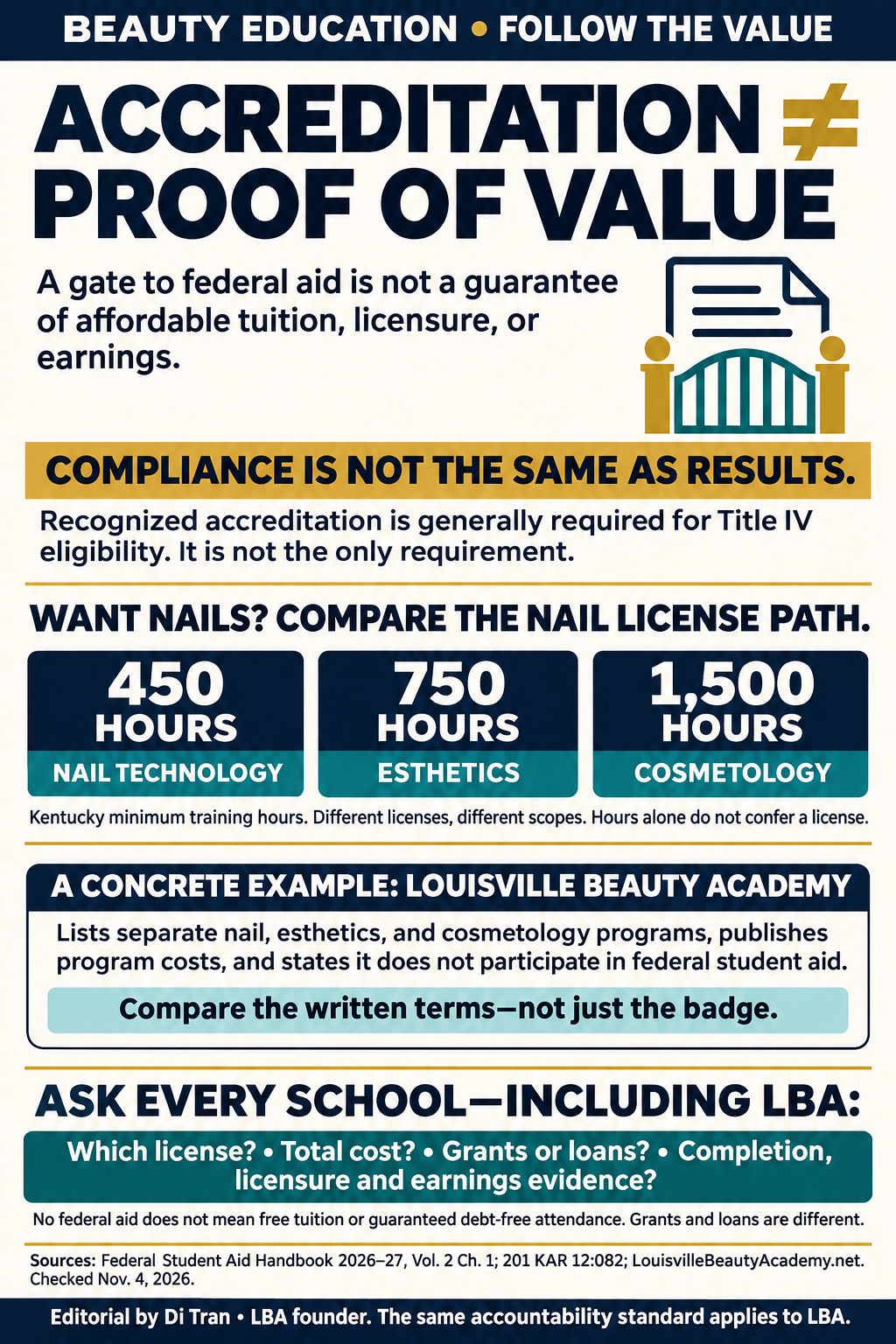
November 4 practical edition: This guide adds a take-home comparison card and the new infographic. It does not repeat or establish any national percentage of schools receiving an earnings warning.
Why a funding credential is not a financial answer
Recognized accreditation is generally part of federal student-aid eligibility, together with other requirements. Separately, the FAFSA lower-earnings indicator can alert students to historical institutional earnings without itself ending aid eligibility. The two signals answer different questions. FSA eligibility handbook · FSA earnings-indicator explanation
The irony is that “you can finance this” can sound like “this is worth financing.” Families should insist on the missing evidence. The earnings indicator is not a program-specific forecast or an exam pass rate. Accreditation does not guarantee value, and a warning does not describe every graduate.
A five-part conversation before anyone signs
1. Ask the student what work they actually want to do
Start with services, not a program name: nails, skincare, hair, or a broader combination. In Kentucky, minimum training hours include 450 for nail technology, 750 for esthetics, and 1,500 for cosmetology. The legal scopes differ; hours alone do not grant a license. Confirm the route for the intended services with the regulator. Kentucky training regulation
Suggested question: “Is there a narrower licensing route for the work I want, and do you offer it?” If the school does not offer it, ask where to verify alternatives. Do not assume that the longest program is necessary or that a shorter one authorizes broader services.
2. Put the price and the funding on separate lines
Write down tuition and every mandatory additional charge. Then list confirmed grants or scholarships separately from loans, cash payments, and installment obligations. Grants generally differ from repayable borrowing; work-study is earned through work. Federal aid types explained by USA.gov
Suggested question: “What is my full obligation if I receive none of the conditional discounts?” Ask what triggers each discount, when it applies, and what happens if attendance or completion conditions are not met. Do not compare one school’s full price with another’s best-case conditional price.
3. Ask for results with definitions
For each school, record the reporting period, starting population, completions, distinct graduates who tested, and verified licensure results. Ask how placement and earnings are measured and how unknown outcomes are treated. Keep an exam attempt separate from a person, employment separate from self-employment, and gross business revenue separate from personal income.
Suggested question: “Can you show the counts behind that percentage?” If comparable evidence is unavailable, write “unknown,” not zero and not success.
4. Make the language understandable
A translated sales conversation is not enough if the student cannot explain the contract in their own words. Invite them to describe the total obligation, schedule, incentive conditions, and withdrawal terms. Arrange qualified interpretation or translation when needed; do not treat an informal explanation as a replacement for the controlling agreement.
Suggested question: “May I take the agreement home and review it before committing?” Clarity protects the student’s agency. The adviser’s role is to support understanding, not to pressure a decision.
5. Stress-test the plan against real life
Discuss transportation, childcare, work schedules, supplies, testing expenses, and a realistic attendance plan. Ask what happens if the student misses time, withdraws, transfers, or needs another exam attempt. Record who will answer questions and where written terms can be found.
Suggested question: “What will I owe—and what options remain—if my circumstances change?”
A Louisville example: look for visible choices and terms
Louisville Beauty Academy publicly lists separate nail, esthetics, and cosmetology programs and program costs, including conditional pricing. It also states that it does not participate in Title IV federal aid. That makes it a useful example of disclosures families can inspect—not proof of superior earnings or a promise that attendance carries no debt.
Ask LBA for the same full written comparison as any other school. Confirm eligibility for incentives and the current agreement. A non-federal-aid model still has costs and obligations; an aid-participating model may include grants that affect the student’s net cost. Compare the actual offers.
A take-home comparison card
Use one copy per school. Leave unsupported answers marked unknown.
- My goal: services I want to provide and the required license.
- My time: required hours, attendance schedule, and realistic completion plan.
- My price: full mandatory charges and separately documented incentives.
- My funding: confirmed nonrepayable support, borrowing, and other payment obligations.
- My evidence: dated completion, licensure, and work/earnings information with definitions.
- My exit terms: withdrawal, refund, transfer, and remaining balance rules.
Bring home the written answers—not just the brochure. These are proposed consumer practices, not a claim that every item is legally mandated. The goal is informed choice: a pathway the student understands, a price they can evaluate, and claims that can be checked.
Perspective and affiliation: Editorial and consumer education prepared at the request of Di Tran, founder of Louisville Beauty Academy. LBA is an affiliated example, not an independently ranked winner. The same disclosure and evidence standards apply to LBA. School statements are identified as such; no comparative earnings advantage is established. This is not a government finding, endorsement, or individualized legal or financial advice. Sources reviewed November 4, 2026; current regulations and signed school terms control.
Research and public-education design: Di Tran University — The College of Humanization.
Discover more from New American Business Association (NABA) - Louisville, KY
Subscribe to get the latest posts sent to your email.