From Training to Trust: How Students Can Document Real Work Before Graduation
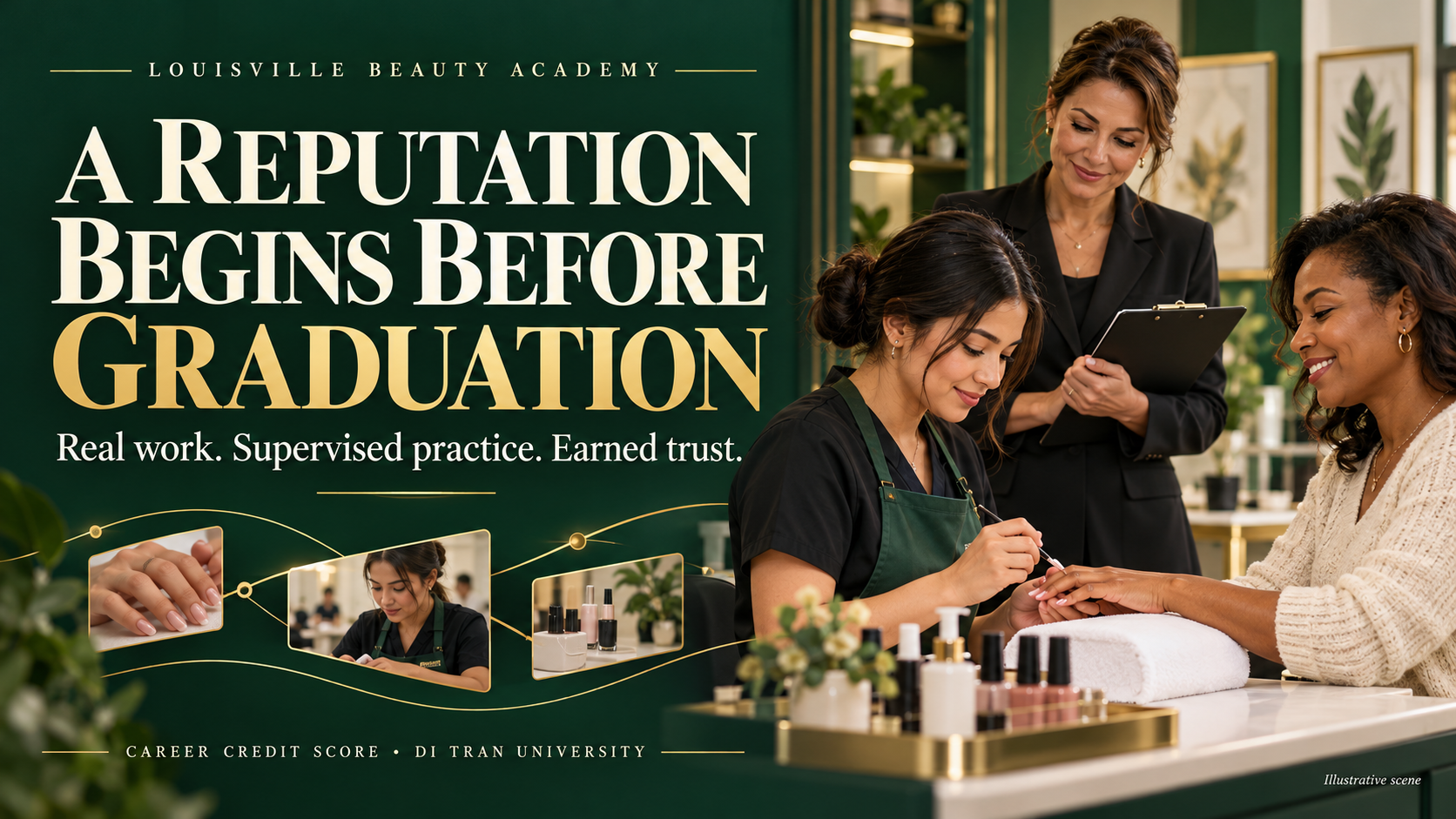
Real work. Supervised practice. Earned trust. How Louisville Beauty Academy and Di Tran University connect learning with documented action through the developing Career Credit Score framework.
For workforce development and small-business communities, training becomes more useful when learners can explain and document what they have practiced. Louisville Beauty Academy’s approach offers a practical example, with instructor assessment and optional customer feedback serving distinct roles.
A résumé can describe ambition. A certificate can document an educational milestone. But professional trust grows through repeated actions: preparing carefully, practicing safely, listening respectfully, and responding to feedback.
At Louisville Beauty Academy (LBA), those habits are practiced during school. Students perform services under instructor supervision, while participating practice models contribute their time and perspective. The opportunity is practical: help students recognize, document, and reflect on their work before they enter the workforce.
Two perspectives, distinct responsibilities
According to LBA, instructors supervise, assess, and grade student work, including safety, sanitation, technique, and professional conduct. These responsibilities remain with the school.
Customers and volunteer practice models can describe their own experiences: whether a student listened, explained the service, communicated respectfully, or helped them feel comfortable. Both perspectives can support learning. A positive review does not establish technical competence, replace an instructor’s assessment, or confer a professional license.
What the public record shows
LBA’s review archive, captured on October 21, 2026, identified 271 five-star Google reviews mentioning a student by name, with student status confirmed by LBA.
That figure counts reviews, not unique students. It represents selected positive feedback, not every rating or customer experience. The archive is a dated record; Google reviews may subsequently change.
Readers can examine short excerpts, names as publicly posted, and source links rather than relying solely on an institutional claim.
Explore LBA’s five-star review archive and sources →
Career Credit Score: building a portfolio of evidence
Di Tran’s developing Career Credit Score framework encourages learners to connect their professional claims with evidence. For a student, that evidence might include instructor-assessed work, permitted photographs of completed services, reflections on feedback, and examples of improvement. Voluntary customer reviews can contribute another perspective.
A useful portfolio explains more than what went well. It records what the student learned, what needed correction, and what changed in the next attempt.
The framework is educational. It is not a financial credit score, a validated scoring instrument, a professional license, or a guarantee of employment or income. The review count does not demonstrate a measured increase in any student’s score.
Take LBA’s free Career Credit Score course →
Di Tran University’s related article explores documentation, verifiable evidence, and professional credibility in an era of AI-generated content.
Read Di Tran University’s discussion of evidence and credibility →
Trust requires freedom to give honest feedback
A credible approach leaves room for praise, criticism, and silence. Practice-model participation and public reviews are optional. No review, five-star rating, or student-name mention should be required or exchanged for a service, discount, grade, or other benefit.
Students should obtain appropriate permission before using identifiable photographs or personal information in a portfolio. Public feedback should be quoted accurately and presented with enough context to preserve its meaning. The purpose is to develop professional habits—not to turn customers into promoters or students into review collectors.
Why this matters beyond beauty school
For workforce organizations, educators, and small businesses, this offers a practical question: How can learners leave training with a clearer record of what they have practiced, how they have improved, and how they serve others?
A portfolio cannot answer every hiring question. Carefully documented work can help a learner explain their experience and give an employer something concrete to discuss. That process can begin with one supervised service, one reflection, and one improvement at a time.
Teach the skill. Practice with supervision. Document the work. Earn trust through consistent care.
Ready to explore beauty education? Visit Louisville Beauty Academy or text 502-625-5531 for current program information, enrollment requirements, and written pricing.
Source and relationship disclosure: This article draws on LBA’s published review archive and course materials, Di Tran University’s related article, and LBA’s confirmation of student status and instructor supervision. It presents work within Di Tran’s affiliated educational and community network; it is not an independent audit. Customer feedback remains separate from school assessment and state licensing requirements. The featured image is an AI-generated illustrative scene, not a photograph of identified students or an actual clinic session.
Discover more from New American Business Association (NABA) - Louisville, KY
Subscribe to get the latest posts sent to your email.