Before You Enroll: Ask Your Beauty School About Federal Aid
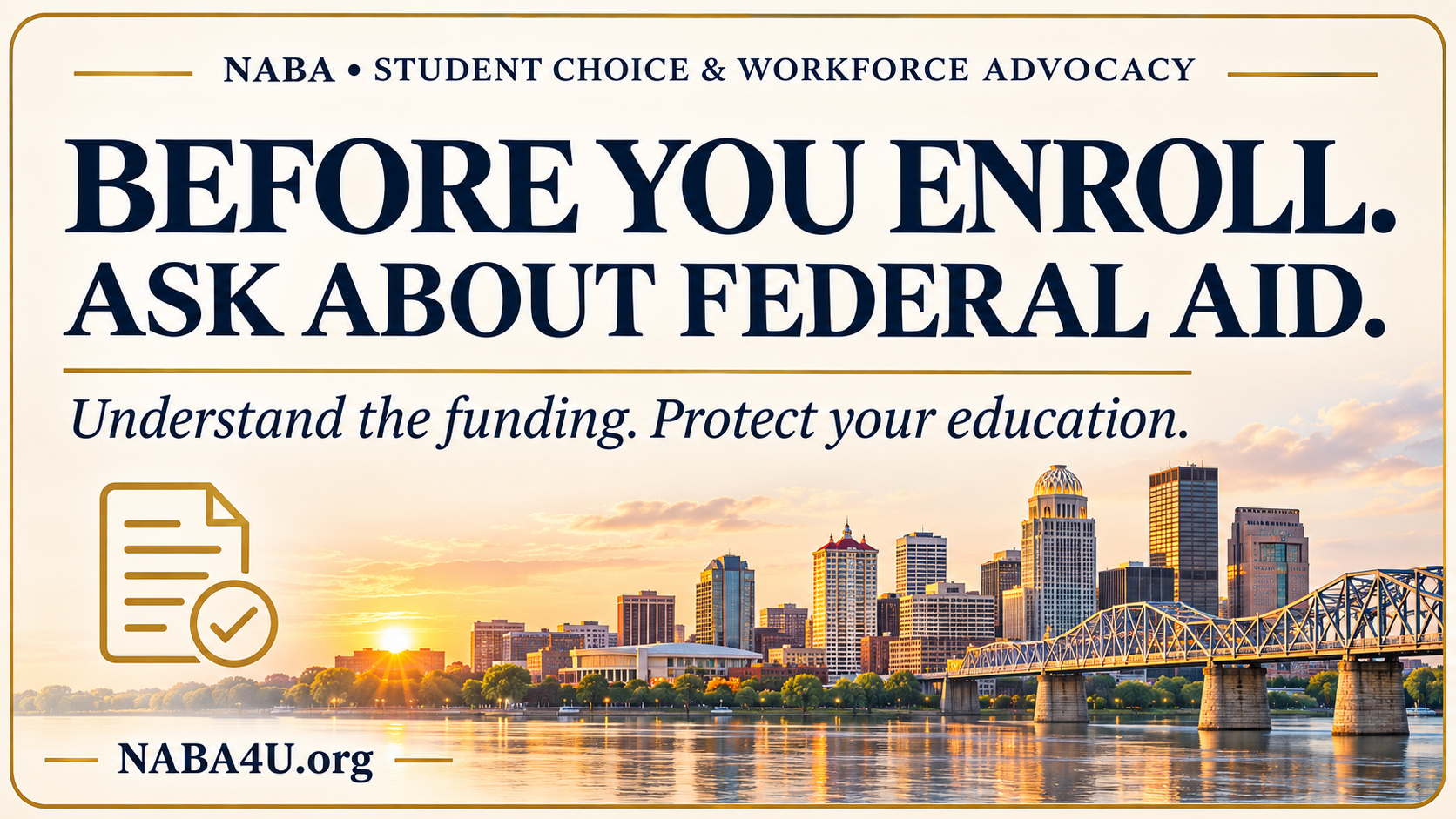
NABA · STUDENT CHOICE & WORKFORCE ADVOCACY
Know what funds your education.
Your education depends on more than the classroom. It also depends on the school’s ability to keep operating and deliver the training you purchased.
Understand the funding. Request the documents. Protect your next step.
NABA urges every prospective beauty-school student to ask the school director the following question—and request a written answer before signing or paying.
“Does this school participate in federal Title IV student-aid programs, such as Pell Grants or federal student loans, for the program I am considering?”
You can begin by asking, “Do you accept FAFSA-based financial aid?” Then request the precise explanation. Merely helping someone complete a FAFSA does not establish that a school participates in Title IV.
If the answer is yes, the school belongs to the Title IV-participating category. Your next question should concern financial dependence and student protection. Participation alone does not establish that a school is financially distressed, under investigation, or likely to close.
Six questions every director should be prepared to address
- What percentage of the school’s revenue comes from federal student aid, and for which reporting year?
- Are there current restrictions, probation notices, adverse actions, or unresolved findings affecting the school, its accreditation, or its federal-aid participation? Please provide the official documents and explain their current status.
- If federal disbursements were delayed or eligibility changed, what resources and written plans would support continued instruction?
- What would happen to my completed hours, records, prepaid tuition, and remaining financial obligations if instruction stopped?
- Which parts of my financial-aid offer are grants, and which are loans that I or my family must repay?
- What is my complete cost, including required fees and materials, and how would withdrawal affect that amount?
The risk to examine: interruption of funding and education
These questions examine a specific risk: how an interruption in a school’s funding could affect your ability to finish. The degree of exposure depends on the school’s finances, operating resources, regulatory circumstances, and contingency arrangements. A yes-or-no answer about federal aid begins the inquiry; it does not complete it.
Students deserve to know what keeps their school operating, what could interrupt instruction, and what practical protections exist. Ask for dated documents, identify who issued them, and distinguish an allegation, a pending review, and a final decision.
Read federal warnings accurately
Federal Student Aid explicitly states that its lower-earnings indicator is informational and does not itself affect Title IV eligibility or participation. It is a reason to examine outcomes—not proof of a pending closure. Read Federal Student Aid’s explanation.
Accuracy strengthens student advocacy. Families deserve specific findings and clear explanations, without false reassurance or unsupported predictions.
Understand closure protections before needing them
Accepting a teach-out or transferring completed credits can affect federal closed-school loan-discharge eligibility. Available options depend on individual circumstances. Review the official guidance before making a decision about transferring or continuing a program. Read CFPB guidance on school closures and student loans.
Apply the same scrutiny to schools without Title IV
If a school does not participate in Title IV, ask equally direct questions about its financial stability, full price, payment terms, refunds, and continuity arrangements. Avoiding federal-aid dependence addresses one financing exposure; it does not eliminate business risk.
For a local example of written price comparison, Louisville Beauty Academy publishes listed costs alongside conditional incentive figures. A possible reduced amount is not an automatic offer: review eligibility, approval requirements, and the current agreement. Review LBA’s published costs and conditions. Independently check Kentucky programs through the Kentucky Board of Cosmetology school directory.
A practical standard for informed choice
NABA advocates clear written answers before enrollment, comparable cost disclosures, understandable outcome measures, and continuity planning that puts students first. These are advocacy proposals, not a claim that every requested disclosure is legally required.
Students should feel comfortable asking difficult questions. Responsible schools should welcome an opportunity to explain their model with evidence.
Ask every director. Request the documents. Compare the answers. Keep them in writing.
For the broader research discussion, read Follow the Money. Verify the Education: Beauty-School Accountability and the Louisville Beauty Academy Case Study.
Discover more from New American Business Association (NABA) - Louisville, KY
Subscribe to get the latest posts sent to your email.