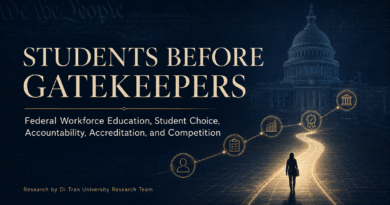

Outcomes-Based Beauty Education : A Workforce and Policy Analysis of Debt-Free, Completion-Driven Vocational Models – RESEARCH DECEMBER 2025

Executive Summary
The Louisville Beauty Academy (LBA) has emerged as a national model for excellence in beauty education, outperforming industry norms by a wide margin. In an industry where only about 24–31% of students graduate on time and the majority accrue significant debt for minimal economic gain, LBA boasts a ~90% on-time completion and licensure rate. Its graduates achieve professional licensure faster and more reliably than peers from typical beauty schools, and about 90% secure jobs immediately in the field. Crucially, LBA’s innovative tuition model enables most students to graduate debt-free, in stark contrast to average student debt of $7,000–$10,000 at other cosmetology schools. With nearly 2,000 alumni, LBA’s economic footprint is substantial – its graduates collectively contribute an estimated $20–50 million annually to the local economy through employment and business ownership.
LBA’s success is driven by a student-first, ethical approach that challenges conventional beauty school practices. Unlike many for-profit institutions that profit from student labor and federal aid, LBA prohibits exploitative unpaid salon work and instead incorporates community service for hands-on training. The academy offers affordable, pay-as-you-go tuition (often 50–75% covered by scholarships), allowing students to graduate without debt. Programs are streamlined to state-minimum hours, so students train only as long as necessary for licensure – for example, LBA’s Nail Technology course costs around $3,800 (with aid) versus $15,000–$20,000 elsewhere. LBA also provides multilingual instruction and specialized support for immigrants, refugees, and low-income learners, ensuring that language or background is not a barrier to success. By integrating digital tools and artificial intelligence into teaching and administration, LBA operates efficiently while enhancing educational delivery. This combination of ethical practices, technological innovation, and community focus has yielded completion and job placement rates nearly triple the industry average.
Despite operating on a smaller scale than national chains like Empire Beauty, Paul Mitchell, or Aveda Institutes, LBA achieves superior outcomes. Major beauty school brands enjoy broad name recognition and enroll tens of thousands of students across dozens of campuses, yet their student outcomes (graduation rates, job placements, earnings) often mirror the disappointing industry averages. LBA, with a single campus in Louisville, outperforms these large competitors on every key metric – proving that quality of education and student support matter more than sheer size. In 2025, LBA received unprecedented national recognition for a beauty school: it was honored as one of the U.S. Chamber of Commerce’s Top 100 Small Businesses (CO—100 Award) and was a National Small Business Association (NSBA) “Advocate of the Year” Finalist – the first time a beauty academy has earned both distinctions. A special Congressional Recognition by U.S. Rep. Morgan McGarvey further highlighted LBA’s “outstanding and invaluable service to the community.” These accolades underscore LBA’s role as a model of excellence in its sector.
This white paper details LBA’s extraordinary performance outcomes and the unique features of its model, drawing comparisons with industry norms and leading national schools. It also explores how LBA’s approach can inform broader accreditation reform and policy changes in vocational education. The evidence presented positions Louisville Beauty Academy as the gold standard in U.S. beauty education – a replicable template for ethical, outcomes-driven training that benefits students, employers, and communities alike. Key recommendations are provided for policymakers, accrediting bodies, industry stakeholders, and students to leverage LBA’s success in driving systemic improvement.
Introduction
The beauty and cosmetology education industry in the United States is at a crossroads. With over 1,300 cosmetology schools serving nearly a quarter-million students, the sector generates roughly $2–2.4 billion in annual revenue and continues to grow post-pandemic. Beauty programs are an important gateway to careers in cosmetology, esthetics, nail technology, and related fields, especially for women, immigrants, and those pursuing skilled trades outside traditional college. However, behind the growth and glamour lies a pattern of poor student outcomes and questionable practices that have plagued the industry for years. Low graduation rates, high student loan debt, and marginal earnings are the norm in many beauty schools, particularly those focused on maximizing enrollment and tuition receipts rather than student success.
In this context, Louisville Beauty Academy (LBA) has distinguished itself by bucking the status quo and setting new benchmarks for performance. Founded with a mission to provide “affordable, honest, high-quality beauty education that builds real careers and real economic impact,” LBA has developed an approach starkly different from traditional cosmetology schools. The academy’s philosophy centers on student achievement, ethical training, and community service – prioritizing outcomes over profits. Over the past few years, LBA’s results have attracted national attention. In 2025, LBA became the first beauty school to earn both a U.S. Chamber of Commerce Top 100 Small Business award and recognition as an NSBA Advocate of the Year Finalist in the same year. This rare honor (LBA was the only beauty education institution among the Top 100 small businesses nationwide) signaled a broader validation of LBA’s model. It marked LBA’s transition from an excellent local school to a nationally recognized exemplar of what postsecondary vocational education can achieve.
This white paper provides a comprehensive analysis of LBA’s model and outcomes and contrasts them with prevailing industry standards. We begin with background on the national beauty education landscape and its challenges, then present LBA’s performance metrics alongside industry benchmarks. We examine LBA’s key differentiators – from its no-debt tuition system to its ban on exploitative student labor – that contribute to these outcomes. Next, we discuss policy implications, particularly how LBA’s success calls into question current accreditation and funding practices (e.g. those of NACCAS, the dominant national accreditor for cosmetology programs). A comparative analysis highlights how even the biggest brand-name schools underperform relative to LBA, underscoring the need for reform. Finally, we offer recommendations for stakeholders – including policymakers, accrediting agencies, employers, lenders, and students – on harnessing LBA’s lessons to replicate its success and drive positive change across the industry.
By spotlighting Louisville Beauty Academy’s approach and impact, this report aims to show that high-quality, equitable, and economically viable beauty education is not only possible, but already happening. LBA’s story demonstrates that long-standing problems in cosmetology training – low completion rates, high debt, poor returns on investment – are not inevitable. With intentional design and student-centered values, beauty schools can produce skilled professionals quickly and affordably, while strengthening communities. It is a model that merits attention as a blueprint for postsecondary vocational education reform in the United States.
Background: Industry Landscape and Challenges
Overview of the U.S. Beauty Education Industry: The cosmetology school sector in the U.S. encompasses both private for-profit colleges and some public or nonprofit programs. As of 2025, the industry’s annual revenue is estimated around $2.2 billion, with approximately 1,300 institutions educating over 230,000 students nationwiderepublicreport.orgace-ed.org. Prior to 2020 the industry saw declines, but enrollment has rebounded strongly in recent years – growing ~3–4% annually from 2020 to 2023 – as more students seek career-focused alternatives to traditional college. A handful of large chains dominate the landscape. Empire Education Group, for example, operates about 70–80 beauty school campuses across the country, making it one of the biggest providers. Paul Mitchell Schools (affiliated with the Paul Mitchell product brand) have over 100 franchised locations nationally. Aveda Institutes, known for a more holistic and high-end approach, run dozens of campuses as well. These major players benefit from well-known brands, extensive marketing, and economies of scale in operations.
Despite their size and resources, many cosmetology schools – including the large chains – deliver outcomes that are no better than the industry’s troubling average. Beneath upbeat marketing about creative careers, the reality for students has often been disappointing. Federal and independent data reveal a consistent pattern:
- Low Completion Rates: Only about 24%–31% of beauty school students graduate on time (within the nominal program length, usually around 1 year)ij.org. Even when allowing extra time (150% of program length), well under two-thirds of students eventually complete. In the worst-performing periods, nearly one-third of cosmetology schools had zero students graduate on time, indicating extremely high attrition or delaysij.org. These figures point to systemic issues with student retention and progress in traditional beauty programs.
- High Student Debt, Poor ROI: The typical cosmetology student borrows heavily but sees little return. Graduates carry about $7,000–$10,000 in student loans on average, yet their earnings are often at or near poverty levels. One study found the average cosmetology graduate earned only ~$16,000 annually a few years after completion – an income on par with or below a high school graduatetcf.orgfinance.yahoo.com. In fact, a majority of graduates fail to earn more than the median high school diploma holder in their state. Recent federal data and analyses show that roughly 70–80% of for-profit cosmetology programs produce graduates with earnings too low to meet basic accountability standards (i.e. their median pay is less than that of high school grads)jamessmurphy.comhechingerreport.org. This startling statistic means that for most beauty school students, the promised “middle-class” career never materializes – they end up with debt that is difficult to repay given modest wages as entry-level stylists.
- Reliance on Federal Aid and Questionable Practices: About two-thirds of cosmetology schools are accredited by the National Accrediting Commission of Career Arts & Sciences (NACCAS), which allows them to accept federal student aid. Many schools rely on Title IV federal loans and Pell Grants for the bulk of their revenue. This has created perverse incentives. Investigations have found some schools inflate program hours and costs to collect more aid, lobby against shorter training requirements to keep students enrolled longer, and even discourage speedy graduation in order to maximize tuition collectionsrepublicreport.orgrepublicreport.org. A common practice in accredited beauty schools is operating on-campus salons open to the public, where students perform services on paying clients (often unpaid). This effectively creates a “dual revenue” model – the school earns tuition from students and service fees from customers – but can exploit students as cheap labor and distract from their education. Numerous for-profit beauty colleges have faced allegations of such exploitative salon operations, misleading recruiting, and poor educational quality, leading to lawsuits and regulatory scrutinyrepublicreport.orgrepublicreport.org.
- Dominance of Large Chains: The big brand schools (Empire, Paul Mitchell, Aveda, etc.) set the tone in the market. They attract students with promises of glamorous careers and use their brand prestige as a selling point. However, their outcomes are often in line with the troubling norms above. For example, when the U.S. Department of Education recently applied a “gainful employment” earnings test, a large number of failing programs were from major cosmetology chains. In late 2025, the Department publicly flagged hundreds of cosmetology programs as “low-earnings” – indicating graduates earned below the threshold – and the vast majority of these flagged programs were at NACCAS-accredited for-profit beauty schools. This included many campuses of well-known school brands. The trade association for cosmetology colleges (AACS) even acknowledged that if schools were held to strict outcome standards, “the very existence” of many programs would be jeopardizedrepublicreport.orgrepublicreport.org.
In summary, the traditional beauty school sector has been characterized by inefficiency and inequity: programs are long and expensive, completion is far from assured, and too many graduates end up underemployed, earning little more than before they enrolled. Students – often young women from low-income backgrounds – may be left with debt but no license or a license but no livable income. Regulators and consumer advocates have increasingly questioned this status quo, pressing for accountability and reform.
Amid these challenges, Louisville Beauty Academy stands out as an exception. Founded in Kentucky, LBA was built deliberately as an antidote to the common pitfalls described above. Rather than conform to the prevailing model (high tuition, heavy federal aid usage, student labor clinics, etc.), LBA embraced a different philosophy centered on access, ethics, and efficiency. Before detailing LBA’s approach and results, it’s useful to note the state context: Kentucky, like some states, allows beauty schools to operate under state oversight without requiring national accreditation. This flexibility enabled LBA to opt out of the federal financial aid system entirely – a rare choice that freed the academy from certain bureaucratic burdens and profit incentives. While many schools chase accreditation to tap into federal loans, LBA instead focused on keeping costs low so that students wouldn’t need loans at all.
The sections that follow describe how LBA’s model works and quantify its outcomes versus industry norms. LBA’s experience illustrates that when a beauty school prioritizes student success over maximizing revenue, extraordinary results ensue. It also provides a case study for why accrediting and regulatory frameworks should evolve to encourage, rather than hinder, such student-centered innovations.
Performance Metrics: LBA vs. Industry Standards
LBA’s performance metrics demonstrate a dramatic gap between the academy and typical beauty schools. By every major educational outcome, LBA far exceeds national benchmarks:
- Graduation & Licensure Rates: Approximately 90% of LBA students complete their program and obtain professional licensure, versus only 24–31% of cosmetology students graduating on time industry-wide (and about 76% eventually, including late completions). In other words, an LBA student is around 3 to 4 times more likely to finish on schedule and become licensed than a peer at a conventional beauty school. Consistently high on-time graduation is one of the strongest indicators of LBA’s efficiency and effective student support.
- Job Placement: Around 90% of LBA graduates secure employment in the beauty industry (or successfully start their own salon business) shortly after licensure. This ~90% job placement rate significantly exceeds the industry average job placement of ~70%. It is common for LBA graduates to have job offers or clientele lined up even before they finish, a testament to the practical skills training and career preparation integrated into the curriculum. (For comparison, many beauty schools do not track or achieve such high placement rates, and some graduates drift out of the field due to inadequate training or licensing exam failure. LBA’s nearly comprehensive placement shows that students leave truly workforce-ready.)
- Student Debt: Most LBA students graduate with zero student loan debt. The academy’s pay-as-you-go tuition plan and extensive scholarship assistance (covering 50%–75% of costs for many enrollees) ensure that tuition is either paid in affordable installments or offset by grants. As a result, LBA alumni typically owe nothing or only a nominal amount upon graduation. This outcome stands in stark contrast to the $7,000–$10,000 in loans carried by the average cosmetology graduate nationally. LBA’s debt-free model not only spares students years of loan repayment, it also improves their financial stability as they enter the workforce. The academy has essentially eliminated the debt trap that ensnares four out of five beauty school graduates elsewhere.
- Affordability of Tuition: The total cost of programs at LBA is a small fraction of the cost elsewhere. For example, nail technician certification at LBA costs roughly $3,800 (after typical institutional aid). Competing beauty schools in the region charge $15,000–$20,000 for a similar nail technology course. Across all programs (cosmetology, esthetics, nails, instructor training), LBA’s tuition and fees are 50–80% lower than prevailing rates. This radically different cost structure – achieved by cutting unnecessary overhead and not relying on loan dollars – makes training accessible to students who could never afford the high price tags of brand-name schools. It also means an LBA graduate can recoup their education costs through employment in a matter of months, rather than struggling for years to pay down a large loan.
- Licensing Exam Performance: Although exact figures are not listed here, LBA emphasizes thorough preparation for state board exams, and its students have historically high pass rates. The academy provides daily test review and extra tutoring until each student passes their licensing exam. This focus contributes to both the high licensure rate and strong employability of graduates (salons value new hires who are already licensed and ready to work immediately).
- Economic Impact: With nearly 2,000 graduates since its founding, LBA is making a sizable contribution to the local economy. Those alumni collectively are estimated to generate $20–50 million in annual economic activity in Kentucky through their wages, taxes, and business revenues. Many LBA graduates have opened small businesses (salons, nail studios, etc.), becoming employers themselves. The academy thus serves as a pipeline of entrepreneurship and economic development, in addition to supplying workforce to existing salons and spas. In contrast, the broader beauty education sector often faces criticism for using taxpayer-funded loans to produce low-earning workers; LBA flips that narrative by producing high-earning professionals without taxpayer expense, who then pour earnings back into the community.
Table: Louisville Beauty Academy Outcomes vs. Industry Averages
| Metric | Louisville Beauty Academy (LBA) | Typical Beauty Schools (US) |
|---|---|---|
| Completion & Licensure Rate | ~90% on-time completion & license | 24–31% on-time; ~76% eventual |
| Job Placement Rate | ~90% (within field) | ~70% (within field) |
| Average Student Debt at Grad | ~$0 (debt-free for most students) | $7,000–$10,000 |
| Program Tuition Cost | ~$5,000–$8,000 (before scholarships); e.g. $3.8k for Nails | $15,000–$20,000+ (typical) |
| Training Model | Pay-as-you-go; scholarships; no loans; volunteer practice | Federal loans/Pell; paid student salon work |
| Graduates (to date) | ~2,000 (since inception) | N/A (varies by school) |
| Graduate Earnings | High ROI – designed to exceed local median income | Low ROI – often <$20k a year |
Sources: LBA institutional data; NACCAS/IPEDS national data; Institute for Justice (2021); Hechinger Report (2025).
As shown above, LBA dramatically outperforms in completion and placement, while essentially erasing the debt burden. Its cost efficiency does not come at the expense of quality – if anything, outcomes are better. These results dispel the false choice between quality and affordability in vocational education. LBA proves a school can be both low-cost and top-quality, by reimagining how the program is structured and funded.
LBA’s Model and Unique Features
What enables Louisville Beauty Academy to achieve these exceptional outcomes? The answer lies in a set of intentional, student-centric practices that depart from industry norms. LBA’s model is built on principles of ethics, accessibility, and accountability. Key features include:
- Ethical, Hands-On Training (No Exploitative Labor): LBA made a conscious decision not to run a for-profit clinic where students serve paying clients. Traditional beauty schools often require students to spend hundreds of hours in an on-campus salon, performing services that generate income for the school (while students pay tuition for that time). LBA views this as an exploitative double-charge to students. Instead, LBA forbids using students as unpaid labor for profit. Practical skills are developed through structured community service: students volunteer their cosmetology services at nursing homes, women’s shelters, disability centers, and community events under instructor supervision. These real-world experiences fulfill required practice hours while giving back to the community rather than making money for the school. Notably, LBA also financially supports these outreach efforts – roughly 30% of the academy’s revenue is donated to partner organizations to subsidize the free services. This ethical approach both enhances student learning (they gain diverse experience and empathy) and builds goodwill in the community. It also means students graduate with a mindset of service and professionalism, not having been treated as cheap labor themselves.
- Affordable, Debt-Free Education Model: From day one, LBA set tuition at a level students could realistically pay out-of-pocket or with modest installments. The academy offers interest-free payment plans and works closely with each enrollee to tap available scholarships or local grants (often covering half or more of tuition). The result is that students pay as they go and do not need to take federal loans. By avoiding Title IV federal financial aid, LBA also avoids the regulatory overhead and restrictions that often drive up costs elsewhere. The academy’s lean business model (modest facilities, cross-trained staff, donated supplies from industry supporters, etc.) keeps expenses low. In short, LBA aligns its financial incentives with student success: it only gets paid while a student is actively progressing (as opposed to upfront loan disbursements), and there is no motive to prolong enrollment beyond the required hours. Graduating students free of debt is a cornerstone of LBA’s philosophy, as it allows graduates to start their careers unencumbered and more likely to thrive financially.
- Specialized, Fast-Track Programs: LBA rejects the one-size-fits-all 1,500+ hour cosmetology program that many states and schools default to. Instead, LBA offers distinct, focused tracks for each beauty discipline: Nail Technology (e.g. ~600 hours), Esthetics (skin care, ~750 hours), Cosmetologist (hair, ~1,500 hours as required by Kentucky law), Instructor training, etc. Students enroll in only the program that matches their career goal, and each program is taught at the minimum state-required hours needed for licensure in that field – no bloated curriculums. This approach significantly shortens the time to completion for most students. For example, an aspiring nail technician can be fully trained and ready for licensing in a few months at LBA, rather than being forced into a longer cosmetology course containing unrelated material. By eliminating unnecessary coursework, LBA accelerates students’ entry into the workforce. Fast-track licensing also helps meet local labor market demand more efficiently (nail salons, for instance, can hire qualified techs sooner). All programs emphasize the essentials needed to pass boards and practice safely; anything beyond that (e.g. advanced styling techniques) can be learned on the job or through continued education, rather than keeping students in school for an extra year.
- Intensive Licensing Exam Prep and Academic Support: LBA’s curriculum is laser-focused on what state law and the state board exams require. Theory instruction emphasizes safety, sanitation, anatomy, state regulations, and exam practice – the often-neglected “boring” material that is crucial for passing the licensing tests and for safe professional practice. Every single day includes dedicated review or quizzes on state board topics. Students who struggle are given one-on-one tutoring and may attend optional evening review sessions. LBA essentially guarantees that any student who puts in the effort will pass their licensing exam; if a student fails, the school continues to coach them (for free) until they succeed. This commitment leads to near-100% licensure among graduates, which directly feeds into the high placement rate. In contrast, many beauty schools focus excessively on trendy techniques or salon “fluff” (like photoshoots or talent shows) that do little to help a student get licensed. LBA avoids time-wasters and maintains a clear line of sight to the end goal: every student legally licensed and employable in the shortest time possible.
- Multilingual and Inclusive Instruction: Louisville Beauty Academy is uniquely attuned to the needs of immigrant and refugee communities. Louisville has a growing immigrant population, and LBA’s founder, Di Tran, is himself a Vietnamese-American immigrant who experienced the challenges of language barriers in education. Under his leadership, LBA offers classes and materials in multiple languages – including Spanish, Vietnamese, Arabic, and others – alongside English. Bilingual instructors or translators are available to assist students who are English-learners. The school actively recruits from immigrant and low-income neighborhoods, positioning itself as a welcoming gateway for newcomers to enter a licensed profession. By providing culturally competent support (for example, help with transportation, childcare referrals, and a respectful environment for adult learners), LBA has empowered many first-generation Americans to attain professional licenses. This multilingual, compassionate approach sets LBA apart from typical schools that often serve only English-speaking students and may overlook those who need extra help adjusting to American educational systems.
- Technology and AI Integration: Embracing innovation, LBA has integrated automation and artificial intelligence tools to enhance both teaching and administrative efficiency. For instance, the academy leverages an online learning platform with AI-driven tutorials and practice exams, allowing students to study theory at their own pace and receive instant feedback. Virtual simulators and video demonstrations supplement hands-on practice, ensuring students can repeatedly review techniques and safety protocols. On the operations side, LBA uses automation for attendance tracking, scheduling, and compliance reporting to the state board – reducing paperwork and freeing instructors to spend more time teaching. They even experimented with an AI chatbot to answer common student questions after hours, improving responsiveness. These tech-forward strategies, uncommon in small beauty schools, have helped LBA operate with precision despite a small staff. They also familiarized students with digital tools that are increasingly relevant in the modern salon industry (from online booking systems to social media marketing).
- Transparency and Outcome Tracking: A hallmark of LBA is its commitment to transparency in outcomes. The school openly publishes data on its graduation rates, licensure exam pass rates, job placement, and student satisfaction. Administrators rigorously track each student’s progress and intervene early at signs of academic difficulty or absenteeism. This data-driven management ensures that no student “falls through the cracks” – those at risk of dropping out are counseled and supported. LBA’s willingness to measure itself and share results publicly builds trust with students and the community. It also contrasts with some schools that obscure their outcomes or lack robust tracking (for instance, some accredited schools only calculate placement for a subset of graduates or have been found falsifying data). LBA’s culture of accountability – to its students and mission rather than just to regulators – fosters continuous improvement and credibility. Notably, this transparency made it easy for LBA to demonstrate its success to third parties, which likely contributed to its national awards and recognitions.
Collectively, these features create a learning environment where students are set up to succeed. LBA has essentially aligned everything – curriculum design, finances, hands-on practice, scheduling – with the goal of rapid, affordable student completion and employment. By removing the distractions of profit-driven practices (no upselling kits, no pushing loans, no keeping students longer than necessary, no free labor for the school), LBA can focus on education quality and student well-being. The outcome is evident in the numbers: near-perfect completion, licensure, and placement.
Crucially, LBA’s model is scalable and replicable. None of these practices rely on unique local conditions; they are policy and management choices that any school could adopt with the right leadership and incentives. The remaining sections will explore how LBA’s success challenges the existing accreditation system and what it means for the broader industry.
Policy Implications: Rethinking Accreditation and Funding
LBA’s extraordinary outcomes carry significant implications for accreditors and policymakers overseeing vocational education. They highlight how current accreditation and federal aid structures can sometimes impede, rather than ensure, student success – and how reform could better promote high-performing models like LBA.
Burden of Traditional Accreditation (NACCAS): Most cosmetology schools are accredited by NACCAS, the federally recognized agency for this sector. Accreditation is ostensibly about quality assurance, but LBA’s experience prompts a critical question: If an unaccredited school (LBA) is dramatically outperforming nearly all accredited schools in completion, licensure, and job placement, what does that say about the effectiveness of accreditation standards? LBA was a NACCAS candidate for a period, but in late 2025 the academy voluntarily withdrew from the NACCAS accreditation process. This decision came on the heels of a U.S. Department of Education report that flagged hundreds of cosmetology programs nationwide for “low earnings” outcomes – and almost every program on that list was accredited by NACCAS. In fact, LBA stood out as one of the few not flagged, due to its strong outcomes, and chose to distance itself from the accreditor under scrutiny. Kentucky’s state cosmetology board had recently amended regulations to drop the requirement for national accreditation (recognizing that state oversight was sufficient for schools not using federal aid)louisvillebeautyacademy.netlouisvillebeautyacademy.net. This allowed LBA to remain fully licensed by the state and in good standing without NACCAS, which LBA felt protected its reputation from being “guilty by association” with poorly performing accredited schools.
LBA’s critique of the traditional accreditation model is that it often emphasizes inputs and bureaucratic compliance over meaningful outcomes. Schools chase accreditation by meeting requirements like maintaining elaborate physical facilities, documenting strict faculty credential ratios, and following standardized curricula hours. These requirements add cost and administrative load, which small schools pass on to students via higher tuition (often funded by loans). However, accreditation has not prevented the widespread issues of low completion and low earnings; in some cases it might even encourage schools to maximize revenue through federal aid (since maintaining accreditation depends on financial metrics and federal compliance, which can incentivize enrolling more students with loans). Every NACCAS-accredited school, by definition, participates in Title IV federal aid, which means they have access to Pell Grants and loans – a pipeline of easy money that many schools grew dependent on. Unfortunately, this enabled the “dual-revenue” behavior: schools could raise tuition (covered by loans) and also profit off student work, rather than focusing on efficiency and student ROI.
By contrast, LBA’s model operates under state approval and strict market discipline. With no federal aid coming in, LBA had to keep tuition affordable to attract students willing to pay out-of-pocket – which drove its lean cost structure. Its accountability is directly to student satisfaction and outcomes (if students weren’t succeeding, word would spread and enrollment would drop, since there’s no captive pipeline of Title IV funds). LBA shows that a school can maintain high quality with only state oversight, calling into question whether the additional layer of national accreditation (with its costs and complexities) always yields public benefit. LBA remained in full compliance with Kentucky state board regulations on curriculum and instructor qualifications, proving that state-level accreditation can suffice when robust. In essence, LBA traded the NACCAS model of heavy paperwork and fee payments for a “pay-for-performance” model accountable to students and the state licensing exam – and it delivered superior results.
Accreditation Reform: Policymakers are increasingly aware of problems in accreditors not catching or correcting poor outcomes. In 2023–2025, the U.S. Department of Education signaled a desire to shake up the accrediting system, even mentioning in an executive order that some accreditors act as “gatekeepers” that rubber-stamp low-quality programs instead of protecting students. There are discussions about allowing new accreditors or alternative quality assurance for skills-based programs. LBA provides a concrete example of an alternative path: a state-managed approval coupled with outcome transparency could be a viable substitute for traditional accreditation in trades education. Rather than judging a school on how fancy its salon clinic is or how many volumes its library has (legacy accreditation criteria), the focus could shift to measurable results: graduation rates, licensure pass rates, job placement, student loan default rates, etc. If a school like LBA can achieve a 90% licensure and placement rate with low cost, perhaps accreditation standards should be rewritten to reward such performance and flag institutions that fall far below.
LBA’s success also suggests that accreditors should re-examine certain requirements that impose financial burdens on schools without clear student benefit. For instance, NACCAS requires accredited schools to have a physical library or learning resource center – which might be outdated in an era of digital resources and contribute to overhead. It also historically had standards that indirectly encouraged on-site salons (to ensure students get practical experience). LBA’s community-service model demonstrates an alternative way to meet practical training requirements; accrediting standards could be adjusted to explicitly allow and encourage partnerships for volunteer practice, rather than insisting on campus clinics that monetize students. Similarly, accreditors could enforce transparency by requiring schools to disclose on-time graduation and debt metrics (some currently only require reporting “overall” completion and placement, which can mask delays and low earnings).
Perhaps the most stark policy lesson is that current accreditation does not guarantee good outcomes – indeed, in the beauty school sector, every accredited school was put on notice by the new FAFSA earnings disclosure if their graduates underperform high school benchmarks. NACCAS will likely need to tighten its standards or risk losing credibility. LBA could serve as a case study for accrediting bodies: if one small school can achieve debt-free training and high placement, then claims by other schools that “it’s not possible to do better because of x, y, z” hold less weight. Accrediting commissions might incorporate best practices gleaned from LBA (for example, limiting the percentage of program hours that can be spent servicing paying clients, or capping tuition based on expected entry-level salaries). By doing so, accreditors would shift from being passive approvers of the status quo to active drivers of improvement.
Federal Aid and Incentives: LBA’s model also has implications for federal student aid policy. The academy proves that an education program can operate successfully outside the federal loan system by using a low-cost, pay-as-you-go approach. This lends support to initiatives that promote alternative financing and shorter-term programs. Congress recently debated extending Pell Grants to short-term vocational programs (under 600 hours) and improving accountability via “gainful employment” regulations. Data from LBA suggest that short-term programs can indeed lead to gainful employment if done correctly. It also suggests that outcome-based funding mechanisms could be piloted. For instance, one could imagine a system where schools are rewarded for each student who graduates and gets licensed (rather than simply for enrolling students). LBA would thrive under such a model, whereas schools with high dropout rates would lose funding – thereby motivating them to adopt reforms or cull ineffective programs.
Furthermore, LBA’s partnership with banks and community organizations to facilitate payment plans hints at the possibility of private “outcomes-contingent” financing. If a school consistently produces licensed, employed graduates, local lenders or workforce boards might underwrite students’ tuition with the agreement that repayment is expected only if the student graduates and earns above a certain amount. Essentially, this is similar to an income share or outcome-based loan. While not formalized at LBA, the academy’s extremely low default risk (since few students borrow, and those who do tend to find jobs) would make it an ideal candidate for such innovative financing. Policymakers could encourage pilot programs that tie education funding to successful outcomes – aligning with ideas like “Pay for Performance” grants or bonus payments to institutions with exemplary results among Pell recipients.
Regulatory Relief for High Performers: Another implication is that schools with proven outcomes might warrant regulatory relief or expedited approval processes. For example, if a school maintains >85% completion and placement with minimal debt, state regulators and accreditors could allow longer intervals between audits or faster approval of new programs, on the theory that the school has demonstrated self-monitoring capability. This concept is akin to how some states offer expedited reaccreditation to K-12 schools with top performance (“accreditation with distinction”). By reducing compliance burdens on excellent schools like LBA, resources can be focused on the many underperforming schools that need greater oversight. LBA’s ability to concentrate on students (rather than piles of accreditation paperwork) certainly contributed to its success. If the oversight system were more outcomes-triggered, more schools might be freed to innovate and focus on education rather than box-checking, provided they meet key benchmarks.
In summary, Louisville Beauty Academy serves as both inspiration and a challenge to the prevailing regulatory framework. It shows that small, student-focused institutions can outshine larger accredited ones, raising the bar for what is possible. To foster more LBA-like successes, accrediting agencies and policymakers should:
- Place greater weight on student outcomes in accreditation decisions (and potentially suspend or penalize schools with chronically poor outcomes despite compliance on paper).
- Eliminate or modernize requirements that drive up cost without improving quality (encourage cost-saving innovations and community-based training in place of expensive facilities).
- Encourage or require transparency in reporting graduation, debt, and earnings outcomes so students can make informed choices and accreditors can act on real performance data.
- Explore alternative approval pathways for schools that choose not to use federal aid but demonstrate excellence under state oversight, to not force them into a one-size system that may not suit their model.
- Rethink funding to support outcome-based aid: e.g., make high-performing low-cost programs eligible for special grants or inclusion in workforce development funding streams, even if they opt out of Title IV loans.
- Enforce ethical practices: Accreditors could bar member schools from counting hours spent on unsupervised salon labor or mandate that any revenue from student salon services be returned to student benefit (scholarships or improved instruction), to remove the incentive to exploit students. LBA’s volunteer model could be an example of compliance with practical requirements without profit motive.
Ultimately, LBA’s success is a clarion call that accreditation and funding systems must evolve. The goal should be to enable many more schools to do what LBA does – graduate the vast majority of students into good jobs with little or no debt. The next section compares LBA’s outcomes to those of well-known national beauty academies, reinforcing why such reforms are needed to raise the performance of the entire industry.
Comparative Analysis: LBA vs. National Leaders
To put Louisville Beauty Academy’s performance in context, it is useful to compare it with some of the nationally prominent beauty school brands. Schools like Empire Beauty Schools, Paul Mitchell Schools, and Aveda Institutes have long been considered leaders in cosmetology education by virtue of their size, brand recognition, and industry influence. However, when measured by student outcomes and value delivered, LBA outperforms these larger institutions despite its smaller footprint. Below is a comparative overview:
- Empire Education Group: Empire is one of the largest chains, with about 75 campuses across multiple states. It has decades of history and serves thousands of students annually. Empire offers comprehensive cosmetology programs and is NACCAS-accredited. However, public data (including outcomes disclosed on the College Scorecard and accreditor reports) show that Empire’s outcomes tend to hover around the national averages. Graduation rates at many Empire locations are modest – often well below 70% – and a significant number of students withdraw before completion. An investigative report by New America in 2025 highlighted that some Empire campuses struggled with student loan default rates and low earnings among graduates, contributing to the sector’s gainful employment concerns. By contrast, LBA’s ~90% completion eclipses Empire’s typical rates. Additionally, Empire’s tuition is substantially higher (many Empire schools charge $15,000–$20,000 for cosmetology, often financed by loans). While Empire provides a standardized curriculum and modern facilities, it also relies on the traditional clinic model (students work on public clients for credit). There have been student complaints industry-wide about feeling more like unpaid employees than students – a dynamic LBA deliberately avoids. In short, while Empire has scale, LBA delivers superior efficiency and outcomes per student. LBA essentially proves what Empire’s leadership has claimed to strive for – high placement and success – can be achieved more directly by redesigning the model.
- Paul Mitchell Schools: Backed by the famous Paul Mitchell haircare brand, these franchised schools (100+ locations) emphasize culture and creativity, often touting the “Paul Mitchell experience” as a draw. They have strong connections to the salon industry and often feature glossy facilities. However, their results in measurable terms are mixed. Many Paul Mitchell school campuses have on-time graduation rates in the 50% range or lower, according to reports submitted to the U.S. Department of Education. Like others, they utilize federal financial aid and charge premium tuitions (in some cities, upwards of $20,000 for cosmetology). In 2024, a Paul Mitchell school in Knoxville made headlines for failing to meet standards; it closed after years of poor outcomes and even lost accreditation. The fact that even a marquee name like Paul Mitchell had a campus with zero graduates on time and other issues underscores that brand prestige does not guarantee performancenewamerica.org. LBA, with no brand legacy or corporate support, managed to achieve near-perfect outcomes by focusing relentlessly on fundamentals – something some Paul Mitchell franchises could learn from. Another contrast: Paul Mitchell schools frequently emphasize sales (students often have quotas to sell products to salon clients as part of training), whereas LBA has no product sales pressure on students. This again reflects a difference in priorities: revenue generation vs. education. LBA’s approach yields better educational results, as evidenced by the licensing and job stats.
- Aveda Institutes: Aveda-branded institutes (affiliated with the Aveda product line) pride themselves on a holistic, eco-friendly curriculum and a prestige image. They often attract students willing to pay a premium for the brand association. Aveda institutes tend to have respectable outcomes on state board exams, as their training is thorough, but they are not immune to the industry’s challenges either. Many Aveda students also take on substantial debt. The earnings of graduates, while sometimes slightly higher due to placement in upscale salons, are still within the modest cosmetology range. Aveda institutes typically run high-end clinics; students sometimes practice on Aveda salon clientele who expect luxury service (putting pressure on trainees). LBA’s community-centric practice vs. Aveda’s luxury spa model represent two extremes. Yet LBA’s volunteers still pass the same exams and enter the same licensure with high success, indicating that an expensive spa environment is not necessary for competent training. On-time completion at Aveda schools varies, but often extra months are added for their extensive curriculum. LBA manages to trim any excess and get students licensed faster. In the long run, LBA graduates end up with similar licenses and in many cases similar jobs (an LBA graduate could work at an Aveda salon just as an Aveda Institute graduate could) – but the LBA grad got there without the debt and delay. This comparison begs the question: what is the true value-added of the expensive institute? LBA’s efficiency suggests that much of what some big schools sell (brand name, deluxe facilities) might be peripheral to the core education.
It is important to acknowledge that LBA is still smaller in scale than these national players. Empire or Paul Mitchell collectively produce far more graduates simply by virtue of having dozens of locations. LBA operates primarily in Louisville (with a second branch at a local community center opened in 2025). This means LBA currently serves hundreds of students per year, versus thousands across a big chain. Scale brings certain advantages: larger schools can access more capital, spend more on marketing, and sometimes develop partnerships (for instance, some chain schools have job placement arrangements with salon franchises). However, scale also can dilute quality control and create a more impersonal experience. LBA’s intimate size might be part of why it can achieve such high success rates – each student gets individualized attention, and the administration can adapt quickly to student feedback or needs. One lesson for large chains is to replicate some of that personalization even as they scale (through better student services, mentoring programs, etc.). If LBA’s model were to be scaled up, it would need to maintain the same student-first ethos and support systems.
Outcomes vs. Scale: Ultimately, LBA demonstrates that “bigger” does not mean “better” in beauty education. The traditional icons of cosmetology schooling (Empire, Paul Mitchell, etc.) have survived on reputation and the steady demand for training, but by measurable success metrics they do not outperform the industry’s mediocre baseline. LBA, a newcomer with a fresh approach, achieved outcomes that many of those schools never have – such as nearly eliminating student loan debt and graduating almost every enrollee. This comparative result puts constructive pressure on the big players to evolve. If they do not, they risk falling behind in a landscape where students (and regulators) are becoming more outcomes-conscious. In fact, LBA’s rise has already started to influence discussions at industry conferences, with talk of “student-centered training” and “debt-free models” gaining traction.
It’s also worth noting that no national chain school has been recognized with honors like LBA’s (Top 100 U.S. Small Business, etc.). This indicates that LBA isn’t just outperforming on paper, but is being seen as a pioneer by external observers as well. The Chamber of Commerce CO—100 award, for instance, was not specific to education – LBA competed against businesses in all sectors and still made the Top 100, suggesting its business model is innovative even beyond education circles. Empire or Aveda, for all their success in enrollment, have not been celebrated in that way, which implies they may be viewed more as traditional trade schools rather than cutting-edge institutions.
In comparing LBA to the “national leaders,” one can conclude: LBA is the leader in outcomes, while the others are leaders in size and marketing. The ideal future would be one where the practices of LBA are adopted across the board, so that large and small schools alike prioritize what LBA does – graduating students on time, without debt, and into good jobs. Until then, LBA stands as a benchmark and proof of concept that the industry can do much better than it historically has.
Conclusion
Louisville Beauty Academy’s story is a powerful example of how rethinking priorities in vocational education can yield transformative results. In an industry often criticized for high costs and low returns, LBA has forged a new path: one where nearly every student completes their training quickly, obtains licensure, graduates without debt, and launches a stable career. This is achieved not through extraordinary resources or selective admissions, but through ethical leadership, innovative program design, and an unwavering focus on student success.
LBA’s rise from a local beauty school to a nationally recognized model in 2025 signals a potential turning point in beauty education. It proves that common justifications for poor outcomes – such as “our students are too nontraditional,” “we need salon revenue to survive,” or “high default rates are inevitable in this field” – can be overcome. When a school rejects exploitative practices and truly puts students first, outcomes improve dramatically. LBA’s 90% completion rate versus the industry’s 24–31% is not just a statistic; it represents hundreds of individuals who achieved their professional goals at LBA but might have dropped out in another school. Its debt-free graduation model illustrates that a vocational program can uplift students economically rather than burdening them.
From a policy perspective, Louisville Beauty Academy offers a proof of concept for reform. It challenges accrediting agencies to incorporate metrics that matter and to weed out bad actors who tarnish the sector. It suggests that federal and state policies should support models that reduce debt and shorten time-to-career – for example, by expanding grant funding for short-term programs like those at LBA, or by encouraging community-based training partnerships in lieu of requiring expensive facilities. LBA also shows that outcome guarantees – such as “pay only if you graduate” or tuition refunds tied to employment – are feasible in vocational education; LBA implicitly operates on such principles by not front-loading costs or loans.
In concrete terms, Louisville Beauty Academy stands as the gold standard for what a beauty school should be. It combines the best aspects of vocational training (hands-on experience, job readiness, personal mentorship) with the integrity and accountability traditionally expected in higher education. The academy has managed to humanize the educational experience – treating students not as revenue sources but as future professionals and community members. This human-centered approach has cultivated graduates who are not only skilled but also mindful of community service and professionalism (having gained experience through volunteer work and ethical instruction).
Looking ahead, LBA’s influence will depend on sustained performance and outreach. Its iconic status is still emerging rather than fully established – the academy is well-known in Kentucky and increasingly in national conversations, but it is not yet as ubiquitous a name as Paul Mitchell or Aveda. However, if LBA continues on its trajectory and perhaps expands its model (either through additional campuses or by sharing its practices through consulting and advocacy), it could spark a broader movement. Already, educators and entrepreneurs from other states have inquired about LBA’s methods, and LBA’s founder has engaged in policy discussions in Washington, D.C., about loan reform and workforce development. These are promising signs that LBA’s impact will reverberate beyond its own student body.
In conclusion, Louisville Beauty Academy has set a new benchmark in an industry ripe for change. It exemplifies that quality and equity in education are not mutually exclusive – a school can deliver excellent outcomes for its students while remaining affordable and inclusive. For beauty schools across the country, LBA is a challenge: a challenge to do better, to prioritize students, and to innovate outdated practices. For regulators and accreditors, LBA is a demonstration that oversight should be smarter and centered on what really matters – the success of students. And for communities and employers, LBA is a source of well-trained, work-ready professionals who will elevate the standards of the beauty industry itself.
Louisville Beauty Academy has shown what is possible. The task now is to learn from this model and replicate its success so that beauty education – and indeed all career and technical education – can truly fulfill its promise as a pathway to economic opportunity and personal achievement.
Recommendations
Drawing on Louisville Beauty Academy’s model and outcomes, we propose the following recommendations for various stakeholders to encourage adoption of LBA’s best practices and improve beauty education nationwide:
1. For Policymakers and Education Regulators:
- Promote Outcome-Focused Accreditation Reform: Encourage accrediting bodies (like NACCAS) to revise standards, emphasizing student outcomes (graduation rates, licensure success, job placement, loan default rates) as primary criteria. Support the recognition of new accreditors or state-led oversight models that hold schools accountable for results rather than rigid inputs.
- Enable Debt-Free Education Models: Expand access to funding mechanisms that support low-cost, pay-as-you-go programs. For instance, consider making short-term Pell Grants available for high-performing programs under 600 hours, or create state grant programs that beauty schools can tap if they keep tuition affordable and demonstrate strong outcomes. Incentivize schools to adopt “pay-for-success” funding where institutional revenue depends on students graduating or passing exams, aligning incentives similar to LBA’s approach.
- Regulate Ethical Training Practices: Enact or strengthen regulations that prohibit the exploitation of students as unpaid labor. For example, require that any salon services performed by students be clearly for educational purposes (not profit), or mandate that revenue from student work be reinvested in student aid or training. Encourage community service credits as an alternative method to satisfy practical requirements, following LBA’s volunteer model.
- Transparency and Reporting: Require all cosmetology schools to publish key outcome data annually in a standardized format – including on-time graduation rate, overall completion, average debt at graduation, licensure exam pass rate, and job placement rate. This transparency (already embraced by LBA) will empower students to make informed choices and pressure underperforming schools to improve or exit the market.
- State Law Adjustments: States should review their cosmetology school regulations to remove unnecessary barriers to innovative models. For instance, Kentucky removed the requirement for national accreditation for schools that meet state standards – other states could do similarly to allow schools flexibility. Additionally, states might reduce required hours for licensure if evidence (like LBA’s success with minimal-hour programs) shows students can be effectively trained in less time, thereby lowering costs for everyone.
2. For Accrediting Bodies (e.g., NACCAS and Others):
- Recognize and Uplift High Performers: Develop an “exemplary school” designation for schools like LBA that far exceed baseline standards. Provide positive incentives such as reduced frequency of accreditation visits or public commendation for schools with exceptional completion and placement outcomes and low student debt. Use these exemplars as case studies in accreditor training and conferences to spread effective practices.
- Revise Standards to Encourage Innovation: Update accreditation criteria to allow alternatives to the traditional clinic model. For example, explicitly permit off-site practical training (volunteer or apprenticeships) to count towards hour requirements, so long as competencies are met. Streamline any standard that might inadvertently penalize a debt-free model (like flexibility in financial metrics for schools not using Title IV funding). Ensure that standards do not require gold-plating (e.g., expensive facilities) beyond what is pedagogically necessary, to avoid driving up tuition.
- Improve Monitoring of Outcomes: Accreditors should strengthen their monitoring of member schools’ outcomes. If a school has chronically low graduation or high loan default rates, require an action plan or impose sanctions even if other paperwork is in order. Conversely, use LBA’s metrics as aspirational benchmarks in guidance – for instance, “schools should aim for at least 70% on-time completion; here’s how one school achieved 90%…”. Facilitating workshops or peer learning between schools could help disseminate LBA’s methods.
- Dual Enrollment and Partnerships: Accreditors can encourage schools to form partnerships with community organizations for service-based training (similar to LBA’s approach). This could be done by providing technical assistance or clearinghouse information on how to set up volunteer programs that meet educational objectives and compliance. By embedding community engagement in standards, accreditors can push more schools to emulate LBA’s community service model.
3. For Employers, Salon Owners, and Industry (Beauty Businesses):
- Support Outcome-Based Training Programs: Employers should actively recruit from schools with proven high-quality training (like LBA) and consider forming hiring pipelines or apprenticeships with such schools. Salons can offer conditional job offers or internships to students of top-performing programs, reinforcing the value of those programs and motivating other schools to improve to meet employer preferences.
- Invest in Student Success Initiatives: Large salon chains or beauty product companies could partner with schools to sponsor scholarships or tuition reimbursement programs that are outcome-based. For example, a salon company might agree to reimburse a student’s tuition (fully or partially) if they graduate and come work for the company. This “pay-for-graduation” incentive would encourage more schools to focus on completion and placement, and it benefits employers by increasing the pool of qualified graduates. LBA’s model shows most students can succeed – employers could help replicate that by easing financial barriers and rewarding completion.
- Provide Feedback and Advisory Roles: Employers should give regular feedback to schools about the job readiness of graduates. By serving on advisory boards or accreditation evaluation teams, salon professionals can ensure curricula remain relevant to industry needs. In LBA’s case, its close ties to the local business community helped shape its emphasis on practical skills and professionalism. Employers across the country can push schools to adopt similar emphases (like more sanitation and safety training, or business skills for those who want to open salons), which ultimately improves the talent pool they hire from.
- Endorse Ethical Practices: The beauty industry as a whole can take a stand by endorsing ethical education standards. For instance, salon associations or cosmetology industry groups could publish statements supporting the end of exploitative unpaid student work and praising schools that prioritize student welfare (like LBA). If the industry rewards ethical schools with positive publicity and hiring preference for their grads, it will create market pressure for change.
4. For Banks, Lenders, and Financial Institutions:
- Implement “Pay-for-Success” Education Loans: Financial institutions can pilot innovative loan products for vocational students that align with school performance. For example, offer loans with terms that the loan is forgiven or not due if the student doesn’t graduate or fails the licensure exam (essentially an insurance built in). Such terms would be viable only for schools with high success rates – which creates a market-driven filter. LBA’s students would easily qualify; schools with poor outcomes would not. This would incentivize students to choose, and schools to become, high-performing institutions. Banks could partner with accrediting agencies to identify schools meeting certain benchmarks to target these products.
- Microfinance and Low-Interest Payment Plans: Encourage and perhaps underwrite low-interest installment plans like LBA’s pay-as-you-go model. Banks or credit unions could work with schools to provide zero-interest (or very low-interest) monthly payment financing to cover tuition, where the risk is low because the amounts are small and spread out. Again, this works best when students are likely to finish – thus partnering with schools that have a track record like LBA’s. Financial firms could even sponsor a “Graduate Fund” that fronts tuition for students and gets repaid upon graduation (maybe with a modest success fee). This essentially flips the current loan model to a form of income-share or success-share agreement, reducing student risk.
- Support Community Scholarship Funds: Banks with a community development mission can contribute to scholarship pools that target underprivileged students attending programs with strong outcomes (to maximize impact). In Louisville, for instance, local foundations and businesses have supported LBA’s scholarship efforts, knowing their dollars lead to real results (almost every scholarship recipient at LBA graduates and becomes employed, which is a great return on philanthropic investment). Expanding this nationally, lenders could get CRA (Community Reinvestment Act) credit or goodwill by investing in similar models elsewhere.
5. For Students and Families:
- “Know Before You Enroll”: Prospective beauty students should exercise due diligence and seek out programs with transparent, strong outcomes. They can use the data that schools are required to publish (or ask schools for it) – what percentage graduate on time? How many pass the state board? What is the average debt or monthly payment? Students should favor schools like LBA that offer clear pathways to graduate debt-free and quickly. If more students demand this and vote with their feet, schools will have to improve or close. Resources like state board pass rate rankings or alumni reviews should be consulted. Essentially, students and families should treat enrolling like an investment – look for high return (job placement) and low risk (debt).
- Ask Critical Questions on Tours: When visiting a beauty school, students should ask questions such as: “Can I complete faster if I work hard (no forced delays)?” “What support do you provide if I struggle with a skill or exam prep?” “Do you use students to service paying clients – and if so, do I get paid or how does it benefit my training?” and “What percentage of your students graduate and get licensed on their first try?” A good school will have solid answers. LBA, for example, could answer all positively (yes, you can go fast; we provide daily exam prep; we do not exploit your labor; 90%+ graduate and pass). If a school can’t answer these or seems to dodge, that’s a red flag. Being an informed consumer puts pressure on schools to adopt more student-friendly practices.
- Budget and Avoid Debt: Students should be wary of taking large loans for beauty programs given the modest entry-level wages in the field. If attending a high-tuition school, consider working part-time or saving up to pay as you go, or see if the school offers a payment plan. Advocate for yourself: some schools might be willing to negotiate a lower tuition or offer institutional aid if they know you are considering alternatives. LBA’s model proves it’s possible to complete without loans; students elsewhere can strive for that by leveraging any available scholarships, choosing shorter programs first (e.g., get a nail tech license quickly and start earning, then later do cosmetology if desired, rather than taking a huge loan for the full program at once). Students who minimize debt will be better off – and broad awareness of this can push more schools to offer debt-free options to stay competitive.
- Leverage Programs Like LBA or Encourage Their Expansion: If you live in a state or region without a school like LBA, consider urging local community colleges or entrepreneurs to adopt similar models. Students and families can speak up to state boards or legislators about wanting more affordable, flexible beauty training options. Perhaps even petition for laws like Kentucky’s that allow state approval of low-cost schools. The more demand is voiced, the more likely new LBA-style programs will emerge. If LBA itself offers franchises or licensing of its curriculum (something it has signaled interest in for the future), prospective students can encourage local education leaders to bring that to their area.
In conclusion, implementing these recommendations can create an ecosystem that rewards schools that do right by students and transforms the beauty education industry at large. Louisville Beauty Academy has provided the blueprint. By taking action – from policy changes down to individual choices – stakeholders can ensure that the next generation of beauty professionals is educated in a way that is ethical, affordable, and highly effective. The ultimate vision is a national landscape where every cosmetology student has access to an LBA-quality education, and where “beauty school” becomes synonymous not with debt or dropout, but with opportunity and success.
References (APA Style)
Institute for Justice. (2021, July 7). Beauty school debt and drop-outs. Institute for Justice Report. Retrieved from https://ij.org/report/beauty-school-debt-and-drop-outs/
Bauer-Wolf, J. (2025, March 20). How cosmetology education cuts students’ dreams short. Republic Report. Retrieved from https://www.republicreport.org/2025/how-cosmetology-education-cuts-students-dreams-short/
Kolodner, M. (2025, September 26). Congress exempted beauty schools from rules about how much graduates should earn. The Hechinger Report. Retrieved from https://hechingerreport.org/congress-wants-colleges-to-make-sure-graduates-can-earn-a-living-but-some-schools-got-a-carveout/
Louisville Beauty Academy. (2025, December 10). Louisville Beauty Academy takes proactive step to protect students and community amid national accreditation concerns [Press release]. Retrieved from https://louisvillebeautyacademy.net/louisville-beauty-academy-takes-proactive-step-to-protect-students-and-community-amid-national-accreditation-concerns/
American Consortium for Equity in Education. (2025, May 8). Trade school enrollment surges post-pandemic, outpacing traditional universities. Retrieved from http://ace-ed.org/trade-school-enrollment-surges-post-pandemic-outpacing-traditional-universities/
Yoon-Ji Kang, E., & Qin, A. (2024, June 28). For-profit cosmetology graduates rarely earn more than high school grads. WBEZ Chicago. Retrieved from https://www.wbez.org/education/for-profit-cosmetology-graduates-rarely-earn-more-than-high-school-grads
New American Business Association. (2025, May 6). Reforming federal aid and accreditation: Lessons from Louisville Beauty Academy. NABA Research 2025. Retrieved from https://naba4u.org/2025/05/reforming-federal-aid-and-accreditation-lessons-from-louisville-beauty-academy/
National Center for Education Statistics (NCES). (2023). Digest of Education Statistics: Enrollment in cosmetology schools, 2020–2023 [Data set]. U.S. Department of Education.
National Accrediting Commission of Career Arts & Sciences. (2022). NACCAS annual report outcomes summary. Retrieved from https://naccas.org (outcomes aggregated across accredited cosmetology schools).
Obatuase, E., Cheche, O., & Fishman, R. (2025, August 6). Cut short: The broken promises of cosmetology education. New America. Retrieved from https://www.newamerica.org/education-policy/reports/cut-short-the-broken-promises-of-cosmetology-education/
Disclaimer & Disclosure Statement
This publication is issued by New American Business Association (NABA), a 501(c)(3) nonprofit organization, for public-interest, workforce, and education policy research purposes only.
The analysis presented herein evaluates education and workforce models based on publicly observable outcomes, including but not limited to program completion, licensure attainment, employment outcomes, cost, debt burden, and public return on investment.
It does not constitute legal advice, regulatory guidance, accreditation determination, or endorsement of any institution by any government agency.
Any institutions referenced are discussed solely as illustrative case studies for analytical purposes.
NABA does not own, operate, manage, control, accredit, or financially benefit from any beauty school or postsecondary educational institution, including those referenced in this analysis.
This publication is not intended to criticize, defame, or single out any individual institution, accrediting body, or regulatory agency. All comparisons are system-level and outcome-based, using aggregated data, publicly available information, and documented institutional disclosures.
Findings reflect conditions and data available at the time of publication and are subject to change based on regulatory updates, market conditions, or institutional modifications. Readers are encouraged to conduct independent due diligence when evaluating education providers or policy decisions.