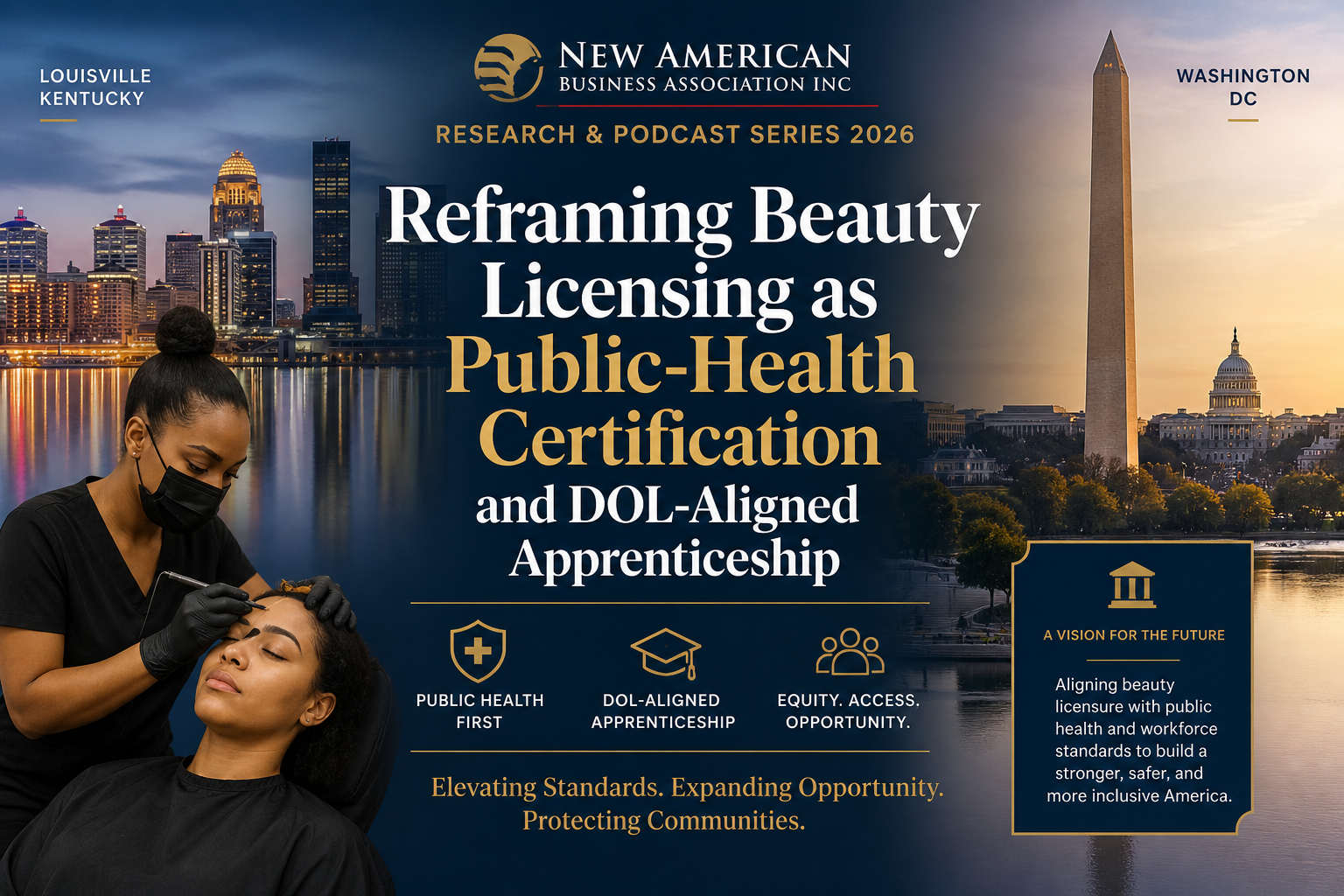
Reframing Beauty Licensing as Public-Health Certification and DOL-Aligned Apprenticeship – RESEARCH & PODCAST SERIES 2026
Executive summary
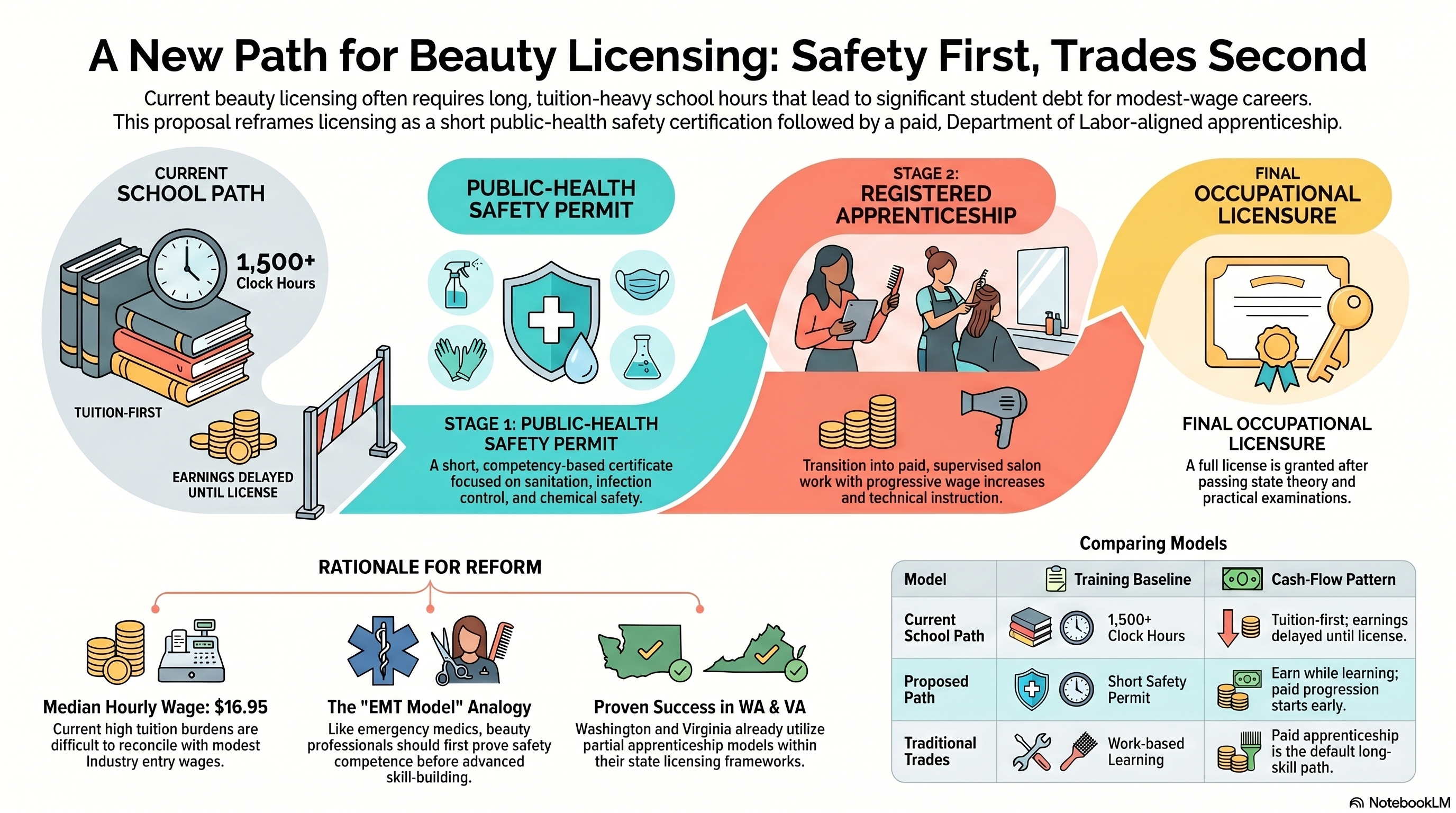
The core policy claim is that beauty licensing is miscast when it is treated primarily as a higher-education issue. In law and in day-to-day regulation, beauty practice is already governed mainly as a state occupational license justified by public health, safety, and welfare. State cosmetology laws and rules focus on dangerous tools, chemical handling, sanitation, blood exposure, disinfection, inspections, and minimum safe practice. The federal higher-education overlay exists largely because some schools choose to participate in programs administered by the U.S. Department of Education[1], not because the federal education system determines who is competent to practice cosmetology. A more coherent approach is to treat mandatory pre-licensure beauty training as a short public-health safety certificate, and the trade itself as paid, supervised work-based learning aligned with the U.S. Department of Labor[2] and state apprenticeship systems. [3]
That reframing is not deregulatory. It does not eliminate licensure, sanitation enforcement, inspections, or competency examinations. It changes what is required up front, what is learned on the job, and which public systems carry the administrative load. Under the current school-centered model, Title IV participation can pull beauty programs into accreditation, audit, financial-responsibility, 90/10, default-management, and Financial Value Transparency/Gainful Employment reporting systems that were built for institutions of higher education, not primarily for small-business trade formation. The Department itself estimated 6.9 million burden hours for one FVT/GE reporting collection, and its 2026 accountability materials showed cosmetology-related programs among the fields with the highest estimated fail rates under the proposed earnings test framework. [4]
A DOL-aligned alternative already has a legal foundation. Registered Apprenticeship is a paid, mentored model with progressive wages, related technical instruction, and a portable credential. Beauty occupations are already approved apprenticeable occupations, and states such as Washington[5] and Virginia[6] already operate partial beauty-apprenticeship models inside their state licensing frameworks. The strongest policy case, therefore, is not that beauty is “not regulated.” It is that the mandatory front-end curriculum should be narrowed to the safety-and-sanitation core, while occupational mastery, speed, advanced service delivery, customer management, and business formation should move into a wage-paid apprenticeship structure. [7]
The resulting advocacy position is straightforward:
- Put the public-health minimum first: sanitation, infection control, blood exposure, chemical safety, contraindications, emergency response, and legal duties, tested through a state safety certificate. [8]
- Move trade formation into paid salon-based apprenticeship under registered standards, wage progression, mentor ratios, and final state theory/practical exams. [9]
- Use workforce tools such as WIOA, Eligible Training Provider List placement for Registered Apprenticeship, and state apprenticeship agencies to finance related instruction and supportive services instead of forcing the whole pathway through a higher-ed compliance stack. [10]
The current legal architecture already separates practice authority from education finance
In the states examined here, beauty practice is regulated as an occupational license through licensing and professional-regulation agencies, not through state higher-education governance. In Washington, the legislature expressly says cosmetology, barbering, manicuring, and esthetics involve tools and chemicals that may be dangerous if improperly applied and therefore must be regulated in the interest of public health, safety, and welfare. In Kentucky[11], the Kentucky Board of Cosmetology[12] states that its mission is to provide educational, health, and regulatory standards for the beauty industry. In Virginia, the Virginia Board for Barbers and Cosmetology[13] sits inside the professional and occupational licensing structure and is authorized to license individuals, businesses, and schools. [14]
That is distinct from the federal higher-ed role. For Title IV eligibility, proprietary and postsecondary vocational institutions must be legally authorized by the state, satisfy federal definitions of eligible institutions and programs, and meet accreditation and related institutional-eligibility requirements. Participating institutions face annual financial and compliance audits, financial responsibility standards, cohort-default accountability, and 90/10 restrictions if they are proprietary schools. Those are finance-and-institution rules; they are not cosmetology-practice rules. [15]
Beauty exams are also already administratively separable from schools. Kentucky’s board uses PSI Services LLC[16] for current candidate bulletins and examination scheduling; Washington uses a third-party administrator for written and practical exams; Virginia’s board posts separate exam-vendor materials as well. At the content level, the National-Interstate Council of State Boards of Cosmetology[17] already builds exam products that target best practices, sanitation, infection control, and safe technique, and practical scoring instruments can fail candidates for unsafe sanitation behaviors. That means the state’s safety function can be tested directly without requiring that the entire skill pathway remain embedded in a tuition-based school model. [18]
The strongest mandatory-training rationale is public health and minimum safe practice
The mandatory content most clearly justified by the state’s police power is the safety-and-sanitation core. Kentucky sanitation rules require bacteriologically effective sanitation of implements and approved disinfectants. Virginia sanitation standards require EPA-registered disinfectants, immediate response to blood and body-fluid contamination, and blood-spill kits in shops, salons, schools, and facilities. Washington’s guidance emphasizes that all tools and implements must be cleaned and disinfected or disposed of after each client, and its statute grounds regulation in health, safety, and welfare. Those are classic public-health rules, not classic higher-education rules. [19]
The hazard profile reinforces that logic. Peer-reviewed literature has documented pedicure-associated rapidly growing mycobacterial infections, HBV/HCV transmission risks in nail salons and barbershops, and broad chemical, ergonomic, and infectious-disease risks for nail salon workers. Other peer-reviewed studies show that targeted health-and-safety interventions can increase knowledge and reduce infection-control infractions in nail salons. California public-health materials also emphasize that salon workers face recurrent exposures to hazardous cosmetic ingredients and workplace chemicals. [20]
That is why the EMT analogy is stronger than it first appears. In the EMS model, the minimum public-safety function is defined as verifiable competence to deliver safe practice. The National Registry of EMTs[21] requires successful completion of the certification examination plus a State EMS Office-approved skills requirement, and the Kentucky Board of Emergency Medical Services[22] makes clear that national certification alone does not grant authority to practice in-state. The national EMS education standards also describe EMT course length as competency-based, with an estimated 150–190 clock hours rather than a fixed, all-purpose “higher education” model. By comparison, Kentucky requires 1,500 hours for cosmetology school, 750 for esthetics, and 450 for nail technology. The policy inference is not that beauty and EMS are identical; it is that beauty’s mandatory front-end curriculum can be limited to the safety minimum, while deeper occupational development can be supervised in paid work. [23]
The labor-market evidence favors paid apprenticeship over tuition-heavy front-end schooling
Beauty is a real workforce and small-business sector, not a niche educational specialty. National BLS data show 313,560 workers in the combined barber/hairdresser/hairstylist/cosmetologist category, and the Occupational Outlook Handbook reports that manicurists and pedicurists held about 210,100 jobs in 2024, with 28 percent self-employed. Census data show that employer beauty salons rebounded to about $22.8 billion in revenue in 2021, and a Census business analysis found that self-employment is unusually prevalent in beauty salons, with self-employed workers outnumbering employer-firm workers in that industry in the example highlighted by the Bureau. [24]
The wage picture explains both the promise and the pressure. BLS reports a median hourly wage of $16.95 for hairdressers, hairstylists, and cosmetologists and $18.73 for barbers in May 2024, with wide distributions from the lowest to the highest deciles. Skincare specialists are projected to grow 7 percent from 2024 to 2034, faster than the average for all occupations. In other words, the field is not economically trivial, but it is often too low-wage at entry to comfortably absorb both large tuition burdens and long foregone-earnings periods. That makes an earn-while-you-learn model especially salient. [25]
The emerging research points in the same direction. A 2025 NBER working paper on cosmetology licensing-hour reductions found that lowering required hours appears beneficial for students because it raises completion, lowers tuition, and expands enrollment for some groups, while finding no detectable effect on cosmetologist earnings. The same paper summarizes literature documenting that high hour requirements can force students into clinic-floor work while they continue paying tuition, and it notes evidence that underreported tipped income appears to explain only about 8 percent of cosmetology earnings—too little to fundamentally change poor earnings outcomes. [26]
This is where the higher-ed mismatch becomes clearest. The current model attaches a small-business service trade to institutional accountability mechanisms designed for colleges. The Education Department’s FVT/GE collection estimated 6,902,430 three-year burden hours across 853,723 responses, and its 2026 accountability analysis put cosmetology and related personal grooming among the highest-failing fields for both undergraduate certificate and associate-degree programs under the proposed earnings framework. That does not prove beauty training is valueless. It does show that forcing the whole pathway through a college-style funding and accountability architecture produces systematic friction. [27]
Comparative tables
| Model or trade | Primary regulator and policy home | Front-end safety threshold | Work-based learning and financing | Competency checkpoint | Practical policy implication | Sources |
| Current Title IV beauty-school pathway | State board for practice authority; higher-ed triad for institutional funding and compliance | Usually large clock-hour school requirement before exam eligibility | Student tuition is primary cash-flow mechanism; Title IV schools also carry accreditation, audit, 90/10, and FVT/GE obligations | State written/practical exams, often delivered by outside vendors | Conflates occupational safety regulation with college-style institutional compliance | [28] |
| Proposed safety certificate plus Registered Apprenticeship | State health authority for safety minimum; state cosmetology board for final practice license; DOL/state apprenticeship agency for trade formation | Short, competency-based sanitation/infection-control/chemical-safety permit before productive work | Paid apprenticeship with related instruction, automatic ETPL eligibility if registered, progressive wages | Safety certificate exam first; final state theory/practical exam after apprenticeship | Better fits the actual police-power rationale while reducing debt pressure and speeding paid entry | [29] |
| EMT model | State EMS office plus national certification body | Competency-based EMT education standards focused on safe minimum practice | Training may occur in different settings; licensure is not controlled by DOE | National exam plus state-approved skills requirement | Strong analogy for separating safety certification from broader career progression | [30] |
| CDL trucking | Federal baseline via FMCSA plus state DMV licensing | Entry-Level Driver Training required before skills tests for first-time CDL/endorsement applicants | Employment pathway is outside the higher-ed triad; training provider registry, not institutional accreditation, is the federal operational model | CDL knowledge and skills testing | Demonstrates that a safety-critical occupation can be federally standardized without being treated principally as higher education | [31] |
| Construction and HVAC apprenticeship | State licensure plus apprenticeship systems; labor-market pathway is employer driven | Occupation-specific safety and work-process standards | Paid apprenticeship is common; wages rise with skill | Journey-level completion, exams where required, and occupational licensure | Shows that long skill formation can occur primarily through wage-paid apprenticeship rather than front-loaded tuition | [32] |
| Worker-facing comparison | Training baseline in sources | Cash-flow pattern while training | Earnings or business signal | What the comparison shows | Sources |
| School-based cosmetology in Kentucky | 1,500 cosmetology school hours; 750 esthetics; 450 nail technology | Tuition first; earnings delayed until license eligibility | Hairdressers/hairstylists/cosmetologists median $16.95 hourly; barbers $18.73 | Long front-end schooling is hard to reconcile with modest entry wages | [33] |
| Salon-based cosmetology apprenticeship example in Washington | 3,000 hours; 1:1 apprentice-to-journey ratio; minimum wage floor; 75/80/90 percent wage progression; explicit safety-sanitation work processes | Earn while learning | Paid progression starts immediately and increases by hours/competency | Beauty can already be organized like a trade rather than only like a school program | [34] |
| Heavy truck driving | ELDT baseline before CDL skills test | Worker typically enters a job-oriented training pipeline, not a higher-ed compliance stack | Median annual wage $57,440 | Safety-critical licensing can be kept outside DOE-centered higher ed | [35] |
| HVAC | Apprenticeship/common employer training path | Earn while learning is common | Median annual wage $59,810 | Wage-paid skill formation is normal in regulated trades | [36] |
| Electrician | Apprenticeships are common; typical examples show 8,000-hour programs | Earn while learning is common | Median annual wage $62,350 | Construction trades use work-based learning as the default long-skill pathway | [37] |
The “proposed” beauty row above is a policy synthesis, not an off-the-shelf national model. It combines existing safety-certification logic from EMS and existing apprenticeship mechanics from Registered Apprenticeship with the final state licensure exam structure beauty boards already use. [38]
Case studies from Washington and Virginia
Washington
Washington is the strongest live proof-of-concept among the examples reviewed. The state statutes explicitly frame beauty regulation in public-health terms, the pathway is housed in the Washington State Department of Licensing[39] rather than in a higher-ed agency, and the state openly presents apprenticeship as an alternative to traditional cosmetology school. A current Washington salon apprenticeship standard approved by the Washington State Apprenticeship and Training Council[40] requires supervised employment, at least a one-to-one apprentice-to-journey ratio, minimum-wage payment, progressive wage advancement at 75, 80, and 90 percent of journey-level wage, evaluation every 1,000 hours, and explicit work-process blocks that include safety, sanitation, and infection control. The model is still a full occupational apprenticeship, not merely a short safety permit, but it proves that beauty can already be organized as paid trade formation under registered standards. [41]
Virginia
Virginia shows the same basic logic inside a different administrative structure. Beauty is regulated through the occupational-licensing system, salons and schools are licensed by the board, apprenticeship is expressly recognized in the cosmetology regulations, and registered apprenticeship is run through Virginia Works[42] as the designated state apprenticeship agency. Virginia sanitation and safety standards require EPA-registered, hospital-grade disinfectants and blood-spill controls, and the state apprenticeship search tool shows live cosmetology sponsors with 3,000-hour terms. This is not a health-department model yet, but it is unmistakably a workforce-development model operating beside occupational licensing. [43]
California
The public-health function is also institutionally feasible. In California[44], the California Department of Public Health[45] provides official salon-worker health resources and maintains the Safe Cosmetics Program, while the California Department of Toxic Substances Control[46] runs the Healthy Nail Salon Recognition framework and has separately evaluated and regulated hazardous chemicals in nail products. That is not full cosmetology licensure under a health board, but it demonstrates that state health and environmental agencies already have the institutional capacity to set worker- and consumer-safety standards for salon work. [47]
Proposed policy design and implementation roadmap
The recommended architecture is a two-stage license: a front-end public-health safety certificate and a final occupational license earned after paid apprenticeship and a state exam. The safety certificate would authorize limited, supervised participation in salon work. The final license would authorize independent practice. Related technical instruction could be offered by community colleges, adult-ed providers, unions, nonprofits, or legacy beauty schools that choose to become apprenticeship partners rather than tuition-first gatekeepers. WIOA can already support Registered Apprenticeship through automatic ETPL eligibility and related instruction/supportive-service mechanisms. [48]
Proposed system flow
flowchart LR
A[Applicant] –> B[State-approved safety curriculum]
B –> C[Safety and sanitation exam]
C –> D[Limited supervised safety permit]
D –> E[Hire into licensed salon apprenticeship sponsor]
E –> F[Paid on-the-job learning]
E –> G[Related technical instruction]
F –> H[State theory and practical licensing exam]
G –> H
H –> I[Full occupational license]
I –> J[Optional advanced tracks: educator, owner, salon manager]
Under this design, the state would test the safety minimum early, then move productive skill formation into paid supervised practice. That mirrors the public-safety logic used in EMS and the wage-progression logic already embedded in Registered Apprenticeship standards. [49]
Proposed stakeholder relationships
flowchart TD
H[State health department or board of health] –> S[Safety curriculum standards]
H –> I[Sanitation inspection protocols]
B[State cosmetology board] –> E[Final licensure standards and scope]
B –> X[Theory and practical exams]
L[DOL Office of Apprenticeship or state apprenticeship agency] –> A[Registered Apprenticeship standards]
W[State workforce board and WIOA system] –> R[Related instruction and supportive services]
P[Approved training providers and community colleges] –> R
M[Licensed salons and sponsors] –> A
M –> O[Paid supervised work]
X –> C[Consumers and licensees]
I –> C
O –> E
The central governance principle is functional alignment: health agencies regulate public-health risk; licensing boards regulate scope and final authority to practice; apprenticeship systems regulate wage-paid skill formation; and workforce systems finance related instruction and support services. [50]
Implementation roadmap
Federal actions. DOL and state apprenticeship agencies should publish beauty-specific Registered Apprenticeship templates for cosmetology, esthetics, nail technology, and related occupations, using the beauty occupations already approved in the federal apprenticeable-occupation system. States should be encouraged to place those programs on ETPLs through the existing automatic-eligibility mechanism. Congress and DOE should also make short, safety-focused public-health training and apprenticeship RTI easier to finance, rather than assuming the full pathway must sit inside a long clock-hour higher-ed program. [51]
State actions. States should enact a limited supervised safety permit tied to sanitation, bloodborne-pathogen response, chemical handling, contraindications, product safety, and legal duties. Full licensure would then require completion of an approved apprenticeship or a school-to-apprenticeship articulated pathway plus the final state theory/practical exam. This keeps state exams and consumer protection intact while reducing the amount of unpaid or tuition-funded pre-licensure time. [52]
Consumer and worker safeguards. Any salon-based model must require wage payment, workers’ compensation coverage, direct supervision ratios, anti-harassment policies, documented work-process schedules, posted apprentice status, periodic state audits of hours and competencies, and hotline-level complaint rights. Washington’s approved beauty-apprenticeship standards already show that ratios, wage progression, and regular reporting can be specified in this occupation. [53]
Transition strategy. The most durable political path is not to abolish schools but to end their monopoly over the mandatory pathway. Legacy beauty schools can become safety-certificate providers, related-instruction partners, pre-apprenticeship hubs, or advanced specialty providers. That makes reform more administratively workable and less disruptive while still moving the core pipeline toward public-health certification plus apprenticeship. [54]
Risks, counterarguments, and limitations
The strongest objection is exploitation: apprentices can become cheap labor. That risk is real, and it is the main reason any reform must use Registered Apprenticeship or a state equivalent with wage progression, mentor ratios, approved standards, signed agreements, and complaint mechanisms. Washington’s cosmetology sponsor standards show how direct supervision, ratio caps, progressive wages, step upgrades, and periodic evaluation can be written into occupation-specific apprenticeship governance. [55]
A second objection is quality control: advanced color, texture, chemical services, skin procedures, and salon professionalism are not reducible to sanitation alone. That is correct, and this paper does not argue otherwise. The point is narrower: the mandatory front-end curriculum justified as a condition of entry should be the public-health minimum; full occupational mastery should still be required, but learned mainly through supervised paid practice and then validated by final state theory and practical exams. The Washington and Virginia models already show that a state can require both apprenticeship and final licensure without treating the whole pathway as ordinary higher education. [56]
A third objection is institutional transition. Beauty schools may argue that they provide structure, equipment, and theory that salons do not always provide well. That concern is substantial, especially for rural areas, for students needing predictable schedules, and for specialties requiring controlled practice environments. The best response is pluralism, not monopoly: preserve a school option, but no longer require that the standard state pathway be school-first. Let schools compete as training partners, related-instruction providers, and advanced-specialty centers. [57]
The main limitation in the evidence base is that the United States does not yet appear to have a fully mature, statewide model that cleanly separates a short public-health safety permit from a later apprenticeship-earned full beauty license. Among the systems reviewed here, Washington and Virginia are the closest partial analogues. Beauty-specific apprenticeship outcome data are also thinner than data for construction and mechanical trades. Finally, the 2026 Education Department earnings-test materials cited above are proposed-rule analyses, not final program determinations. Even so, the legal, health, and workforce evidence already supports the central conclusion: beauty is better governed as public-health protection plus workforce development than as a conventional DOE-centered higher-education sector. [58]
[1] [54] [56] [58] https://dol.wa.gov/professional-licenses/cosmetology/cosmetology-apprenticeship-program
https://dol.wa.gov/professional-licenses/cosmetology/cosmetology-apprenticeship-program
[2] [3] [14] [41] https://app.leg.wa.gov/rcw/default.aspx?cite=18.16&full=true
https://app.leg.wa.gov/rcw/default.aspx?cite=18.16&full=true
[4] [22] https://fsapartners.ed.gov/knowledge-center/fsa-handbook/2024-2025/vol2/ch4-audits-standards-limitations-cohort-default-rates
[5] [21] [30] [38] [49] https://www.ems.gov/assets/National-EMS-Education-Standards-FINAL-Jan-2009.pdf
https://www.ems.gov/assets/National-EMS-Education-Standards-FINAL-Jan-2009.pdf
[6] [7] [9] [12] [13] [42] [57] https://www.apprenticeship.gov/employers/registered-apprenticeship-program
https://www.apprenticeship.gov/employers/registered-apprenticeship-program
[8] [17] [19] [46] [52] https://kbc.ky.gov/Documents/201%20KAR%2012.100.pdf
https://kbc.ky.gov/Documents/201%20KAR%2012.100.pdf
[10] [29] [48] https://www.ecfr.gov/current/title-20/chapter-V/part-680/subpart-C/section-680.330
https://www.ecfr.gov/current/title-20/chapter-V/part-680/subpart-C/section-680.330
[11] [31] [35] https://www.fmcsa.dot.gov/registration/commercial-drivers-license/entry-level-driver-training-eldt
https://www.fmcsa.dot.gov/registration/commercial-drivers-license/entry-level-driver-training-eldt
[15] https://fsapartners.ed.gov/knowledge-center/fsa-handbook/2024-2025/vol2/ch1-institutional-eligibility
[16] [26] https://edworkingpapers.com/ai25-1221
https://edworkingpapers.com/ai25-1221
[18] https://kbc.ky.gov/exams/Pages/default.aspx
https://kbc.ky.gov/exams/Pages/default.aspx
[20] https://pubmed.ncbi.nlm.nih.gov/11986410/
https://pubmed.ncbi.nlm.nih.gov/11986410
[23] https://nremt.org/EMT/EMT-State-Licensed-Pathway
https://nremt.org/EMT/EMT-State-Licensed-Pathway
[24] https://www.bls.gov/news.release/ocwage.t01.htm
https://www.bls.gov/news.release/ocwage.t01.htm
[25] [40] https://www.bls.gov/ooh/personal-care-and-service/barbers-hairstylists-and-cosmetologists.htm
https://www.bls.gov/ooh/personal-care-and-service/barbers-hairstylists-and-cosmetologists.htm
[27] https://fsapartners.ed.gov/knowledge-center/library/federal-registers/2024-05-17/comment-request-financial-value-transparency-and-gainful-employment-reporting-requirements
[28] [33] [45] https://kbc.ky.gov/Licensure/Pages/License-Requirements.aspx
https://kbc.ky.gov/Licensure/Pages/License-Requirements.aspx
[32] [37] [44] https://www.bls.gov/ooh/construction-and-extraction/electricians.htm
https://www.bls.gov/ooh/construction-and-extraction/electricians.htm
[34] [53] https://lni.wa.gov/licensing-permits/apprenticeship/agenda-docs/23-kimberly-irene-salon.pdf
https://lni.wa.gov/licensing-permits/apprenticeship/agenda-docs/23-kimberly-irene-salon.pdf
[36] https://www.bls.gov/ooh/installation-maintenance-and-repair/heating-air-conditioning-and-refrigeration-mechanics-and-installers.htm
[39] [50] https://virginiaworks.gov/wp-content/uploads/2025/06/Approved-WIOA-CSP-Virginia_PYs_2024-2027.pdf
https://virginiaworks.gov/wp-content/uploads/2025/06/Approved-WIOA-CSP-Virginia_PYs_2024-2027.pdf
[43] https://law.lis.virginia.gov/admincode/title18/agency41/chapter20/section40/
https://law.lis.virginia.gov/admincode/title18/agency41/chapter20/section40
[47] https://www.cdph.ca.gov/Programs/CCDPHP/DEODC/OHB/CSCP/Pages/Resources.aspx
https://www.cdph.ca.gov/Programs/CCDPHP/DEODC/OHB/CSCP/Pages/Resources.aspx
[51] https://www.apprenticeship.gov/sites/default/files/wps/approved-occupations.xlsx
https://www.apprenticeship.gov/sites/default/files/wps/approved-occupations.xlsx
[55] https://www.apprenticeship.gov/sites/default/files/ETA_Form_671_Section_II.pdf
https://www.apprenticeship.gov/sites/default/files/ETA_Form_671_Section_II.pdf
Discover more from New American Business Association (NABA) - Louisville, KY
Subscribe to get the latest posts sent to your email.