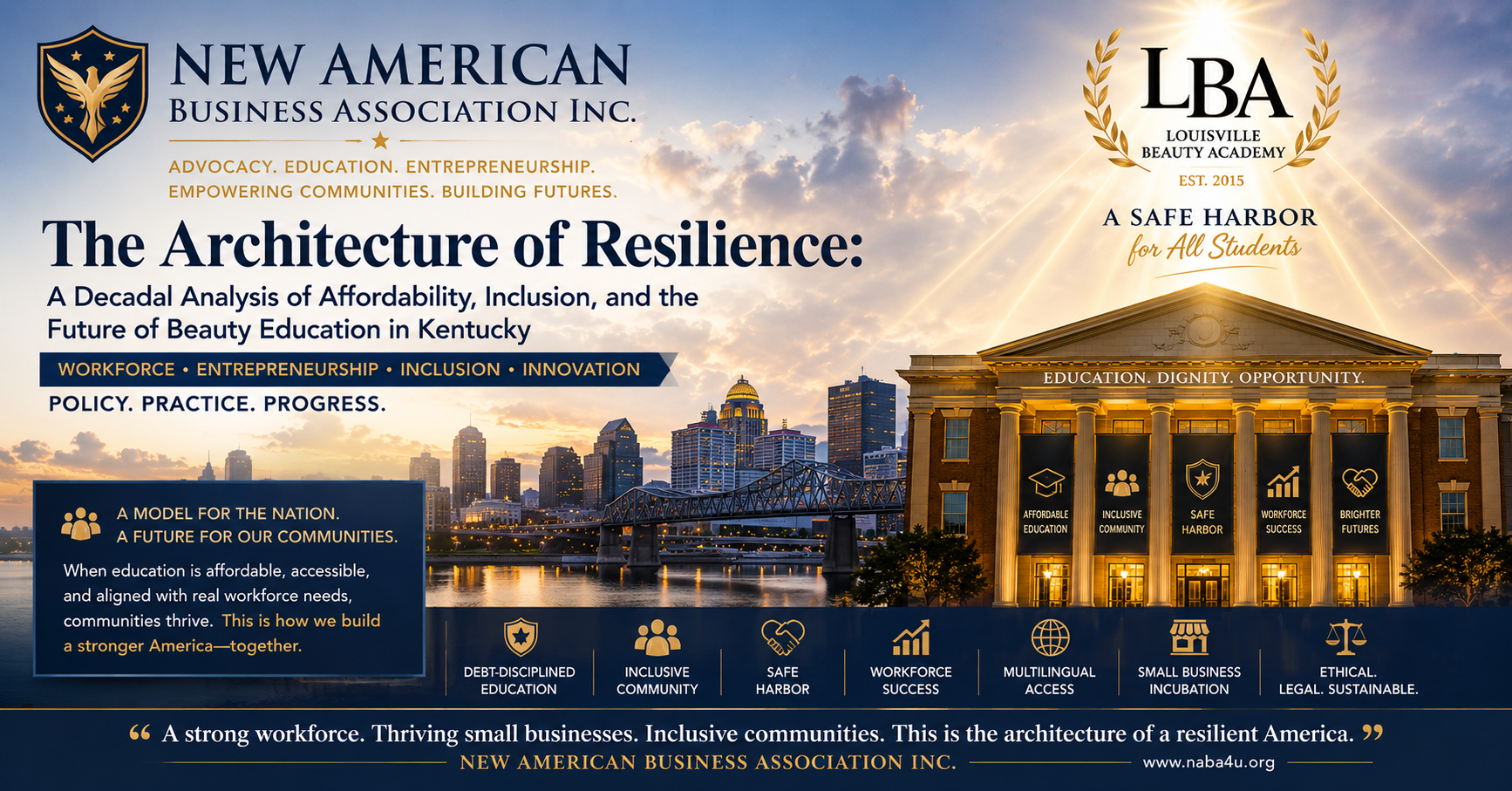
The Architecture of Resilience: A Decadal Analysis of Affordability, Inclusion, and the Future of Beauty Education in Kentucky
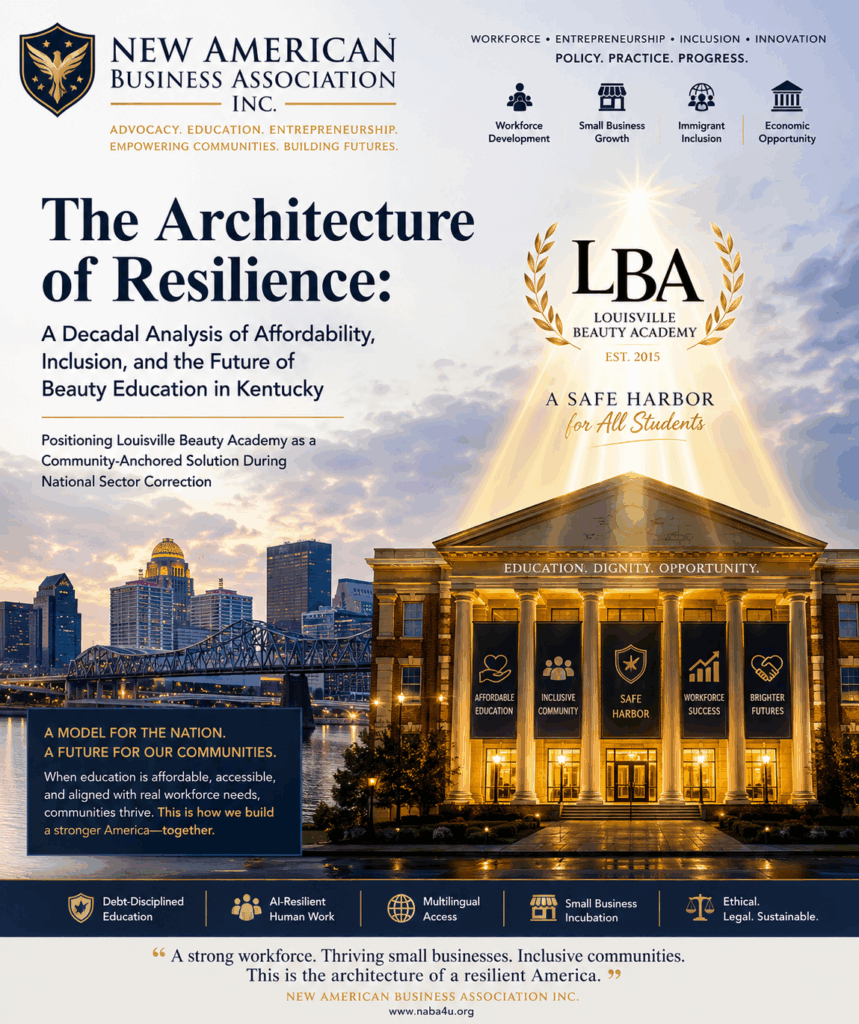
Positioning Louisville Beauty Academy as a Community-Anchored Solution During National Sector Correction
The landscape of vocational education in the United States, specifically within the personal care and beauty services sector, is currently navigating a profound structural realignment. For decades, the industry has been characterized by a prevailing model centered on federal financial aid dependence, high tuition barriers, and significant student debt accumulation. Recent regulatory shifts, most notably the implementation and judicial defense of the Gainful Employment and Financial Value Transparency frameworks, are signaling a systemic correction intended to prioritize student outcomes and fiscal accountability.1 Within this period of broader industry transition, Louisville Beauty Academy emerges not as a reactive entity, but as a proactive architectural model of what vocational education can become when founded upon a doctrine of community-rooted affordability. Having operated for ten years with a discipline focused on radical cost reduction—often achieving 50% to 75% lower effective costs for students compared to traditional institutions—the academy stands as an anti-fragile institution.5 This report explores the intersection of federal regulatory reform, state-level legislative progress in Kentucky, and the emerging empathy economy, positioning the academy as a stable, future-ready solution for workforce development and small business formation in the Commonwealth.
The Regulatory Correction: From Extraction to Accountability
The beauty education sector has historically faced challenges regarding the alignment of education costs with post-graduation earnings. The U.S. Department of Education’s Final Rule on Financial Value Transparency and Gainful Employment represents a pivot toward measuring the actual value of career-specific training.3 This regulation establishes a dual-metric accountability framework designed to ensure that graduates of vocational programs are not burdened by debt they cannot reasonably repay. The necessity of these regulations is underscored by a history of student exploitation within some segments of the proprietary school sector.5 Investigations and class-action settlements over the last two decades have exposed patterns of deceptive financial aid practices and the use of students for unpaid labor.5 Settlements involving entities like the Douglas J Aveda Institute ($2.8 million) and the closure of Marinello Schools of Beauty following federal investigations into aid fraud illustrate the risks inherent in debt-heavy models.5
The Mechanics of Fiscal Responsibility
The Gainful Employment framework utilizes two primary metrics to determine a program’s eligibility for federal Title IV funding: the Debt-to-Earnings rate and the Earnings Premium test. The Debt-to-Earnings rate measures the median annual debt payments of graduates against their median annual earnings.2 A program is considered to have passed if its median annual payment is less than or equal to 8% of annual earnings, or less than or equal to 20% of discretionary earnings.2 The Earnings Premium test further ensures that graduates are earning more than a typical high school graduate in their state who did not pursue postsecondary education.2 While some sector organizations have challenged these rules in court, citing concerns over the reporting of tip income and the socioeconomic status of the students served, federal courts have largely upheld the Department’s authority to use these tools to assess the value of taxpayer-funded investments.1 Louisville Beauty Academy has intentionally operated outside of this debt-heavy cycle. By prioritizing low-tuition, high-accessibility models that do not rely on the same inflated aid structures, the academy has remained insulated from the instability currently facing schools that may struggle to meet the new federal debt-to-earnings thresholds.5
A Context of Systemic Fragility
The current instability in the industry should not be viewed as a sign of the industry’s decline, but rather as a correction of unsustainable financial practices. Many institutions were historically built on a foundation of federal financial aid dependence and inflated tuition rates that were disconnected from practical repayment realities.1 This model created a stigma of uneven quality and outcomes, leading to public distrust. In contrast, the doctrine established by Louisville Beauty Academy a decade ago was designed to serve the real needs of the community by cutting costs radically and keeping tuition affordable directly to students.5 This long-term discipline was not a weakness, but a strength that has prepared the institution for the current regulatory environment. The academy’s focus on implementation, safety, sanitation, and licensure readiness without heavy dependence on inflated federal aid structures represents a foresight that is now being recognized as a national model for ethical vocational education.5
The Louisville Beauty Academy Doctrine: A Decade of Affordability Discipline
Louisville Beauty Academy was founded on a premise that diverges sharply from the industry standard. Rather than building a cost structure that maximizes federal aid extraction, the academy focused on serving the immediate, practical needs of the Louisville and Kentucky community. This affordability discipline has resulted in a model where tuition is often a fraction of the cost found at larger, national franchise schools.5 The institution has spent ten years advocating for a workforce-first model that prioritizes the student’s ability to enter the profession with minimal debt and maximum readiness for licensure.5
Comparative Tuition and Economic Access
The economic disparity between the academy’s model and the broader market is significant. In Kentucky, the average tuition for a cosmetology program is approximately $16,589, with some high-profile programs reaching over $24,000 when including kits and supplies.5 In contrast, the academy’s tuition for similar programs is positioned significantly lower, frequently reducing the financial burden on students by 50% to 75%.5
| Institution Category | Average Tuition (KY 2024-2025) | Average Books & Supplies | Total Estimated Investment |
| Louisville Beauty Academy | ~$6,250.50 | Included/Minimal | ~$6,500 |
| State Vocational Average | $16,589 | $2,214 | $18,803 |
| Large Franchise Schools | ~$19,391 | ~$3,710 | ~$23,101 |
| Public (KCTCS) Programs | Variable | Variable | ~$12,000 – $14,000 |
Data synthesized from.5
This pricing strategy is not merely a competitive tactic but a foundational philosophy of community service. By keeping the cost of education within a range that can be managed through interest-free payment plans or modest workforce grants, the academy ensures that students enter the workforce with manageable debt, often reported at less than $5,000.5 This stands in stark contrast to the industry average debt load of $10,000 to $20,000.5
Operational Efficiency and AI Integration
The academy’s ability to maintain high-quality education at a lower cost is driven by operational innovation. The institution utilizes advanced digital systems for compliance, attendance, and hour tracking. These AI-integrated systems provide immutable audit logs that ensure 100% digital compliance documentation and real-time audit readiness for the Kentucky Board of Cosmetology.5 By automating administrative burdens that typically require large back-office teams in aid-dependent schools, the academy reallocates resources toward student instruction and licensure readiness. The result is a 95% licensure rate, significantly exceeding the industry average of 67%.5 Furthermore, the academy boasts a 90% graduate employment rate within 60 days of completion, compared to a sector average of 58%.5 These outcomes demonstrate that affordability does not come at the expense of quality; rather, it enhances the student’s ability to focus on their professional development without the weight of predatory debt.
Multilingual Advocacy and Inclusive Workforce Development
A critical component of the academy’s community-rooted mission is its focus on serving the diverse, often immigrant-led, beauty workforce in Kentucky. For years, the institution has been a leading voice in advocating for multilingual licensing exams, recognizing that language barriers should not be a hurdle to professional dignity or economic participation.10 This advocacy is framed as a public good, a workforce good, and a signal that the future of workforce development must be accessible and inclusive.
The Impact of Senate Bill 14
In 2024, years of advocacy culminated in the signing of Senate Bill 14 by Governor Andy Beshear. This historic legislation, supported by hundreds of community members and led in part by the academy’s leadership, revolutionized the Kentucky State Board of Cosmetology’s approach to inclusion.12 The journey to this milestone involved over 20 community meetings, thousands of communications to state legislators, and an unwavering commitment to the rights of non-English speakers within the industry.12 As of September 17, 2024, the Kentucky State Board of Cosmetology implemented multiple language options for the Nail Licensing exam, including Simplified Chinese, Spanish, Vietnamese, Korean, and English.13 The introduction of these exams, alongside the appointment of the first Asian woman and the first licensed nail technician to the State Board, represents a significant victory for the collective effort of the local beauty community.12 The academy continues to support these graduates by providing education in seven major languages, including Khmer and Portuguese, ensuring that the workforce reflects the true diversity of Louisville.10
Cultural Dignity and Economic Participation
The push for multilinguality in licensing is more than a matter of convenience; it is an issue of economic dignity. Many members of the beauty workforce, particularly in the nail and esthetics sectors, are entrepreneurs who contribute significantly to the local economy.13 By removing language barriers to licensure, the state of Kentucky has unlocked the potential of thousands of individuals who were previously marginalized by an English-only testing system.12 This inclusive approach aligns with the Kentucky Chamber of Commerce’s priorities for 2026, which emphasize strengthening the workforce and supporting the business model through regulatory relief and workforce strategies.14 The academy’s role in this advocacy positions it not just as a school, but as a community guardian and an engine for social and economic integration.
The Human Frontier: Beauty as an AI-Resilient Profession
As artificial intelligence transforms sectors ranging from logistics to data analysis, the personal care industry stands as one of the most resilient frontiers of human service. The “Empathy Economy,” a concept gaining traction in global economic reports for 2026 and beyond, highlights sectors where personal connection and human interaction are prized above all.16 The argument for beauty education in an AI-driven world is strong: the profession is rooted in touch, trust, presence, and personal care—elements that machines cannot replicate.
The Empathy Economy and the Personal Touch
Reports indicate that by 2026, as technology advances, there will be a corresponding shift in disposable income toward sectors such as education, care, and entertainment—the “empathy” sectors where automation is carefully managed in partnership with workers.16 Personal care services, which involve physical touch, emotional trust, and individual transformation, are inherently resistant to AI replacement.16 While AI may transform administration, marketing, compliance, scheduling, and discoverability, the core of the beauty profession remains deeply human.5 A serious beauty professional provides more than a service; they provide confidence, cultural identity, and a sense of community connection.17
| Future-Proof Attribute | AI Capability | Human Professional Role |
| Physical Transformation | Limited to non-tactile design. | Precision cutting, chemical application, tactile care. |
| Emotional Trust | Simulated through data. | Real presence, empathy, and personal confidence building. |
| Culture & Identity | Pattern recognition. | Authentic expression and human storytelling. |
| Service Innovation | Algorithm-based. | Adaptive, intuitive service based on human needs. |
Insights derived from.16
Future-Proofing through Skills and Identity
The academy’s curriculum emphasizes these durable skills—communication, confidence-building, and cultural competence—which align with the Kentucky Chamber of Commerce’s 2026 priorities.15 By framing beauty education as a public-health certification combined with professional artistry, the academy prepares students for a career that is not only stable but central to the social fabric of the neighborhood. The “progression of value” in the modern economy moves from mere utility to staged experiences and emotional connection.18 A beauty professional serves not just as a technician, but as a community confidant and a service provider whose value is enhanced, rather than diminished, by the rise of digital tools.
Small Business Development: The Economic Engine of the Neighborhood
Louisville Beauty Academy operates as more than a school; it is an incubator for small business development. The beauty industry is a primary vehicle for entrepreneurship, particularly for women and minorities. Graduates of the academy often transition from licensed professionals to booth renters, suite operators, and salon owners, creating a ripple effect of economic energy throughout Louisville and the wider Commonwealth.
The Pathway to Ownership
The beauty services market in the U.S. is valued at approximately $62 billion and continues to show robust post-pandemic growth.5 By minimizing student debt, the academy allows its graduates to reinvest their initial earnings into their own businesses rather than using their entire income to service high-interest student loans. This debt-disciplined approach is essential for the long-term health of the local economy.
| Economic Milestone | Role of LBA Model | Result for Louisville |
| Licensure | 95% pass rate ensures quick entry into the workforce. | Increased workforce participation. |
| Debt Management | Average debt <$5,000 vs. $16,000+ national average. | Higher disposable income for graduates. |
| Entrepreneurship | Curriculum includes business and compliance literacy. | Formation of LLCs and new salon suites. |
| Employment | 90% placement rate within 60 days. | Stable tax base and service availability. |
Data synthesized from.5
Graduates are positioned as taxpaying service providers, supply buyers, and local employers. This small-business development engine is a key component of the fabric of Louisville, Kentucky, and American entrepreneurship. The academy’s model aligns with the Greater Louisville Inc economic development priorities, which focus on supporting a robust workforce pipeline and a pro-business environment.20 By removing the barrier of excessive debt, the academy fosters a sustainable cycle of neighborhood economic energy where licensed professionals can become homeowners and community leaders.
Professional Literacy and Legal Empowerment
Central to the academy’s success is its focus on legal and professional literacy. Every student receives a digital copy of state regulations (KRS 317A and 201 KAR 12) upon enrollment to ensure they understand the legal framework of their profession.5 This empowerment through information protects graduates from exploitation and ensures they operate with a mindset of “YES I CAN / I HAVE DONE IT”.5 By teaching compliance alongside technical skills, the academy ensures that its graduates are prepared to navigate the complexities of running a small business, from sanitation audits to LLC creation.
Alignment with Federal, State, and Civic Priorities
The 2026 legislative and workforce priorities in Kentucky emphasize a “Big Bold Future” characterized by affordable, high-quality credentials that connect education to good jobs.19 The Prichard Committee and the Kentucky Chamber of Commerce both stress the need for durable skills and the removal of barriers for low- and moderate-income families.15 Louisville Beauty Academy stands as a constructive answer to these civic goals by reducing financial barriers, targeting high-demand roles, and leading in immigrant workforce integration.
Supporting a Workforce-First Model
The academy has proposed a shift from traditional institution-centered aid models toward a participant-centered workforce development model. This model reframes beauty licensing as a public-health certification combined with Department of Labor-aligned apprenticeships.5 Such a shift would utilize frameworks like the Workforce Innovation and Opportunity Act (WIOA) to provide training finance through Individual Training Accounts, essentially acting as a student-controlled voucher model.5
This alignment with workforce participation and small business formation matches the goals of state and local policymakers. The Kentucky Chamber of Commerce’s 2026 agenda includes improving data collection to target resources, supporting affordability, and engaging local communities in designing solutions.15 The academy’s success as a state-approved, non-accredited provider that operates without Title IV aid proves that federal grants could fully cover educational costs at low-price providers while employers cover trade formation through apprenticeship wages.5
City and Chamber Synergies
Greater Louisville Inc (GLI) highlights the importance of work-ready skill building and industry-specific training programs to maintain the region’s competitive business climate.20 Louisville Beauty Academy’s results—zero state audit violations and a student complaint rate of less than 1%—reflect the kind of institutional excellence that local chambers and economic development boards prize.5 The academy is not just a participant in the Louisville economy; it is an active contributor to the city’s reputation as an attractive place to do business.
Reassurance in a Changing Landscape
The current period of industry instability is not a reason for panic, but a moment for community reassurance. The tightening of federal aid conditions should be framed as part of a broader correction toward responsibility and real value. For ten years, Louisville Beauty Academy has been doing the affordability work that systems are now finally catching up to. This long discipline represents integrity and foresight, not weakness.
A Message to Students and Families
To the students and families of the Commonwealth, the message is clear: the beauty industry is not disappearing. Beauty careers remain real, human, needed, and economically relevant. The academy remains a stable, reachable, and affordable anchor for those looking to enter the profession. The academy’s commitment to removing barriers—whether financial, linguistic, or administrative—ensures that the path to a career in personal care remains open to all.
Protecting the Public Trust
By aligning pedagogy with regulation and technology, the institution safeguards both students’ rights and the public trust.5 The “national model of legal integrity” represented by the academy stands in contrast to models built on extraction.5 This commitment to ethics ensures that the beauty industry is transformed from an opaque trade into a transparent and respected profession. The community can take pride in knowing that Louisville is home to an institution that has spent a decade building the kind of model that the current moment now requires.
The Future of Beauty Education: A Strategic Outlook
As the sector moves forward, the focus will increasingly shift toward success-based reimbursement and lower-cost education. The academy’s model demonstrates that lawful, ethical, and profitable vocational education is achievable without over-reliance on debt-heavy financial aid.5 This perspective is vital for the long-term resilience of the workforce.
Scalability and Innovation
The academy’s use of AI for compliance and its modular design for campus scalability offer a blueprint for future vocational training.5 By combining regulatory precision with community compassion, the institution has created a replicable framework that can be adapted to other trades and regions.5 This innovation ensures that the school is not only prepared for the changes of today but is actively shaping the landscape of tomorrow.
A Beacon of Practical Inclusion
The successful implementation of multilingual licensing in Kentucky is a signal to the rest of the nation that inclusion and standards are not mutually exclusive. By advocating for the rights of all practitioners to be tested on their knowledge rather than their English proficiency, the academy has helped create a more equitable market. This success reinforces the idea that beauty education must be practical, inclusive, and grounded in the dignity of work.
Synthesis and Recommendations for Stakeholders
The evidence presented suggests that the transition currently underway in the beauty education sector is a healthy realignment. For stakeholders at the federal, state, and city levels, Louisville Beauty Academy represents a constructive partner in achieving shared goals of workforce readiness and economic stability.
For Federal and State Policymakers
Policymakers should look to the academy’s model as a case study in how to maintain high outcomes while reducing costs. The transition toward accountability through the Gainful Employment rule is supported by the existence of schools like this one, which prove that students can be prepared for the workforce without incurring burdensome debt. Continued support for WIOA-aligned training and apprenticeships can further enhance this model.
For Local Chambers and Economic Boards
Greater Louisville Inc and the Kentucky Chamber of Commerce can view the academy as an engine for neighborhood economic energy. Supporting the growth of low-cost, high-compliance vocational schools is a key strategy for increasing workforce participation and fostering small business development. The academy’s alignment with “durable skills” training makes its graduates valuable assets to the regional economy.
For Students and the Community
The primary recommendation for the community is to approach the current industry disruption with confidence. The personal care profession is resilient and AI-proof. Institutions that have spent the last decade prioritizing affordability and community need are the most stable choices for those seeking a future in this field. The academy stands ready to continue its service with the same discipline and dedication that has defined its first ten years.
Conclusion: A Vision of Stability and Service
The beauty industry is maturing. The current shift toward transparency and accountability is not a threat to the profession but a validation of the values that have long been at the core of Louisville Beauty Academy. For a decade, the academy has stood as a beacon of affordability, accessibility, and human dignity. By choosing to reduce costs directly for students and advocating for the inclusion of all voices in the industry, the institution has built a foundation that is as durable as the human connections it fosters.
Change is happening, and while some traditional models may struggle to adapt to new standards of accountability, the personal care profession remains a human essential. Affordability and responsibility matter now more than ever. Louisville Beauty Academy has spent ten years building the kind of model that this moment requires. The institution remains committed to serving Louisville, Kentucky, and the wider community with practical opportunity and unwavering integrity. To the community: fear not. The academy is here, it has always been here, and it will continue to stand as a stable, future-ready answer during this period of industry correction.
Public-Positioning Article: Standing Firm in a Shifting Landscape
In recent months, the conversation surrounding beauty education in the United States has been marked by a sense of transition. New federal rules focusing on “Gainful Employment” and “Financial Value Transparency” have sparked debates about the future of career-specific training. For some, these changes represent a moment of uncertainty; for us at Louisville Beauty Academy, they represent a moment of validation.
For ten years, we have operated on a doctrine that is different from much of our industry. While many institutions built their models on high tuition and a heavy dependence on federal student debt, we chose a path of radical affordability. Our mission has always been simple: to serve the real needs of our community by keeping the path to professional licensure reachable for everyone. Whether it meant cutting effective costs by 50% to 75% or advocating for licensing exams in seven different languages, we have consistently prioritized people over extraction.
Today, as national systems catch up to the need for accountability and lower debt, we want to reassure our community: do not be afraid. The beauty industry is not disappearing. It is, in fact, one of the most resilient and human professions in our modern economy. In an age of artificial intelligence, the skills of touch, trust, and personal care remain uniquely human and more valuable than ever. We call this the “Empathy Economy,” and it is where our graduates shine.
Our long discipline of affordability was never a weakness; it was our greatest strength. It has allowed us to maintain a 95% licensure rate and a 90% job placement rate, all while keeping student debt at a fraction of the national average. We have spent a decade preparing for this moment, building an institution that is not just a school, but a small-business engine for the city of Louisville and the Commonwealth of Kentucky.
We have always stood with the people of our community—the working adults, the immigrants, the dreamers, and the practical professionals. We have advocated for your rights, celebrated your cultural heritage, and provided the tools for your economic independence. As the landscape of beauty education evolves, we remain your stable, community-rooted anchor. We are here, we have been here, and we will continue to be here to help you build a career with dignity, affordability, and pride.
Closing Statement: A Legacy of Integrity
Louisville Beauty Academy represents the intersection of tradition and innovation. By anchoring our school in the timeless values of safety, sanitation, and human connection, while embracing the technology and transparency that modern regulation requires, we have created a model of resilience. We invite our students, our neighbors, and our partners in government and business to see this period of industry change not as a crisis, but as a healthy correction toward the values we have practiced from the beginning. Our commitment to the community is unwavering, and our vision for the future of beauty education is one of accessibility and excellence for all.
Social Media Excerpt: The Future is Human
The beauty industry is evolving, and Louisville Beauty Academy is leading the way. While others are reacting to new federal accountability rules, we are standing firm in the affordability model we’ve practiced for 10 years. We believe in beauty education that builds careers without building debt. In an AI-driven world, the human touch is more valuable than ever—and we’re here to help you master it. From multilingual advocacy to record-setting licensure rates, we’re proud to be Louisville’s stable, community-anchored choice for professional growth. Join us as we build an inclusive, resilient future together. #LouisvilleBeautyAcademy #EmpathyEconomy #AffordableEducation #KentuckyProud #FutureReady
Works cited
- American Association of Cosmetology Schools v. U.S. Dept of Ed. and Ogle School Management v. U.S. Dept of Ed. (2024) Challenges Gainful Employment Rule, accessed May 7, 2026, https://policytracker.wiche.edu/judicial-action/american-association-cosmetology-schools-v-us-dept-ed-and-ogle-school-management-v
- Gainful Employment Take One: Motivation, History, and the Reality of the New Rules, accessed May 7, 2026, https://www.richmondfed.org/region_communities/regional_data_analysis/community_college_survey/community_college_insights/2024/gainful_employment_20240322
- Gainful Employment | AACS, accessed May 7, 2026, https://myaacs.org/gainful-employment/
- Department of Education Publishes Financial Value Transparency and Gainful Employment Final Rule – Duane Morris, accessed May 7, 2026, https://www.duanemorris.com/alerts/department_education_publishes_financial_value_transparency_gainful_employment_final_rule_1023.html
- Louisville Beauty Academy: A National Model of Legal Integrity in …, accessed May 7, 2026, https://naba4u.org/2025/11/louisville-beauty-academy-a-national-model-of-legal-integrity-in-beauty-education-research-2025/
- Trump’s Education Department Shocks with Support of Biden’s …, accessed May 7, 2026, https://www.thompsoncoburn.com/insights/trumps-education-department-shocks-with-support-of-bidens-financial-value-transparency-and-gainful-employment-rule/
- May 8, 2025 SUBMITTED VIA REGULATIONS.GOV Hon. Linda McMahon Secretary U.S. Department of Education 400 Maryland Avenue, SW Wash – AACS, accessed May 7, 2026, https://myaacs.org/wp-content/uploads/2025/05/2025-05-08-AACS-Comments-for-Neg-Reg-Topics.pdf
- Cosmetology/Cosmetologist Vocational Program Tuition and Completion Time Comparison Between Kentucky Colleges (2024-2025), accessed May 7, 2026, https://www.collegetuitioncompare.com/compare/tables/vocational-program/cosmetology-cosmetologist/?state=KY
- Ten Best Cosmetology Schools in Kentucky – KY, accessed May 7, 2026, https://www.cosmetology-license.com/kentucky/top-ten-cosmetology-schools-in-kentucky/
- Louisville Beauty Academy: Becoming One of the Most Admired, accessed May 7, 2026, https://naba4u.org/2026/04/louisville-beauty-academy-becoming-one-of-the-most-admired-rising-models-in-ethical-accessible-debt-disciplined-human-centered-beauty-education-research-podcast-series-2026/
- LICENSE YOUR BEAUTY TALENT TODAY —Enroll at Louisville Beauty Academy, Kentucky’s most affordable, immigrant-founded, and nationally award-winning beauty college, proudly recognized by the U.S. Chamber of Commerce Top 100 Small Businesses and the National Small Business Association.Unmatched affordability. Proven results. Transform your life in 2025 with our exclusive Big Incentive, accessed May 7, 2026, https://louisvillebeautyacademy.net/
- multi-language licensing exams Archives – Louisville Beauty Academy, accessed May 7, 2026, https://louisvillebeautyacademy.net/tag/multi-language-licensing-exams/
- Historic Milestone: Kentucky State Board of Cosmetology Implements Multiple Languages for Nail Licensing Exam – September 17, 2024 3pm – Louisville Beauty Academy, accessed May 7, 2026, https://louisvillebeautyacademy.net/historic-milestone-kentucky-state-board-of-cosmetology-implements-multiple-languages-for-nail-licensing-exam-september-17-2024-3pm/
- Opportunity Starts Here: 2026 Legislative Priorities | Kentucky Chamber, accessed May 7, 2026, https://www.kychamber.com/opportunity-starts-here-2026-legislative-priorities
- Legislative Priorities Marketing Piece 2026.indd – Kentucky Chamber, accessed May 7, 2026, https://www.kychamber.com/sites/default/files/pdfs/Legislative%20Priorities%20Marketing%20Piece%202026.pdf
- We wish our Readers aHHAAPPPPYY NNEEWW YYEEAARR – The Indian Panorama, accessed May 7, 2026, https://www.theindianpanorama.news/wp-content/uploads/2019/12/TIP-January-3-New-Year-Special-Edition.pdf
- Paul’s Positive Podcast – Buzzsprout, accessed May 7, 2026, https://feeds.buzzsprout.com/2259519.rss
- changing the experience economy discourse – UvA-DARE (Digital Academic Repository), accessed May 7, 2026, https://pure.uva.nl/ws/files/1334515/94867_thesis.pdf
- 2026 LEGISLATIVE PRIORITIES FOR A BIG BOLD FUTURE – Prichard Committee, accessed May 7, 2026, http://prichardcommittee.org/wp-content/uploads/2026/02/2026LegislativePriorities2.3.pdf
- Regional Economic Development – Greater Louisville Inc., accessed May 7, 2026, https://www.greaterlouisville.com/economic-development/