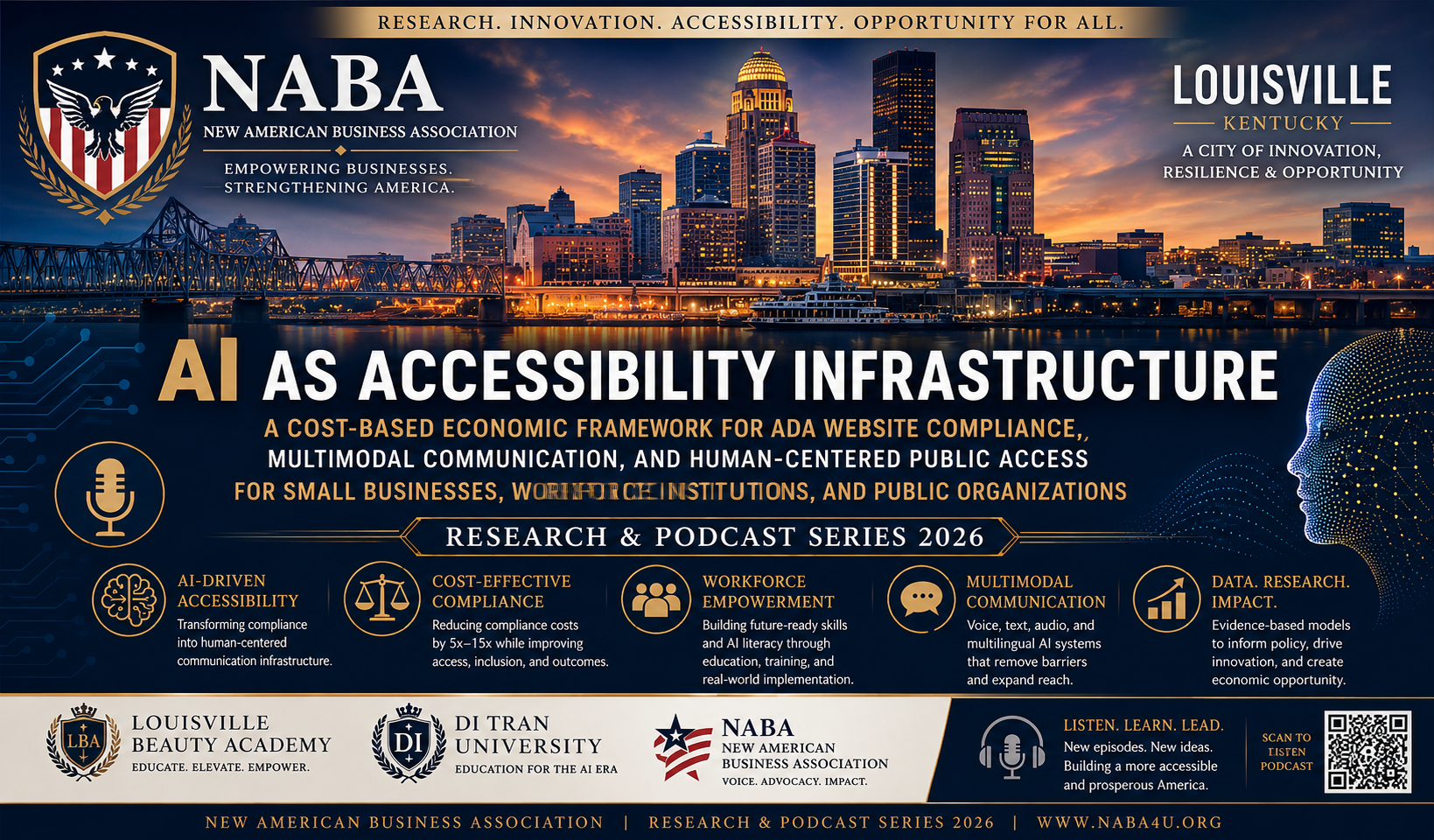
AI as Accessibility Infrastructure: A Cost-Based Economic Framework for ADA Website Compliance, Multimodal Communication, and Human-Centered Public Access for Small Businesses, Workforce Institutions, and Public Organizations – RESEARCH & PODCAST SERIES 2026
AI as Accessibility Infrastructure: A Cost-Based Economic Framework for ADA Compliance and Human-Centered Public Access
Executive Summary
The digital ecosystem of the twenty-first century has evolved from a supplemental information layer into the primary infrastructure for commerce, education, and civic engagement. However, this infrastructure remains structurally inaccessible to a significant segment of the population. Current empirical data suggests that approximately 95 percent of the top one million website homepages exhibit detectable failures under the Web Content Accessibility Guidelines (WCAG).1 For small businesses, vocational institutions, and local government entities, the financial and operational burden of traditional Americans with Disabilities Act (ADA) compliance represents a regressive tax that stifles innovation and limits market participation.
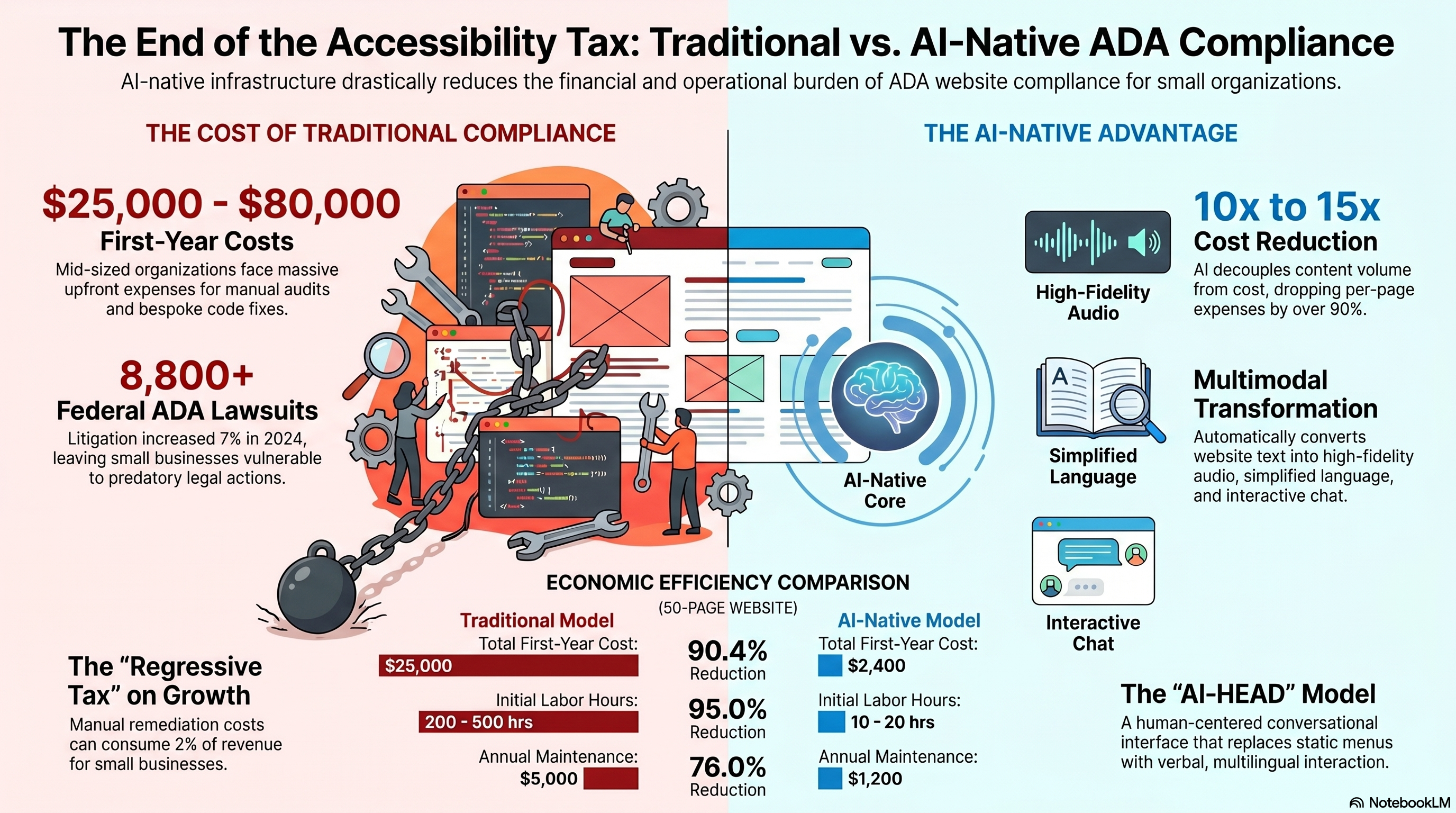
Traditional compliance models, characterized by manual audits and bespoke code remediation, impose first-year costs often exceeding $25,000 to $80,000 for mid-sized organizations.3 This research proposes a transformative paradigm: the adoption of AI-native multimodal communication systems as foundational accessibility infrastructure. By leveraging generative artificial intelligence, organizations can move beyond static compliance toward a dynamic, human-centered communication model. This framework demonstrates that AI-driven systems can reduce compliance-related expenditures by 5x to 15x while simultaneously improving functional outcomes through conversational interfaces, automated audio narration, and real-time multilingual adaptation.4
Centrally, this paper introduces the “DI TRAN AI-HEAD” model—an operational philosophy pioneered by institutions such as the Louisville Beauty Academy, Di Tran University, and the New American Business Association (NABA)—which positions AI not as a mere utility, but as a scalable public infrastructure capable of democratizing communication.6 Policy recommendations focus on federal “Safe Harbor” provisions for AI-assisted compliance and the establishment of SBA-led grants to facilitate the transition from legacy manual remediation to AI-native systems.
The ADA Digital Accessibility Landscape: Evolution and Enforcement Realities
Defining Digital Accessibility in the Modern Era
At its core, digital accessibility refers to the inclusive practice of ensuring there are no barriers that prevent interaction with, or access to, websites and digital tools by people with physical disabilities, situational disabilities, and socio-economic restrictions on bandwidth and equipment. Under the Americans with Disabilities Act (ADA), particularly Titles II and III, websites are increasingly viewed as “places of public accommodation.” This means that the same legal obligations that require physical ramps and elevators also mandate that digital storefronts and government portals be navigable by all users, including those using assistive technologies like screen readers or voice control software.
The technical blueprint for this requirement is the Web Content Accessibility Guidelines (WCAG), a series of standards published by the World Wide Web Consortium (W3C). Currently, the legal and operational benchmark is WCAG 2.1 and 2.2 Level AA.2 These standards are built on four principles: Perceivable (users must be able to see or hear the content), Operable (users must be able to navigate it), Understandable (the content must be clear), and Robust (the content must work with various technologies). Despite these clear definitions, the path to compliance is fraught with technical complexity that many small organizations find impossible to navigate without external help.
Regulatory Trends: DOJ Title II and Beyond
A significant shift occurred on April 24, 2024, when the Department of Justice (DOJ) finalized a rule under Title II of the ADA specifically targeting state and local governments.8 This rule mandates that these public entities ensure their web content and mobile applications meet WCAG 2.1 Level AA. This is not merely a suggestion; it includes strict compliance deadlines. Public entities with populations of 50,000 or more must comply by April 2026, while smaller jurisdictions have until April 2027.8 This regulatory movement signals a transition from an era of “good faith effort” to one of “technical mandate.”
While Title III, which applies to private businesses, has not yet seen a matching codified rule from the DOJ, federal courts and settlement agreements almost universally utilize WCAG 2.1 AA as the de facto standard.2 The ambiguity for small businesses lies in the lack of a “safe harbor” or a clear, standardized toolkit, leaving them vulnerable to a fragmented legal landscape.
The Litigation Crisis and Its Impact on Small Organizations
The failure to achieve digital inclusion has birthed a mature, data-driven litigation environment. In 2024, over 8,800 ADA Title III lawsuits were filed in federal courts, representing a 7 percent increase from the previous year.10 These lawsuits are not evenly distributed; they are highly concentrated in states like California, New York, Florida, Texas, and Illinois.11 For a small business, the receipt of a demand letter is often the first time they realize their website is inaccessible.
The economic fallout is immediate. Settlements for small businesses typically range from $5,000 to $20,000.10 However, this is only the tip of the iceberg. Total legal fees can exceed $50,000, and the business is still required to remediate the site, often under an accelerated, court-mandated timeline that drives up the cost of labor.3 Furthermore, many businesses fall into the “repeat lawsuit” trap. If a business only implements surface-level fixes—such as a “widget” or an “overlay” that does not address the underlying code—plaintiff firms often file a second suit within months.2
Real Market Cost Analysis: The Economics of Traditional Remediation
The traditional model of accessibility remediation is fundamentally a human-capital problem. It requires specialized knowledge at the intersection of web development, user experience design, and disability advocacy. Because this expertise is scarce, market pricing is high and prohibitive for smaller entities.
Market Pricing Ranges for Professional Services
The following table synthesizes current market data for traditional accessibility services as of late 2024 and projections for 2025.
| Service Category | Low-End (Small/Static) | Median (Standard Business) | Enterprise / Complex |
| Expert Audit | $1,500 – $2,500 | $5,000 – $15,000 | $25,000 – $75,000+ |
| Manual Remediation | $5,000 – $10,000 | $15,000 – $50,000 | $100,000 – $250,000+ |
| Ongoing Monitoring | $200 – $500/mo | $500 – $1,500/mo | $2,000 – $5,000/mo |
| Developer Training | $500 per head | $1,500 per head | $5,000+ (Corporate) |
| User Testing (PWD) | $2,000 | $5,000 – $10,000 | $20,000+ |
3
Granular Cost Breakdown by Deliverable
Remediation is rarely a single “fix.” It involves a series of technical interventions across the entire website architecture.
- Audit Specifics: A basic manual audit of 5-10 pages costs between $2,000 and $5,000, while a comprehensive audit covering 20-50 pages ranges from $8,000 to $20,000.3
- Per-Component Fixes: Remedying image alt-text costs between $1 and $5 per image. For a site with 500 images, this is an immediate $1,500–$2,500 expense.3
- Technical Structural Fixes: Correcting keyboard navigation and focus management—essential for users with motor impairments—can cost between $2,000 and $10,000 depending on the complexity of custom UI components.3
- Multimedia Compliance: Video captioning averages $3-$10 per minute, and audio description (essential for the blind) costs $15-$30 per minute.3
- Document Remediation: Converting PDFs to be screen-reader accessible is often quoted on a per-page basis, ranging from $5 to $25 per page.3
Operational Assumptions for Different Organization Types
| Organization Type | Pages | Audit Cost (Trad) | Remediation (Trad) | Annual Maintenance |
| Small Business (Local) | 50 | $5,000 | $15,000 | $5,000 |
| Nonprofit / Foundation | 100 | $8,000 | $25,000 | $10,000 |
| Workforce School (NABA) | 250 | $15,000 | $50,000 | $15,000 |
| Local Gov Agency | 1,000 | $25,000 | $100,000 | $40,000 |
3
The “accessibility tax” on a 50-page small business website can total $20,000 in the first year alone. For a business with $1,000,000 in revenue, this is 2 percent of total revenue—a significant burden when compared to an enterprise with $1 billion in revenue, where $200,000 in compliance costs is a negligible 0.02 percent of revenue.
Mathematical Comparison Models: Traditional vs. AI-Native
The central thesis of this research is that AI can fundamentally decouple the relationship between content volume and compliance cost. Traditional models scale linearly or even super-linearly with complexity; AI models scale logarithmically.
The Traditional Economic Model
Let be the total cost of traditional compliance over time
:

Where:
: Fixed cost of the initial expert audit.
: Total number of pages/components.
: Cost per page of manual remediation.
: Monthly maintenance cost (updates, scans).
: Legal risk/settlement probability (a hidden variable).
In this model, the average cost per page () is high because
(manual labor) is static. For a 50-page site,
might be $400 ($20,000 total).
The AI-Native Economic Model
Let be the total cost of AI-native infrastructure:

Where:
: Monthly cost for AI accessibility infrastructure (e.g., $99/mo).
: Marginal cost of AI processing (pennies per page).
: Minimal human oversight for AI-generated outputs.
In this model, as the number of pages increases, the
drops precipitously.
ROI and Cost Reduction Calculations
| Comparison Metric | Traditional Model | AI-Native Model | % Reduction |
| Cost per Page (Audit+Fix) | $175 – $500 | $15 – $40 | 91.4% – 92.0% |
| Labor Hours (Initial) | 200 – 500 hrs | 10 – 20 hrs | 95.0% – 96.0% |
| Consultant Hours (Yearly) | 50 – 100 hrs | 2 – 5 hrs | 96.0% – 95.0% |
| Total First Year (50 pgs) | $25,000 | $2,400 | 90.4% |
| Total First Year (250 pgs) | $65,000 | $4,800 | 92.6% |
3
The math is clear: the AI-native model provides a 10x to 15x reduction in total cost. For a workforce institution like Di Tran University, which may have hundreds of pages of educational content, the savings of $60,000 per year can be reallocated to student scholarships or curriculum development, directly impacting the institution’s core mission.7
AI Multimodal Accessibility Framework: From Content to Communication
The traditional approach to accessibility focuses on a “technical checklist”—does the image have an alt-tag? The AI-native approach focuses on “multimodal transformation”—how can we turn this text into whatever the user needs?
The Transformation Pathways
AI systems can now automatically ingest a single “source of truth” (a webpage or document) and transform it into several accessible modalities:
- Automated Audio Narration (Podcasts): Using models like ElevenLabs, a website can automatically generate high-fidelity audio versions of every article or service page.4 This serves not only the blind but also those with dyslexia or those who prefer “eyes-free” consumption in a mobile workforce.
- Simplified Language Adaptation: LLMs can process dense, complex vocational or legal text and output “plain language” versions. This is critical for cognitive accessibility and for immigrant-owned businesses whose owners may be learning English as a second language.6
- Generative Vision (Smart Alt-Text): AI vision models can analyze complex infographics and generate detailed text descriptions that go far beyond what a busy web developer would typically write.17
- Conversational Interactivity: Instead of forcing a user to navigate a complex menu, a generative chatbot can allow a user to ask, “How do I renew my barber’s license?” and receive a direct, verbal answer and a link to the specific form.6
Workforce Productivity and Inclusion
By shifting the burden of accessibility from the “content creator” to the “AI infrastructure,” organizations experience a massive boost in productivity. In the traditional model, a staff member at a nonprofit might spend 4 hours captioning a single video. Using AI dubbing and captioning services, that same task takes 10 minutes of review.4 This democratizes the ability to create accessible content, ensuring that even the smallest organizations can serve the public with dignity and inclusion.
The “DI TRAN AI-HEAD” Model: A Human-Centered Infrastructure
The “DI TRAN AI-HEAD” represents a philosophical and operational pivot. Developed by Di Tran and supported by the New American Business Association (NABA), this model moves away from the “invisible” code fixes of the past and toward an “embodied” AI assistant.6
Concept and Operation
The AI-Head is an AI-native conversational system that acts as the front-end for accessibility. Rather than a static website, the user interacts with a human-like avatar or voice interface that “understands” the entire site’s content.
- Verbal Interaction: Users can ask questions verbally, which is essential for those with visual or motor impairments.
- Dynamic Adaptation: The AI-Head can change its tone, language, and complexity based on user feedback. If a user says, “I don’t understand that,” the AI can offer a simplified explanation instantly.
- Multilingual Sovereignty: For immigrant-owned businesses, the AI-Head speaks the language of the community, whether that is Vietnamese, Spanish, or Arabic, making the “public accommodation” truly public.6
Transformation of Accessibility
This model transforms accessibility from a “technical debt” into “public communication infrastructure.” It argues that a website’s job is not just to “be there” but to “be useful.” For an organization like Louisville Beauty Academy, the AI-Head ensures that a prospective student—regardless of their primary language or physical ability—can navigate the enrollment process as easily as anyone else.7
Small Business and Public Organization Impact Analysis
The Disproportionate Burden on Small Entities
The current ADA enforcement landscape treats a local hardware store with 10 employees the same as a global retailer with 100,000 employees. This “one-size-fits-all” regulatory approach ignores the reality of staffing and revenue. Small businesses often rely on “plug-and-play” website builders (Wix, Squarespace) which, while improving, still produce code that fails many WCAG checks.1
A $20,000 settlement is a catastrophic event for a “New American” business owner who has reinvested every penny into inventory and staff.6 It is not just the money; it is the operational disruption. A small business owner must suddenly become an expert in “ARIA roles” and “contrast ratios,” taking them away from their core mission of serving their community.
The Democratizing Role of AI
AI-native infrastructure acts as a “Great Equalizer.” It provides the same level of accessibility firepower to a local nonprofit as it does to a Fortune 500 company.
- Cost Elasticity: AI subscriptions scale with usage, meaning a small site pays very little compared to an enterprise site.4
- No Technical Staff Required: The AI handles the “heavy lifting” of remediation, allowing small organizations to focus on their services rather than their code.
- Risk Mitigation: By providing a superior, multimodal experience, businesses drastically reduce the “plaintiff appeal” of their site. A site that offers a full conversational interface and audio narration is a much harder target for a lawsuit than a static site with missing alt-text.2
Federal Policy Recommendations
To realize the benefits of AI as accessibility infrastructure, the following policy changes are recommended at the federal and state levels:
1. SBA “AI Accessibility Safe Harbor”
The SBA Office of Advocacy should work with the DOJ to establish a “Safe Harbor” for small businesses that implement certified AI-native accessibility systems.
- Proposal: If a small business provides a primary conversational AI interface (like the AI-Head) and an automated accessibility layer that handles 95% of detectable WCAG errors, they should be granted immunity from private litigation, provided they have a “Notice and Cure” process in place.
- Justification: This protects businesses from predatory suits while ensuring that users with disabilities have a functional, effective way to access the site.
2. DOJ/DOE “Outcome-Based” Conformance
Federal agencies should shift from a “technical conformance” model to an “outcome-based” model.
- Proposal: Instead of measuring purely by code-level WCAG checkboxes, the DOJ should recognize “Equivalent Facilitation.” If a user can achieve their goal (e.g., buying a product, filing a form) through an AI interface as efficiently as a non-disabled user, the entity should be deemed compliant.
- Benefit: This encourages innovation in UI/UX rather than forcing every site to conform to a rigid, often outdated, code structure.
3. Federal “Accessibility API” and Toolkits
The Department of Education and Department of Labor should fund the creation of a “Federal Accessibility API”—a suite of open-source or subsidized AI models for alt-text generation, plain-language translation, and audio narration.
- Mechanism: These tools should be made available for free to any 501(c)(3) nonprofit or small business with under $1 million in revenue.
4. Expansion of the Disabled Access Credit (Section 44)
Currently, the IRS provides a 50% tax credit for accessibility expenses up to $10,250.14
- Proposal: Increase the credit to $25,000 for “AI-Native Infrastructure” investments. This would allow small businesses to fully offset the cost of moving to a human-centered AI communication model.
Accessibility as Human Communication: A Vision for 2035
The ultimate goal of this framework is to move beyond the term “accessibility” entirely and replace it with “universal communication.”
The Operational Philosophy
“Accessibility should be measured not only by technical checklist compliance, but by the practical human ability to understand, interact with, and consume information in the communication format most accessible to each individual.”
This philosophy, central to the Di Tran University model, posits that the “default” state of a website should be adaptive.7 In 2035, a website will not be a static document; it will be a dynamic agent. For a user with low vision, the website is a voice. For a user with cognitive challenges, the website is a simplified infographic. For a user in a noisy environment, the website is a series of clear, high-contrast captions.
Projections and Future Outlook
By 2030, we expect “post-source remediation”—where AI agents fix accessibility issues in the browser in real-time—to become the dominant strategy.18 This will effectively “immunize” the web against many common coding errors. By 2035, we project that the marginal cost of accessibility will be zero. It will be a built-in feature of every LLM-driven web engine, just as “spell check” is a built-in feature of every word processor today.
| Year | Paradigm | Role of Human | Cost for SMB |
| 2024 | Manual / Punitive | Expert Developer | $25,000+ |
| 2027 | AI-Assisted / Hybrid | Reviewer / Auditor | $5,000 |
| 2030 | AI-Native / Multimodal | Content Creator | $500 (Subscription) |
| 2035 | Universal / Adaptive | None (Integrated) | $0 (Platform Feature) |
15
Conclusion
The transition from “manual compliance” to “AI infrastructure” is an economic and moral imperative. The current model is failing: it is too expensive for small businesses, too slow for government, and ultimately, it is not actually making the internet accessible for the 1.3 billion people globally with disabilities.14
By adopting the “DI TRAN AI-HEAD” and the multimodal frameworks discussed herein, we can democratize access to information. Small businesses and workforce institutions like NABA and Louisville Beauty Academy are at the forefront of this change, proving that technology can be used to humanize, not just automate.6 We call upon the SBA, DOJ, and Congress to recognize this shift and provide the policy framework necessary to turn “accessibility” from a legal burden into a universal human right of communication.
Policy Brief: AI-Native Accessibility Infrastructure
Title: Democratizing Digital Access through AI
Date: May 2026
Target: Congressional Small Business Committee, SBA Office of Advocacy
The Problem: ADA website litigation increased 7% in 2024, with small businesses paying an average of $20,000 in settlements for issues they cannot afford to fix using traditional manual methods.10
The Solution: Shift federal policy to recognize AI-native multimodal interfaces as a primary means of compliance.
Key Impacts:
- Cost: Reduces first-year compliance costs by over 90%.3
- Reach: Allows small businesses to instantly serve multilingual and disabled customers.6
- Productivity: Frees up hundreds of labor hours previously spent on manual alt-text and captioning.14
Recommendations: Establish an AI Accessibility “Safe Harbor” and expand the IRS Section 44 tax credit for AI infrastructure.14
SBA Comment-Letter Draft
Re: Final Rule on Accessibility of Web Content and Mobile Apps (Title II)
To the Civil Rights Division, Department of Justice:
The New American Business Association (NABA) and associated workforce institutions appreciate the Department’s commitment to digital inclusion. However, we must reiterate the concerns of the SBA Office of Advocacy regarding the underestimation of compliance costs for small entities.8
The current $175 per-page estimate for remediation fails to account for the high cost of specialized accessibility developers and the recurring nature of digital maintenance.10 Our research indicates that AI-native systems, such as the “DI TRAN AI-HEAD,” represent a far more sustainable path for small organizations.6 We urge the Department to include a provision for “AI-Native Conformance,” allowing entities to meet their obligations through dynamic, conversational interfaces that achieve the same—or better—human outcomes as technical code-level compliance.
Congressional Briefing Summary
Topic: The Economic Case for AI in Digital Accessibility Summary: Traditional ADA compliance is a “failed market.” Despite billions spent on manual remediation, 95% of sites remain inaccessible.1 AI offers a 15x cost reduction by automating the transformation of content into audio, simplified text, and interactive chat.4 Ask: Support legislation that provides “Notice and Cure” protections for businesses that implement recognized AI accessibility layers. This will protect small businesses from “drive-by” lawsuits while providing immediate, high-quality access for the disabled community.2
Works cited
- Seyfarth’s ADA Title III Blog on Digital Accessibility Cited by the ABA, accessed May 11, 2026, https://www.seyfarth.com/news-insights/seyfarths-ada-title-iii-blog-on-digital-accessibility-cited-by-the-aba.html
- Digital Accessibility Under Title III of the ADA: Recent Developments and Risk Mitigation Best Practices, accessed May 11, 2026, https://www.americanbar.org/groups/business_law/resources/business-law-today/2025-august/digital-accessibility-under-title-iii-ada/
- How Much Does Website Accessibility Cost? 2025 Pricing Guide …, accessed May 11, 2026, https://testparty.ai/blog/website-accessibility-cost-2025
- ElevenLabs Pricing 2025: Plans & Costs Reviewed – Tekpon 2026, accessed May 11, 2026, https://tekpon.com/software/elevenlabs/pricing/
- ElevenLabs Pricing for Creators & Businesses of All Sizes, accessed May 11, 2026, https://elevenlabs.io/pricing
- Di Tran — Founder & CEO | Visionary Leader in Workforce Education, Humanized AI, and Immigrant Entrepreneurship – New American Business Association (NABA) – Louisville, KY, accessed May 11, 2026, https://naba4u.org/di-tran-founder-ceo-visionary-leader-in-workforce-education-humanized-ai-and-immigrant-entrepreneurship/
- The Million-Dollar Paradox: Reevaluating Vocational Heritage, The, accessed May 11, 2026, https://louisvillebeautyacademy.net/the-million-dollar-paradox-reevaluating-vocational-heritage-the-mba-illusion-and-the-humanization-of-work-in-the-ai-era-public-research-library-beauty-industry-2026-podcast-series/
- Justice Department Finalizes Rule Requiring State and Local Governments to Make their Websites Accessible, accessed May 11, 2026, https://advocacy.sba.gov/2024/04/25/justice-department-finalizes-rule-requiring-state-and-local-governments-to-make-their-websites-accessible/
- Fact Sheet: New Rule on the Accessibility of Web Content and Mobile Apps Provided by State and Local Governments | ADA.gov, accessed May 11, 2026, https://www.ada.gov/resources/2024-03-08-web-rule/
- How Much Does an ADA Accessibility Audit Cost?, accessed May 11, 2026, https://customwebaudits.com/how-much-does-an-ada-accessibility-audit-cost/
- Website Accessibility in 2025: Lessons from 2024 Lawsuit Trends – AudioEye, accessed May 11, 2026, https://www.audioeye.com/post/website-accessibility-in-2025/
- WCAG Audit Services & ADA Website Compliance Audits – web audit solutions llc, accessed May 11, 2026, https://webauditsolutions.com/pages/accessibility-audit-pricing
- ADA Web Lawsuits in 2026: Key Insights from 2025 Filings – Accessible Minds, accessed May 11, 2026, https://accessiblemindstech.com/ada-web-lawsuits-2026-insights-from-2025-filings/
- Understanding ADA Compliance Costs – The A11Y Collective, accessed May 11, 2026, https://www.a11y-collective.com/blog/cost-of-ada-compliance/
- 2026: New AI Features for Digital Accessibility Projects Are Mildly Shocking, accessed May 11, 2026, https://adabook.medium.com/2026-new-ai-features-for-digital-accessibility-projects-are-mildly-shocking-e2c58343b055
- Hassle-Free Translation Subscriptions | BLEND Pricing – BLEND Localization, accessed May 11, 2026, https://www.getblend.com/pricing/
- Generative AI & Web Accessibility: How Audits Will Evolve in 2025 – achecker.ca, accessed May 11, 2026, https://achecker.ca/blog/ai-and-accessibility-2025
- Web Accessibility in 2026: Five Predictions Shaped by How the Web Is Changing, accessed May 11, 2026, https://blog.usablenet.com/web-accessibility-2026-predictions