

A Young Louisville Builder’s Second App: Jayden Tran, 12, Makes Math Practice Free
September 25 portfolio update: Math Adventure is Jayden Tran’s second public, working learning application, following his earlier Typing Lab. The live Math Adventure release became publicly available on September 24, 2026, and remains free to explore at its single official address: https://louisvilleit.org/math-adventure/.
The Tran family’s three young learners are Jayden, 12; Skylar, 10; and Dylan, 9. Jayden is the named student developer of Math Adventure. Skylar and Dylan are his younger brothers and part of the family learning environment that keeps the project focused on a real question: Can a child open this experience, understand where to begin, and feel invited to keep learning?
Why a second working app matters
A single prototype can show curiosity. A second deployed product begins to show a repeatable discipline: identify a need, design a usable experience, test it, release it, listen, and improve. Typing Lab focused on guided typing practice. Math Adventure applies the same builder mindset to mathematics through a starting-point experience, structured practice, level tests, and visible progress.
This is not presented as proof that a 12-year-old has finished learning computer science, mathematics, product design, or educational research. It is stronger—and more honest—as evidence that a young learner is beginning to practice the full cycle of responsible creation.
The kind of evidence rigorous schools value
Selective schools and serious educators look beyond superlatives. They look for authentic intellectual habits and verifiable work. This project gives Jayden a foundation he can continue earning through:
- initiative: moving from an idea to a public, usable product;
- iteration: building a second application in a different learning domain;
- human-centered design: making the first screen welcoming and the next step clear;
- service: removing the price barrier so families can explore it free;
- technical responsibility: stating what the app does, what it does not do, and how local browser data works;
- academic humility: treating teacher feedback, testing, mathematical checking, writing, and revision as part of the build; and
- transparent collaboration: identifying the work as student-led and developed under parent/adult supervision with AI-assisted tools, without pretending that assistance did not exist.
The long-term portfolio will be strongest if Jayden can explain his own decisions, demonstrate the app, document changes, measure non-sensitive usage or learning feedback, identify mistakes, and show what he improved. The goal is not to manufacture an impressive story. The goal is to keep doing work worthy of one.
See the real application
The two interface images below are screenshots from the live public experience—not conceptual mockups.
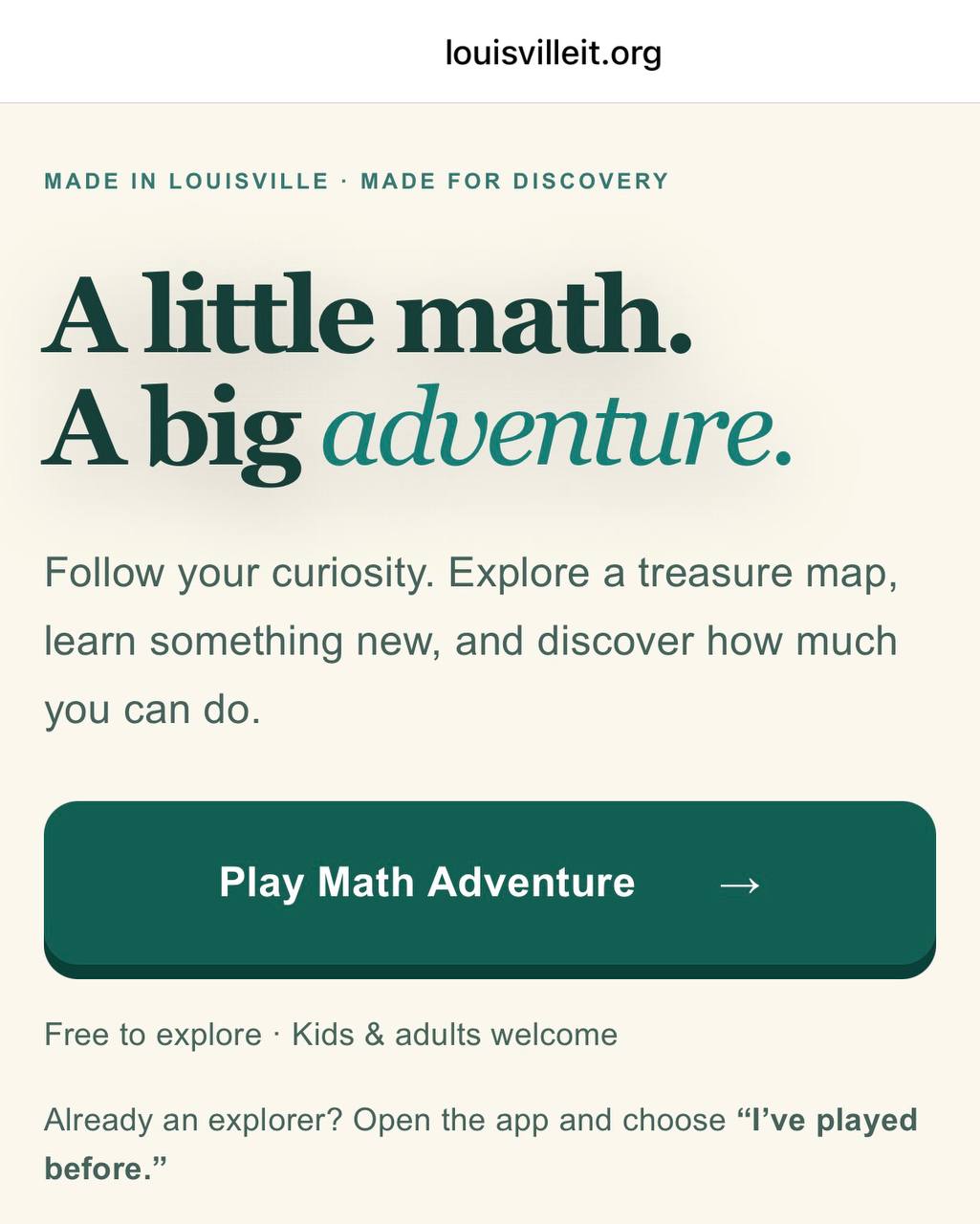
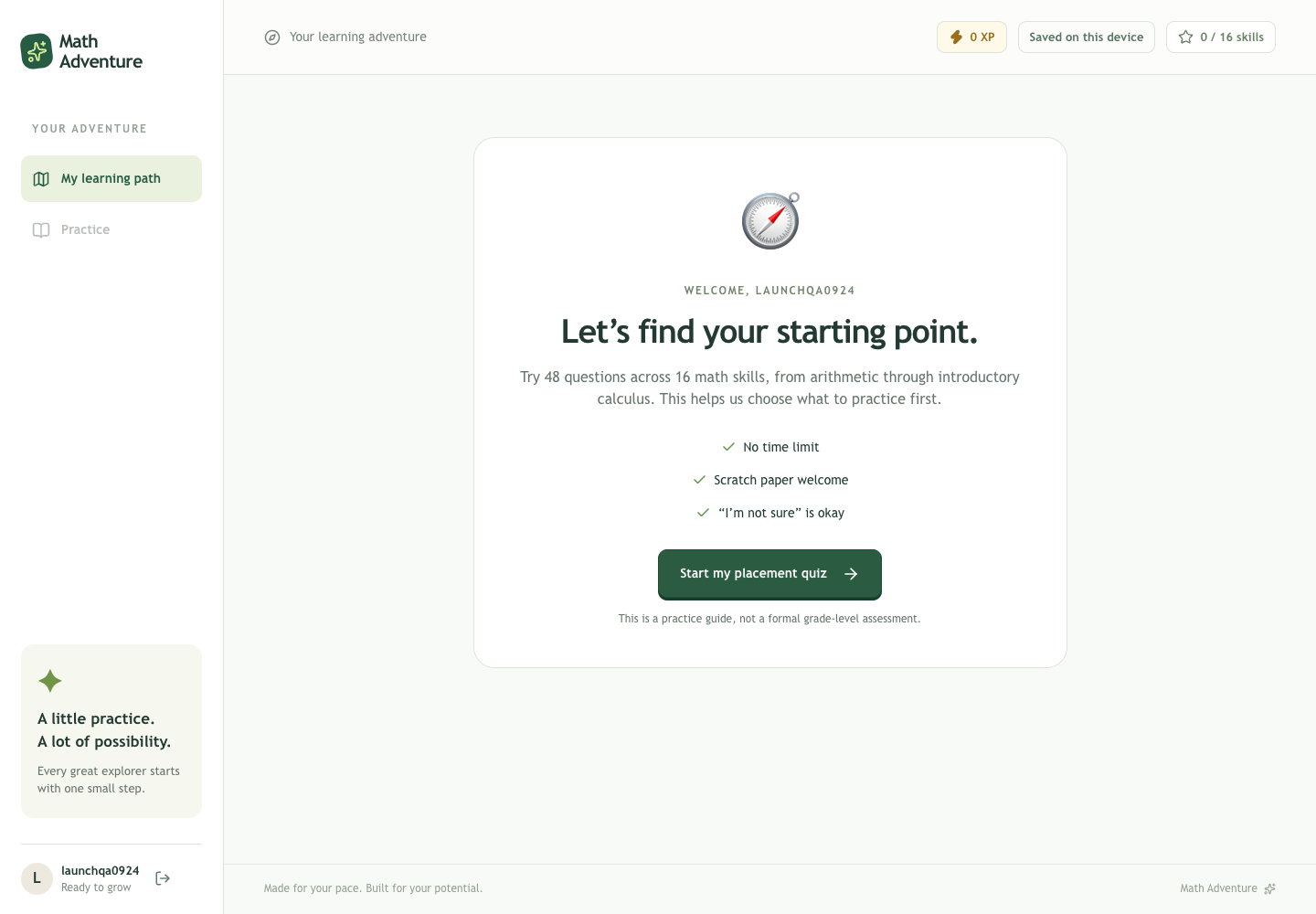
Explore the second app free: https://louisvilleit.org/math-adventure/
Accuracy note: Jayden’s, Skylar’s, and Dylan’s ages and family relationship are parent-provided. Jayden is credited as the student developer; this article does not claim that Skylar or Dylan co-developed the application. Both public app links and the pictured Math Adventure screens were checked live on September 25, 2026.
NABA Community Builder Spotlight: For immigrant and working families, this is entrepreneurship in its most human form: learn something valuable, build a useful solution, remove a cost barrier, and invite the community to test and improve it.
Jayden Tran’s Math Adventure shows what education can become when a young learner moves from knowing to building, testing, sharing, and serving.
At about 9 p.m. in a Louisville home, the scene did not look like a traditional product launch. There was no stage, no spotlight, and no expensive production. There was a kitchen table, a laptop, younger children gathered close, and a 12-year-old ready to share something he had built for other learners.
That young builder was Jayden Tran. His new web app, Math Adventure, is now available online at no cost. Jayden’s intention, as described by his family, is simple: give children—including his brothers Dylan and Redd, his classmates, his school community, and learners everywhere—a free place to practice mathematics and grow more confident.
Play Math Adventure free: https://louisvilleit.org/math-adventure/
Education becomes powerful when knowledge is implemented
Jayden’s release carries a larger lesson. In an age when information is everywhere, education cannot stop at remembering an answer or passing a test. Learners also need opportunities to:
- apply what they know;
- test it in a real environment;
- identify what does not work;
- improve through analysis and feedback; and
- place the result into the hands of people who can use it.
That is implementation. It turns a lesson into a tool and a student into a contributor.
Jayden has learned mathematics in school and, according to his family, through years of weekly math tutoring with Ru. Math Adventure is his effort to convert that learning into something useful for others. The point is not that a 12-year-old knows everything. The point is that he is willing to build, test, learn, revise, and share.
What Math Adventure includes
Louisville Institute of Technology independently opened and tested the live public release on September 24, 2026. The working app currently includes:
- a 48-question starting-point quiz across 16 skill areas;
- a learning path extending from arithmetic through introductory calculus;
- step-by-step examples and practice activities;
- 200 practice questions per level;
- a 20-question level test;
- an 80% score requirement to complete a level, followed by more practice when a learner needs another attempt;
- a child-friendly “I’m not sure” option;
- a mobile-responsive interface; and
- local progress saved in the browser.
No ChatGPT account is required. A learner creates a username and password inside the app. The profile is a local browser lock, not an online account: it does not sync across devices, it has no password-recovery system, and clearing browser data removes the profile and progress. Families should use a new password that is not used for email or any other account.
The placement experience is a practice guide, not a formal grade-level assessment, and the app should complement—not replace—teachers, schoolwork, tutoring, parental guidance, or professional educational support.
Why “free” is part of the design
Jayden did not want a paywall between a child and the opportunity to practice. That decision matters.
Access to a device and the internet is not equal for every family, and a free web app does not solve every barrier. But removing the price of the software is still a meaningful step. It allows a child, parent, tutor, classroom, or community group to try the learning experience without a subscription.
Accessibility in education begins with a practical question: Who can actually use what we build?
For Jayden, the answer he is reaching toward is: everyone possible.
Why Louisville, Kentucky, is amazing
Louisville’s strength is not only found in its skyline, institutions, businesses, or celebrated events. It is also found in ordinary homes where families gather around a young person’s work and help turn curiosity into service.
This is a city where immigrant and working families can carry deep respect for education while encouraging a child to become a builder. It is a community where learning can move from school, to tutoring, to a kitchen table, to a live application that anyone with a browser can open.
That is a form of Louisville innovation worth celebrating: local, human, practical, and generous.
A launch measured by usefulness
The most important question about a new learning app is not whether its creator is young. It is whether the work helps a real person practice, understand, and move forward.
Math Adventure is now public, which means the next stage is evidence: children trying it, families observing it, educators offering thoughtful feedback, and Jayden continuing to improve it. A launch is not the end of learning. It is the beginning of responsibility to the learner.
Jayden’s example offers a challenge to students and adults alike:
Do not only collect knowledge. Implement it. Test it. Analyze it. Improve it. Then use it to serve someone else.
From a Louisville kitchen table, a 12-year-old has taken that next step.
Try the app
- Math Adventure: https://louisvilleit.org/math-adventure/
Parents and educators should supervise children’s technology use, review the local-profile limitations above, and share only non-sensitive feedback.
Editor’s note: Jayden’s age, release intention, family relationships, launch-time context, and tutoring history were provided by his family. App-function statements were checked against the live public release on September 24, 2026.