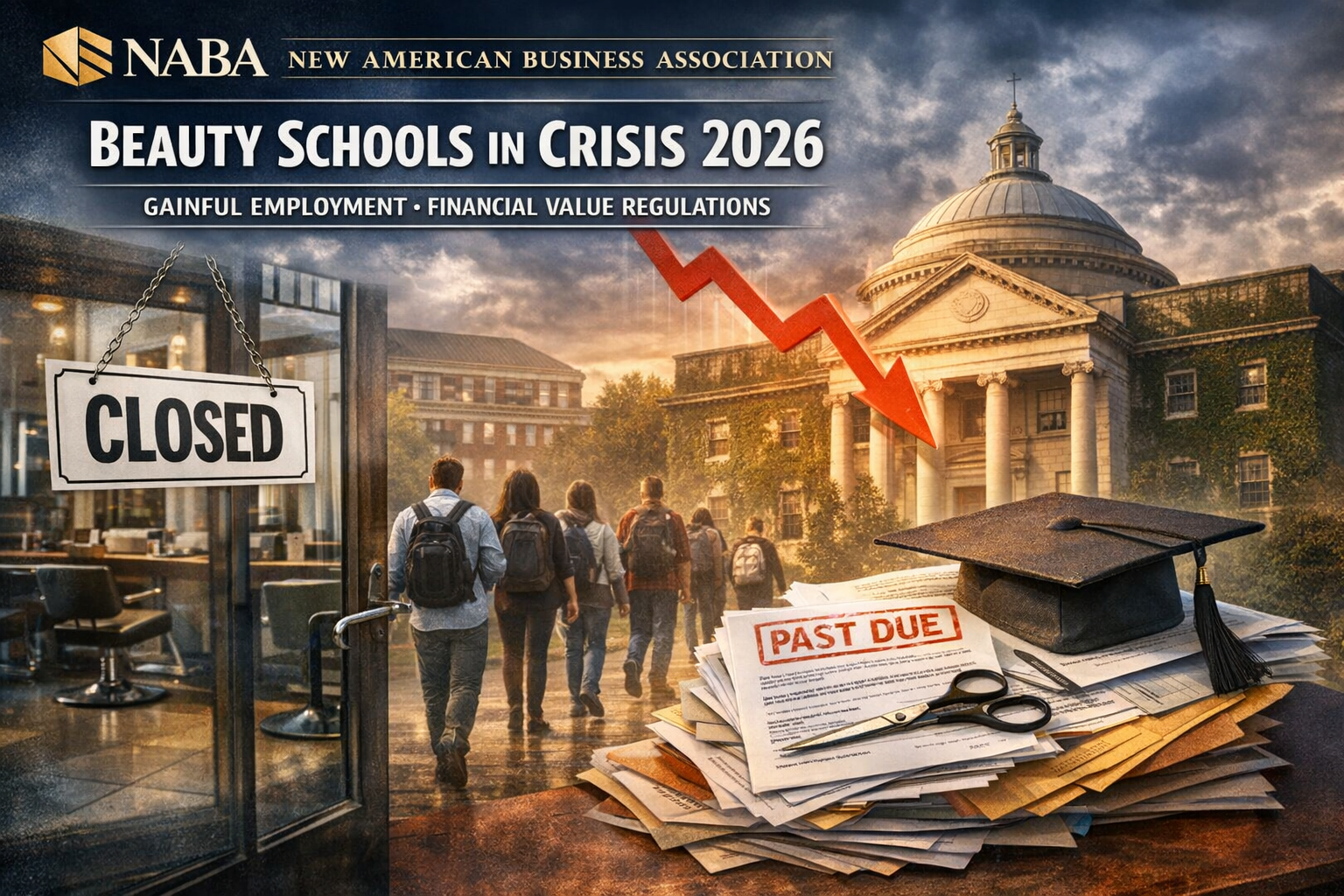
Beauty/Cosmetology Schools Under Financial Value Transparency and Gainful Employment Pressure (Week of March 14–20, 2026) – RESEARCH SERIES 2026
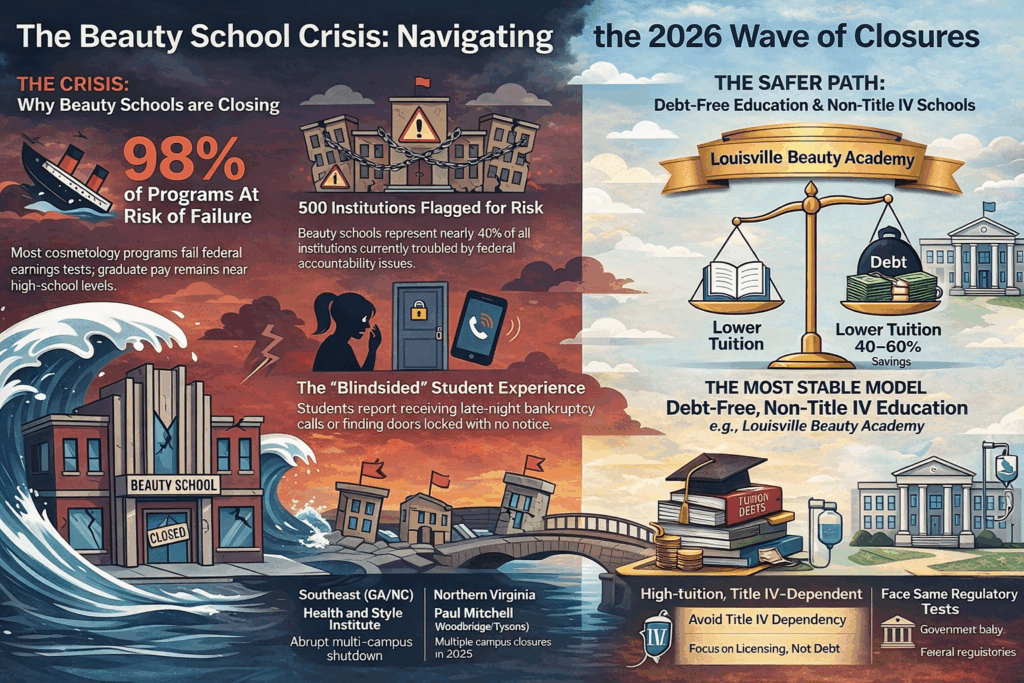
🔹 What is causing beauty schools to close in 2026?
Beauty schools are closing due to federal regulations like Gainful Employment (GE) and Financial Value Transparency (FVT), which require programs to prove graduates earn enough relative to their debt. Many high-tuition cosmetology schools fail these tests, leading to loss of funding and closures.
🔹 What is Gainful Employment in cosmetology education?
Gainful Employment is a federal rule that evaluates whether graduates of programs, including cosmetology schools, earn enough income to justify their student debt. Programs that fail repeatedly can lose access to federal financial aid.
🔹 What is Financial Value Transparency (FVT)?
Financial Value Transparency requires schools to disclose student outcomes, including earnings and debt levels, allowing regulators and students to assess whether programs provide real economic value.
🔹 Are cosmetology schools worth it in 2026?
Cosmetology schools can be worth it if tuition is affordable and aligned with expected earnings. High-cost, debt-heavy programs are increasingly risky under new federal regulations, while lower-cost or non-Title IV schools may offer better value.
🔹 Why are high-tuition beauty schools at risk?
High-tuition beauty schools often rely on federal aid and charge more than graduates can realistically earn back, making them vulnerable to failing federal accountability tests and losing funding.
🔹 What happens when a beauty school closes?
When a beauty school closes, students may need to transfer to another school, complete a teach-out program, or risk losing time and money already invested.
🔹 What is a non-Title IV beauty school?
A non-Title IV beauty school does not rely on federal student aid and typically offers lower tuition, reducing student debt and regulatory risk.
🔹 Are there safer alternatives to expensive beauty schools?
Yes. Community colleges, public technical programs, and low-cost private schools often provide similar licensing outcomes at significantly lower cost and risk.
🔹 What opportunities exist in the beauty school market right now?
As high-cost schools close, there is growing opportunity for affordable, transparent, and debt-free education models to enter underserved markets and meet demand.
🔹 What regions are most affected by beauty school closures?
Regions like Northern Virginia, Atlanta, and parts of the Midwest show multiple school closures and market instability, indicating potential gaps for new education providers.
Recent news, policy analysis, and social media posts indicate mounting distress among federally aided beauty and cosmetology schools as Financial Value Transparency (FVT), Gainful Employment (GE), and Trump‑era accountability expansions (OBBBA, “Do No Harm” tests) move toward full enforcement by 2026. The sector shows a pattern of abrupt campus closures, accreditation problems, and student uncertainty, with for‑profit chains and Title IV‑dependent schools most exposed.[1][2][3][4][5]
Across the last several months, at least three clearly identified beauty institutions (or multi‑campus chains) have closed campuses or entire operations, and multiple Paul Mitchell locations have shut down or relinquished accreditation, while Reddit posts document students scrambling to transfer, complete teach‑outs, or cope with sudden bankruptcy announcements. Commentary from policy organizations and sector observers suggests several hundred cosmetology schools are flagged for low earnings or financial risk, foreshadowing many more closures and aid losses as outcome‑based tests bite between 2026 and 2028.[2][3][4][6][7][8][9][10]
Background: Federal Accountability Regime Targeting Beauty Schools
Federal accountability now combines Financial Value Transparency disclosures with high‑stakes program eligibility rules, especially for career and for‑profit programs. Key elements include:[3][2]
- A Debt‑to‑Earnings (D/E) metric and an Earnings Premium (EP) test that compare graduates’ loan burdens and earnings to high‑school‑only peers in the same state, with repeated failures triggering Title IV aid loss.[2][3]
- The One Big Beautiful Bill Act (OBBBA) and related “Do No Harm” earnings‑premium standard, extending outcome‑based accountability across all Title IV programs and adding a “Pell penalty” that strips Pell eligibility if a Pell‑heavy school repeatedly fails earnings tests.[3][2]
Analyses cited by advocates and the Department suggest that a large majority of cosmetology programs—up to 98%—would fail the earnings‑premium test under current thresholds, because entry‑level stylist wages are near or below those of typical high‑school graduates. New America estimates that about 500 institutions flagged by ED for accountability issues are beauty schools, roughly two in five of all troubled institutions, and warns students away from high‑tuition, big‑brand chains like Paul Mitchell and Empire Beauty.[4][2]
Event Log: Closures, Suspensions, and Distress Signals
Structured Event Table (Recent Known Cases)
| Institution | City/State | Chain/Brand | Event Type | Approx. Date | Notes & Sources |
| Phagans’ Medford Beauty School (Phagans’ Cosmetology College) | Medford, OR | Phagans’ regional chain | Campus closure after teach‑out | Announced Jan 2025; reported Feb 25, 2025 | Medford campus permanently closed after teaching out current students; part of a 4‑campus Oregon chain; state higher‑ed commission involved in closure coordination.[6] |
| Health and Style Institute | Buckhead & Kennesaw, GA; 2 NC campuses | Multi‑campus beauty school | Abrupt multi‑campus closure | Early Feb 2025 | All locations closed “effective immediately” after 13+ years of operation; owners cited FAFSA processing disruptions and state board delays as drivers of cash‑flow crisis; students told to retrieve belongings and transcripts to transfer.[7][11] |
| Beauty Artistry Academy | Eastgate (Union Township/Cincinnati area), OH | Independent school | Abrupt closure; funding and accreditation problems | Mid‑Sept 2025 (closure letter Sept 15, 2025) | Closed after taking full tuition from students; owner blamed ED staffing cuts and 18‑month delays in Title IV certification review and inability to refinance SBA loan; approximately 96 graduates over two years and 20 active students were affected; not accredited by NACCAS despite website claiming candidate status.[8] |
| Paul Mitchell School (Colorado Springs campus) | Colorado Springs, CO | Paul Mitchell | Nail and cosmetology programs suspended by state board | Dec 2025 | Colorado Private Occupational School Board suspended cosmetology and nail programs over ventilation and permitting violations; students reported being taught outdoors under space heaters; school says two of five programs are suspended and pledges to fix issues.[12] |
| Paul Mitchell Knoxville campus | Knoxville, TN | Paul Mitchell | Accreditation loss; protracted closure process | Accreditation revocation notice Aug 2025; closure process over several years | NACCAS moved to strip accreditation after persistent financial problems; New America analysis frames this as emblematic of lax oversight that allowed a troubled campus to operate for years despite multiple red flags.[5] |
| Paul Mitchell schools (multiple locations) | Various (incl. Woodbridge & Tysons Corner, VA; WI campuses) | Paul Mitchell | Multiple campus closures; accreditation relinquishments | Early–mid 2025 (community reports) | Reddit users report that Paul Mitchell schools in Woodbridge and Tysons Corner closed after visible decline; commenter notes at least six Paul Mitchell schools closed nationwide in 2025 and six campuses relinquished NACCAS accreditation, with four more on probation; two WI owners reportedly convicted of federal financial‑aid fraud.[10] |
| Emma’s (cosmetology academy) – name as reported by student | Unspecified U.S. location | Independent/”reputable” franchise per student | Bankruptcy and abrupt closure | Early July 2024 | Student recounts late‑night video call where instructor announced “Emma’s has officially gone bankrupt. I’m out of a job, and you’re out of an academy”; students left with sudden need to find teach‑outs or transfers.[9] |
| Unnamed cosmetology franchise (Reddit teach‑out post) | Unspecified | Franchise | Permanent closure with accelerated teach‑out | May 2024 | Student describes school “permanently closing” and forcing existing students into extreme schedules (9:30–17:00 plus 18:00–22:00 daily) to finish programs before shutdown; school arranged teach‑out with another provider.[13] |
| Unnamed beauty school chain (3‑location closure) | Unspecified | Chain | Sudden closure of three locations, no notice | Feb 2025 | r/legaladvice poster reports owner closed three campuses via early‑morning email and notification to state board, leaving “hundreds of students and staff” without access to records or clear teach‑out plans.[14] |
| Empire Beauty School (specific campus) | Unspecified | Empire Beauty School | At least one campus closed | By Jan 2025 | r/Cosmetology commenter says they attended Empire and that their campus has since shut down; thread frames cosmetology school as a “scam” with poor value.[15] |
| Gene Juarez Academy (Seattle‑area campus) | Seattle metro, WA | Gene Juarez | Campus closure | Before Apr 2025 | Reddit commenter on Seattle‑area schools notes that the Gene Juarez school “has closed down” and expresses surprise, suggesting local shock and disruption.[16] |
| Federico College | Fresno, CA | Federico | Abrupt closure | Early Oct 2024 | r/fresno thread reports Federico College “shuts doors unexpectedly”, leaving students stranded; commenter notes it was only approved by California BPPE, not a recognized accreditor, and warns that upcoming gainful‑employment regulations will hit such schools hard.[17] |
| Lincoln Beauty School | Tacoma, WA | Local school | Campus closure / relocation | By Jan 2025 | r/Tacoma users report Lincoln Beauty School sealed and boarded up; some comments suggest owner sold the building and may reopen across the street; Clover Park Technical College cosmetology salon is mentioned as an alternative.[18] |
Student Stress, Transfer Needs, and Lived Experience
Themes from Reddit and Other Social Media
Reddit threads across r/Cosmetology, r/legaladvice, r/fresno, and local subreddits provide a window into student experiences when beauty schools close or destabilize. Common patterns include:[14][13][9][18][10]
- Abrupt closure notifications: Students describe receiving late‑night calls or same‑day emails announcing bankruptcy or permanent closure, often with instructors themselves in tears and minimal official guidance (e.g., Emma’s bankruptcy call; three‑location chain closure at 5:30 a.m.).[9][14]
- Teach‑out pressure and extreme schedules: In at least one case, a closing franchise forced students into 11.5‑hour days (9:30–17:00 plus 18:00–22:00) every weekday to complete programs before a cutoff, with students calling this “outrageous” and impossible alongside full‑time jobs.[13]
- Unclear transfer pathways: Students repeatedly ask whether state boards, accrediting agencies, or the Department of Education manage teach‑outs, and receive conflicting or partially accurate advice about who controls teach‑out plans and transfer of hours.[9]
- Financial shock and sunk costs: Posts emphasize having “invested a lot of money” only to be displaced or dismissed, with particular frustration at being “kicked out” of programs like Paul Mitchell or watching programs close after paying over 10,000 in tuition.[7][8][19]
- Distrust of for‑profit schools and big brands: Multiple threads describe cosmetology school as a “scam,” highlight poor instruction quality, or encourage prospective students to avoid high‑tuition chains (Aveda, Paul Mitchell, Empire) in favor of lower‑cost options.[20][15][16][17]
Approximate Student Impact (Where Quantified)
The public record rarely provides precise enrollment counts at closure, but a few cases have indicative numbers:
- Beauty Artistry Academy (OH): Owner reported 96 graduates over two years and 20 students pursuing certificates at time of closure.[8]
- Three‑location chain (unnamed): r/legaladvice poster claims “hundreds of students and staff” impacted by surprise 3‑campus shutdown.[14]
- Health and Style Institute: Fox 5 Atlanta story references “students and staff” across four campuses; while counts are not given, multi‑site closures of 50–200 students per campus are plausible given sector norms.[7]
- Federico College (Fresno): Local thread discusses “students stranded” but provides no numbers; typical enrollment at similar institutions suggests dozens or low hundreds.[17]
Given these limited data points, recent closures documented here likely involve several hundred to perhaps over a thousand cosmetology students across the 2024–2025 period, even before formal FVT/GE sanctions are fully applied.[1][4][8]
Regions with Concentrated Disruption
Southeast (Georgia, North Carolina; broader Paul Mitchell network)
- Atlanta metro (Buckhead, Kennesaw, GA): Health and Style Institute’s sudden closure at both Georgia locations shut down a popular beauty school option in metro Atlanta, with the owner citing FAFSA processing disruptions and state board delays. Students were encouraged to transfer but had to navigate options themselves, indicating system‑wide fragility.[7]
- Paul Mitchell closures in Virginia and Wisconsin: Community reports indicate Paul Mitchell schools in Woodbridge and Tysons Corner (Northern Virginia) closed in 2025, with students displaced to other schools like Aveda or AVI. Commenters also claim two Wisconsin school owners tied to Paul Mitchell were convicted of federal financial‑aid fraud and note six campuses relinquishing NACCAS accreditation in a single year.[10]
These developments suggest pockets of intense disruption in the broader Southeast/Mid‑Atlantic corridor, especially where Paul Mitchell campuses served as anchor providers.
Pacific Northwest (Oregon and Washington)
- Medford, OR: Phagans’ Medford Beauty School closed its Medford campus after a teach‑out, consolidating operations in other Oregon locations.[6]
- Seattle metro, WA: Reddit reports that the Gene Juarez Academy campus closed, and local users in Tacoma describe Lincoln Beauty School shuttering its original building, though there are hints of possible relocation.[16][18]
In Tacoma, Clover Park Technical College (CPTC) is cited as an alternative cosmetology salon and training site, implying at least one public, likely lower‑tuition option remains available to displaced students.[18]
Midwest (Ohio and surrounding states)
- Cincinnati/Eastgate, OH: Beauty Artistry Academy’s abrupt closure after only two years of operation, combined with lack of accredited status and problems securing Title IV certification, left at least 20 active students seeking transfers and refunds.[8]
- Unspecified Midwestern chain and Emma’s: Posts referencing Emma’s bankruptcy and a COO of a “local chain of cosmetology schools in the Midwest” responding to students suggest broader regional vulnerability, though specific campuses are not always named.[9]
Emerging Narratives: Predatory vs. Affordable/Community‑Based Schools
Several sources explicitly or implicitly frame certain beauty schools as predatory or poor value:
- High‑tuition, low‑outcome chains: New America singles out Empire Beauty and Paul Mitchell as examples of for‑profit cosmetology chains that students should avoid, given their prevalence on federal risk lists and low earnings outcomes.[4]
- Empire and closed campuses: Reddit posters call cosmetology school a “SCAM” and cite Empire Beauty School closing at least one campus as validation of concerns about poor value and instability.[15]
- Paul Mitchell fraud and accreditation issues: Community commentary about multiple Paul Mitchell campuses closing, accreditation relinquishments, and Wisconsin owners convicted of federal financial‑aid fraud contributes to a “predatory” or unstable image.[5][10]
- Unaffordable debt vs. low wages: Analyses from advocacy groups and policy think tanks emphasize that many cosmetology graduates earn no more than high‑school graduates despite accruing large debts, directly motivating GE and FVT rules to police these programs.[1][2][4]
Affordable / Community‑Based and Non‑Title‑IV “Safe Haven” Narratives
On the other side, several sources—and notably some authored or amplified by Louisville Beauty Academy and allies—develop a “safe haven” narrative for lower‑tuition, non‑Title‑IV, or public programs:
- Non‑Title‑IV, low‑tuition beauty colleges: Louisville Beauty Academy’s own 2026 Financial Transparency and Clarity reports argue that non‑Title‑IV schools can charge dramatically lower tuition (often 40–60% less) because they avoid federal compliance overhead, maintain hours at state minimums, and do not inflate prices to capture maximum aid.[2][3]
- Community college cosmetology and public tech programs: Reddit recommendations frequently encourage prospective students to choose community colleges or adult‑education/Boces programs over expensive private chains, citing lower tuition, grants instead of loans, and similar licensure outcomes.[21][20][9]
- Local technical alternatives in Tacoma: In the Lincoln Beauty School thread, community members explicitly point to Clover Park Technical College’s cosmetology salon as a replacement option, illustrating a community‑based, likely lower‑tuition alternative after a private school closes.[18]
These narratives create a clear positioning opportunity for low‑tuition, non‑Title‑IV programs as stable, debt‑averse pathways in contrast to for‑profit chains depicted as fragile and debt‑driven.
Common Student Concerns and Language
Across posts related to closures, teach‑outs, or dissatisfaction, several recurring concerns appear in students’ own words:[19][15][13][14][9]
- Fear of being “out of an academy” or “stranded”: Students describe feeling suddenly cut off from their education, unsure if their hours will transfer or if they can finish in time.
- Anger at lack of transparency: Language focuses on being “blindsided” by sudden emails or calls, owners “locking the doors,” and not being told about financial instability when schools were still accepting full‑tuition payments.[8][14][7]
- Overwork and burnout: Accelerated teach‑out schedules described as “outrageous” and impossible for those with jobs or families, suggesting that teach‑out implementation can itself be harmful.[13]
- Distrust of ownership and administration: Posters reference “questionable activities” by owners, suspect fraud, or express shock that a “reputable” franchise would collapse so abruptly.[10][14][9]
- Regret over debt and opportunity cost: Licensed stylists and long‑time graduates in some threads warn that they still carry student loan debt years later and would not recommend expensive schools to others, especially given relatively low wages and lack of benefits in entry‑level salon work.[22][21][15]
This language can inform messaging that emphasizes predictability, transparency, modest tuition, and clear transfer policies as competitive differentiators.
The requested priority‑market flag requires both (a) evidence of two or more beauty schools in serious distress in a city/region, and (b) absence of a clearly identified low‑tuition, non‑Title‑IV alternative.
Given available public data and community posts, the following preliminary observations can be made:
Northern Virginia / DC Suburbs (Woodbridge, Tysons Corner)
- Distress signals: Reddit reports Paul Mitchell schools in Woodbridge and Tysons Corner closing in 2025, with students displaced to Aveda or AVI.[10]
- Alternative landscape (as visible in posts): The thread mentions Aveda and AVI as receiving transfer students but does not clearly indicate whether these are lower‑tuition or non‑Title‑IV; in national context, Aveda is generally Title‑IV‑participating and relatively high‑tuition.[21][20]
Based on current open‑source signals, Northern Virginia could meet the “multiple distressed schools” condition, but there is not yet clear evidence of a low‑tuition, non‑Title‑IV cosmetology provider actively filling the gap. This makes the region a candidate for deeper due‑diligence and potential outreach.
Atlanta Metro (Buckhead, Kennesaw) and Surrounding Georgia/Carolinas
- Distress signals: Health and Style Institute closed multiple campuses spanning Georgia and North Carolina. Reddit also references broader instability in Southern beauty schools, though many posts lack precise geography.[11][7]
- Alternative landscape: The Fox 5 story notes students can transfer to “other schools in the area” but does not name any; typical options likely include other for‑profit chains and community colleges.[7]
Current evidence confirms significant disruption but not yet the absence of alternatives. A structured scan of Georgia’s state‑licensed non‑Title‑IV schools would be needed to determine whether a genuine safe‑haven gap exists.
Pacific Northwest (Seattle/Tacoma and Medford)
- Distress signals: Gene Juarez Academy closure in Seattle area; Lincoln Beauty School closure/relocation in Tacoma; Phagans’ Medford campus closure in southern Oregon.[6][16][18]
- Alternative landscape: Clover Park Technical College is explicitly named as an alternative in Tacoma; Phagans’ maintains other Oregon campuses; Washington and Oregon both have community‑college cosmetology programs.[6][18]
Given this, the Pacific Northwest shows meaningful churn but does not clearly meet the “no low‑tuition alternative” condition, at least in Tacoma and broader metro areas.
- Distress signals: Beauty Artistry Academy closed after two years, leaving at least 20 active students seeking alternatives.[8]
- Alternative landscape: Local coverage does not list cosmetology alternatives, but Ohio has multiple public career/technical centers and community‑college cosmetology programs; whether these exist in the immediate Eastgate catchment at low tuition is not evident from available sources.[8]
The Cincinnati–Eastgate suburban area is a potential candidate for further mapping of local providers and tuition levels to assess whether a non‑Title‑IV provider gap exists.
Overall Assessment for This Week’s Scan
Based solely on public news and Reddit‑level evidence, no region can yet be confidently labeled as having multiple distressed cosmetology schools and zero low‑tuition, non‑Title‑IV alternatives. However, Northern Virginia (Woodbridge/Tysons), parts of metro Atlanta, and Cincinnati/Eastgate emerge as priority targets for deeper, state‑licensure‑level mapping, because they combine:
- Recent closures or suspensions at multiple cosmetology campuses.
- Heavy presence of large for‑profit or brand‑name chains.
- Lack of explicit mention (in accessible sources) of low‑tuition, non‑Title‑IV alternatives being promoted as safe havens.
Implications and Monitoring Recommendations
- Scale of coming disruption: Federal policy analysis suggests hundreds of cosmetology programs—possibly a majority of Title‑IV‑participating beauty schools—will be exposed to aid loss between 2026 and 2028 under FVT/GE and OBBBA rules, especially where tuition exceeds 20,000 and graduate earnings remain near high‑school levels.[3][4][1][2]
- Chains as leading indicators: Multi‑campus chains (Paul Mitchell, Empire, Health and Style, Federico, regional brands like Phagans’) are already showing stress via closures, accreditation actions, and fraud cases; these brands can be watched as early barometers of where regional capacity will contract next.[5][4][1][6][10][8]
- Student‑voice channels: Reddit (r/Cosmetology, r/StudentLoans, r/financialaid, local city subs), TikTok, and local Facebook groups repeatedly surface closure news before formal press coverage, often with rich qualitative detail about student sentiment, teach‑out burdens, and transfer searches.[15][17][14][13][18][9]
- Safe‑haven positioning: There is a clear rhetorical space for “debt‑free,” “community‑based,” “low‑tuition,” non‑Title‑IV beauty colleges that keep hours at state minimums and avoid aid‑driven tuition inflation; Louisville Beauty Academy’s own materials already occupy this narrative and can be adapted for targeted outreach in distressed markets.[23][2][3]
Future weekly scans should: (1) track new GE/FVT and OBBBA implementation announcements that name specific failing programs; (2) monitor federal and accreditor actions against chains; (3) harvest Reddit/TikTok posts explicitly naming closing campuses; and (4) cross‑reference those cities with state licensure lists to identify where non‑Title‑IV, low‑tuition providers are absent, highlighting true expansion hot spots.
- Gainful Employment Rules and School Closures (2014–Present) – Gainful Employment Rules and School Closures (2014–Present) – MAY 2025 STUDY … Gainful Employment …
- Understanding Federal Aid Models and Debt-Free Vocational … – Louisville Beauty Academy has operated for more than 10 years as a state-licensed beauty college tha…
- Beauty Education Clarity Report 2026: A Student-Protection … – Programs failing for two out of three years lose eligibility for Federal Direct Loans. The AHEAD neg…
- Should Failing Beauty Schools Keep Access to Federal Aid? New … – About two out of every five of those institutions, or a little fewer than 500, is a cosmetology scho…
- Why Did It Take a Paul Mitchell Knoxville Years to Close? – The failures within the for-profit beauty school industry allowed a Paul Mitchell campus to remain o…
- Cosmetology college consolidates S. Oregon campuses, closes … – Phagans’ Medford Beauty School is now permanently closed, with staff on site Tuesday finishing clean…
- Students shocked after popular metro Atlanta beauty school abruptly … – Students and faculty members at a popular metro Atlanta beauty school were shocked to find out that …
- Eastgate beauty school accepted full tuition, then closed abruptly – UNION TOWNSHIP, Ohio — An Eastgate beauty school abruptly closed in September, months after collecti…
- My cosmetology school just closed and idk what to do!!! – Reddit – … closed it for me. I am only 19 years old and I had only been … Should i go to college for cosm…
- anyone know why paul mitchell in woodbridge and tysons corner … – anyone know why paul mitchell in woodbridge and tysons corner closed down so unexpectedly? … beaut…
- We want to help all Health & Style Beauty School … – Instagram – … permanently closed due to FAFSA processing complications and other … What cosmetology school i…
- Paul Mitchell School nail, cosmetology programs suspended – KRDO – (KRDO) — Paul Mitchell Cosmetology and Beauty School has been forced to cut back on its offered pro…
- Cosmo school is permanently closing and I need help : r/Cosmetology – They do have a teach-out agreement with another school. The kicker … Should i go to college for co…
- Beauty School Shuts Down 3 Locations with No Notice : r/legaladvice – Staff & students were blind sided when we received an email saying our school was permanently closed…
- Cosmetology school is a SCAM – Reddit – I felt the the same way about empire beauty school and that schools closed now … reReddit: Top pos…
- Seattle-area cosmetology schools (April 2025) – Reddit – Gene Juarez shut down and the … Salon education director here: Cosmetology school is essentially t…
- Federico College shuts doors unexpectedly, leaving students stranded – They’re not credibly backed and can shut down at any time. … Sometimes they are offered by public …
- What happened to the Lincoln Beauty school? : r/Tacoma – Reddit – The Beauty School has gone to live with Mrs. Frisbee … Another business in Tacoma closing or close…
- I just got kicked out of cosmo school : r/Cosmetology – Reddit – If it’s PMTS Indy that place needs shut down – I go to Aveda in Carmel now, highly suggest! … cosm…
- Student Scholarship : r/Cosmetology – Reddit – Here are some tips for saving the most money for cosmetology school: First, make sure you are applyi…
- Community College VS Private Beauty School? : r/Cosmetology – All private schools in Kentucky are eligible to participate in the Federal Title IV Financial Aid Pr…
- Oklahoma eliminating Cosmetology Board July 1 – Reddit – I’m not currently working in a salon, but I have been licensed for 12 years and still have student l…
- Federal Aid, Tuition Costs, and Debt-Free – YouTube – Beauty School Financial Transparency Report (2026): Federal Aid, Tuition Costs, and Debt-Free. 3 vie…
⚠️ DISCLAIMER — EDUCATIONAL & PUBLIC INFORMATION PURPOSE ONLY
This publication is provided by the New American Business Association (NABA) strictly for educational, informational, and general market awareness purposes only.
All content herein is derived from publicly available sources, third-party reports, media coverage, and community discussions. While reasonable efforts have been made to compile and present information accurately, NABA makes no representations or warranties of any kind, express or implied, regarding the completeness, accuracy, reliability, or timeliness of the information presented.
This material:
- Does not constitute legal, financial, regulatory, or educational advice
- Does not guarantee accuracy or current validity of any referenced data, events, or institutional status
- Should not be relied upon as the sole basis for any decision-making
Readers are strongly advised to independently verify all information by directly contacting:
- Relevant schools or institutions
- Applicable state licensing boards or regulatory agencies
- Appropriate legal, financial, or compliance professionals
Institutional conditions, accreditation status, regulatory standing, and financial circumstances may change rapidly and without notice.
By engaging with this material, you acknowledge and agree that:
- All interpretations and actions taken are solely at your own discretion and risk
- NABA assumes no liability for any outcomes, losses, or decisions made based on this information