Weekly Monitoring: Beauty/Cosmetology Schools Under Financial Value Transparency & Gainful Employment Pressure (Week of Mar 17–23, 2026) – RESEARCH SERIES 2026
Disclaimer: This research is developed by Di Tran University – The College of Humanization Research Team and shared by New American Business Association (NABA) for educational, workforce development, and public policy discussion purposes only. All information is based on publicly available sources and research at the time of publication and may evolve. This content does not constitute legal, financial, or regulatory advice, nor does it intend to make claims about any specific institution. Any references to organizations or events are for contextual analysis within broader industry trends. Readers are encouraged to independently verify information and consult appropriate professionals for specific guidance.
Federal Financial Value Transparency (FVT), Gainful Employment (GE), and Trump‑era One Big Beautiful Bill Act (OBBBA) accountability rules are converging to put intense pressure on high‑tuition, Title IV‑dependent beauty and cosmetology schools. Recent coverage and policy analysis indicate that cosmetology programs are among the most exposed sectors, with federal analysts and think tanks warning that a majority of Title‑IV cosmetology programs may ultimately fail new earnings tests. Within this landscape, several named schools and chains have already closed or shown severe distress, while a parallel narrative is emerging around low‑tuition, non‑Title‑IV “safe haven” models such as Louisville Beauty Academy and similar community‑based institutions.[1][2][3][4][5][6][7][8][9][10][11]
1. Regulatory Context Driving Distress
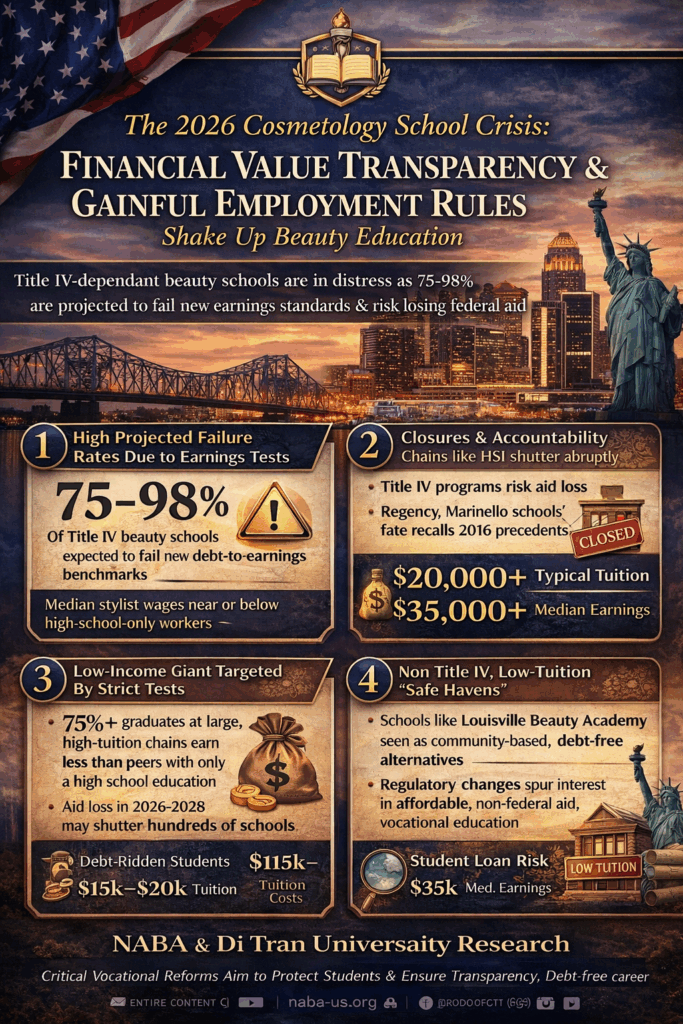
Federal rules now tie Title IV eligibility for career programs, including most cosmetology schools, to graduate outcomes on debt‑to‑earnings (D/E) and earnings‑premium (EP) tests compared with high‑school‑only workers in the same state. Under the OBBBA “Do No Harm” framework, programs that fail these earnings standards for two out of three consecutive years lose access to federal Direct Loans, and Pell‑heavy schools can also lose Pell eligibility entirely, a “death sentence” for aid‑dependent beauty colleges. Policy researchers estimate that 75–98 percent of Title‑IV cosmetology programs would fail the new earnings thresholds, given typical tuition above 15,000–20,000 dollars and median stylist wages near or below high‑school wage medians.[3][4][5][6][12][11][1]
2. Event Log: Named Beauty/Cosmetology Schools in Distress (2024–2025)
The table below captures concrete, named incidents where beauty/cosmetology schools experienced closures or severe distress explicitly linked to cash‑flow problems, FAFSA or federal regulatory changes, accreditation barriers, or anticipated Title IV risk. This log focuses on 2024–2025 events surfaced in mainstream news and policy analysis; it is not yet exhaustive.
| Institution | City/State (Metro) | Chain/Brand | Event Type | Date (public report) | Approx. Students Mentioned | Notes / Regulatory Link | Key Sources |
| Health and Style Institute (HSI) – multi‑campus | Atlanta & Kennesaw, GA; Greensboro & another NC location (Atlanta & Triad metros) | Health and Style Institute | Abrupt chain‑wide closure (all campuses) citing FAFSA complications, federal regulatory changes, and state board delays; 13+ years in operation | Announcement and coverage Feb 1–7, 2025 | Local TV reports describe “hundreds of students” scrambling after abrupt closure; chain operated four campuses | Closure blamed on FAFSA processing disruptions causing “egregious” cash‑flow problems, new federal regulations, and slow response from the Georgia Board of Cosmetology and Barbers to a campus relocation request; students and staff arrived to padlocked buildings with little notice and had to retrieve belongings later under controlled access.[13][14][15][16][17] | WXII/WFMY Greensboro reports, FOX5 Atlanta coverage, local social posts, and policy review referencing HSI as an example of small for‑profit beauty schools closing amid regulatory and funding stress.[13][14][15][18][16][17] |
| Beauty Artistry Academy | Eastgate/Union Township, OH (Cincinnati metro) | Independent school | Abrupt closure after taking full tuition from some students; owner cites federal funding cuts, SBA loan issues, and delays in Title IV certification review | Closure letter dated Sept 15, 2025; investigative report Nov 12, 2025 | Owner reports 96 graduates over two years and 20 active students at time of closure (≈116 directly affected) | School never accredited by NACCAS despite website suggesting candidate status; owner states federal staffing cuts created 18‑month delays in Title IV program review, and a bank refused to refinance the SBA loan; students report losing more than 10,000 dollars each and describe being told “they didn’t have the funding anymore” only months after paying full tuition.[19][4] | WCPO I‑Team investigation, Ohio cosmetology board email, and NABA policy article profiling Beauty Artistry Academy as a case study of fragile, aid‑seeking beauty schools closing abruptly.[19][4] |
Historical closures such as Marinello Schools of Beauty and Regency Beauty Institute (both 2016) remain central to the policy narrative—Marinello after loss of Title IV eligibility for fraud, Regency explicitly citing GE‑related threats to federal funding—but they pre‑date the current FVT/OBBBA regime. They nonetheless inform current expectations that many high‑tuition cosmetology chains could close once new earnings metrics are enforced.[17][1][3]
3. Federal and Sector‑Wide Distress Signals
Federal analysts recently flagged roughly 1,100–1,365 colleges where large shares of borrowers who began repayment after 2020 are already delinquent or in default, with cosmetology and hair design schools heavily represented; many of these institutions risk losing Title IV eligibility under default‑rate or low‑earnings provisions. New America’s analysis emphasizes that cosmetology schools already performed poorly on loan‑distress measures before the pandemic and argues that the Education Department should rapidly implement or strengthen gainful‑employment rules, given that 75 percent or more of cosmetology graduates at large chains fail to earn more than high‑school‑only peers. Sector‑focused research from NABA and Di Tran University projects that “hundreds of cosmetology programs—possibly a majority of Title‑IV beauty schools—will be exposed to aid loss between 2026 and 2028,” especially where tuition exceeds 20,000 dollars and earnings remain near 35,000 dollars per year.[4][20][5][6][21][11][3]
4. Student Stress, Language, and Social‑Media Narratives
4.1 Direct closure experiences
Local TV coverage from Greensboro and Atlanta shows cosmetology students arriving at Health and Style Institute campuses to find padlocked doors and closure announcements, with one student saying “I cried like what am I supposed to do now… It’s really discouraging honestly because I’m so lost and I don’t know what to do.” Students report anxiety over lost hours, uncertainty about taking state‑board exams, fear of “wasting all this time,” and concerns about refunds, while instructors describe being blindsided and losing access to personal teaching tools left inside the building. In the Eastgate case, students and parents describe being “shocked” that Beauty Artistry Academy accepted full 10,000–13,000 dollar tuition payments only months before announcing closure and say they were told simply that the school “didn’t have the funding anymore,” leaving some with only days of training remaining.[13][19][14][15][18]
4.2 Reddit and online discussion
A widely circulated r/Cosmetology post titled “in 2027, 92% Beauty Schools are going to close under new Trump rules” summarizes the OBBBA “Do No Harm” earnings requirement and 3‑year metric, warning that schools failing earnings tests will be excluded from federal loan programs and may also lose Pell eligibility if over half of students are Pell recipients. Commenters ask whether “more affordable schools” with higher employment rates will survive while high‑tuition chains like Lincoln Tech and Empire close, and express confusion about timelines for enforcement and what it means for current students deciding where to enroll.[22][11][3]
Other r/Cosmetology threads describe beauty school as “a scam” or “predatory,” citing tuition far above perceived value, unpaid student labor in school salons, chaotic teaching environments, and frequent staff turnover. One widely upvoted commenter about a Paul Mitchell campus calls the institution “the most ridiculous excuse for a school,” accusing management of “financial fraud and identity theft” and arguing the school should be “permanently” closed, while others say many beauty schools feel like “juvenile psych ward[s]” and leave graduates unprepared for real salon work. Posts from students whose cosmetology schools “just closed” focus on panic about transfer options, teach‑out plans, and whether hours will count toward licensure, often noting that they were never warned about the school’s financial fragility.[23][24][25][13]
4.3 Emerging themes in student language
Across news and Reddit, several themes recur: students describe feeling “lost,” “scammed,” and “unprepared,” and emphasize fear about losing transferability of hours, access to state‑board exams, and refunds when schools close abruptly. There is also rising awareness of federal accountability language—students mention FAFSA problems, Pell loss, “gainful employment,” and “low‑earning” program flags, even if they are not fully clear on the details, and some explicitly state that esthiology programs in their region “have already lost funding.” Finally, several commenters contrast high‑tuition chains with community colleges, apprenticeships, or local low‑cost schools, framing the latter as safer, more structured, or more ethical options.[26][19][14][27][24][25][22][4][13][23]
5. Predatory vs. Affordable/Community‑Based Narratives
5.1 Programs framed as predatory or high‑risk
Policy organizations such as New America and The Century Foundation characterize many for‑profit cosmetology programs as “debt traps” that leave graduates with low earnings and high default risk, calling out big chains like Empire Beauty and Paul Mitchell as examples where a very high share of graduates fail earnings metrics or default‑related benchmarks. Analyses of federal data show that nearly one‑third of cosmetology certificate programs failed or were in the warning zone under the 2014 GE rule, and subsequent modeling suggests that around three‑quarters of cosmetology students today are in programs likely to fail current earnings thresholds. Reddit narratives echo this framing, with comments labeling certain chain schools as “crooks” and “thieves” who “ruin [students’] futures” by charging high tuition while providing minimal education and leveraging federal aid.[5][6][21][11][17][3][26][23]
5.2 Programs framed as affordable or community‑based
A counter‑narrative in academic and policy work highlights non‑Title‑IV and low‑tuition cosmetology schools as more sustainable, student‑friendly models. An American University study using Texas data finds that non‑Title‑IV cosmetology schools often charge one‑third or less of the tuition of nearby Title‑IV counterparts while delivering similar licensing‑exam pass rates, arguing that GE‑style regulations would not significantly harm access because non‑Title‑IV options are widespread and cheaper. Case studies including Modern Beauty Academy and SSL Skin Institute show non‑Title‑IV programs with tuition between roughly 4,700 and 12,300 dollars, compared with 13,000–16,000 dollars at nearby Title‑IV schools offering similar hour requirements.[7][26]
Louisville Beauty Academy (LBA) is repeatedly cited in policy research as a “debt‑free,” state‑licensed, non‑Title‑IV model that keeps cosmetology tuition around 6,000–8,000 dollars and graduates most students without federal debt. Analyses emphasize that LBA intentionally opted out of federal aid, uses pay‑as‑you‑go, interest‑free payment plans, avoids student‑labor salons in favor of supervised community service, and has produced roughly 2,000 licensed professionals with high completion and job‑placement rates, positioning it as a “safe haven” and blueprint for reform. Other regional schools—such as MAK Beauty Institute in Georgia and Destiny Beauty Academy near Cincinnati—market themselves around graduating “debt free” via affordable tuition and flexible payment plans, though their precise Title‑IV status is not always clear from public marketing alone.[8][9][28][29][10][30][31][32]
6. Regional Patterns of Disruption (Current Week’s Lens)
6.1 Regions with concrete distress events
The most clearly documented beauty‑school disruptions in the last 14–16 months cluster in two broad regions:
- Southeastern corridor (Georgia and North Carolina): Health and Style Institute’s chain‑wide closure affected campuses in Atlanta, Kennesaw, and at least two North Carolina locations, including Greensboro, leaving hundreds of students scrambling and forcing state boards to help quickly arrange transfers to alternatives such as Elaine Sterling Institute and International School of Skin, Nailcare & Massage Therapy. Policy commentators further highlight that many cosmetology schools in the South are heavily Pell‑dependent and thus especially vulnerable to the OBBBA “Pell penalty.”[14][15][18][16][11][3][4][13]
- Greater Cincinnati / Eastgate, Ohio: Beauty Artistry Academy’s abrupt 2025 closure in Eastgate following failed attempts to secure Title IV eligibility and refinance its SBA loan left around 20 active students and roughly 96 recent graduates affected; regulators noted that the school had no recognized accreditation despite marketing a candidate‑status narrative. The event prompted complaints to the Ohio Attorney General and raised questions about consumer protection for small, aid‑seeking beauty schools.[19][4]
Sector‑wide research suggests other hotspots where many cosmetology programs are projected to fail earnings metrics—especially states with dense for‑profit beauty sectors such as Texas, Florida, and California—but public reporting has not yet tied those projections to specific 2025–2026 closures in the way seen for HSI and Beauty Artistry Academy.[17][3][26][7]
6.2 Approximate scale of impacted students
Published coverage around the HSI closures references “hundreds of students” at individual campuses in Greensboro and Atlanta, and the chain operated four locations over 13 years, implying at least several hundred and potentially more than a thousand current or recently enrolled students affected across all sites. The Eastgate case provides explicit counts—96 graduates over two years and 20 active students—indicating at least 116 students directly touched by the closure, not counting would‑be future enrollees who had expressed interest contingent on federal aid. When combined with estimates from policy analyses that many cosmetology programs will lose eligibility between 2026 and 2028, the documented closures appear to be early signs of a much larger wave rather than isolated anomalies.[15][16][3][4][13][19][14][5][17]
7. Safe‑Haven Supply vs. Distress Clusters
7.1 Evidence of safe‑haven supply in disrupted regions
In the Atlanta/Greensboro region, news coverage of the HSI closures notes that students were encouraged to transfer to other accredited beauty schools such as Elaine Sterling Institute (Atlanta) and International School of Skin, Nailcare & Massage Therapy (Sandy Springs), which continue to operate but still participate in federal aid. At the same time, independent beauty institutes in the broader Atlanta area—like MAK Beauty Institute and a number of small schools marketing “graduate debt free,” low‑tuition, and flexible payment plans—signal at least some presence of lower‑debt alternatives, although public sources do not always specify whether these schools are fully outside Title IV.[33][30][34][35][15]
In the Cincinnati/Eastgate area, Destiny Beauty Academy (Springdale, OH) promotes “affordable tuition,” “debt‑free” graduation, and flexible payment plans, and social posts market it as an option for barber and beauty students seeking lower‑cost training; however, again, Title‑IV participation status is not explicit online. Traditional chains such as Empire Beauty School also operate in the Cincinnati region and remain Title‑IV participants, but federal data and policy analysis flag many Empire campuses nationally as high‑risk on default and earnings measures.[21][31][32][36][37]
Given these mixed signals, neither metro currently meets a strict, evidence‑backed definition of having no low‑tuition, non‑Title‑IV alternatives, but both exhibit:
- Documented closures or acute financial distress at one or more beauty schools; and
- An emerging, but still thinly documented, layer of debt‑free or low‑tuition providers whose regulatory status and capacity require further local validation.[31][32][19][15]
7.2 Other regions with structural risk but limited qualitative data
Policy modeling points to states such as Texas and Florida as having unusually high concentrations of Title‑IV cosmetology programs with large tuition premiums over non‑Title‑IV competitors, implying high exposure to FVT/GE earnings tests. At the same time, descriptive data from Texas shows that non‑Title‑IV cosmetology and barber schools operate in 98 percent of counties that have at least one licensed school, suggesting that in that state, non‑Title‑IV safe‑haven capacity is already substantial. More fine‑grained, city‑level matching of distress events to the presence or absence of debt‑free alternatives in these states will require systematic scraping and classification of federal listings, state licensing rosters, and local marketing (Title‑IV status is rarely front‑and‑center in consumer‑facing materials).[38][26][7][17]
8. Monitoring Blueprint and Data Schema
8.1 Core data schema for ongoing logging
For operational monitoring, each finding can be captured as one row with the following fields:
- Institution name (exact school or chain name)
- City/State and metro (to allow regional aggregation)
- Chain/brand (e.g., Paul Mitchell, Empire, independent)
- Event type (closure, Title IV loss, Pell loss, accreditation action, lawsuit, layoffs, major schedule cuts, teach‑out announcement, federal warning list appearance)
- Regulatory trigger (FVT/GE metrics, OBBBA “Do No Harm” failure, default‑rate sanctions, HCM status, accreditation findings, or “unspecified federal regulations” if vague in coverage)
- Date (announcement or report date, plus effective date if specified)
- Approximate number of impacted students (only when explicit—e.g., “hundreds,” numeric counts, or enrollment ranges)
- Source URL(s) (news article, blog, or official release; plus permalink for primary Reddit/X/TikTok posts if student narratives are central)
- Tags (“predatory”, “affordable”, “community‑based”, “non‑Title‑IV”, “debt‑free”, “teach‑out”, “lawsuit”, “mass layoff”, “high‑risk metrics”)
This schema matches the fields in the event log above and can be implemented in a spreadsheet or database that supports filtering by metro and tag.
8.2 Source streams and example queries
To maintain continuous monitoring, the following source streams and saved searches are recommended:
- News & federal announcements: Google News alerts for combinations such as “cosmetology school closed,” “beauty school loss of Title IV,” “Gainful Employment cosmetology,” “Financial Value Transparency beauty school,” and “OBBBA low‑earnings programs,” alongside subscriptions to Department of Education FSA Partner announcements and Federal Register notices on accountability rules.[2][39][40][41]
- Policy and education blogs: Regular review of New America, The Century Foundation, AEI, NASFAA, and NABA/Di Tran University research series on cosmetology and low‑earning programs, which often surface named schools and aggregate metrics before mainstream news does.[42][6][1][3][26][5][17]
- Reddit: Targeted monitoring of r/Cosmetology, r/StudentLoans, r/FAFSA, and related subs using queries like “my cosmetology school closed,” “beauty school teach out,” “lost Pell,” “Gainful Employment cosmetology,” “Trump rules beauty school,” and “cosmetology scam,” capturing both incident reports and sentiment.[43][27][25][22][23]
- X/Twitter, TikTok, and Instagram: Hashtag and keyword streams such as #beautyschool, #cosmoschool, “school closed,” “Title IV,” “Pell Grant,” “graduate debt‑free,” and school‑specific brand names (e.g., “Health and Style Institute,” “Empire Beauty,” “Paul Mitchell School”), plus short‑form clips documenting padlocked campuses or urgent student updates.[16][34][44][14][15]
- Major education outlets: Ongoing review of Hechinger Report, Inside Higher Ed, Chronicle of Higher Education, and trade press for cosmetology‑specific angles on low‑earning program lists, closed‑school discharge guidance, and default‑rate sanctions.[45][46][2][42][21]
Automated pipelines (e.g., via n8n or Zapier) can ingest RSS feeds, public APIs, or keyword‑filtered social streams, classify mentions by institution and event type, and append candidate rows to the log for manual confirmation.
A weekly summarizer should:
- Aggregate by metro and state, counting distinct institutions with new distress events that week (closures, federal warnings, lawsuits, large layoffs, teach‑outs announced).
- Sum or qualitatively describe impacted student counts where reported, while explicitly noting when coverage gives only non‑numeric descriptors (e.g., “hundreds”).
- Cluster student narratives from Reddit, X, and TikTok by language themes (e.g., fear of transfer, refund anxiety, anger at “scams,” praise for low‑cost alternatives) to keep a running taxonomy of concerns.[25][22][13][19][14][23]
- Mark metros that appear to have: (a) two or more distressed institutions and (b) weak or unclear presence of low‑tuition, non‑Title‑IV providers, flagging them as candidates for deeper local reconnaissance before being classified as priority expansion markets.
9. Implications for “Safe Haven” Strategy and Next Steps
Emerging evidence supports the view that high‑tuition, Title‑IV beauty colleges face mounting structural risk under FVT, GE, and OBBBA, with early closures like Health and Style Institute and Beauty Artistry Academy foreshadowing wider disruption between 2026 and 2028. At the same time, research on Texas and case studies of Louisville Beauty Academy, Modern Beauty Academy, and other low‑tuition institutions indicate that non‑Title‑IV, community‑based models can provide licensure outcomes with far less debt, and are already being framed as “safe havens” in policy debates.[9][28][29][10][2][3][4][7][8][17]
For a Louisville‑style model seeking expansion markets, the near‑term priority is to:
- Systematically map metros where multiple beauty schools show distress signals but the only visible alternatives are high‑tuition, Title‑IV programs; and
- Validate on‑the‑ground whether candidate “debt‑free” or low‑tuition schools in those markets are truly non‑Title‑IV, stable, and aligned with student‑first values, or whether a gap remains for a new or partner institution.
The Southeast (Atlanta/Greensboro corridor) and greater Cincinnati/Eastgate currently stand out as concrete disruption clusters with early safe‑haven narratives but incomplete public information on low‑tuition capacity, making them strong candidates for deeper local due diligence in the next monitoring cycles.[32][13][19][15][31]
- Beauty Education Clarity Report 2026: A Student-Protection … – The AHEAD negotiated rulemaking committee reached consensus in January 2026, with the existing Finan…
- Cosmetology Schools Face Major Federal Aid Cuts Under 2026 Rules – If a program’s graduates earn the same or less for two out of three years, the school automatically …
- Understanding Federal Aid Models and Debt-Free Vocational … – Beauty School Financial Transparency Report (2026):Understanding … beauty college that does not pa…
- Beauty/Cosmetology Schools Under Financial Value Transparency … – Beauty schools are closing due to federal regulations like Gainful Employment (GE) and Financial Val…
- Beauty School Market Intelligence & Public Sentiment Research … – 2026 Gainful Employment – nasfaa, accessed … Should you go into cosmetology in 2025 … reddit.com…
- The Financial Reality of Vocational Education in America (2026): A … – … cosmetology-education-research-2025/; (GEN-24-04) Regulatory Requirements for Financial Value Tr…
- [PDF] Cosmetology Schools Everywhere – American University – In sharp contrast with Salon Boutique Academy, however, this non-Title IV institution charges less t…
- A Workforce and Policy Analysis of Debt-Free, Completion-Driven … – With no federal aid coming in, LBA had to keep tuition affordable to … community-based training in…
- Debt-Free Licensure and Workforce Outcomes in Cosmetology … – This paper addresses the following research question: Can non-Title IV, state-licensed cosmetology t…
- Federal Aid, Licensure, and the Debt Crisis in Cosmetology Education – In contrast, Louisville Beauty Academy stands out in the literature as a state-approved, low-cost, d…
- What the One Big Beautiful Bill Means for Cosmetology Students – The OBBBA will drastically change the current financial aid and student loan system, including chang…
- Gold-Standard Transparency in Cosmetology Education: A Legal … – Beauty/Cosmetology Schools Under Financial Value Transparency and Gainful Employment Pressure (Week …
- Greensboro cosmetology school closes abruptly, leaving students in … – Caitlin Allen and her classmates found out that Health and Style Institute, a cosmetology school wou…
- Students scrambling after beauty school in Greensboro … – YouTube – When students arrived for class at the Health and Style Institute on Monday morning, they were met w…
- Students shocked after popular metro Atlanta beauty school abruptly … – The Health and Style Institute announced its sudden closure over the weekend, leaving students and s…
- The Health and Style Institute closed permanently The … – Instagram – The Health and Style Institute is a beauty school with locations in Kennesaw and Atlanta, Georgia, a…
- Gainful Employment Rules and School Closures (2014–Present) – In short, since 2014 gainful employment regulations have contributed to numerous school closures, an…
- Cosmetology school abruptly closes as Health and Style Institute … – Cosmetology school abruptly closes as Health and Style Institute leaves Triad students in limbo. WXI…
- Eastgate beauty school accepted full tuition, then closed abruptly – UNION TOWNSHIP, Ohio — An Eastgate beauty school abruptly closed in September, months after collecti…
- US Department of Education Flags 1365 Low-Earning Schools – … cosmetology or hair design schools. While people love to stigmatize … lost Title IV eligibilit…
- Should Failing Beauty Schools Keep Access to Federal Aid? New … – The federal government can pull federal aid when 30% or more of a college’s graduates have defaulted…
- in 2027, 92% Beauty Schools are going to close under new Trump … – in 2027, 92% Beauty Schools are going to close under new Trump rules … In 2025, President Trump si…
- paul mitchell school is a scam : r/Cosmetology – Reddit – I never actually needed loans because the state paid for my beauty school … I transferred to a PM …
- Is cosmo school just awful? : r/Cosmetology – Reddit – Both of us teach out of sheer passion for the industry not for the money. … cosmetology school as …
- My cosmetology school just closed and idk what to do!!! – Reddit – My cosmetology school just closed and idk what to do!!! Last … Should i go to college for cosmetol…
- Cosmetology Training Needs a Make-Over – The Century Foundation – This spring, the U.S. Department of Education announced that it was discharging the federal student …
- Education or Sales Jobs : r/Cosmetology – Reddit – Hello! I have both my cosmetology … Even if there is an Education Department, Gainful Employment w…
- Louisville: Where Beauty Education Rises to National Prominence … – … community-based beauty education cosmetology … no federal aid beauty training nonprofit …
- A Strategic Policy Framework for Debt-Free Vocational Beauty … – Outcomes-Based Beauty Education : A Workforce and Policy Analysis of Debt-Free, Completion-Driven Vo…
- Cosmetology Student Becomes Beauty School Owner – “In less than 12 months, students can graduate and begin a career as a salon professional debt free,…
- Destiny Beauty Academy | Beauty School in Springdale, OH – They are passionate about providing students with the skills needed to succeed in the ever-evolving …
- Affordable beauty and barber school in Cincinnati – Facebook – Destiny Beauty Academy is NOW enrolling. START YOUR BARBER CAREER DEBT FREE! 1800-Hour Program Affor…
- Best Trade Schools in Atlanta – Costs range from $549-$2,899 per semester with flexible payment plans and no federal aid requirement…
- Ready to Turn Your Passion for Beauty into a Real Career? If you’ve … – Photo by Lovett Beauty School- Atlanta, Georgia on February 23, 2026. … ✔️ Graduate DEBT-FREE ✔️ S…
- Atlanta’s premier hair school now enrolling – Facebook – … debt free! What are you waiting for Atlanta, start your new journey … Lovett Beauty School ▻ A…
- Destiny Beauty Academy #cincinnati #NowEnrolling #beautyschool … – Now Enrolling for Feb Classes Be a part of our Debt Free Family! This ain’t like those other barber …
- [XLS] Institutions that Have Adopted the Financial Aid Shopping Sheet … – * Non-Title IV eligible schools’ enrollment not included. 10. 11. 12. 13. 14 … Empire Beauty Schoo…
- Understanding Title IV Institution Codes and Their Importance – APPALACHIAN BEAUTY SCHOOL, INC. BELFRY, KY. 015133, LA JAMES INTERNATIONAL COLLEGE – DAV, DAVENPORT,…
- Proposed Department of Education Rules Set to Impact … – The proposed rules, if formalized, will make a higher education program ineligible for Title IV High…
- Withdrawals and the Return of Title IV Funds – FSA Partner Connect – This volume covers how a school should manage Title IV funds when a student completely withdraws fro…
- School-Determined Requirements | 2025-2026 Federal Student Aid … – A person must be enrolled as a regular student in an eligible program to receive Federal Student Aid…
- Cut Short: The Broken Promises of Cosmetology Education – Cosmetology education in the U.S. needs dire reform. It fails to meet student expectations and leave…
- I think my school is scamming me – subreddit: /r/FAFSA
author: SkirtSea5994
I think my school is scamming me
I received a finan…
- Lasting Layers of Beauty Institute (@lastinglayersofbeauty) – Facebook – We would love to help you accomplish your BEAUTY CAREER GOALS DEBT FREE! Receive your first 140-250 …
- Cosmetology schools and other certificate programs got exemption … – In 2023, the American Association of Career Schools sued to block the gainful employment rule. “AACS…
- Closed School Discharge | Federal Student Aid – Missing: Greensboro | Show results with:Greensboro