Louisville Beauty Academy & Di Tran University: A Comprehensive Strategic Research Paper on Federal Workforce Law, Accreditation Reform, and the Path to AI-Driven Excellence – RESEARCH & PODCAST SERIES 2026
Disclaimer
This publication by New American Business Association (NABA) is provided for educational, workforce policy, research, and public discussion purposes only. It reflects strategic analysis, institutional perspectives, and publicly available information at the time of publication. Nothing herein constitutes legal advice, regulatory approval, accreditation representation, financial advice, or official governmental guidance. References to laws, agencies, organizations, or policy developments are informational and do not imply endorsement or affiliation. Forward-looking statements, projections, and proposed frameworks are conceptual in nature and subject to change. Readers should consult qualified professionals and official sources before relying on any portion of this publication.
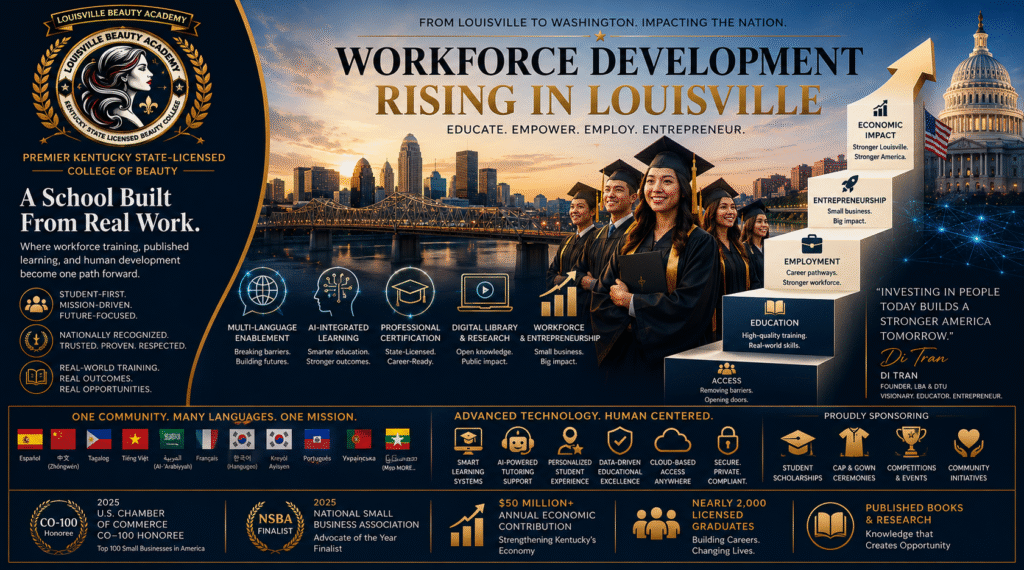
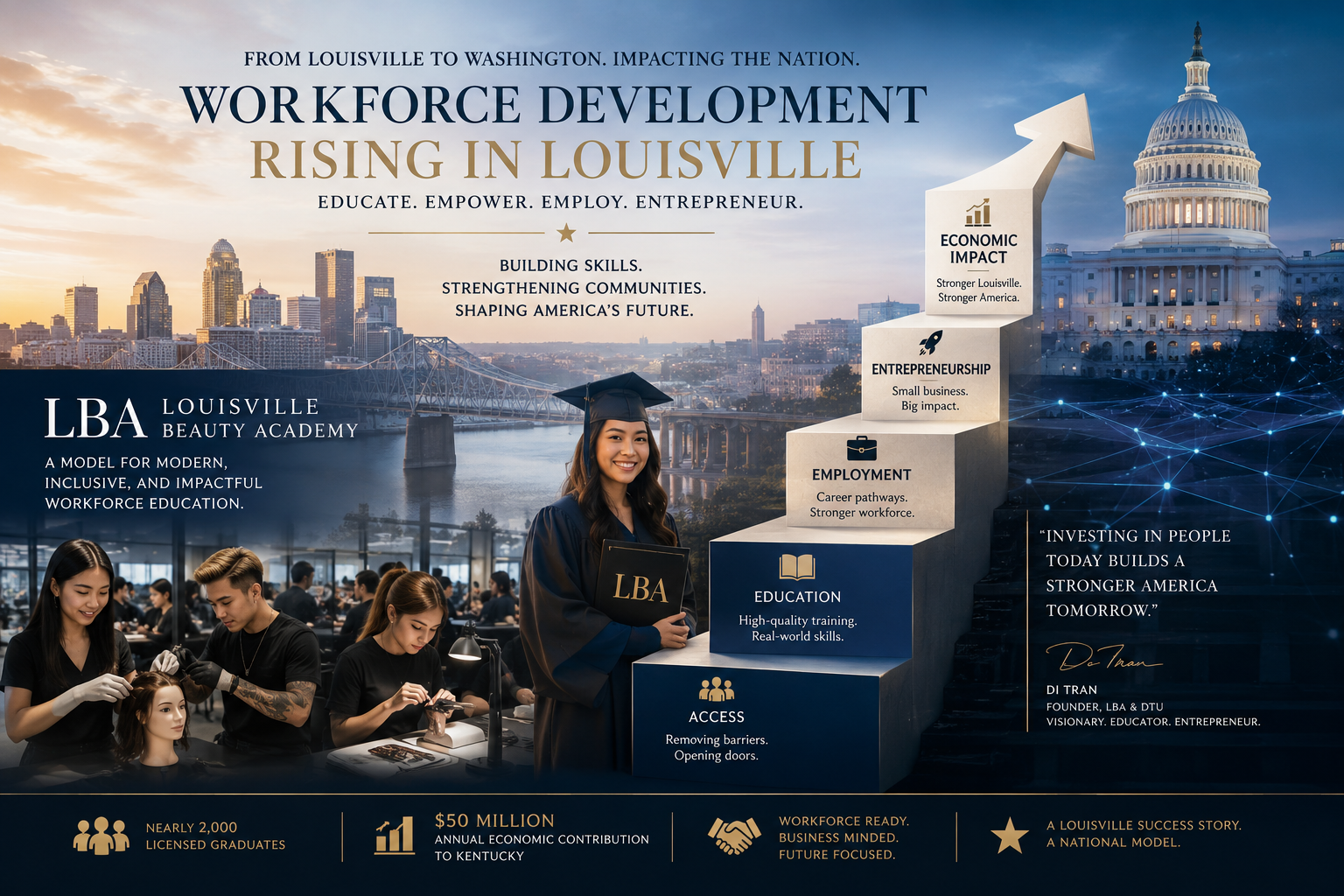
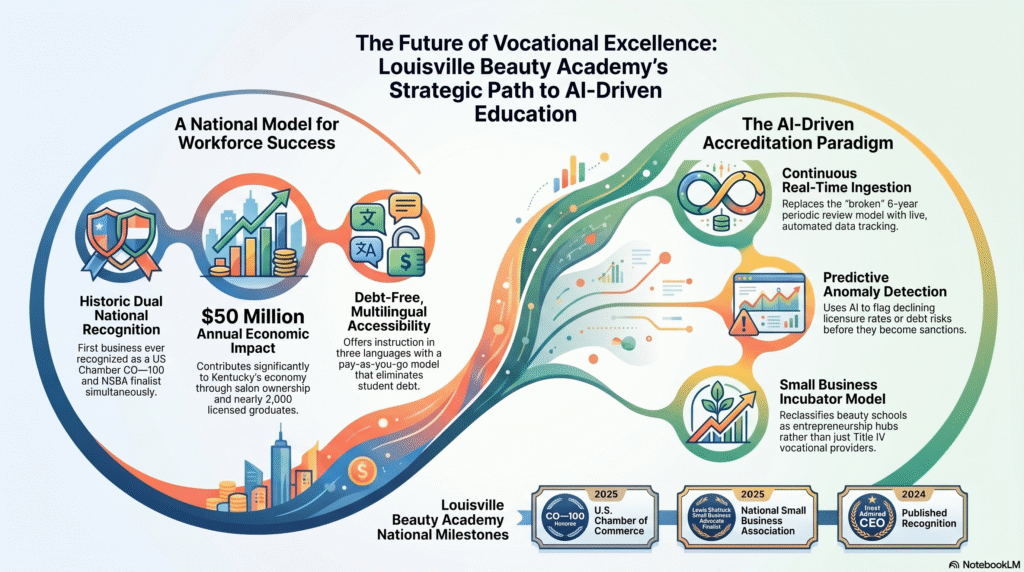
Louisville Beauty Academy (LBA), founded and led by Di Tran, stands as one of the most recognized vocational beauty schools in the United States — not merely in Kentucky. In 2025, LBA became the only Kentucky business selected for the U.S. Chamber of Commerce CO—100 Awards, chosen from over 12,500 applicants nationwide. That same year, the school was simultaneously recognized as a finalist for the National Small Business Association’s Lewis Shattuck Small Business Advocate of the Year Award — the first time in history any business achieved both recognitions in the same calendar year. With nearly 2,000 licensed graduates and an estimated $50 million annual contribution to Kentucky’s economy, LBA is not a marginal institution. It is a national model.[1][2][3][4][^5]
Di Tran University (DTU), also founded by Di Tran, extends this mission into a broader AI-enabled, workforce-first, technology-integrated postsecondary ecosystem — a pioneering institution built on “The Triadic Learning Architecture” combining short-term career readiness, long-term human development, and advanced technology integration.[^6]
This report addresses six critical dimensions:
- Where federal gainful employment law stands today and how it creates risk and opportunity for LBA and DTU
- The institutional performance and compliance posture of LBA under Kentucky state law
- Multi-agency workforce strategy across DOL, SBA, and KentuckianaWorks/WIOA
- The accreditation landscape — NACCAS’s documented failures and the emerging reform environment
- The AI-driven, continuous, transparent accreditation architecture that LBA and DTU should build and champion
- The association and chamber ecosystem — who is in each camp, what they are doing, and which camp is currently winning
Section 1: Federal Gainful Employment Law — Where It Stands Today (2026)
The phrase “gainful employment” originates from the Higher Education Act (HEA), which requires that career education programs receiving federal financial aid must prepare students for “gainful employment in a recognized occupation.” Congress has never statutorily defined that term, instead delegating definitional authority to the U.S. Department of Education (ED). This delegation has produced three distinct regulatory eras, each shaped by shifting presidential administrations.[7][8]
1.2 The Biden-Era GE Rule (2023–2025)
In October 2023, the Biden administration published the Financial Value Transparency and Gainful Employment Rule, which took effect July 1, 2024. This was the most expansive and stringent version of gainful employment regulation ever enacted, covering:[9][10]
- All nondegree programs at public and nonprofit institutions
- All programs at for-profit institutions
- Introducing two tests that every covered program must pass:
Test 1 — Debt-to-Earnings (D/E): Graduates’ annual federal loan payments must not exceed 8% of their annual earnings or 20% of their discretionary income.[11][12]
Test 2 — Earnings Premium: At least half of a program’s graduates must outearn workers in their state with only a high school diploma.[13][12]
Programs failing either test in two of three consecutive years lose access to federal financial aid, with sanctions potentially taking effect starting 2027. The rule also established a new public-facing database comparing program-level debt, earnings, and outcomes — labeling underperforming programs as “low-earning” or “high-debt-burden”.[14][15][^12]
1.3 The American Association of Cosmetology Schools (AACS) Lawsuit
On December 22, 2023, the American Association of Cosmetology Schools (AACS), alongside Texas-based DuVall’s School of Cosmetology, filed suit in the U.S. District Court for the Northern District of Texas to block the rule. Their central arguments:[16][13]
- The D/E ratio is fundamentally flawed for tipped, self-employed, and independent contractor workers whose true income is systematically undercounted in IRS and federal wage data[17][13]
- The rule is arbitrary and capricious — ED overstepped its authority under the HEA[18][17]
- The rule violates First Amendment rights by selectively restricting colleges’ ability to operate[^18]
- Most cosmetology schools would fail the rule, threatening the existence of an entire sector[16][13]
In October 2025, a federal judge dismissed the lawsuit, ruling that the GE rule did not overstep ED’s authority. However, the court’s ruling acknowledged the shifting political environment, noting that “the Trump administration is considering potential changes to the gainful employment regulations in the coming months”.[^12]
1.4 The Trump Administration’s Surprising Posture (2025)
Many in the industry expected the second Trump administration — whose first term had rescinded the Obama-era GE rule in 2019 — to immediately repeal Biden’s version. The reality has been more nuanced:
In May 2025, Trump’s ED revealed it intended to defend the Biden GE Rule in court rather than abandon it, shocking many observers. ED’s position appeared to be that financial value transparency and earnings accountability — stripped of the original rule’s perceived institutional bias — aligned with the administration’s broader accountability agenda.[^15]
1.5 The One Big Beautiful Bill Act (OBBBA) — The New Framework (July 4, 2025)
President Trump signed the One Big Beautiful Bill Act into law on July 4, 2025. This legislation fundamentally restructured federal accountability for higher education:[19][20]
- Created a new Earnings Premium (EP) test applying to associate’s, bachelor’s, and graduate-level programs at all Title IV institutions — often called “gainful employment for all”[20][21]
- The EP test compares graduate median earnings (measured four years after graduation using IRS data) to the median earnings of similarly-aged workers with only a high school diploma in the same state[22][21]
- Programs failing the EP test for two out of three years lose access to federal student loans starting July 1, 2026[23][20]
- Critically for beauty schools: undergraduate certificate programs were exempted from the OBBBA EP test — however, these programs remain subject to the existing GE regulation’s earnings standards[21][24]
In February 2026, the Trump ED’s negotiated rulemaking committee (AHEAD) reached consensus to repeal the Biden GE Rule and replace it with the new OBBBA earnings premium test framework — applying equal accountability standards to all colleges, not just career schools and for-profits.[^25]
1.6 What This Means for LBA and DTU Right Now
The regulatory landscape as of May 2026 creates both risk and strategic opportunity:
Risk factors:
- Undergraduate certificate programs (cosmetology, esthetics, nail technology) remain subject to modified GE regulation even under the OBBBA framework[24][21]
- Public labeling of programs as “low-earning” creates reputational risk regardless of sanctions — prospective students will see these labels in the new ED database[26][15]
- The earnings benchmarks use IRS data, which structurally undercounts beauty professionals’ actual income from tips, cash transactions, and self-employment[13][17]
Strategic opportunities:
- LBA’s debt-free, pay-as-you-go model directly addresses the D/E concern — students who graduate without federal loan debt cannot fail the debt-to-earnings test[5][27]
- The OBBBA’s broader accountability framework shifts attention to all institutions, not just cosmetology schools, reducing stigma on the sector[25][20]
- LBA’s documented economic impact ($50M annually) and ~2,000 graduates creates a powerful empirical case for the school’s value to Kentucky’s workforce[2][27]
- The new “Success-Based Reimbursement” model proposed by NABA (Di Tran’s own association) — paying schools for verified licensure, job placement, and business formation — directly aligns with where federal policy is moving[28][27]
Section 2: Institutional Performance — How LBA Is Doing
2.1 State Licensing and Regulatory Standing
LBA operates under the authority of the Kentucky Board of Cosmetology (KBC), which maintains a public registry of licensed schools with pass/fail data. LBA’s current programs include:[^29]
- Cosmetology (1,500 hours) — full licensure
- Esthetics
- Nail Technology
- Shampoo Styling
- Instructor Certification
LBA is described in its own public materials and in the U.S. Chamber profile as a school offering “gold-standard over-compliance excellence” — a posture of exceeding regulatory minimums rather than merely meeting them. The Kentucky regulatory framework (KRS 317A and 201 KAR 12) forms the compliance baseline, and LBA has publicly committed to alignment with both.[30][31][^5]
2.2 Student Demographics and Accessibility Model
LBA’s student body is explicitly multicultural, multilingual, and economically diverse:
- Instruction offered in English, Vietnamese, and Spanish[2][5]
- Serves immigrants, women, and low-income individuals seeking professional licensure without financial burden[5][2]
- Flexible, pay-as-you-go tuition — no requirement to use federal student loans[27][5]
- Graduates range from age 18 to 75+, spanning diverse cultural and language backgrounds[^32]
This model structurally insulates LBA from the debt-driven GE metrics: when students pay without federal loans, the D/E test becomes irrelevant for those students.[^5]
2.3 Economic and Workforce Impact
Based on publicly documented institutional claims and NABA research:
- ~2,000 licensed graduates produced over LBA’s operational history[2][5]
- Estimated $20M–$50M annual economic contribution to Kentucky through employment, salon ownership, services, and taxes[33][2]
- NABA research frames LBA graduates as micro-entrepreneurs and small business operators, not just employees — a framing that directly challenges the GE earnings metrics that measure wage employment only[28][27]
2.4 National Recognition Milestones
| Recognition | Organization | Year | Significance |
| CO—100 Honoree — “Enduring Business” | U.S. Chamber of Commerce | 2025 | Only Kentucky business; only beauty school nationally[1][3] |
| NSBA Lewis Shattuck Small Business Advocate Finalist | National Small Business Association | 2025 | First institution to achieve both CO—100 and NSBA finalist in same year[^4] |
| “Most Admired CEO” recognition | Published recognition | 2024 | Di Tran recognized for workforce development leadership[^34] |
| National Waves in Beauty Education | NABA | Sept 2025 | Highlighted as national model for accessible, debt-free beauty education[^2] |
2.5 Gaps and Honest Assessment
LBA is not without challenges that must be acknowledged strategically:
- NACCAS accreditation status: LBA currently operates as a state-licensed (not NACCAS-accredited) institution, meaning students cannot use federal Title IV funds (Pell Grants, subsidized loans) to pay tuition. This limits access for some income brackets but is also a structural advantage against GE sanctions.[35][5]
- Scale: With 5–9 staff, LBA operates as a micro-institution. Scaling the model while maintaining quality and the personal culture is the central operational challenge.[^5]
- Data infrastructure: To compete in the AI-accreditation era, LBA needs real-time systems for tracking licensure outcomes, employment, and earnings — infrastructure that does not yet publicly exist at the required level of sophistication.
Section 3: Multi-Agency Workforce Development Strategy
3.1 DOL / WIOA — The Core Workforce Engine
The Workforce Innovation and Opportunity Act (WIOA), administered through the U.S. Department of Labor’s Employment and Training Administration, is the primary federal funding mechanism for workforce training outside of Title IV. For LBA and DTU, WIOA represents the most immediate, accessible federal funding pathway:[36][37]
How WIOA works for beauty schools:
- Local Workforce Development Boards (WDBs) can fund eligible students through Individual Training Accounts (ITAs)
- Students who meet WIOA eligibility criteria (income, employment status, age) can receive training vouchers covering tuition, books, and exam fees
- WDBs can support on-the-job training (OJT) and Registered Apprenticeship components, including theory instruction (RTI)[38][36]
Louisville/Kentucky WIOA landscape:
- KentuckianaWorks is the workforce development board for the Louisville metro region, covering Jefferson, Bullitt, Henry, Oldham, Shelby, Spencer, and Trimble counties[^39]
- KentuckianaWorks is funded primarily by DOL/WIOA and Louisville Metro Government[^39]
- Kentucky Career Centers (statewide network) provide access to WIOA career counseling, training referrals, and employment services[^40]
- Kentucky’s WIOA state plan is overseen by the Kentucky Workforce Innovation Board (KWIB) and the Education and Labor Cabinet[^41]
Concrete action items for LBA and DTU:
- Apply to be listed on the Kentucky Eligible Training Provider List (ETPL) — this is the gateway for WIOA-funded student referrals from Kentucky Career Centers[^40]
- Establish a formal partnership with KentuckianaWorks to create a direct referral pipeline for WIOA-eligible students
- Design programs in alignment with high-demand occupations tracked by the Kentucky Labor Market Information (kylmi.ky.gov) system[^40]
3.2 DOL Registered Apprenticeship in Cosmetology
The U.S. Department of Labor Registered Apprenticeship framework for cosmetology is an emerging and powerful pathway. Indiana-based organizations have already pioneered this model:
- USDOL Registered Apprenticeship programs for cosmetology allow students to earn wages while they learn in a host salon setting[42][38]
- Apprentices complete the same hours required for state licensure (e.g., 2,000 hours in Indiana) but through paid, real-world training[43][38]
- These programs are eligible for WIOA funding (specifically WIOA Title I supportive services) and employer-sponsored models[^42]
For LBA in Kentucky:
- Kentucky requires 1,500 hours for cosmetology licensure — lower than Indiana’s 2,000 hours, making a KY apprenticeship model even more feasible
- LBA should explore partnership with salons and employers to design a Kentucky Registered Cosmetology Apprenticeship, registering it with the DOL Office of Apprenticeship
- This would make LBA the first DOL-registered cosmetology apprenticeship provider in Kentucky — a major differentiating credential
3.3 SBA — Treating Students as Future Business Owners
A core insight in NABA’s federal research agenda is that beauty schools are small-business incubators, not merely vocational training providers. Current federal-aid structures treat them as Title IV higher-education providers, creating a systemic distortion of tuition and under-recognizing the sector’s primary output: micro-entrepreneurship.[27][28]
SBA programs directly relevant to LBA and DTU students:
| SBA Program | Relevance to Beauty Graduates |
| SBA Microloans | Up to $50,000 for startup salons, mobile beauty businesses, or booth rental buildouts[^44] |
| SCORE Mentorship | Free business mentoring from retired executives — ideal for new salon owners and independent contractors[^45] |
| Small Business Development Centers (SBDCs) | Free consulting on business plans, licensing, marketing, and financial management[^44] |
| SBA Learning Platform | Online courses in business operations, finance, and marketing for entrepreneurs at any stage[^46] |
| 8(a) Business Development Program | For eligible socially and economically disadvantaged entrepreneurs — many LBA graduates may qualify[^44] |
| Women’s Business Centers | Support for women-owned beauty businesses, which comprise the majority of LBA graduates[^44] |
Strategic recommendation:
Embed an “Entrepreneurship Pathway” curriculum module in every LBA program that walks students through: business plan fundamentals, booth rental vs. employment vs. salon ownership economics, SBA loan applications, and SCORE enrollment. This module makes LBA a credentialed small-business launch pad, not just a cosmetology school.
3.4 Aligning With the NABA Research Framework
NABA’s 2026 federal research agenda — authored and championed by Di Tran — proposes a paradigm shift in how federal agencies view beauty schools:[28][27]
The proposed new framework has three pillars:
- Competition Neutrality: Allow lean, state-licensed models like LBA to compete on outcomes rather than compliance overhead[^28]
- Results-Based Reimbursement: Federal support tied to verified licensure, job placement, and business formation — not enrollment[27][28]
- SBA Pathway Realignment: Reclassify beauty schools as small-business incubators with integrated entrepreneurial support, aligning federal investment across DOL + SBA + ED rather than siloing them under Title IV[27][28]
This framework, if adopted or even partially advanced through agency policy, would fundamentally change how LBA and DTU are funded, evaluated, and recognized at the federal level.
Section 4: The Accreditation Landscape — NACCAS, Its Failures, and the Reform Window
The National Accrediting Commission of Career Arts and Sciences (NACCAS) is the U.S. Department of Education-recognized national institutional accreditor for postsecondary cosmetology schools and related career arts and sciences programs. Founded in 1969, NACCAS:[47][48]
- Accredits approximately 1,300 institutions nationally[^49]
- Is required to maintain recognition by ED through periodic compliance reviews
- Conducts institutional reviews based on standards covering curriculum, facilities, staff qualifications, and outcomes including graduation and licensure pass rates[50][51]
- Operates on a periodic, paper-based review cycle — not continuous or real-time[^51]
NACCAS accreditation is the gateway to federal Title IV aid (Pell Grants and subsidized loans) for cosmetology school students. Without it, students cannot use federal grants or loans — which is the current status of LBA.[52][5]
4.2 NACCAS’s Documented Failures
In 2025–2026, New America published a landmark investigation documenting systemic failures in NACCAS oversight:[53][54][^52]
Finding 1 — Non-disclosure of sanctions: Schools that NACCAS had placed on probation or moved to withdraw accreditation were not disclosing this information on their websites or in course catalogs. When New America researchers posed as prospective students in secret-shopper calls, these schools did not divulge their sanctioned status.[^53]
Finding 2 — Illogical enforcement logic: Instead of assessing schools’ full compliance records, NACCAS treated each rule violation as an isolated incident rather than as evidence of systemic institutional problems.[^53]
Finding 3 — Slow response to deterioration: The Paul Mitchell Knoxville case — where NACCAS repeatedly flagged the campus for financial instability over 13 years before finally revoking accreditation — illustrates how the periodic-review model fails to protect students in real time. The school had a 3% graduation rate for first-time, full-time students yet remained accredited for years.[^52]
Finding 4 — Consumer harm: NACCAS’s oversight methods have “undermined the premise of accreditation as a consumer protection,” permitting colleges with ongoing compliance issues to continue enrolling students.[^54]
4.3 Trump’s Executive Order on Accreditation Reform (April 2025)
President Trump signed an executive order in April 2025 titled “Reforming Accreditation to Strengthen Higher Education” — directly calling out accreditors for:[^55]
- Routinely approving low-quality institutions despite poor graduation rates (national 6-year undergraduate graduation rate: 64%)[^55]
- Allowing programs with negative return on investment (nearly 25% of bachelor’s degrees, 40%+ of master’s degrees)[^55]
- Imposing DEI-based accreditation standards that the administration deemed discriminatory[^55]
- Failing in their consumer protection responsibilities[^55]
This executive order created political and regulatory momentum for new accreditation models — and specifically endorses the idea that existing accreditors may be replaced or supplemented by newer, outcome-focused bodies.[56][55]
4.4 ACCSC — The Alternative Accreditor for Career Schools
The Accrediting Commission of Career Schools and Colleges (ACCSC) is another ED-recognized accreditor that covers career and technical programs, including some beauty-adjacent vocational programs. It is distinct from NACCAS and could serve as an alternative pathway for accreditation if LBA and DTU want to access Title IV without going through NACCAS.[^57]
4.5 The “Gravity” of the New Accreditation Model
LBA and DTU should position themselves at the forefront of an emerging accreditation paradigm — one that is AI-driven, continuous, and outcome-validated. The current system’s failures create a political and market window to propose, pilot, and ultimately champion a new model. The key insight is this: you do not have to wait for the federal government to bless a new accreditor to start building the architecture. You build it, demonstrate it, make it credible, and then advocate for federal recognition.
Section 5: AI-Driven Continuous Accreditation — The Architecture
5.1 Why Current Accreditation Is Broken by Design
Traditional accreditation — including NACCAS — operates on a periodic, paper-based, self-report model. Schools submit documentation every 6 years (or more frequently if on probation). Site visitors review documents and conduct a campus visit. Accreditors make a formal decision. The cycle repeats.[56][51]
This model:
- Captures data at a moment in time, not continuously
- Relies heavily on self-reporting, which creates incentives for selective disclosure
- Cannot detect deterioration between cycles (the Paul Mitchell Knoxville problem)[^52]
- Does not measure what matters most to students: actual earnings, job placement, and debt manageability
The modern regulatory and technology environment demands something entirely different: proof of compliance in real time.[^58]
5.2 What AI-Driven Continuous Accreditation Looks Like
Forbes, the International Education Accreditation Council (IEAC), and academic researchers have all argued that AI can transform accreditation into a dynamic, evidence-based process:[59][60][^56]
Core components of an AI-driven accreditation system:
| Component | Function |
| Real-time data ingestion | Enrollment, completion, licensure pass rates, student satisfaction, employer feedback — updated continuously[58][61] |
| Predictive analytics | Machine learning models track KPIs and alert leadership and regulators to deviations from standards before they become sanctions[60][59] |
| Natural language querying | Leadership, regulators, or accreditors can ask “show me completion rates by program and language cohort” and receive instant, cited answers[^61] |
| Automated evidence portfolios | AI auto-assembles accreditation evidence and self-study documents, mapped to specific standards — replacing weeks of manual preparation[^61] |
| Anomaly detection | AI flags unusual patterns — declining licensure pass rates, increased dropout in a specific instructor section, debt-to-income risks — before they become institutional problems[58][59] |
| Public transparency dashboards | Program-level cost, typical debt, completion, licensure pass rates, job placement, and entrepreneurship outcomes displayed publicly — in multiple languages[9][26] |
| Multilingual feedback loops | Student feedback collected and analyzed in English, Vietnamese, Spanish — aligning with LBA’s actual student body[32][58] |
5.3 Comparison: NACCAS vs. AI-Driven Model
| Dimension | NACCAS | AI-Driven Model |
| Review frequency | Every 6 years (periodic)[^51] | Continuous / real-time[56][58] |
| Data source | Self-report + site visit[^50] | Live system data + IRS/Census integration |
| Earnings tracking | Graduation rate + licensure pass rate[^51] | Post-graduation earnings, job placement, business formation[56][60] |
| Transparency | Internal findings, limited public disclosure[^53] | Full public dashboard — students, regulators, employers see everything[9][26] |
| Failure response time | Years (Paul Mitchell Knoxville: 13 years)[^52] | Days — predictive alerts, immediate corrective triggers[^60] |
| Language support | English only | Multilingual — matching actual student demographics[^58] |
| Cost to institution | High — compliance staff, paper documentation, site visits[^62] | Lower long-run cost — automation handles evidence compilation[^61] |
| DEI / inclusion metrics | Inconsistent, politically contested[^55] | Demographic disaggregation by language, income, origin — outcome-focused, not ideological |
5.4 The LBA/DTU Workforce Observatory — Core Infrastructure
The first concrete implementation step is building what can be called the LBA/DTU Workforce Observatory — a data infrastructure that:
- Tracks every learner from enrollment inquiry through post-graduation outcomes (employment, earnings, business formation, licensure) for at least 3 years post-graduation
- Integrates with state systems — Kentucky Board of Cosmetology licensing records, KentuckianaWorks WIOA reporting, and eventually IRS earnings data through permitted channels
- Feeds a public-facing transparency dashboard visible on the LBA and DTU websites — updated at minimum quarterly, ideally monthly
- Generates AI-readable compliance reports that can be submitted to ED, KBC, WIOA boards, and eventually accreditors in standardized formats
- Supports multilingual student feedback collection — satisfaction surveys in English, Vietnamese, and Spanish, with AI sentiment analysis and quarterly leadership review
This Observatory becomes LBA’s and DTU’s most powerful asset — a credibility engine that makes the institutions more transparent than any accreditor currently requires, and more verifiable than any competing school can claim.
5.5 Governance Model for the New Accreditation Framework
LBA and DTU should not attempt to build this alone. The governance structure should include:
- Internal Data Committee: LBA/DTU leadership, with designated data officer role
- External Advisory Board: Employer partners (salons, spas, wellness chains), KentuckianaWorks, SBA/SBDC, NABA, and select community members
- Technology Partners: AI/data firms with higher education compliance experience
- Policy Partners: Think tanks (New America, Urban Institute, Third Way), advocacy coalitions (PBA, AACS), and potentially university research partners
- Regulatory Liaisons: KBC, ED’s Office of Postsecondary Education, DOL Office of Apprenticeship
Section 6: The Association and Chamber Ecosystem — Every Camp Mapped
6.1 Master Table of Key Associations, Chambers, and Organizations
| Organization | Type | Stance on GE/Beauty Schools | LBA/DTU Connection | Status |
| U.S. Chamber of Commerce | National business chamber | Pro–small business, supports workforce development; less focused on GE specifics[^63] | CO—100 honoree — formal, high-profile connection[1][3] | ✅ Active ally |
| NABA (New American Business Association) | Nonprofit business association | Strongly aligned with LBA — champions outcomes-based reform, SBA reclassification of beauty schools[28][27] | Founded by Di Tran — direct organizational arm[2][64] | ✅ Core advocate |
| NSBA (National Small Business Association) | National policy advocacy | Advocates for small business regulatory relief; supportive of reform that reduces burdens on small schools[^4] | Di Tran NSBA Advocate of the Year finalist 2025[^4] | ✅ Active ally |
| Professional Beauty Association (PBA) | Industry trade association | Directly opposed to GE “low value” label for cosmetology; issued public call to action against Biden GE Rule[^65] | Sector peer — aligned on GE advocacy | ✅ Strategic ally |
| AACS (American Association of Cosmetology Schools) | School trade association | Filed landmark lawsuit against Biden GE Rule; argued D/E metrics are flawed for tipped workers[16][13] | Sector peer — aligned on accreditation and GE | ✅ Strategic ally |
| NACCAS | National accreditor | Maintains status quo accreditation framework; under criticism for accountability failures[53][54] | LBA not currently NACCAS-accredited[^5] | ⚠️ Monitored — reform target |
| New America | Policy think tank | Critical of NACCAS; investigating beauty school accountability failures; supports stronger outcomes-based oversight[53][54][^52] | Not directly connected but research supports reform argument | ℹ️ Informational ally |
| KentuckianaWorks | Regional workforce board | WIOA administrator for Louisville metro; potential direct funding partner[^39] | Not yet formally partnered — high-priority target[^39] | 🎯 Priority partnership |
| Kentucky Career Center / KWIB | State workforce system | Manages WIOA funding, ETPL listing, career counseling referrals[40][41] | ETPL listing pending — key access point for WIOA-eligible students | 🎯 Priority target |
| SBA (Louisville District) | Federal agency | Supports small business formation and growth — natural ally for student-to-entrepreneur model[44][46] | Not yet formally engaged — strategic opportunity | 🎯 Priority target |
| Louisville Metro Chamber | Local business chamber | Supports local economic development and workforce training | LBA CO—100 recognition elevates profile locally | ✅ Reputational ally |
| IEAC (International Education Accreditation Council) | International accreditor | Pioneering AI-driven, real-time accreditation tools; positioned at the forefront of accreditation reform[^60] | Not yet connected — potential technology/framework partner | 🔭 Explore partnership |
| Forbes / American Institute | Policy media | Published analysis calling for AI transformation of accreditation; amplifies reform narrative[^56] | Not directly connected — citation and advocacy resource | ℹ️ Informational ally |
6.2 The Three Camps and Who Is Winning
Camp A: Strict Accountability / Consumer Protection Camp
Members: New America, TICAS, some consumer advocacy groups, former Biden ED officials, IHEP
Core position: GE metrics must remain stringent; programs that leave graduates unable to repay debt should lose federal funding. Beauty schools labeled “low value” are accurately labeled, and students deserve protection from predatory enrollment.[66][11][^54]
Recent wins:
- Biden GE Rule passed and survived legal challenge in court[^12]
- New America’s NACCAS investigation created political pressure for accountability reform[54][53]
Current momentum: Diminishing. The OBBBA replaced the Biden GE Rule architecture with a broader earnings premium test, reducing the specific targeting of cosmetology/career schools. The strict camp no longer controls the regulatory pen.[20][25]
Camp B: Institutional / Industry Flexibility Camp (LBA’s Natural Home)
Members: AACS, PBA, NABA, LBA, Di Tran University, many state-licensed beauty schools, proprietary school coalitions, U.S. Chamber, NSBA
Core position: GE metrics are structurally flawed for the beauty sector because they miss tips, self-employment income, and entrepreneurship outcomes. Beauty schools should be funded and evaluated on actual workforce and small-business formation outcomes, not on flawed federal wage databases. Schools like LBA that operate debt-free should be celebrated, not penalized.[65][13][28][27]
Recent wins:
- OBBBA exempted undergraduate certificate programs from the new earnings premium test — a major win for cosmetology schools[21][24]
- Trump ED defended and then moved to repeal the Biden GE Rule through negotiated rulemaking[^25]
- NACCAS investigation created an opening for alternative accreditation models that are more outcome-focused and less bureaucratic[53][55]
- LBA’s CO—100 recognition created a nationally credible voice for the sector at the Chamber level[3][1]
- NABA’s federal research agenda proposing SBA reclassification and Results-Based Reimbursement is gaining traction as a policy idea[28][27]
Current momentum: Rising and winning. This camp has achieved the most concrete regulatory gains in 2025–2026.
Camp C: Transparency-First / Hybrid Reform Camp
Members: Urban Institute, Third Way, some moderate ED officials, accreditation reform advocates, Forbes/American Institute
Core position: Students deserve transparent, real-time, program-level data on cost, debt, and earnings outcomes. Accreditation should be continuous and evidence-based rather than periodic and self-reported. Sanctions may be appropriate in some cases, but transparency and improvement incentives are more important than eligibility cutoffs.[58][59][9][56]
Recent wins:
- The Financial Value Transparency component of the Biden GE Rule — requiring public databases of program-level debt and earnings — has survived political changes and is expanding[15][9]
- Trump’s accreditation EO explicitly supports outcomes-based, technology-enabled oversight — aligning with this camp’s vision[56][55]
- AI-driven accreditation tools are being adopted by platforms and accreditors internationally[60][58]
Current momentum: Steady and growing. This camp does not control regulatory outcomes directly, but its transparency and AI-infrastructure ideas are being incorporated by both the institutional and the accountability camps.
6.3 Executive Verdict: Which Camp Is Winning for LBA
For Louisville Beauty Academy and Di Tran University, the current winner is the intersection of Camp B (industry flexibility) and Camp C (transparency-first):
- The regulatory threat (Biden GE Rule sanctions) has been substantially neutralized through OBBBA exemptions and the AHEAD rulemaking process[24][21][^25]
- The opportunity (transparency-based credibility, AI-driven outcomes documentation) is wide open for an institution with LBA’s track record and national recognition[58][56][^55]
- NABA’s federal research framework — combining Results-Based Reimbursement, SBA reclassification, and DOL workforce integration — is the most forward-looking policy proposal in the beauty education space[27][28]
- LBA’s debt-free model already structurally wins the GE argument: you cannot fail a debt-to-earnings test if your students have no debt[^5]
Section 7: The Full 1-3-5 Year Roadmap
Year 1 (June 2026 – May 2027): Build the Foundation
Regulatory & Compliance:
- [ ] File for ETPL (Eligible Training Provider List) listing with KentuckianaWorks and Kentucky Career Center to unlock WIOA-funded student referrals[39][40]
- [ ] Engage KBC to confirm updated regulatory standing and publish annual compliance transparency report
- [ ] Model LBA programs against OBBBA earnings premium benchmarks using publicly available Kentucky wage data — document the findings and publish them proactively[22][20]
- [ ] Retain a Title IV / accreditation consultant to evaluate the path to NACCAS or ACCSC accreditation — run cost/benefit analysis given LBA’s debt-free model
Data and AI Infrastructure:
- [ ] Deploy a minimum viable Student Outcomes Tracker — a database that follows every enrollee from application through 2 years post-graduation (licensure, employment status, business ownership, estimated earnings)
- [ ] Launch public-facing Transparency Dashboard on the LBA website showing: completion rates, licensure pass rates, typical program cost, typical first-year earnings, and employer placement rates — updated quarterly
- [ ] Implement multilingual student satisfaction survey system (English, Vietnamese, Spanish) with quarterly analysis reports
Workforce Partnerships:
- [ ] Initiate formal meetings with KentuckianaWorks and Louisville metro Kentucky Career Centers to establish a student referral and employer connection partnership
- [ ] Contact Louisville SBA District Office to explore SCORE partnership and embedding SBA resources into LBA’s curriculum
- [ ] Begin design of a Kentucky DOL Registered Cosmetology Apprenticeship program in partnership with 3–5 host salons
Advocacy:
- [ ] Submit formal public comment in any ongoing AHEAD/ED negotiated rulemaking supporting the NABA “Results-Based Reimbursement” and SBA reclassification framework[^28]
- [ ] Leverage CO—100 status to request meetings with Kentucky congressional delegation (both chambers) on beauty school workforce policy
Year 3 (2028): Scale and Systematize
Accreditation:
- [ ] Decision point: pursue NACCAS/ACCSC accreditation if the debt-free model is being replicated at scale and Title IV access would serve new student populations
- [ ] Alternatively, publish the LBA/DTU AI accreditation architecture as an open-source framework and begin seeking coalitions to formally propose a new ED-recognized accreditor
- [ ] Partner with 2–3 other like-minded beauty schools nationally to co-develop and pilot the AI-driven continuous accreditation framework
Workforce Development:
- [ ] Launch the Kentucky DOL Registered Cosmetology Apprenticeship — fully operational, with 10+ host salons and WIOA co-funding
- [ ] Di Tran University’s workforce programs listed on ETPL and WIOA-funded — serving dislocated workers, adult learners, and English Language Learners through DTU’s AI-enabled curriculum[^6]
- [ ] Establish formal SBA Partnership Center within LBA — a designated space and weekly office hours for SCORE mentors, SBA loan application assistance, and small business registration support for beauty graduates
Data and Research:
- [ ] Publish first annual LBA/DTU Workforce Report — a peer-quality research document demonstrating graduate earnings (including self-employment and tips where data can be gathered), business formation rates, and economic impact — submitted to ED, DOL, SBA, and Congress as evidence for policy reform[^27]
- [ ] AI Workforce Observatory running continuously, feeding public dashboard and supplying data for any accreditation reviews
Year 5 (2030): National Model and Policy Leadership
Positioning:
- [ ] LBA and DTU recognized as national models for AI-driven, outcome-validated, debt-free beauty and workforce education
- [ ] NABA’s federal policy framework — SBA reclassification, Results-Based Reimbursement, DOL workforce integration — formally adopted or under active consideration by at least one federal agency
- [ ] DTU operating as a multi-program, accredited workforce university with AI-native learning infrastructure[^6]
Accreditation:
- [ ] If a new AI-driven accreditor has been proposed and is in ED recognition proceedings, LBA/DTU serves as a founding member institution
- [ ] If the existing NACCAS framework has been substantially reformed (which current pressures make likely), LBA/DTU’s transparency architecture serves as the model for reformed standards[56][55]
Legacy:
- [ ] Di Tran recognized nationally as the architect of a new, outcomes-based, immigrant-accessible, debt-free beauty education model that changed how the federal government funds and evaluates workforce programs
- [ ] NABA publishes the definitive federal research agenda for beauty education as a workforce and small-business development system[28][27]
Conclusion: The Strategic Thesis
Louisville Beauty Academy and Di Tran University occupy a rare position in American education: they are small enough to be agile, credible enough to be heard, and mission-aligned enough to be trusted. The regulatory window of 2025–2027 is the most favorable in a generation for institutions with their model.
The gainful employment threat has been substantially neutralized through legislative and regulatory action — the OBBBA exempts undergraduate certificate programs from the earnings premium test, and the Biden GE Rule is being repealed through AHEAD negotiations. NACCAS is under serious public scrutiny and faces a political environment in which the President himself has called for accreditation reform. The DOL, SBA, and KentuckianaWorks all have programs that LBA and DTU are positioned to access but have not yet fully engaged.[44][36][21][24][25][39][53][55]
The single most powerful move LBA and DTU can make is to build their own proof — a continuous, AI-driven, public, transparent record of outcomes that makes any external accreditor’s periodic review redundant. When you publish your own data openly and it shows graduation, licensure, employment, and economic impact that rivals or exceeds any NACCAS-accredited school, you no longer need anyone else’s credential to prove your worth. You become the standard.[26][58][56][27]
That is the strategic thesis for Louisville Beauty Academy and Di Tran University in 2026 and beyond.
- Tag: US Chamber of Commerce Top 100 Small Businesses – – Louisville Beauty Academy is the ONLY Kentucky business named to the U.S. Chamber CO—100 Awards 20…
- Making National Waves in Beauty Education – SEPTEMBER 2025 – … 2025 by the U.S. Chamber of Commerce CO—100 Awards. Out of a highly … Louisville Beauty Academ…
- Louisville Beauty Academy Named One of America’s Top 100 Small … – – Louisville Beauty Academy is the ONLY Kentucky business named to the U.S. Chamber CO—100 Awards 20…
- LOUISVILLE BEAUTY ACADEMY ACHIEVES HISTORIC DUAL … – Di Tran, a 2025 NSBA finalist, has exemplified advocacy by founding the New American Business Associ…
- Louisville Beauty Academy | CO- by US Chamber of Commerce – Louisville Beauty Academy is a state-licensed, multilingual vocational school offering affordable, d…
- Di Tran University – Founded by Di Tran, a luminary with over three decades of expertise in workforce development, techno…
- Gainful Employment Web Center – Congress to date has avoided defining gainful employment, leaving the Department of Education free t…
- Issue Briefs – Gainful Employment – The “gainful employment” definition was established in regulations during the Obama Administration t…
- Financial Value Transparency and Gainful Employment – The Secretary establishes and amends regulations related to gainful employment (GE) to address ongoi…
- ED’s New Financial Value Transparency and Gainful … – On October 10, 2023, the U.S. Department of Education published its new Financial Value Transparency…
- Cosmetology Schools Sue to Void Rule Aimed at … – On December 22, the trade association American Association of Cosmetology Schools, along with Texas-…
- Federal judge dismisses legal challenge to gainful employment rule – Although the Biden-era rule survived litigation, the Trump administration is considering making chan…
- Education Department sued over gainful employment rule – Inside Higher Ed Laura Spitalniak January 5, 2024 The American Association of Cosmetology Schools sa…
- The Gainful Employment Rule under a Second Trump … – The GE rule, which took effect in 2024, sets debt and earnings requirements for certain higher educa…
- Trump’s Education Department Shocks with Support of Biden’s … – In October 2023, the Biden Administration published its GE Rule, which represents the agency’s third…
- Cosmetology schools sue to block gainful-employment regs – The trade association representing cosmetology schools is suing the Biden administration to block it…
- Trade Schools Sue Over Gainful Employment Rule – SHRM – A trade organization for cosmetology schools is suing the Biden administration to block a new gainfu…
- Education Department sued over gainful employment rule – CAPPS – Inside Higher Ed Laura Spitalniak January 5, 2024 The American Association of Cosmetology Schools sa…
- The Implementation Timeline of the One Big Beautiful Bill Act – On July 4, 2025, President Donald Trump signed congressional Republicans’ One Big Beautiful Bill Act…
- Big Beautiful Bill – Earnings Premium for Nonprofit and Public … – Big Beautiful Bill – Earnings Premium for Nonprofit and Public Universities · Basics. The EP has not…
- New accountability framework will help ensure higher education … – The new outcomes-based accountability framework establishes an earnings premium test that assesses w…
- [PDF] Ppt1_Explanation of Earnings Test and GE Changes_v3 – Three objectives: • Describing the new earnings test created by the One Big Beautiful Bill Act (OBBB…
- Effect of Changes to Title IV of the Higher Education Act in the One … – Earnings Premium Framework. The Act establishes a new accountability framework, the Earnings Premium…
- The One Big Beautiful Bill Act’s New Accountability Standard – This brief presents estimates of which programs are likely to pass or fail the new OBBBA earnings st…
- Trump-McMahon Ed Dept. Repeals Gainful Employment, Levels … – The committee unanimously agreed to repeal the Gainful Employment Rule—a selective, discriminatory r…
- transparent beauty education model Archives – Louisville KY – It does not name or target specific schools. Instead, it provides a systems-level examination of mea…
- Reclassifying Beauty Education: The Model for Workforce … – YouTube – and outcomes: the Louisville Beauty Academy model. Operating without … Reclassifying Beauty Educat…
- A Federal Research Agenda for SBA, Department of Education, DOL … – SBA Pathway Realignment. Treat beauty schools as small-business incubators with integrated entrepren…
- Schools – Kentucky Board of Cosmetology – Louisville Beauty Academy at Harbor House. 2233 Lower Hunters Trace Louisville, KY 40216. Phone: 502…
- Louisville Beauty Academy: A National Model of Legal Integrity in … – New American Business Association (NABA) – Louisville, KY. Our Sponsor – Louisville Beauty Academy –…
- Louisville Beauty Academy – Louisville’s First Multicultural Beauty Trade School | Gold-Standard Over-Compliance Excellence Stat…
- [✨ ថ្ងៃបញ្ចប់ការសិក្សា — ចាប់ផ្តើមជីវិតឲ្យរឹងមាំ 🎓
YES I CAN → I HAVE DONE IT → YES, YOU WILL 💛
- Di Tran, Most Admired CEO, Celebrates USA and Workforce … – Di Tran, Most Admired CEO, Celebrates USA and Workforce Development with a Message of Love and Care …
- Understanding the Path: Bureaucratic Steps to Open a New … – Opening a new private vocational or beauty college in Kentucky involves navigating a complex series …
- Workforce Innovation and Opportunity Act (V2) – Apprenticeship.gov – WIOA is designed to help job seekers access employment, education, training, and support services to…
- Workforce Innovation and Opportunity Act | U.S. Department of Labor – WIOA is designed to help job seekers access employment, education, training, and support services to…
- Cosmetology Apprenticeship | Indiana Licensed | Indianapolis – Earn your Indiana cosmetology license through a paid apprenticeship. 2000 hours of supervised salon …
- Who We Are – KentuckianaWorks – KentuckianaWorks is the workforce development board for the Louisville region, which includes Bullit…
- Training – Individuals – Kentucky Career Center – The federal Workforce Innovation and Opportunity Act (WIOA) provides worker training, on-the-job tra…
- The Kentucky Workforce Innovation Board (KWIB) and Department … – The four-year state plan represents an agreement among the core partners identified in WIOA and serv…
- Cosmetology Apprenticeship | Indiana Licensed – Workforce Training – DOL Registered Apprenticeship. 2,000 hours of supervised salon training under a licensed cosmetologi…
- Host a Cosmetology Apprenticeship – Elevate for Humanity – The Indiana Cosmetology Apprenticeship is a USDOL Registered Apprenticeship. Your salon hosts appren…
- How Small Business Administration (SBA) Helps Businesses Grow – The agency provides technical training and education programs that help entrepreneurs master best pr…
- Student Entrepreneur Guide: Resources, Grants & Tools – Free resources for student entrepreneurs: Business plan templates, startup grants, SCORE mentorship,…
- SBA Learning Platform | U.S. Small Business Administration – SBA offers online training programs, and development and growth opportunities designed to empower an…
- About Us – What is NACCAS? | National Accrediting Commission of … – NACCAS is an autonomous, independent accrediting commission constituted as a nonprofit Delaware corp…
- NACCAS – National Accrediting Commission of Career Arts … – … Cosmetology Accrediting Commission (CAC). … These schools offer over thirty(30) courses and pr…
- National Accrediting Commission of Cosmetology Arts and … – NACCAS is recognized by the U.S. Department of Education as a national agency for the institutional …
- How NACCAS Helps Pave the Best Path for Beauty School Hopefuls – NACCAS only looks at schools to see if they conform to a set of minimum common standards. That said,…
- A Step-By-Step Guide to Beauty School Accreditation – Concerning beauty schools, NACCAS determines which schools meet standard education requirements in t…
- Why Did It Take a Paul Mitchell Knoxville Years to Close? – New America’s upcoming report on the cosmetology industry will explore why beauty schools fail to la…
- The Cost of a Failing Beauty School Accreditor – Republic Report – Several schools that NACCAS sanctioned, for a range of reasons, like financial tumult, do not refere…
- Cosmetology Without Accountability: Failures of a Beauty School … – NACCAS’s oversight methods undermine the premise of accreditation as a consumer protection. It permi…
- Reforming Accreditation to Strengthen Higher Education – Unfortunately, accreditors have not only failed in this responsibility to students, families, and Am…
- How Technology Could Transform Higher Education’s … – Higher ed accreditation is stuck in the past with periodic reviews. AI and real-time data could tran…
- Agencies That Accredit Beauty Schools – Avalon Institute – Avalon Institute is one of the many accredited beauty schools. We offer a variety of beauty courses …
- AI in Higher Education Accreditation – NIU College – Discover how AI is transforming higher education accreditation and state approval with smarter compl…
- [PDF] Artificial Intelligence in Higher Education Accreditation – Artificial Intelligence (AI) is transforming higher education accreditation by en- hancing quality a…
- Quality Assurance with AI and Automation: The Prospects for … – Machine learning models can track key performance indicators (KPIs) in real time, alerting accredita…
- AI-Powered Assessment & Credentialing In Higher Ed – Accreditation Readiness Assistant – AI could monitor compliance with accreditation standards, flag m…
- The Shocking Truth About This School’s NACCAS Inspection Failure – This was the WORST NACCAS Inspection “EVER”! This was a 51 page report from a school getting their f…
- Chambers of commerce are folding. Here’s what’s next. – The Role of Associations and Chambers in Post- COVID19 Economic Recovery – Center for International …
- New American Business Association | Louisville KY – Facebook – The study highlights how Louisville Beauty Academy has spent over a decade building a workforce-firs…
- Take Action: DOE Gainful Employment Rule – Pro Beauty Central – A call to action from the Professional Beauty Association and Executive Director Nina Daily
- The Gainful Employment Rule and Why it Matters – The rule seeks to protect students from low-value programs that leave graduates with unaffordable de…


